

Virtuals Protocol can help an AI agent find work, receive payment and raise development capital, but those activities do not all require the same token. Current developer documentation separates an agent’s working life from its optional token launch. That distinction sits at the center of this Virtuals Protocol Review: expanding an agent economy and creating lasting demand for VIRTUAL are connected ambitions with different financial tests.
Launches give the token a visible role through liquidity pairing and market participation. Recurring demand depends on what happens afterward: customers returning, providers earning usable income, capital remaining in the ecosystem and economic flows reaching VIRTUAL through identifiable mechanisms. Understanding those relationships requires reading launch rules alongside payment documentation, treasury allocations and contract security reports.
This research provides information, not investment, trading, staking, legal or technical-audit advice. VIRTUAL and individual agent tokens carry market, liquidity, contract and operational risks. Confirm current terms before relying on any mechanism described here.
Research draws on public Virtuals documentation, developer guides, market-data services and independent security research checked on October 17, 2026. Documentation describes intended mechanisms. It does not independently establish paid adoption. This review does not claim firsthand product testing or a code audit.
Quick Verdict
Virtuals has a more concrete economic framework than an AI label attached to a token. Its launch infrastructure links VIRTUAL to agent-token liquidity, while ACP provides agreements and settlement for services. Those capabilities support a credible product proposition.
The unresolved issue concerns how much recurring activity actually requires VIRTUAL. Current development guides include USDC-funded jobs and agents operating without their own tokens. Launch fees, trading fees, service revenue and treasury receipts also belong to different accounts. A convincing token thesis needs evidence that durable customer spending produces sustained VIRTUAL balances, liquidity demand or another executed economic benefit after incentives and recipient selling enter the calculation.
Key Takeaways
Virtuals’ Products and Their Economic Roles
From a Working Agent to a Paying Customer
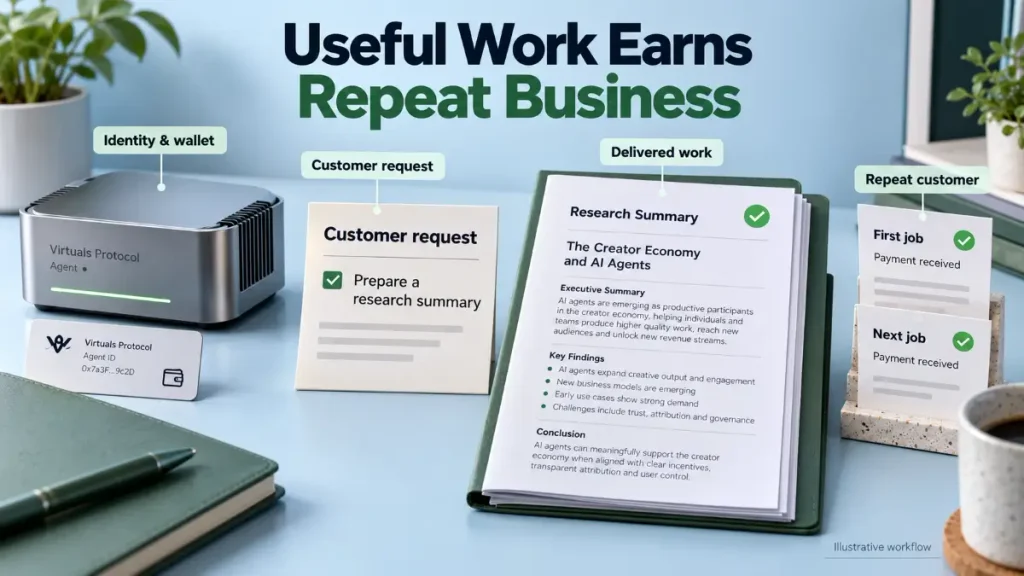
An agent becomes commercially useful when someone repeatedly pays it to complete a task. Launching a token can finance that work, but the launch itself does not establish a dependable service. A research assistant needs accurate output, while an operational agent needs reliable execution and permissions that match its responsibilities. Customers judge whether the result saves time, improves a process or solves a problem worth paying to address.
Virtuals addresses several practical obstacles through EconomyOS. Its documentation brings identity, wallets, compute access and commerce into a common environment. Developers can assemble these components instead of building every payment and coordination layer themselves. That reduces the infrastructure they need to arrange, although the application still has to earn the customer’s next purchase.
How Launch Funding Becomes a Tradable Liquidity Pool
The capital-formation documentation describes a VIRTUAL-denominated bonding curve. A bonding curve prices early trades according to preset rules as funds enter or leave the market. At the stated 42,000 VIRTUAL liquidity threshold, the standard mechanism moves into an agent-token liquidity pool on Uniswap V2, with a documented ten-year LP lock. This arrangement gives VIRTUAL a direct role in launching and trading those projects. Launch activity can require participants to obtain the base asset and can build reserves supporting subsequent markets.
However, launch parameters differ across interfaces and modules. The web documentation describes mostly free creation with fees for selected features, while the CLI guide describes a launch-fee requirement. A universal cost per agent would therefore oversimplify the current documentation. The selected launch route and its actual transaction terms determine the applicable charge. Graduation also measures funding and market participation. It does not certify customer retention, autonomous capability or a sustainable operating margin. Those outcomes need separate records after the launch.
Liquidity-pool ownership and the assets inside a pool are different things. Locking the LP position restricts withdrawal through that ownership interest. Trading still changes the underlying reserves as buyers and sellers exchange the paired assets. If holders sell an agent token into its VIRTUAL pair, the pool can transfer VIRTUAL to those sellers. The LP position may remain locked throughout that process. Describing every token inside such a pool as permanently removed from circulation would therefore misrepresent the mechanism.
A better measurement follows reserve balances over time, together with trading flows and any special wind-down conditions. Stable or growing liquidity across mature projects would support the capital-market proposition more convincingly than simply adding the initial amounts from every graduation.
Recurring Jobs Can Settle in USDC
Current ACP architecture documentation shows clients funding jobs through USDC escrow. Providers submit deliverables, and approval releases the escrowed payment; rejection follows the documented return path. The client workflow also supports subscription access, where a paid access window can cover subsequent jobs. Those features create a plausible foundation for repeat business. A customer can purchase ongoing services without negotiating every interaction from scratch. Yet the payment asset matters: recurring USDC turnover does not, by itself, establish recurring VIRTUAL purchases.
Older inference-payment documentation describes per-use VIRTUAL transfers. That remains evidence of a documented model, but it cannot override current workflow-specific instructions. Different products or versions may follow different paths. To connect stablecoin commerce to VIRTUAL, research needs an additional step: a required conversion, a fee allocation, retained token balances or another verifiable mechanism. Without that connection, commercial adoption can support the platform while leaving the native token’s direct demand less certain.
How Agent Spending Reaches Different Recipients
Tokenization Is an Option, Not an Agent Requirement
EconomyOS explicitly permits an agent to hold funds, trade and accept jobs without issuing its own token. It also documents an alternative Occupy launchpad that uses selected tokenized-equity quote assets rather than the default VIRTUAL quote asset. This flexibility can help adoption. Builders who need identity and commerce infrastructure may have little reason to launch a tradable asset. Removing that requirement can make the service easier to evaluate on practical grounds.
For token analysis, the implication is narrower: agent counts cannot stand in for VIRTUAL-funded launches. Activity should separate untokenized agents, standard launchpad projects and alternative launch routes. The share using each path matters as much as the overall population.
Trading Fees and Buybacks Reach Different Assets
The current standard launch documentation describes a baseline 1% trading fee, with 70% of that fee assigned to the creator and 30% to the Virtuals Treasury. Optional trial arrangements can change when the founder accesses the allocation. An illustrative $10,000 of eligible volume would produce $100 in gross fees under that baseline: $70 for the creator allocation and $30 for the treasury allocation. This calculation describes the rule, not observed revenue, and excludes special launch taxes or other configuration differences.
Treasury receipts do not automatically become holder income. Operating costs, incentives and future spending decisions sit between collection and any possible benefit to the wider token economy. Likewise, creator income can help finance development without creating demand for VIRTUAL after the creator converts those proceeds into operating funds. An individual agent token represents a separate project-level asset. Its distribution, permissions and economic arrangements need their own review. VIRTUAL operates across the broader protocol and its associated markets. Holding one does not automatically grant the rights associated with another.
The anti-sniper mechanism illustrates the distinction. Official documentation describes using collected launch taxes to repurchase agent tokens, with allocations going to the team under vesting terms. That is not a stated VIRTUAL buyback or a general VIRTUAL burn. Even at the agent level, a repurchase followed by allocation differs from permanent destruction. The tokens continue to exist unless a separate mechanism removes them.
Claims about “buybacks” should therefore identify the purchased asset, funding source and final recipient. Otherwise, a real project-level mechanism can produce an inaccurate conclusion about the parent token.
aGDP Measures Activity Beyond Service Income
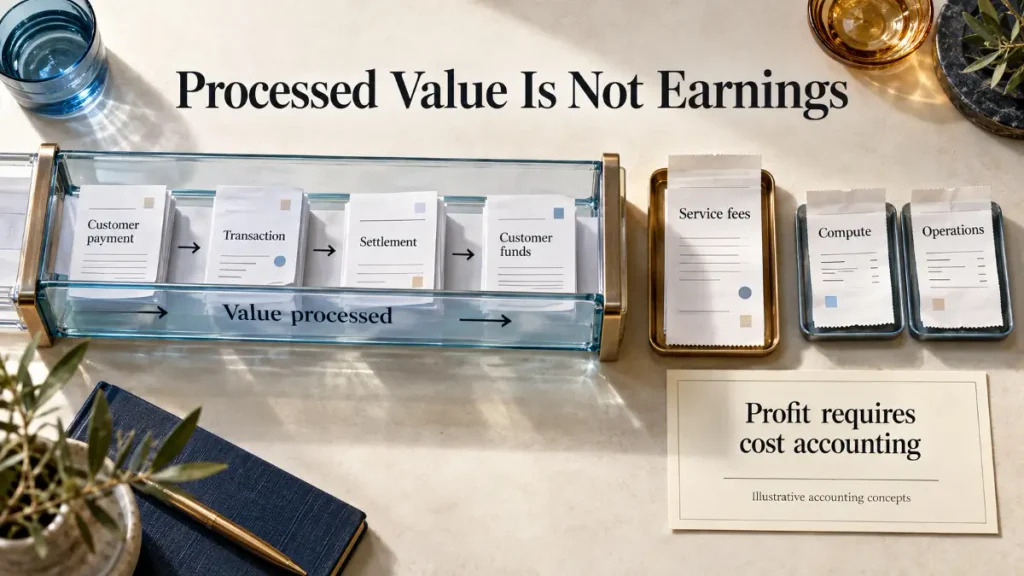
Virtuals’ ACP glossary defines agentic GDP using value processed during jobs, including trading value and service fees. The measure can also include funds received or passed between participants. It does not describe consolidated business earnings. Consider an illustrative agent handling $20,000 of customer-directed transactions and charging $40 for its service. The amount processed describes workload scale; the service charge describes gross income from that task. Neither number establishes profit after compute and operating costs.
Transfers between collaborating agents create another accounting challenge. A customer payment and the provider’s payment to a subcontractor can both contribute to activity while drawing on the same originating expenditure. aGDP can help explain the breadth of work passing through the system. Evaluating commercial quality requires a narrower reconciliation: external customer payments, provider earnings, infrastructure costs and protocol receipts. Mixing those measures would make a busy payment system look more profitable than the available evidence supports.
From Job Counts to Paying-Customer Records
Public documentation establishes a developed architecture and accessible implementation guides. The materials reviewed do not provide a complete, independently reconciled statement of recurring customer revenue across the entire ecosystem. Dashboard totals need a defined measurement period and clear rules for counting internal transfers, refunded jobs and repeat customers. This review does not adopt a headline ecosystem total as independently verified service revenue.
Useful adoption reporting would disclose its measurement period, contract coverage and treatment of internal transfers. It would also separate customers paying for services from participants trading agent tokens. Repeated purchases by unrelated customers would carry more analytical weight than a growing launch count. So would evidence that providers retain customers after subsidies end, rather than depending on fresh token-market attention to cover their costs.
After Hyperboost’s Fourteen-Day Reward Window
The launch mechanics describe Hyperboost as a post-graduation distribution lasting fourteen days. Rewards cover trading participation and content, using an allocation of agent tokens. These rewards can extend attention beyond the initial graduation event. Incentivized activity can help a new market attract participants, but it cannot establish how those participants will behave once compensation stops. Early activity therefore needs a follow-up measurement after the reward window closes.
Retention after the reward period offers a more demanding test. Trading depth, customer spending and provider earnings should remain visible when the short distribution window ends. A market that repeatedly loses activity after incentives expire depends on a different economic engine from one supported by recurring customers. Rewards also add tokens to recipients’ available balances. Their eventual choices remain uncertain; receiving an allocation does not establish an intention to sell.
Founder Runway Comes with Funding and Exit Conditions
Automated Capital Formation provides a route for founders to access funding as their project’s token reaches specified valuation levels. The documentation describes distributions tied to fully diluted valuation and proceeds paid to founders in USDC. That mechanism can finance product development before an agent generates sufficient operating income. It also makes token-market conditions part of the funding model. A rising project valuation can support runway even while the customer business remains immature.
Analysis should track those funding sources separately. Capital raised from token distributions belongs in financing records; money earned by delivering services belongs in operating records. Combining them can conceal whether customers actually sustain the business. The optional 60 Days module gives founders a defined period to decide whether to commit. Its documentation describes a wind-down and refund framework if they do not proceed, with eligibility rules governing different balances and funding sources.
Those terms require more precision than the phrase “refundable launch.” Refunds for eligible token holders depend on available funds and can fall short of the original expenditure. The Growth Allocation arrangement has its own stated treatment; it should not be generalized to every buyer or allocation. The wind-down instructions also describe returning remaining LP assets through the applicable process. That is a reason to read the trial configuration alongside broad descriptions of long-term liquidity locks.
Offering a structured exit can improve accountability. It cannot remove market losses, eliminate contract risk or establish that every holder receives the same recovery.
Recurring Payments Need a Reason to Retain VIRTUAL
VIRTUAL demand becomes more durable when participants need ongoing access to something valuable and repeatedly choose a token-linked route to obtain it. Mature liquidity markets and continued ecosystem participation can contribute, but their significance depends on scale and retention. Payment turnover alone provides an incomplete answer. If a customer acquires tokens immediately before payment and a recipient converts them immediately afterward, the same small inventory can support substantial transaction value. Larger spending totals do not necessarily require proportionately larger balances.
Research should therefore examine the duration and purpose of token holdings. Working balances, liquidity reserves and time-locked positions have different characteristics. Their effect depends on treasury distributions and tokens returning to markets. The strongest case would combine repeat external demand with transparent accounting that shows where VIRTUAL remains necessary. It would also explain why participants continue using that route when alternative payment or launch options exist.

veVIRTUAL Offers Participation with a Time Commitment
The staking documentation describes locking VIRTUAL for up to two years to receive veVIRTUAL. Voting weight depends on the amount and duration, decaying toward the end of the lock. Auto Max-Lock maintains the maximum-duration setting until the user changes it under the applicable rules. Eligible launches can allocate up to 5% of their agent-token supply through the optional Airdrop Distribution module. This creates an ecosystem participation benefit, but the allocation is not a fixed cash payment or a uniform entitlement from every launch.
The economic quality of an airdrop depends on the distributed asset, available liquidity and project execution. Nominal token quantities do not establish a realizable return. Locking also changes the holder’s ability to respond to circumstances. Reduced immediate transferability can affect available float, while the eventual return of liquidity remains part of the supply analysis. Neither effect guarantees a favorable market outcome.
Tokenomics: Fixed Supply and Deployable Treasury Assets
Official tokenomics specify a total supply of 1 billion VIRTUAL, with no future inflation. The stated allocation assigns 60% to public distribution, 5% to liquidity and 35% to the ecosystem treasury. The same page says all tokens are fully unlocked and vested. That last statement does not mean every token already circulates under market-data providers’ definitions. Treasury-held assets can become more available through grants, incentives or other approved spending without any new minting.
Reading the Gap Between Allocation and Circulation
CoinMarketCap reported approximately 659.05 million circulating VIRTUAL during this check, while CoinGecko showed approximately 658.39 million. The difference is modest, but it makes a single unattributed exact figure inappropriate. Neither estimate should replace the original allocation percentages. Distribution describes the token’s allocation framework; circulation describes a provider’s current classification of available supply. They answer different questions.
The treasury documentation also describes an annual emissions limit and governance approval for deployment. Its wording refers to “the next three years” without clearly anchoring that phrase on the retrieved page. This review therefore does not turn it into a dated forward calendar or an exact annual release forecast. Actual transfers, approvals and remaining balances would offer a firmer basis for monitoring future availability. A transfer still requires context: moving tokens between controlled wallets is different from distributing them to outside recipients.
Who Controls Incentives and Treasury Decisions?
The dedicated governance page describes veVIRTUAL-based proposals, voting and treasury decisions. It also lists previously approved proposals. However, the staking page still labels governance power “Coming Soon,” indicating inconsistent documentation rather than a basis for assuming every feature has identical operational status. Governance matters because decisions can alter incentives and capital deployment. Published voting rules are only one part of that assessment. Participation, concentration and the authority responsible for implementing an approved decision also affect the outcome.
A passed proposal establishes an authorization or decision within its process. An execution record establishes that someone implemented it. Those are separate milestones, especially when evaluating spending and changes to token economics. Transparent records connecting proposals to executed transactions would help readers assess how much influence holders exercise and how treasury resources support the operating network.
What the 2025 Code4rena Review Actually Covers
Code4rena’s published report covers a competition conducted from April 17 to May 7, 2025. It records six high-severity and twenty-six medium-severity findings across the reviewed system. Those are findings from the assessed codebase, not proof that identical vulnerabilities remain in every current deployment. The report provides substantive independent security work. Its value comes from the specified scope, affected components and technical explanations. It does not certify later releases, every launched agent or all connected services.
An assessment of current exposure would match deployed implementations with reviewed versions and examine the treatment of relevant findings. This review does not claim to have completed that mapping across the entire ecosystem. The official audit archive and disclosure policy provide additional research starting points. Their existence supports ongoing scrutiny; it cannot justify describing the protocol as risk-free or treating a security rating as a complete operational assessment.

Autonomous Wallets Add an Operational Risk Layer
An agent can execute an authorized action correctly while making a commercially poor decision. A payment record establishes that funds moved; it does not establish that the purchased work was accurate, appropriate or worth its cost. EconomyOS documents signer-based wallet access, while ACP uses job contracts and extensible hooks. This separates several responsibilities across the system, but it also gives reviewers more dependencies to examine: wallet permissions, hook behavior, event handling and application logic.
External models, data providers and runtime infrastructure introduce further dependencies. A model can misinterpret a request or rely on unreliable input even when settlement behaves as designed. Evaluation rules also determine what counts as an acceptable deliverable. Spending limits, constrained permissions and clear approval boundaries therefore matter alongside contract audits. Commercial reliability depends on the entire workflow, including decisions made before a transaction reaches the blockchain.
Why Shared Agent Infrastructure Could Be Useful
Virtuals connects pieces that developers otherwise need to assemble: a working identity, a payment-capable wallet, a service marketplace and optional financing. That combination addresses practical coordination problems around software agents doing paid work. Its capital-market design also provides an identifiable VIRTUAL use case. Pairing, launch participation and ecosystem locking offer mechanisms that a researcher can investigate rather than relying solely on broad enthusiasm about AI.
The best version of this model would let useful agents attract customers, earn income and fund continued improvement through a common commercial environment. Financing could help builders reach that stage without becoming the only source of economic activity.
Who Pays When Token Launches Slow?
Successful infrastructure can serve participants who prefer stablecoin settlement, operate without agent tokens or use alternative funding arrangements. That may expand the addressable customer base while weakening simple claims about universal native-token demand. Launch markets introduce another vulnerability. If fee income depends heavily on new token attention, funding and activity can weaken together during quieter periods. Mature service businesses should show more continuity than launch-driven speculation, but public aggregate activity cannot establish that continuity on its own.
Customer concentration would also matter. Strong total spending from a small connected group differs from broad adoption across unrelated buyers. Incentives, internal transfers and recurring customer payments need separate treatment before any profitability claim becomes credible.
The Metrics That Would Make the Economics Clearer
Confidence would improve with repeat-customer cohorts, clearly defined service revenue and reconciled protocol receipts. Reporting should show whether customers continue paying after launch incentives expire and whether providers cover the infrastructure needed to deliver those services. For the token, useful disclosures would connect activity to required purchases, reserve balances, lock durations and treasury deployment. Payment routing by asset would help quantify how much commerce uses VIRTUAL directly and how much uses stablecoins or alternative assets.
The thesis would weaken if token-market activity dominated while customer retention remained poor, or if treasury-funded incentives explained most apparent growth. Undocumented contract changes and inconsistent operating data would create separate concerns.
Final Assessment: Repeat Customers Are the Harder Test
Virtuals presents a coherent attempt to connect agent operations, commerce and financing. Its usefulness depends on whether developers deliver services that customers want repeatedly. This Virtuals Protocol Review therefore treats operating performance and native-token demand as separate conclusions. The platform has a practical coordination purpose; its commercial durability depends on paying customers returning after the launch excitement fades.
VIRTUAL has concrete utility within standard launch markets and ecosystem participation. How much recurring adoption reaches the token depends on payment choices, retained liquidity, locking and treasury deployment. Clear records connecting those flows would strengthen the economic case. Until then, repeat paid work and verified implementation provide a more useful basis for assessment than the number of tokens launched.
Research Scope and Unresolved Records
This assessment compares capital-formation rules with current developer workflows instead of assuming one documentation page describes every product. Market-data estimates retain their source context, and independent audit findings retain their historical scope. The review distinguishes project statements from independently established outcomes. It does not assert a reconciled ecosystem revenue total, universal current audit coverage or identical fees across all interfaces. Those limits affect the strength of the conclusions and identify the records future updates should examine.
Key Questions About Virtuals Protocol and VIRTUAL
Does every agent need its own token?
No. Current EconomyOS documentation permits agents to operate and accept jobs without issuing an agent token.
How do standard launches use VIRTUAL?
The standard launchpad pairs agent tokens with VIRTUAL through its funding and liquidity mechanisms.
Do all ACP payments require VIRTUAL?
No universal requirement follows from the current guides. Documented client workflows include USDC-funded escrow.
Does aGDP represent protocol revenue?
No. Its definition includes value processed during jobs, which can include trading amounts and other fund movements.
Does an LP lock permanently remove VIRTUAL?
No. The lock restricts the LP ownership position. Trading can still change the assets held inside the pool.
Do launch buybacks purchase VIRTUAL?
The documented anti-sniper mechanism repurchases the launched agent token, rather than establishing a VIRTUAL buyback.
What is VIRTUAL’s maximum supply?
Official tokenomics specify 1 billion VIRTUAL with no future inflation. Treasury deployment can still change market availability.
Does veVIRTUAL provide fixed cash income?
No. Documented benefits include ecosystem participation and eligible airdrops, whose value and liquidity vary.
Does the 60 Days module guarantee a full refund?
No. Recovery depends on the relevant allocation rules and available funds. The documentation limits general refund claims.
Does an audit cover every current agent?
No. Each report has a defined code scope and review period, separate from later deployments and application behavior.

Founder & Managing Editor of CryptosMedia. Zahid Hussain leads evidence-based crypto research covering tokenomics, security, governance, adoption, and risk.
CryptosMedia separates verified facts from interpretation, avoids buy/sell recommendations, and updates reviews when major evidence changes.