
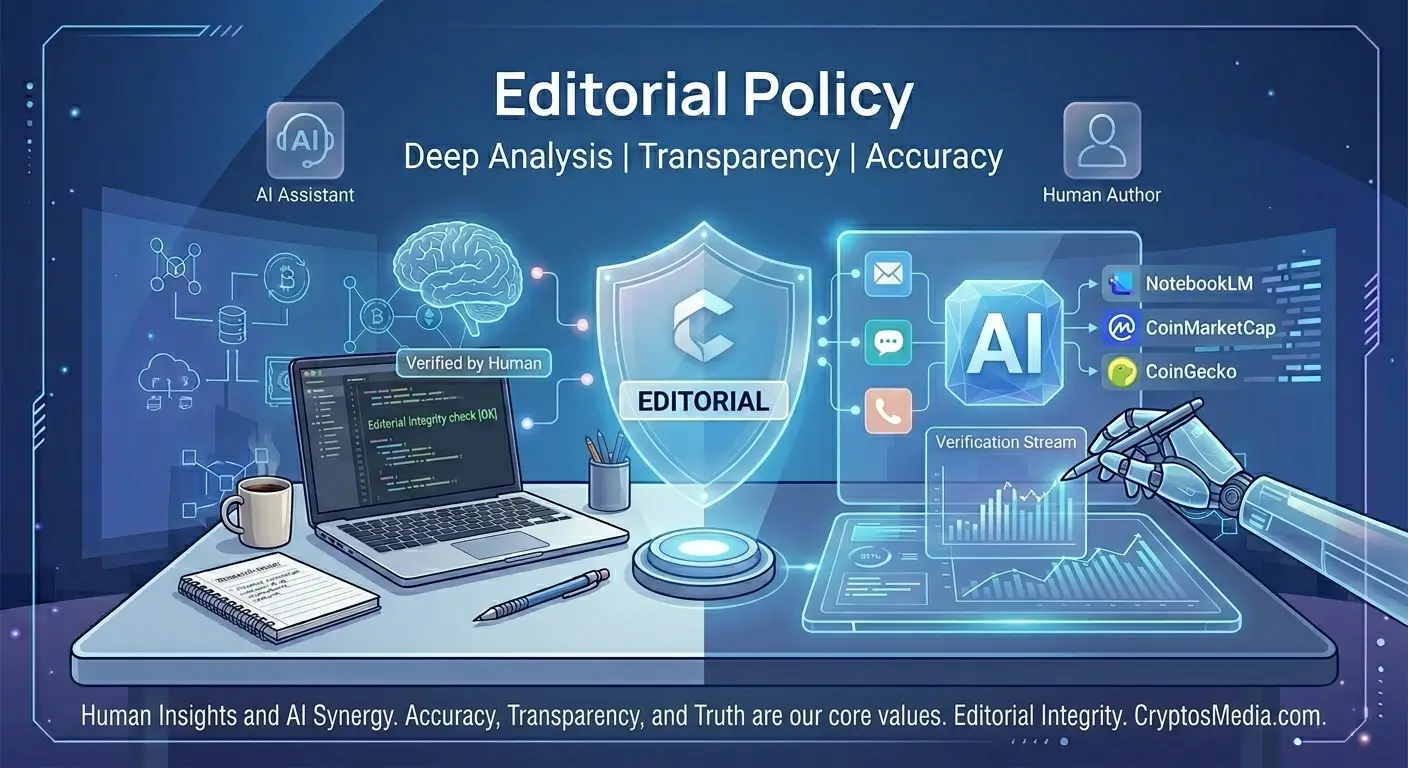
CryptosMedia publishes cryptocurrency reviews, protocol analysis, security coverage, and market-risk research for readers who want evidence before conclusions. This policy explains how we research, write, review, update, and correct our content.
Last Updated: August 2026
1. Research and Source Standards
We prefer primary and directly attributable sources whenever they are available. Depending on the topic, these may include official project documentation, whitepapers, governance proposals, blockchain explorers, repositories or release notes, audit and security reports, regulatory or court records, and statements from the organization responsible for the product or protocol.
Third-party sources such as data aggregators, research platforms, news reports, and community discussions may provide useful context, but they are not treated as substitutes for primary evidence when a material claim can be checked directly. Market-data services may also disagree because of methodology, timing, or token-classification differences, so figures are dated or qualified when appropriate.
2. Fact, Interpretation, and Uncertainty
Our goal is to make a clear distinction between verifiable facts and editorial analysis. Technical design, token supply, governance rules, exploit history, audit scope, and other factual claims should be supported by evidence. Conclusions about risk, decentralization, sustainability, or competitive position are editorial judgments based on that evidence.
Crypto systems change quickly. A protocol upgrade, governance vote, exploit, token unlock, exchange decision, or regulatory development can make an earlier statement incomplete. Where a fact is time-sensitive, we aim to identify the relevant date or explain that the figure can change.
3. Reviews Are Not Hands-On Testing Unless We Say So
CryptosMedia does not present research-based analysis as first-hand product testing. If an article is based on documentation, public data, source review, or other research, it should be described that way. We do not invent wallet use, transactions, validator operation, direct access, private briefings, partnerships, audits, or other experience that did not occur.
4. Use of AI Tools
AI tools may assist with research organization, language refinement, formatting, comparison of source material, or editorial quality checks. They are not treated as authoritative sources. Material factual claims should be checked against reliable evidence before publication, and editorial responsibility remains with the human publisher.
AI output can be wrong, incomplete, or outdated. We therefore do not describe the use of an AI tool as proof that a fact is correct.
5. Security, Scam, and Risk Claims
Security and scam-related claims can affect readers and the organizations discussed, so they require particular care. We distinguish documented exploits, disclosed vulnerabilities, regulatory actions, failed products, liquidity concerns, governance risks, and speculative warning signs. A risk indicator is not automatically proof of fraud.
When credible evidence is limited or conflicting, the article should reflect that uncertainty rather than present a stronger conclusion than the evidence supports.
6. Commercial Relationships and Editorial Independence
A request for coverage, collaboration, or promotion does not guarantee publication or favorable treatment. Sponsored or paid content, if accepted, should be clearly identified so readers can distinguish it from independent editorial work. Commercial considerations should not be used to hide material risks or factual problems.
7. Updates, Corrections, and Material Changes
We update content when important facts change, when reliable new evidence becomes available, or when an error is identified. Minor wording and formatting improvements may not require a visible correction note. Material factual corrections should be handled transparently and without changing the article’s published URL simply to refresh it.
Readers can report a possible error through our Contact Us page. Please include the article URL, the statement you believe is incorrect, and supporting evidence where possible. Our dedicated Corrections Policy explains how correction requests are reviewed.
8. Links and Citation Practice
External links are used to help readers inspect important evidence or obtain additional context. A link does not imply endorsement of every claim made by the linked website. We prefer the most authoritative source available for claims involving protocol mechanics, governance, security incidents, tokenomics, legal matters, or official policy.
9. Financial and Investment Context
CryptosMedia content is educational and informational. It is not personalized financial, legal, tax, or investment advice. Crypto assets can be volatile and technically complex, and readers should verify material facts independently before making financial decisions. See our Disclaimer for additional information.
10. Editorial Responsibility
CryptosMedia is responsible for the content it publishes. Our standard is not that every article will remain permanently complete; that would be unrealistic in a fast-changing market. Our standard is that claims should be supported at the time of publication, uncertainty should be acknowledged, and meaningful errors should be corrected when identified.