
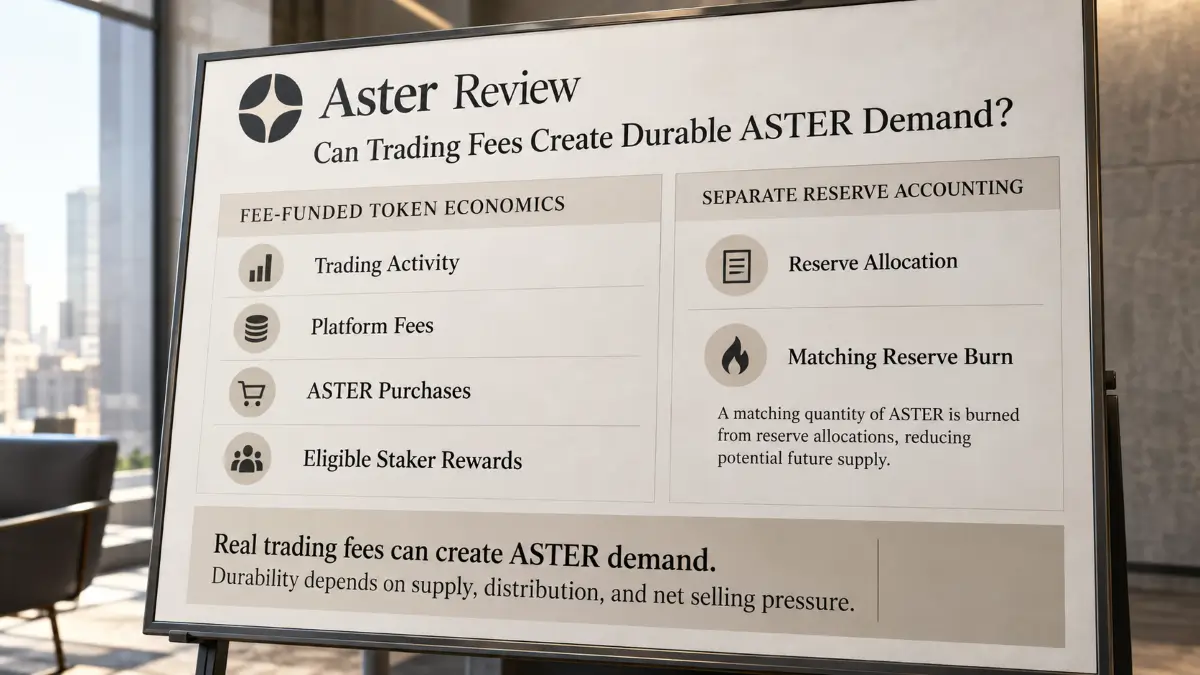
Basically, crypto projects can build useful products without giving their native tokens an equally useful economic role. A busy exchange may collect fees while its token mainly funds incentives, and impressive trading volume does not by itself tell holders where value goes. Aster makes that distinction worth examining because its derivatives business has measurable activity and its token economics changed significantly during 2026.
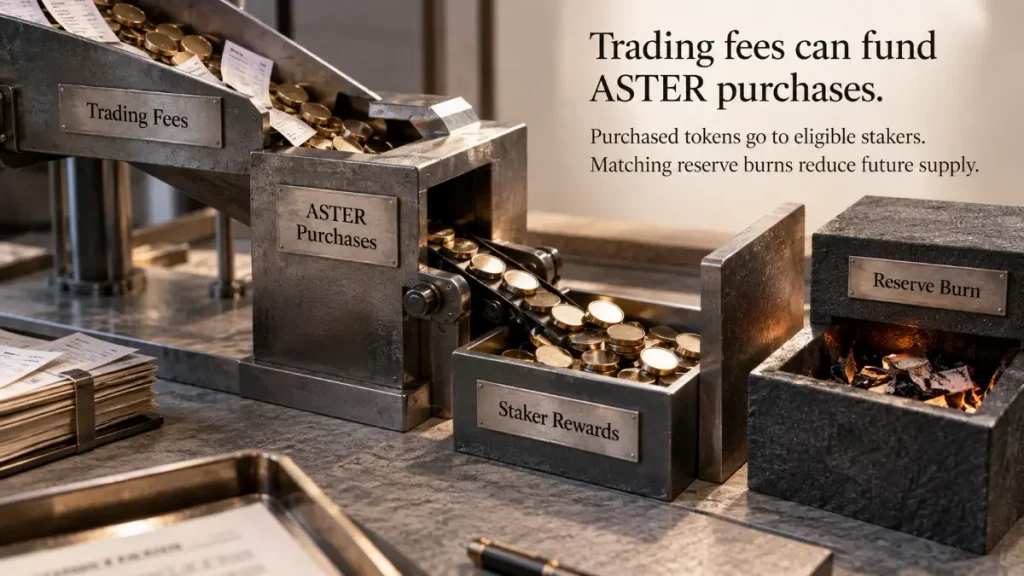
Aster offers perpetual and spot trading, hidden orders, yield-oriented collateral, and markets linked to selected traditional assets. It has also developed Aster Chain, a blockchain designed around derivatives execution and account privacy. The crucial change for ASTER is more specific. Under Aster’s current policy, 99% of daily platform fees fund market purchases of ASTER, while a separate mechanism burns an equivalent amount from reserve allocations. Purchased tokens go to eligible stakers rather than disappearing from circulation.
This Aster review follows the money before considering the marketing. It examines what the exchange actually does, what its trading figures prove, how fees reach ASTER, and whether distributions and operational risks could weaken that connection. The analysis is educational, not a prediction of token prices or personal financial advice.
Aster has a functioning trading product and a defined route from platform fees to ASTER market purchases, but product activity alone does not prove durable token demand. The investment thesis depends on whether recurring fee-funded purchases and genuine holding demand remain meaningful relative to staking rewards, community distributions, unlocks, and other sources of liquid supply.
Key Takeaways
- Aster’s exchange activity and ASTER’s token economics should be evaluated separately.
- Trading volume can demonstrate product usage, but volume is not revenue and does not automatically create token demand.
- Under the current mechanism described in this review, platform fees fund ASTER market purchases; purchased tokens and reserve burns are economically different actions.
- Staking can reduce immediately liquid supply, but staking rewards can also become future sellable supply.
- Unlock schedules describe when tokens may become liquid; they do not prove that recipients will sell.
- Governance, validator control, security, and the ability to change economic rules remain part of the token thesis.
- The strongest future evidence would be transparent, repeatable reporting of fees, executed purchases, reserve burns, circulating supply, distributions, and governance changes over multiple market conditions.
This research is for informational and educational purposes only and is not financial, investment, legal, or tax advice. Crypto assets are highly volatile and can result in substantial losses. Verify current data and conduct your own research before making financial decisions.
Aster at a Glance
| Item | Research view |
|---|---|
| Project | Aster trading ecosystem |
| Token | ASTER |
| Core question | Can product activity translate into durable net token demand? |
| Value path examined | Trading fees → ASTER market purchases, alongside a separate reserve-burn mechanism |
| Main positive evidence | Operating product plus a measurable fee-to-token mechanism |
| Main unresolved risk | Whether token demand remains stronger than new liquid supply and selling pressure over time |
What the Project Actually Does
Aster emerged from the combination of Astherus and APX Finance in late 2024. Astherus contributed yield-focused products, while APX brought derivatives infrastructure into the unified platform. The exchange now combines professional order-book perpetuals, spot trading, simplified high-leverage products, and selected markets referencing assets outside crypto. Its published product descriptions identify yield-oriented assets such as asBNB and USDF alongside its derivatives services.
The product range matters because different traders need different execution and collateral arrangements. Someone opening a modest spot position faces a different set of costs and risks from someone maintaining a leveraged perpetual position with yield-bearing collateral. Offering both activities under one brand does not make their protections identical, nor does wallet access remove every intermediary or infrastructure dependency.
Hidden Orders Have a Specific Use
A large visible limit order can reveal a trader’s intended price and size before execution. Other market participants may react by adjusting quotes or withdrawing liquidity. Aster’s hidden-order documentation explains how traders can conceal their orders from the public order book until execution. The feature can reduce information leakage, especially for traders who do not want their full intention displayed in advance.
Concealment does not guarantee a better fill. A hidden order still depends on available counterparties, execution rules, and market conditions. It also should not be confused with comprehensive account privacy. Hiding an unfilled order on a trading interface is narrower than demonstrating who can view positions, authorize transactions, or inspect settlement information throughout a blockchain system.
Mechanism, Account System, and Value Path
Aster describes its own Layer 1 as infrastructure optimized for derivatives and private execution. Published specifications include ambitious throughput and short block-time targets, but design claims are not the same as independent evidence of sustained performance under stress. Actual execution quality also depends on order processing, pricing, liquidity, validator availability, and withdrawals. A fast chain cannot make an illiquid market safe to trade.
The privacy architecture seeks to conceal sensitive account and order information. That may protect traders from unwanted public observation, yet it changes what outside observers can independently inspect. A useful security assessment asks which operations remain publicly verifiable, who can access protected data, and what happens if the operators responsible for execution or settlement become unavailable.

The Blockworks Aster transparency filing , published in July 2026, described restricted external validator participation during the initial phase and validator-signature requirements for deposits and withdrawals. Those findings establish the disclosed model at the time, not an assertion that every setting must remain unchanged forever. Later upgrades would need their own verification. The relevant lesson is that private execution and permissionless control are separate properties, and neither should be assumed from the other.
Volume and Activity Evidence: Useful, but Not Enough
Aster is not relying solely on projected adoption. The DefiLlama Aster Perps dashboard records substantial perpetual volume, open interest, and trading fees. Those independent measurements support the conclusion that the platform processes economically meaningful activity, although reported totals vary with market conditions and tracker methodology.
Perpetual volume measures notional contracts traded, including leveraged exposure. It is not customer deposits, revenue, or a count of unique paying traders. Open interest measures outstanding contracts rather than completed transactions. Neither figure establishes how much of the activity would persist if trading incentives changed. Fees offer a more direct economic signal, but even gross fees should not automatically be called net profit after infrastructure costs and other obligations.
| Evidence | What It Shows | What It Does Not Prove |
|---|---|---|
| Perpetual volume | Contracts trade at substantial scale | Equivalent customer spending |
| Open interest | Material positions remain open | Low market or liquidation risk |
| Trading fees | Users generate measurable fee flows | Permanent future profitability |
| Spot and RWA markets | The product extends beyond crypto perps | Similar demand across every market |
| Fee-funded purchases | Trading activity creates ASTER demand | Guaranteed positive token returns |
Incentives Can Affect the Quality of Volume
Reward programs can encourage traders to increase activity to qualify for distributions. That does not make their trades fictitious, but it complicates the distinction between organic demand and subsidized activity. The useful question is whether customers continue trading and paying fees when an incentive becomes smaller or ends. Persistent fees across different market conditions would provide stronger evidence than a single record-volume period.
Aster’s stock- and commodity-linked perpetuals also require careful interpretation. A derivative referencing a share does not convey ownership of the underlying company, voting rights, or an ordinary shareholder claim. Reference markets may close while crypto trading continues, making price feeds and liquidation rules especially important. Product breadth is a capability, whereas independently observable activity in each market is evidence of actual adoption.
Live Activity vs Token Demand
| Observed signal | What it can show | What it does not prove |
|---|---|---|
| Trading volume | Market activity and user participation | Revenue, profit, or durable ASTER demand by itself |
| Platform fees | Economic activity that can fund the stated purchase mechanism | That purchases will exceed future sell pressure |
| Fee-funded purchases | Direct market demand when executed | Permanent removal of those purchased tokens from liquid supply |
| Staked balances | Tokens temporarily committed or locked | Permanent value capture or guaranteed holder returns |
| Reserve burns | Reduction in potential future supply | A second market purchase or automatic reduction in today’s liquid float |
ASTER Token Utility and Value-Capture Analysis
ASTER supports staking on Aster Chain and participates in selected trading-benefit and ecosystem programs. Certain VIP arrangements consider token holdings alongside trading volume, giving some active traders a practical reason to maintain a balance. Staking creates a different incentive by committing tokens for a chosen period in exchange for rewards under network rules. These uses can encourage holding, but each depends on program conditions that may change.
Token utility should not be confused with an automatic claim on company profits or treasury assets. Holding ASTER does not, by itself, establish a legal right to every fee the exchange collects. Aster’s more concrete economic connection comes from its fee-funded purchase policy, which should be examined separately from governance language, loyalty benefits, and newly distributed staking rewards.
Product Success vs Token Demand
Aster can succeed as a trading product without every unit of product growth creating equivalent ASTER demand. Users may trade because of liquidity, execution, leverage, market access, or product design; those reasons describe product-market activity, not automatic token value capture.
The token thesis therefore requires a second step: identifying which parts of platform activity create measurable ASTER purchases, holding requirements, staking demand, or reduced future supply. That distinction is central to the analysis below. The same separation between product activity and token economics is useful when comparing Aster with Hyperliquid and Synthetix.
How Trading Fees Reach the ASTER Token
Aster changed its economic mechanism in June 2026. According to its disclosed policy, summarized in the July 2026 transparency filing, 99% of daily platform fees fund ASTER purchases through a time-weighted process. The protocol distributes the acquired tokens to eligible veASTER stakers as additional rewards. That creates a traceable route from an exchange service to market demand for its native token.
The sequence matters. Traders pay to use the venue, the fee allocation finances purchases from existing market supply, and qualifying stakers receive the tokens. This is different from rewarding users exclusively with tokens released from a previously allocated pool. It is also different from a contractual promise that ordinary ASTER holders receive a dividend. Participation and reward amounts depend on the actual staking rules.
A Buyback and a Reserve Burn Are Not the Same Transaction
For each ASTER purchased under the current arrangement, Aster separately burns an equivalent quantity from its reserve allocations, with the team allocation prioritized. Stakers receive the purchased tokens and may eventually sell them on liquid markets. The reserve burn permanently removes tokens from a pool that might otherwise enter supply later.These effects are economically distinct and should never be presented as though the same purchased tokens are permanently destroyed twice.
The reserve burn can reduce future dilution without necessarily shrinking today’s liquid float. Meanwhile, the market purchase creates immediate demand without guaranteeing that the recipient will continue holding the reward. Aster has described a supply-reduction target of 3 billion ASTER under the policy. That target is a stated mechanism goal rather than a completed outcome or an immutable law.
Fee-funded purchases distributed to stakers and matching reserve burns must be counted separately rather than treating the burn as another payment funded by the same fees. This separation is essential when comparing the strength of token value capture with the quantity of tokens that could become available later.
What the Mechanism Still Cannot Prove
Actual purchases support the existence of a fee-to-token route, but their future size depends on trading fees. If customer activity falls, the money available for purchases falls as well. Even a high percentage of a shrinking fee base may produce less demand than a lower percentage of a larger one. The long-term test is therefore recurring purchasing capacity across market conditions, not the 99% headline alone.
Staking Can Lock Supply Without Creating Free Yield
Aster Chain users can select a validator and a lock period when staking ASTER. The official staking FAQ explains that rewards depend on factors including validator performance, commission, stake share, and the weight associated with the selected lock. Weekly reward epochs and early-withdrawal penalties give the lock duration practical consequences for participants.
Rewards need to be separated by source. Newly distributed ASTER from an allocation increases the amount held by reward recipients. ASTER purchased with trading fees instead transfers existing tokens from sellers to stakers. Both may encourage participation, but only the second reflects direct exchange-funded purchasing demand. Neither reward type guarantees a profitable outcome after changes in token value, locking costs, or potential selling by other recipients.
A large staked balance can reduce immediately available supply, yet staking is not a permanent burn. Participants may eventually withdraw, renew their locks, or sell rewards. The meaningful evidence is the relationship between actual locked balances, new distributions, fee-funded purchases, and withdrawals over time.
Tokenomics and Unlock Pressure
ASTER launched with an original maximum supply of 8 billion tokens. The official tokenomics page allocates 53.5% to airdrops, 30% to ecosystem and community purposes, 7% to treasury, 5% to team and advisers, and 4.5% to liquidity and listings. These percentages describe the initial allocation, not the exact quantity available for trading on any later date.
| Tokenomics Item | Published Position | Why It Matters |
|---|---|---|
| Original maximum supply | 8 billion ASTER | Starting supply ceiling |
| Airdrops | 53.5% | Major long-term community distribution |
| Ecosystem and community | 30% | Staking, migration and development funding |
| Treasury | 7% | Potential future deployment under applicable controls |
| Team and advisers | 5% | Vesting and reserve-burn exposure |
| Liquidity and listings | 4.5% | Original market-liquidity allocation |
| Fee-funded buybacks | 99% of daily platform fees | Exchange-linked market purchases |
| Matching reserve burn | One ASTER per ASTER purchased | Reduction of potential future supply |
Community Allocations Do Not Unlock as One Block
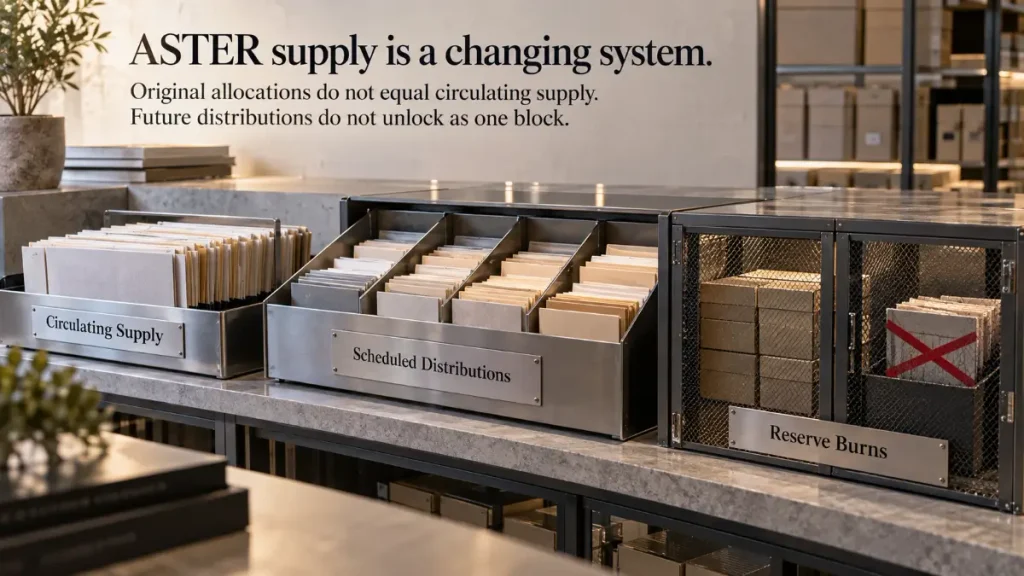
The original airdrop pool totals 4.28 billion ASTER. Aster described an initial release at token generation and gradual later distributions, subject to applicable program conditions. Individual campaigns can also distinguish immediate claims from vested claims. As a result, subtracting current circulating supply from the original maximum does not reveal one single imminent unlock event.
Recipients do not necessarily sell their tokens immediately after release. Likewise, a token described as allocated may not yet be transferable or included in a tracker’s circulating-supply calculation. Readers need an updated release calendar, actual claim records, and a consistent supply methodology rather than a dramatic percentage unsupported by timing details. The distinction between immediate and vested campaign claims illustrates why individual airdrop rules need to be assessed separately.
Ecosystem Emissions and the Team Cliff Have Changed
The original ecosystem model provided a much larger linear distribution rate. Aster’s disclosed January 2026 change replaced the relevant ecosystem linear release with a staking-reward model whose weekly base and loyalty pools comprise 150,000 and 300,000 ASTER, respectively. Fee-funded token purchases are separate from those allocation-funded rewards. The older allocation schedule remains useful history, but it should not be presented as the unchanged current release rate. Other categories, particularly airdrops, still need their own accounting.
In its September 2026 team-allocation announcement , Aster moved the cliff from September 17, 2026 to September 17, 2027. The original team allocation was 400 million ASTER, with monthly vesting planned after the cliff. This postponement removes a scheduled near-term release, while the matching burn policy may reduce the reserve balance before later vesting. It does not mean the entire original team allocation must become liquid in one transaction in 2027.
The Real Test Is Net Economic Demand
The economic picture has two broad sides. Market purchases, useful holding requirements, and staking locks can support demand or reduce immediate liquidity. Community distributions, new staking rewards, eventual unlocks, and sales by reward recipients can increase available supply. Reserve burns remove part of the potential future supply but should not be counted as another purchase from existing holders.
Aster can generate meaningful buybacks during a period of active trading and still experience selling pressure from other sources. Conversely, a scheduled unlock does not prove that every recipient will immediately sell. The durable question is how fee-funded purchasing and actual holding behavior compare with tokens becoming liquid over multiple reporting periods.
This also explains why an attractive-looking staking yield cannot settle the issue. Rewards paid in ASTER may grow a participant’s token balance while the token’s purchasing power changes independently. An assessment focused on economics must identify where the underlying demand originates rather than simply comparing reward percentages.
Security and Governance Risks
Aster documentation describes governance as part of ASTER’s role, but staking and governance labels do not establish that token holders control every important decision today. The July 2026 Blockworks filing reported that major protocol decisions then sat with the core team and that Aster Chain’s initial validator participation was restricted. The disclosed arrangements raise concrete questions about who can alter fee routing, reward parameters, upgrades, treasury spending, and emergency procedures.
These are not merely abstract decentralization concerns. A change to the fee-allocation rule would affect the mechanism linking trading activity to ASTER. Administrative control over settlement or withdrawals could matter to users even if an underlying smart contract continues functioning. Later governance changes may address some limitations, but a roadmap is not proof that binding authority has already transferred.
YZi Labs backing also should not be confused with demonstrated control of the treasury or every protocol decision. Investment relationships, day-to-day operators, legal entities, and governance powers are distinct facts. Where current public disclosures do not establish the exact holder of a particular authority, the appropriate conclusion is that the control path remains insufficiently documented.
Security Scope and Operational Dependencies
The CertiK Aster project record displays an audit-remediation status and identifies several available third-party audits. Its project summary does not establish that auditors have reviewed every component of Aster Chain and the exchange or resolved every issue in their reports.An audit covers its documented code scope and version, not the safety of the complete operating system.
Aster’s risk surface includes derivatives execution, collateral valuation, validator signatures, deposits and withdrawals, external market data, private account information, and operational controls. An audit of selected files does not independently verify every one of these components. The relevant questions concern the deployed version of the reviewed code, remaining findings, privileged access, and what happens when an outside service becomes unavailable.

Leverage, Oracles and Yield Collateral Compound Risk
Perpetual traders depend on mark prices and margin calculations, not just the last price displayed in an order book. A faulty or stale reference price can affect liquidation decisions even when settlement code runs as designed. The importance of report freshness and source validation is examined in CryptosMedia’s Chainlink review , although that comparison does not establish which oracle Aster uses for any particular market.
Stock- and commodity-linked markets complicate this further because the underlying market may have different hours, liquidity, or corporate events. Funding payments and trading fees also affect the cost of maintaining a position.
Yield-oriented collateral adds another dependency. A trader using an asset whose value depends on staking, hedging, a stablecoin mechanism, or an external protocol may face changes in collateral value independently of the derivatives position. High leverage can amplify the consequences. Capital efficiency is therefore a product capability, not proof that the combined risk is lower than holding simpler collateral.
Users also need to verify current geographic eligibility and product restrictions through Aster’s official terms before using a derivatives service. A market being accessible through a website does not establish that the product is permitted in every jurisdiction or available to every customer.
Case For
- Aster has an operating trading product rather than a token thesis built only on future roadmap claims.
- The current model described in this review creates a direct route from platform fees to ASTER market purchases.
- A separate reserve-burn mechanism can reduce potential future dilution when it is actually executed.
- Staking and broader token utility can create additional reasons to hold ASTER beyond governance alone.
Case Against
- High trading activity does not guarantee that token demand will remain stronger than new liquid supply.
- Purchased tokens distributed as rewards can later return to the market, so buybacks should not be treated as permanent supply removal.
- Community distributions, staking rewards, and future unlocks can add sellable supply even when reserve burns reduce other allocations.
- Governance, validator concentration, operational controls, and changes to fee-allocation rules can alter the economic thesis.
What Would Strengthen or Weaken the Thesis
Aster already has a functioning product and a defined route from trading fees to token purchases. The next evidence should be a consistent record of fees, executed buybacks, reserve burns, and actual distribution across different market conditions. Publishing those flows with dates and identifiable transaction records would make it easier to separate organic exchange economics from temporary incentive-driven activity.
A clear, updated supply reconciliation would also help. It should distinguish circulating supply from total supply after burns, show allocations remaining in reserve, and identify which campaigns or vesting tranches can become liquid next. Governance disclosures should explain who can change the economic rules and what approval process applies. None of these measurements alone predicts a token price, but together they would support a stronger assessment of whether product use produces sustained token demand.
Final Assessment
Aster’s operating exchange and revised tokenomics make its economic case more substantial than a model based only on governance promises and newly distributed rewards. Real trading fees now fund ASTER purchases, while separate reserve burns reduce potential future supply. The design establishes a meaningful connection between platform activity and the token without giving ordinary holders an automatic legal claim to all exchange revenue.
The unresolved issue is durability. Trading activity can fluctuate, acquired tokens can return to market through staking rewards, and community distributions remain part of the supply picture. Governance, validator controls, oracles, leverage, and collateral arrangements also affect the business that generates the fees. The evidence supports an operating fee-to-token mechanism, but its performance across changing conditions remains the central question for ASTER economics.
Frequently Asked Questions About Aster
Aster operates perpetual and spot trading products, including privacy-focused order features and selected derivatives linked to non-crypto markets. Its wider ecosystem includes Aster Chain, staking, and yield-oriented collateral options. Different products carry different execution, pricing, and collateral risks.
ASTER supports staking and eligible trading-benefit programs. Aster also uses a defined share of platform fees to buy ASTER and distribute those purchased tokens to qualifying stakers. These functions are not equivalent to unconditional ownership of exchange profits.
No. Purchased ASTER goes to eligible stakers under the current policy. A separate equivalent quantity is burned from reserves, with team allocation prioritized. The purchase creates market demand, while the reserve burn reduces potential future supply.
No. Different allocations have different vesting, claiming, and release rules, and recipients do not necessarily sell every token as soon as it becomes liquid. Actual release timing and market behavior matter more than treating all noncirculating tokens as one imminent unlock.
Aster announced that the team-allocation cliff was moved to September 17, 2027. The original allocation was 400 million ASTER, but the remaining reserve can change as matching burns continue. The delayed cliff does not mean the full allocation becomes liquid at once.
No. Security reviews apply to specified code scopes and versions. The CertiK project record does not certify the safety of every exchange component. Users also depend on validators, pricing systems, withdrawals, collateral mechanisms, and later software changes that one audit cannot comprehensively assess.
Whether recurring fee-funded purchases and sustained token-holding demand remain economically significant relative to new liquid distributions and potential selling by reward recipients. The answer depends on measured activity and supply flows over time, not a fixed buyback percentage alone.

Founder & Managing Editor of CryptosMedia. Zahid Hussain leads evidence-based crypto research covering tokenomics, security, governance, adoption, and risk.
CryptosMedia separates verified facts from interpretation, avoids buy/sell recommendations, and updates reviews when major evidence changes.
1 thought on “Aster Review: Can Trading Fees Create Durable ASTER Demand?”