
The Aave V4 upgrade is changing how decentralized finance (DeFi) lending works, but it brings hidden dangers. DeFi platforms often show a perfect picture to the public with high profits and automated code. Behind the dashboard graphics lies a complex system of crypto smart contracts, liquidity pools, and economic incentives that need critical analysis. This article looks past the marketing to examine the core mechanics. We will look at the new architecture, recent exploits, the changes in Aavenomics 3.0, and the actual utility of the AAVE token.
How I Audited This DeFi Project
I evaluated the official documentation, historical whitepapers, smart contract reports, and live market data. To keep facts accurate, I treated all market cap, volume, and supply figures as time-sensitive based on July 9, 2026. I checked the mechanics of liquidity pools, the scope of safety reserves, and cross-referenced public auditing history with documented security incidents. I do not do simulated code deployments; my analysis relies strictly on verified on-chain events and official developer disclosures.

The Evolution of DeFi Liquidity Pools
Aave is a non-custodial liquidity protocol on multiple blockchains, mostly on Ethereum. It allows borrowing and lending without central middlemen, as smart contracts automatically manage all asset transfers.
Shifting from ETHLend to a Unified Model
Stani Kulechov originally launched the project in November 2017 as ETHLend. It started as a peer-to-peer lending system where the platform directly matched individual borrowers and lenders. This model was highly inefficient, suffering from low liquidity and long wait times. Kulechov’s team rebranded the project to Aave in early 2020. Under this new setup, the protocol dropped peer-to-peer matching for pooled liquidity.
How Borrowing and Lending Works Natively
Instead of waiting for a counterparty, lenders deposit assets into unified smart contracts called lending pools.
- For Lenders: Depositing assets immediately mints corresponding interest-bearing tokens, known as aTokens. These aTokens represent a claim on the pool’s assets and passively increase in value as borrowers pay interest. Lenders redeem their underlying principal and interest by burning their aTokens.
- For Borrowers: Accessing liquidity from these pools requires depositing high-quality collateral that exceeds the value of the borrowed assets. This is called overcollateralization. If a borrower’s collateral value falls below a predefined threshold, the protocol’s algorithm automatically liquidates the collateral on the open market to protect lenders.
Uncollateralized Liquidity via Flash Loans
Aave’s secondary borrowing mechanic is the flash loan, which does not require collateral. A user can borrow any amount of available liquidity from a pool, provided they return the principal plus a 0.09% fee within the exact same blockchain transaction block. If the borrower fails to return the funds and fee within that single block, the system automatically reverses the entire transaction. While flash loans help with complex strategies like arbitrage, executing them safely requires advanced programming skills.
AAVE Token Supply, Utility, and Market Value
The AAVE token is an ERC-20 asset that serves as the administrative and security core of the protocol. The development team introduced it via a 100:1 migration from the original LEND token.
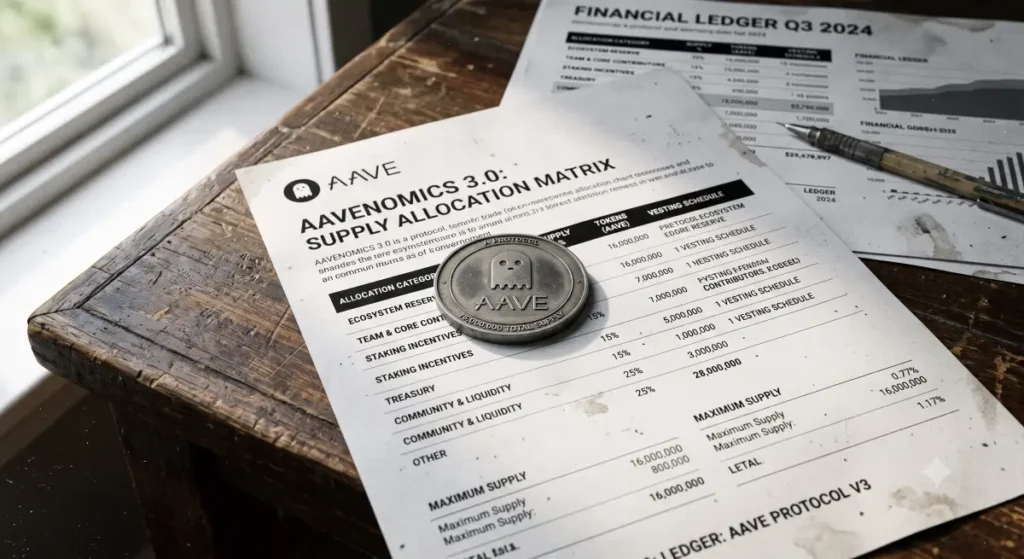
On July 9, 2026, market data listed the Aave token price near $88.34 with a 24-hour trading volume of $239,107,333. The protocol maintains a verified circulating supply of 15,414,022.35 AAVE out of a hard-capped maximum supply of 16,000,000 AAVE. This capped supply makes the token non-inflationary.
| Tokenomics Factor | Details | Why It Matters |
|---|---|---|
| Max Supply | Capped at 16,000,000 AAVE | Prevents long-term dilution from arbitrary minting. |
| Circulating Supply | 15,414,022.35 AAVE | Minimizes the risk of massive unexpected supply unlocks. |
| Safety Module Staking | Backstop Reserve Funded by Stakers | The protocol can liquidate staked AAVE to cover shortfalls. |
| Value Recapture | Burn Mechanisms and Automated Buybacks | Links token demand directly to protocol usage. |
Core Utility Roles
- Governance: Token holders use AAVE to vote on Aave Improvement Proposals, dictating changes to risk parameters and supported assets.
- The Safety Module: Stakers deposit AAVE into a dedicated insurance pool. In exchange, they receive incentives. Staking carries real risk; if a shortfall event occurs, the Safety Module can sell a portion of the staked tokens to restore pool solvency.
- Aavenomics 3.0 Buybacks: In mid-2026, Aave implemented an automated buyback strategy. This model uses 100% of protocol fee revenue to continuously purchase AAVE tokens directly from the open market.
Exploring the Hub-and-Spoke Architecture
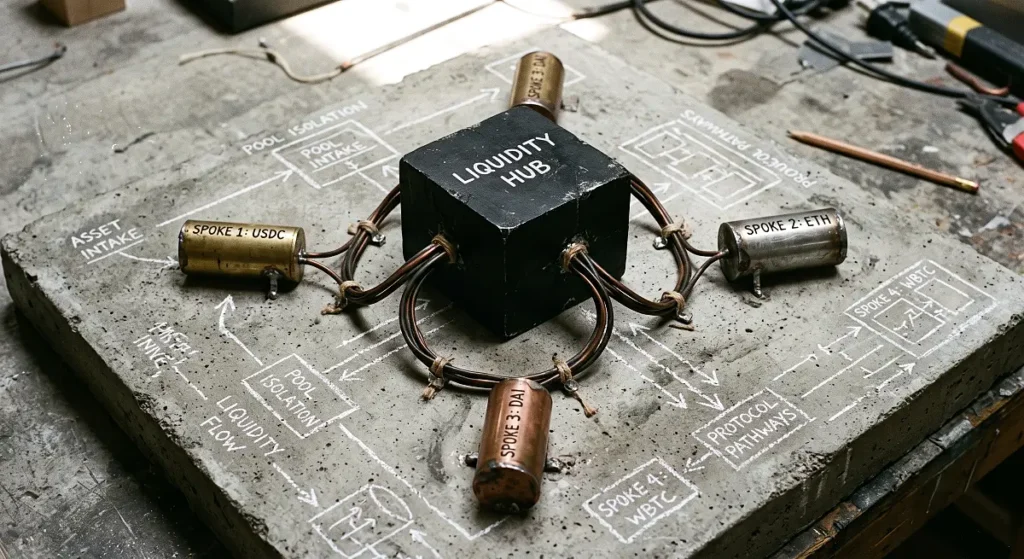
The Aave V4 upgrade replaces the single-pool design with a Hub-and-Spoke model. The Liquidity Hub acts as the central ledger, while individual Spokes act as specialized lending markets. This structure allows Aave to isolate risk parameters for distinct asset classes.
Inside the Global Dollar Hub
A primary component of the Aave V4 upgrade is the Global Dollar Hub, designed to aggregate stablecoin liquidity on Ethereum. This hub integrates stablecoins like GHO and USDG to facilitate lower-fee transactions and improve capital routing. GHO currently utilizes the Aave Savings Rate of 4.25% APY via Savings GHO to drive adoption.
Targeting the Traditional Securities Market
The Aave V4 upgrade explicitly bridges traditional Wall Street mechanisms with decentralized finance. The protocol integrates tokenized real-world assets and tokenized stocks on Aave Horizon. Through integrations like mGLOBAL, institutional users can deposit tokenized private credit or treasury bills as collateral to borrow stablecoins.
Security Audits and Real Vulnerabilities
Aave possesses one of the more seasoned security profiles in DeFi, backed by an annual SOC 2 Type 2 security audit and formal verification by Certora. No protocol is entirely risk-free. Aave has suffered substantial stress events that users must evaluate.
The Legacy V3 Bridge Exploit
In mid-2026, a critical bridge vulnerability caused a massive panic, leading to an $8.45 billion emergency withdrawal. While the protocol survived this liquidity shock, the event highlighted the systemic risks present in cross-chain bridge dependencies.
The KelpDAO Bad Debt Incident
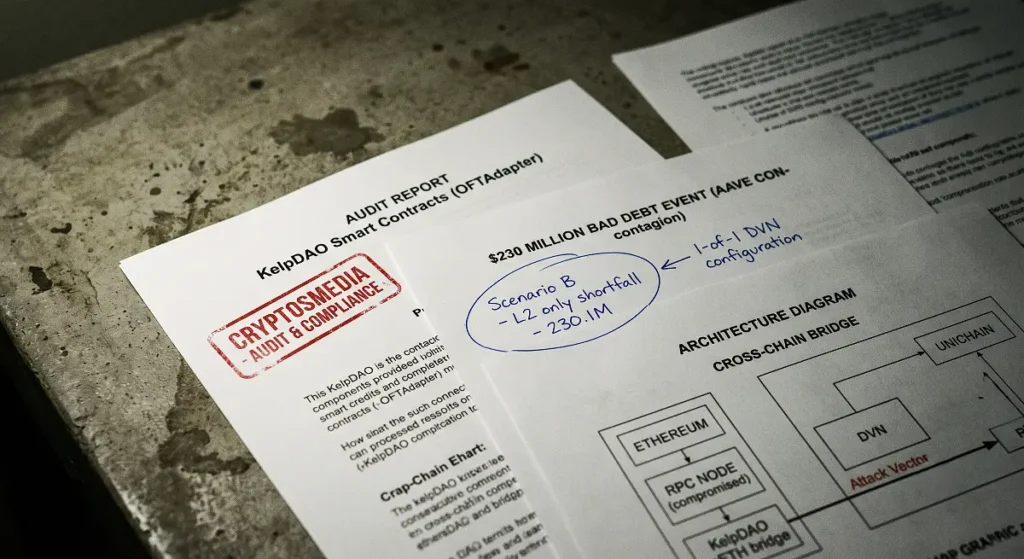
On June 17, 2026, an exploit involving KelpDAO generated $230 million in bad debt directly on Aave’s balance sheet. This crisis forced the protocol to overhaul its asset listing standards and lead a $320 million ETH recovery effort to cover the shortfall and protect depositors. These incidents demonstrate that even a formally verified protocol remains vulnerable to external integrations.
Governance Dynamics and Centralization Risks
The Aave Decentralized Autonomous Organization theoretically governs the protocol as holders vote on proposals. However, the reality of its governance reveals central points of failure.
- The Aave Labs vs. Aave Chan Initiative Dispute: In June 2026, Aave’s internal governance faced a major disruption when the community discontinued the Aave Chan Initiative following severe disputes with Aave Labs’ core development team over fee structures.
- No Control Over Deployed Code: In its legal disclosures, Aave Labs explicitly states that it does not operate or control any version of the Aave Protocol. The code executes itself. If a governance vote pushes a developer error to the mainnet, no centralized customer support exists to reverse transactions.
Comparing Aave V4 with Competitors
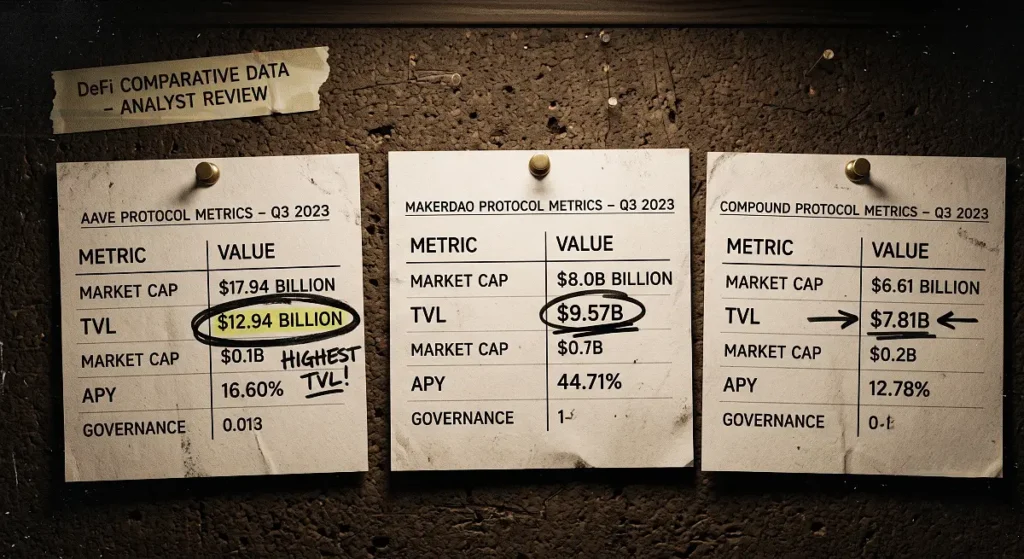
To evaluate Aave’s market position, it is useful to compare its core variables against other prominent lending protocols like Maker and Compound.
| Metric | Aave | Maker (Sky) | Compound |
|---|---|---|---|
| Primary Category | Multichain Pooled Lending | Stablecoin Debt Ingestion | Ethereum Pooled Lending |
| Total Value Locked | $12.94 Billion | Varies | Lower than Aave |
| Token Capping | Hard Cap of 16M AAVE | Variable | Hard Capped |
| Primary Token Utility | Governance, Safety Module | Governance, Burn Mechanism | Governance Only |
| Major Deficit Risk | Third-Party Smart Contract Exploits | Undercollateralized Peg Failures | Liquidity Utilization Locks |
DeFi Investor Checklist: What to Verify Independently
Before depositing assets or holding AAVE, I recommend verifying the following on-chain metrics:
- Active Safety Module Balance: Check how much AAVE currently sits staked in the Safety Module relative to the protocol’s outstanding debt.
- Health Factor of Deployed Positions: If borrowing, monitor your health factor constantly. A drop near 1.0 triggers auto-liquidation, which you cannot reverse.
- V4 Core Verification Status: Access Certora’s public formal verification reports to ensure security teams have fully audited any new spoke contracts.
- Historical Exploit Recovery Timelines: Read the post-mortem analyses of the KelpDAO bad debt event to understand how long the Safety Module took to stabilize the pools.
Deciding If Aave’s Ecosystem Aligns with Your Focus
This Guide Is Most Useful If You Are:
- A decentralized finance participant looking to supply stablecoin liquidity to earn passive yield.
- A developer or institutional researcher evaluating ERC-4626 vaults and Hub-and-Spoke models.
- A crypto researcher attempting to analyze open-market token buybacks under Aavenomics 3.0.

Extra-Careful Readers Should Slow Down If You Are:
- Uncomfortable with smart contract exploits; the protocol’s history shows that even audited pools can lose money.
- Expecting guaranteed yields; algorithms entirely set the interest rates.
- Unfamiliar with on-chain liquidations; automated keepers will liquidate your position without warning.
Common Questions About the Aave Protocol
Is the AAVE token inflationary?
No. The AAVE token has a hard-capped maximum supply of 16,000,000 AAVE. Under Aavenomics 3.0, the protocol uses fee revenues to execute open-market buybacks of the token.
What happens if an Aave borrower defaults?
Because all loans on Aave demand overcollateralization, a default does not rely on a collection agency. If a borrower’s collateral value falls below the pool’s safety threshold, the protocol triggers an automated liquidation.
Who operates and controls the Aave smart contracts?
The Aave DAO entirely governs Aave on-chain. Aave Labs does not operate, control, or possess admin keys to any version of the protocol deployed on permissionless blockchains.
What is the Safety Module risk?
If you stake AAVE in the Safety Module, your tokens act as a backup reserve. In the event of extreme market failure, the protocol holds the right to sell a portion of your staked AAVE to cover deficits.
The Bottom Line on Aave V4
Aave remains the largest decentralized liquidity market in crypto, boasting over $12.94 billion in TVL. The Aave V4 upgrade and its move toward tokenized traditional securities show a clear institutional-grade product direction. Its massive scale makes it a prime target. The friction surrounding governance shows that smart contract risk and centralization remain operational realities. Interacting with this protocol requires accepting that its security depends entirely on code execution.

Founder & Managing Editor of CryptosMedia. Zahid Hussain leads evidence-based crypto research covering tokenomics, security, governance, adoption, and risk.
CryptosMedia separates verified facts from interpretation, avoids buy/sell recommendations, and updates reviews when major evidence changes.