
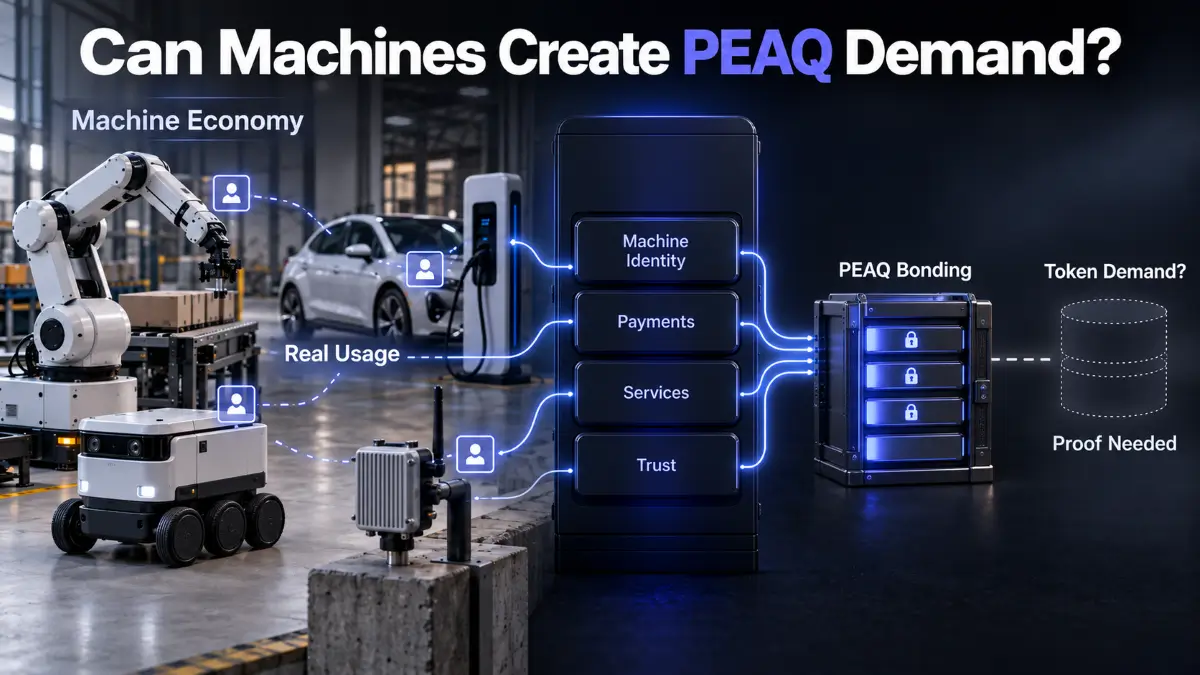
Peaq wants to build economic infrastructure for machines, robots, vehicles, sensors, and AI agents. The project does more than give devices a blockchain wallet. Its stack aims to give machines identity, reputation, payment access, service discovery, data markets, and a portable trust record that can follow them across different execution environments.
This Peaq Network Review focuses on the question that matters most for the token. Machine activity can grow without creating durable PEAQ demand. Peaq now connects the token to network fees, staking, machine activation, governance, and a broader bonding model for trust services. The token case depends on whether those mechanisms can absorb enough demand while vesting and inflation continue to expand available supply.
This article is for research and education only. It does not provide financial advice or a buy or sell recommendation. Supply figures, network metrics, and roadmap status can change, so readers should verify time-sensitive data before making financial decisions.
Peaq Has a Real Product Stack
Peaq now has more substance than a simple Machine Economy narrative. Current peaqOS documentation lists Activate, Qualify, Scale, Stream, and Monetize as live functions. Verify and Tokenize remain on the roadmap.
Activate gives a machine a peaqID, a Machine NFT, a wallet identity, and a bond. The current registration flow requires a 1 PEAQ bond. Qualify builds a Machine Credit Rating from revenue and activity history. Scale lets an owner pair an AI agent with a machine and define spending limits, service permissions, and transaction rules. Stream lets machines sell signed data. Monetize provides an early path for bonded machines to offer compute capacity.
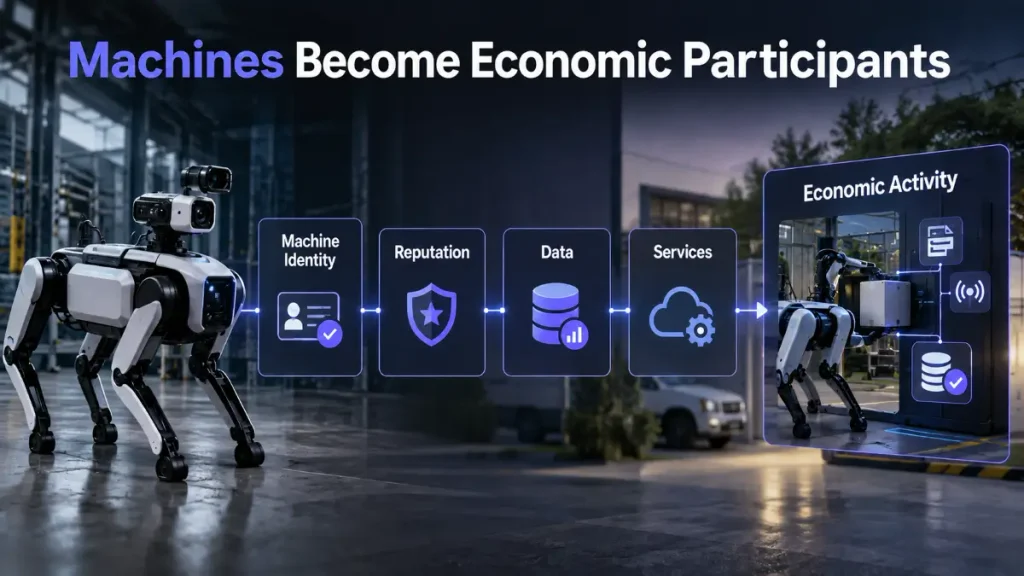
That mix matters because it creates several possible economic loops. A machine can establish an identity, build a history, sell data, buy services, or provide compute. Peaq therefore has a clearer product thesis than projects that only attach a token to an AI or robotics label.
The roadmap still matters. Verify aims to add hardware attestation and trusted third-party checks, while Tokenize aims to fractionalize machines into investable assets. Neither function is live yet. Readers should separate working products from future functionality instead of treating the full roadmap as current adoption.
Portable Machine Identity Is More Important Than Raw Speed
Peaq does not need to beat every Layer 1 on transaction speed to make its thesis work. The more interesting idea is portable machine identity and trust.
A machine may use one chain for settlement, another service for storage, a different market for compute, and an AI agent for purchasing decisions. If every environment creates a separate identity and history, the machine loses continuity. Peaq tries to provide a common identity and reputation layer that can move with the machine.
The current Machine NFT design uses LayerZero V2. That makes cross-chain messaging dependencies relevant to Peaq because portability adds an external infrastructure dependency. A machine identity can become more useful across chains, but the system also inherits risks from the interoperability layer it uses.
Agent Payments Add Utility Without Guaranteeing Token Demand
The Scale function shows how machine commerce could work in practice. An owner can pair an AI agent with a machine, set per-transaction and daily spending limits, restrict available services, and let the system manage ordering, payment, escrow, execution, confirmation, and disputes.
That approach closely matches controlled AI agent payments, where useful automation depends on bounded authority rather than unlimited wallet access. Machines need permission systems that let software act without giving it unrestricted control over funds.
Token capture remains a separate question. A machine can create payment volume while using another asset for settlement. Peaq itself now acknowledges this design choice. Its trust model allows coordination fees to use the native asset of the machine’s execution environment rather than forcing every payment through PEAQ.
That means transaction growth alone cannot prove PEAQ demand. The token needs another route into the economic loop.
Bonding Is the Core Value-Capture Experiment
Peaq’s Purple Paper gives the clearest answer to the value-capture problem. The proposed trust layer requires machines and validators to bond PEAQ when they want stronger trust services, portable reputation, settlement guarantees, orchestration, or verification rights.
This model changes the token thesis. Instead of forcing users to spend PEAQ on every external action, Peaq wants active machines to lock PEAQ as participation collateral. Higher-value machines can require larger bonds because their economic risk is greater. Validators also bond PEAQ and face slashing if they perform verification work dishonestly or negligently.
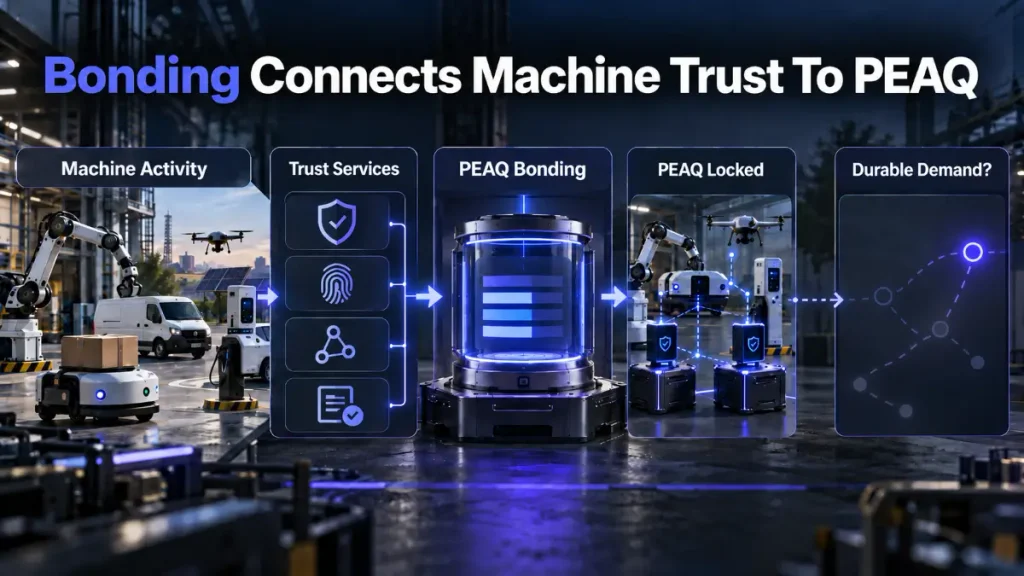
The distinction between current and future demand is important. The live Activate flow currently uses a 1 PEAQ bond. The broader tiered bonding architecture describes a more ambitious economic model. Peaq still needs to show how many machines adopt those trust services, how much PEAQ they lock, and how long they keep it locked.
This is the strongest part of the PEAQ thesis, but it also remains the part that needs the most evidence.
Traction Looks Large, but Definitions Matter
Peaq reports substantial ecosystem reach. The March 2026 Purple Paper says the network had onboarded more than 3.3 million machines, robots, devices, vehicles, and agents with verified machine identities. It also reports more than 200 million transactions and over 60 DePIN and Machine Economy applications.
Those numbers show activity, but they do not answer the token question. A registered identity does not prove that a machine earns revenue. A transaction does not automatically represent a paid service. An application count does not show how many products generate recurring economic activity.
Better evidence would show active bonded machines, machine-generated revenue, paid service volume, average PEAQ locked per machine, and repeat usage across trust services. Those metrics would connect product adoption to economics more directly.
Compute Adds Another Machine Revenue Path
The Monetize function gives registered and bonded machines an early route into compute markets. Peaq currently lists compute as the first capacity type and names Akash as the first aggregator network. The roadmap says aggregator discovery, connections, and automated settlement will roll out later.
This creates a useful connection with decentralized compute markets. A machine that can earn from spare compute becomes more than a passive device. It becomes an economic participant with its own wallet and revenue history.
Still, the revenue path does not automatically strengthen PEAQ. The important question is whether compute activity increases bonding, staking, network fees, or another form of token demand. If revenue grows while token participation stays flat, Peaq can build a useful machine network without creating equally strong value capture for PEAQ.
Tokenomics: Unlocks and Inflation Create Two Pressures
The official tokenomics documentation lists 4.2 billion PEAQ at genesis. Peaq starts its inflation schedule at 3.5 percent, reduces that rate by 10 percent each year, and eventually stabilizes at 1 percent. The published schedule reaches a maximum supply of about 5.67 billion PEAQ.
Genesis allocation also matters. Investors received 34 percent. Community allocations received 21 percent. Core contributors received 11.5 percent, EoT Labs received 8.5 percent, network security received 5 percent, and ecosystem plus treasury allocations received 20 percent.
How Vesting and Inflation Affect PEAQ Supply
Vesting and inflation create different forms of supply pressure. Vesting makes previously allocated tokens available according to the release schedule. Inflation creates new PEAQ. The official schedule shows monthly unlocks of about 88.58 million PEAQ during the current vesting phase, while scheduled inflation adds another stream of newly minted tokens. Peaq also notes that some campaign-related unlock projections may change.
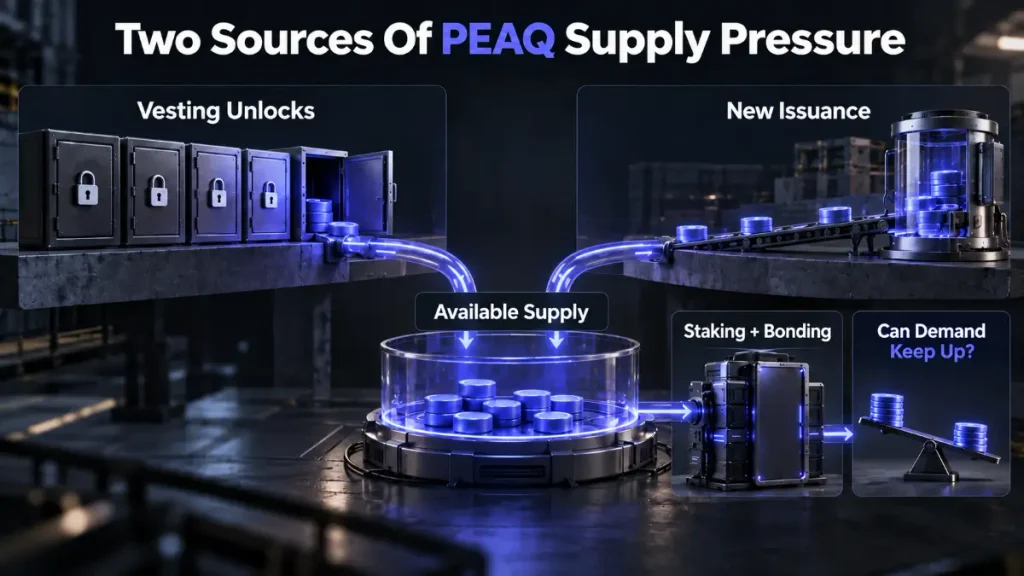
An unlock does not mean a holder sold tokens. Likewise, newly minted PEAQ does not all enter circulation immediately. Peaq says validators and delegators receive 40 percent of yearly inflation directly, while treasury-related pools initially receive the other 60 percent outside circulating supply. Locked and vesting tokens can also participate in staking, and staking rewards arrive unlocked.
That last point matters because a token can remain under vesting while still generating liquid staking rewards. A simple locked-versus-unlocked chart therefore gives only part of the supply picture.
| Tokenomics Item | Current Position | Why It Matters |
|---|---|---|
| Genesis supply | 4.2B PEAQ | Sets the starting token base |
| Maximum supply | About 5.67B PEAQ | Defines the current long-term supply ceiling |
| Initial inflation | 3.5% | Adds new supply before annual reductions |
| Investor allocation | 34% | Creates meaningful vesting exposure |
| Community allocation | 21% | Supports adoption and ecosystem distribution |
| Core contributors and EoT Labs | 20% combined | Creates long-term contributor exposure |
| Current monthly unlock phase | About 88.58M PEAQ | Expands available supply under the published schedule |
| Staking | Validators and delegators | Supports security and token demand |
| Live machine activation bond | 1 PEAQ minimum | Connects machine registration to PEAQ today |
| Main value-capture path | Fees, staking, bonding, governance | Usage must reach PEAQ through these routes |
| Main tokenomics risk | Supply growth outruns durable demand | Product adoption may not absorb unlocks and issuance |
The central test is simple. Peaq needs recurring token demand to grow faster than the economic pressure created by unlocks and issuance.
Governance Still Has a Transition Risk
Peaq’s governance documentation describes a staged transition. During the initial post-launch period, the Foundation keeps veto power to protect network stability. The longer-term plan moves decision-making toward on-chain governance involving PEAQ holders, a Council, and a Technical Committee.
Treasury control follows the same logic. Foundation-managed addresses still cover several community, security, ecosystem, grants, and expansion pools. Over time, governance may distribute more authority. Until that transition happens, administrative concentration remains part of the risk model.
March 2026 Stall Exposed a Reliability Risk
Peaq experienced a material network incident on March 23, 2026. Block production stalled for several hours, and exchanges delayed deposits and withdrawals while the network recovered. QuickNode’s incident reporting described a network-level block height stall, while Kraken tracked delayed PEAQ funding during the event.
The incident matters because machines may depend on timely state updates, identity checks, payments, and service coordination. A network that stops producing blocks can interrupt those workflows.
Available evidence confirms the stall and recovery, but it does not establish a detailed public root cause. The safest conclusion is narrower. Peaq faced a serious availability event, restored operation, and now needs to show that network resilience improves as machine activity grows.
Audit Evidence Helps, but Scope Matters
CertiK published a Peaq Network audit with a revision date in June 2024. Its current audit page lists 35 findings, including four major and nine medium findings. CertiK reports five findings as resolved, two as partially resolved, and 28 as acknowledged. It lists no critical finding.
That evidence adds useful code-level scrutiny, but it does not certify the whole 2026 architecture. The audit predates much of the current peaqOS roadmap and the expanded omnichain trust model.
Security now depends on more than audited code. Chain liveness, validator behavior, machine keys, LayerZero messaging, data quality, AI delegation, service providers, future hardware attestation, and governance controls all sit inside the broader failure boundary.
What Peaq Needs to Prove Next
The first useful metric is active bonded machines. Peaq should show how many machines use trust-tier services, how much PEAQ they bond, and how long those bonds stay active.
Economic activity comes next. Machine payment volume, paid data access, compute revenue, coordination fees, and service transactions would help separate real commerce from registration counts.
Token capture is the harder test. Growth should produce more staking, more bonding, or more fee demand than the pressure created by vesting and inflation. This same problem appears across distributed infrastructure token economics, where useful hardware networks can expand without guaranteeing proportional native-token demand.
Execution also matters. Verify and Tokenize still sit on the roadmap. The broader bonding model needs measurable adoption. Not every future feature needs to launch immediately, but readers need a clear line between live functionality and planned economics.
Peaq Network Review Verdict: Product Ahead of Token Proof
Among DePIN projects, Peaq has a relatively clear product thesis. Machines need identity, wallets, permission controls, reputation, data markets, compute access, and payment coordination. Peaq already offers working infrastructure across several of those areas.
PEAQ also has real utility. Network fees, staking, governance, machine activation, and the developing trust-bond model all create potential demand paths. The shift toward bonding is especially important because Peaq does not force every machine payment into PEAQ.
The main weakness is timing. Large vesting releases and inflation continue while the strongest value-capture mechanism still needs broader adoption. Project-reported machine counts show reach, but they do not yet prove that machine economics remove enough PEAQ from active supply.
That leaves Peaq in a credible but unfinished position. The project no longer needs to prove that it can build machine-focused infrastructure. Its harder task is proving that real machine activity creates recurring PEAQ demand faster than supply expands.
Frequently Asked Questions
Peaq is blockchain infrastructure for the Machine Economy. It gives machines and AI-controlled devices tools for identity, wallets, reputation, data services, payments, compute participation, and other economic activity.
PEAQ pays network fees, supports validator and delegator staking, participates in governance, and provides machine activation bonds. Peaq also plans broader bonding requirements for higher-trust machine services.
The current official schedule starts with 4.2 billion PEAQ at genesis and gradually increases supply under a disinflationary model. The published schedule reaches a maximum of about 5.67 billion PEAQ.
No. Machine identities and transactions show network reach, but they do not prove token demand. Stronger evidence would show active PEAQ bonds, staking demand, paid services, machine revenue, and recurring economic activity.
Available evidence confirms a block production stall, but it does not show that a hack caused the incident. The safest description is a network availability incident unless stronger evidence establishes a different cause.
CertiK published a Peaq Network audit that it revised in June 2024. The audit adds useful code review evidence, but its scope does not prove that every current or future Peaq component is secure.

Founder & Managing Editor of CryptosMedia. Zahid Hussain leads evidence-based crypto research covering tokenomics, security, governance, adoption, and risk.
CryptosMedia separates verified facts from interpretation, avoids buy/sell recommendations, and updates reviews when major evidence changes.
4 thoughts on “Peaq Network Review: Can Machines Create PEAQ Demand?”