
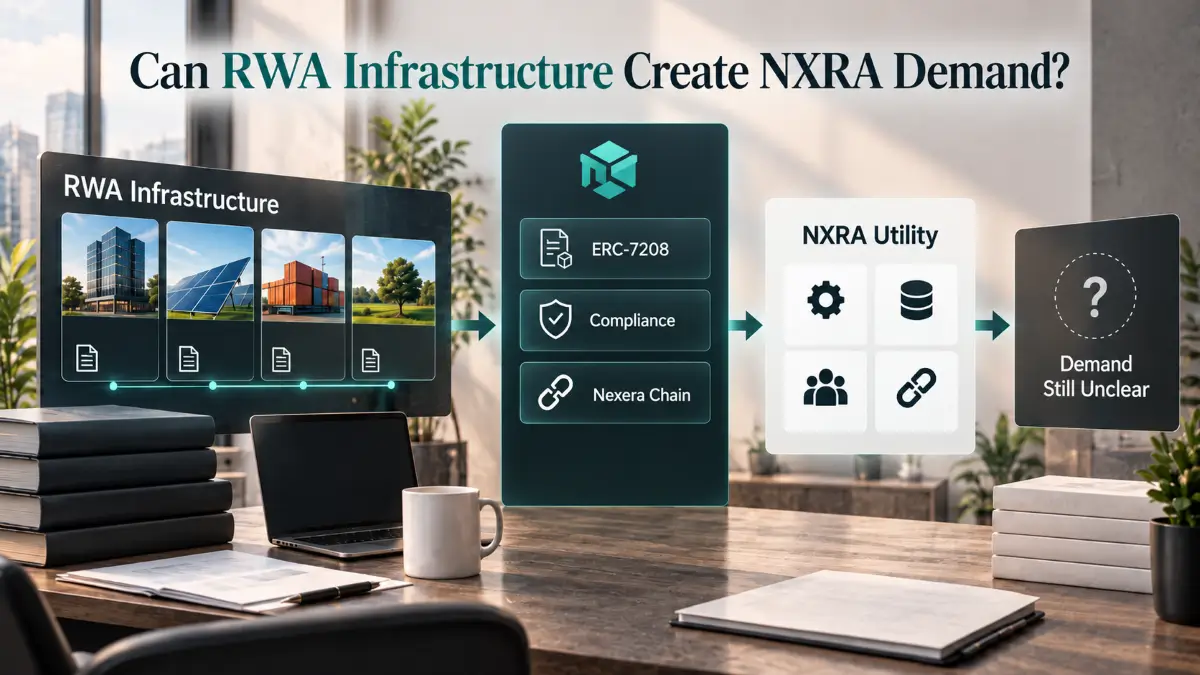
Nexera has changed more than once since its AllianceBlock roots. The project now presents itself as infrastructure for compliant tokenization, interoperability, identity, staking, and real-world asset markets. Its technical stack is broader than a narrow NXRA narrative of one token, one staking product, and one real-world asset story.
This Nexera Review asks a narrower question. Nexera can keep building useful infrastructure without automatically creating durable demand for NXRA. The strongest current evidence is the continued development of ERC-7208, Evergon, compliance tooling, Nexera Launch, and Nexera Chain. The weaker part is proving how much real economic activity these products generate and how much of that activity reaches NXRA.
The token also has a more complicated supply history than a simple locked-versus-circulating calculation suggests. Nexera published an 850 million NXRA maximum supply during the 2023 migration from ALBT. Current market data now shows a 2 billion maximum, about 1.347 billion total supply, and about 1.246 billion circulating. That difference needs explanation rather than a claim that every token outside circulation will eventually hit the market.
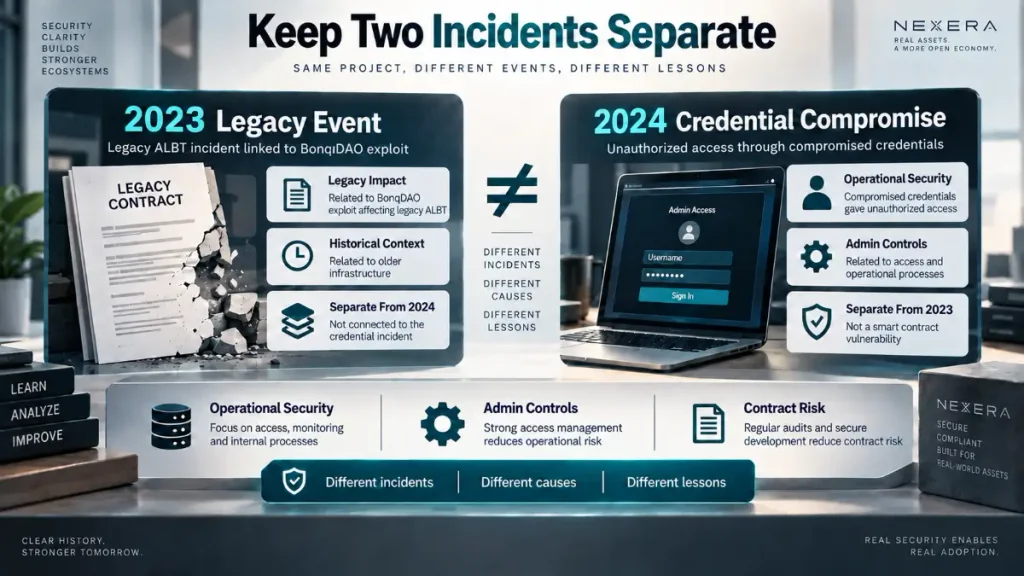
Security history needs the same care. The 2023 BonqDAO event that affected legacy ALBT and the 2024 Fundrs credential compromise were different incidents. A proxy contract, a pause function, an audit, and a compromised operational key also describe different risks. Combining them into one security score produces more heat than insight.
This article is for research and education only. It is not financial advice or a buy or sell recommendation. Token supply, liquidity, network activity, and product usage can change.
Nexera Is Now Bigger Than One RWA Product
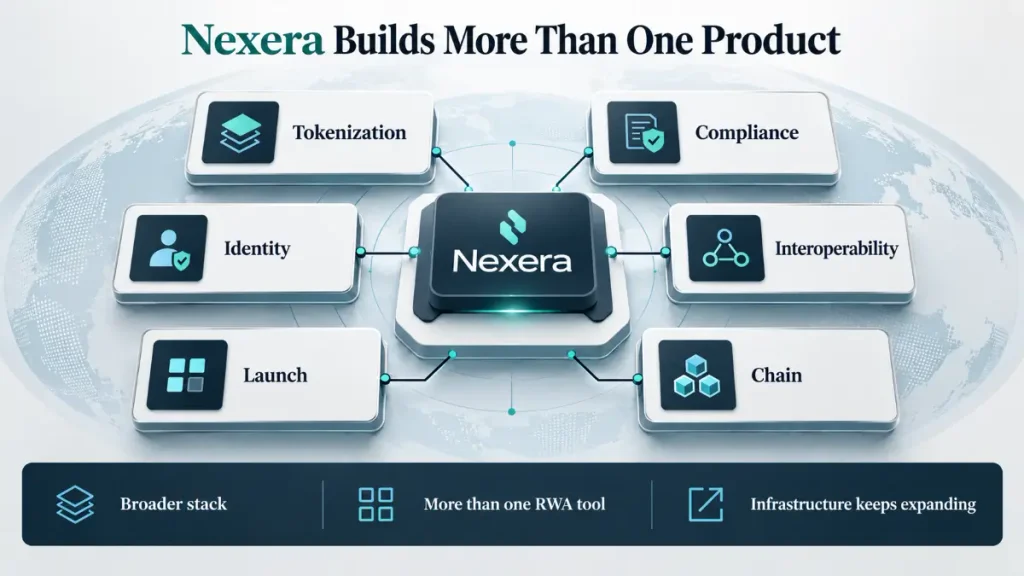
Nexera describes its current stack around tokenization, compliance, interoperability, and asset management. Its builder portal lists the Nexera Standard, Token Market Infrastructure, interoperability tooling, Nexera ID, and compliance modules. Current documentation also describes a Staking Protocol, Fraction Protocol, ComPilot, and Evergon.
That matters because readers should no longer evaluate Nexera as if its only product were a tokenized-asset marketplace. Nexera is trying to provide components that businesses can use to issue assets, enforce eligibility rules, manage investor access, fractionalize ownership, move information across chains, and operate token markets.
The closest comparison inside the wider crypto market is not a simple Layer 1 race. Nexera sits between RWA infrastructure, compliance middleware, application tooling, and a dedicated chain. Readers examining institutional tokenization can also compare this approach with a different RWA adoption model.
The important distinction is between product breadth and verified adoption. A long product menu proves that Nexera has built multiple components. It does not prove that institutions are using them at meaningful scale, that tokenized assets are actively trading, or that NXRA captures value from every deployment.
ERC-7208 Separates Asset Data From Business Logic
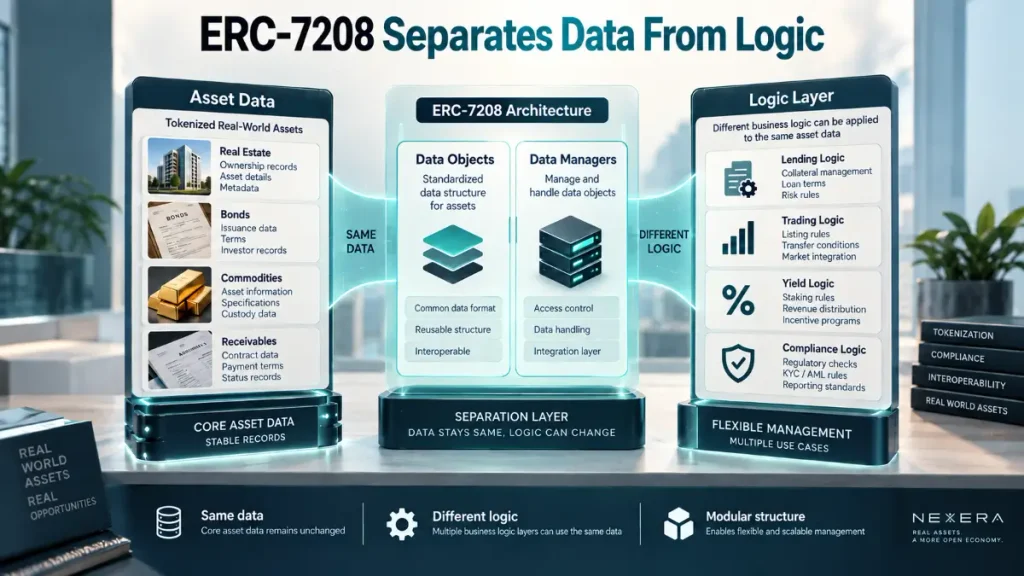
The strongest technical idea in Nexera is the Nexera Standard, also known as ERC-7208. Its core design separates data storage from the business logic that manages the data.
Traditional token contracts often keep balances, metadata, permissions, and logic tightly coupled. ERC-7208 introduces a modular structure built around Data Points, Data Objects, Data Managers, a Data Point Registry, and a Data Index. A Data Object can hold information while a Data Manager defines how applications use that information.
That separation can make upgrades and interoperability easier. A project can change the management layer without rebuilding the underlying asset data from scratch. It can also expose the same data through different token interfaces when a use case needs different forms of representation.
This is more precise than saying Nexera can simply change a compliance law inside a token. ERC-7208 provides an architecture that can support changing logic. Legal compliance still depends on correct rules, identity data, jurisdiction, governance, administrators, and the systems that enforce those rules.
The flexibility also creates a control question. If administrators can replace or extend logic, readers need to know who authorizes those changes, who controls access, whether teams delay or review upgrades, and what happens if an attacker compromises an administrator. Modularity can reduce migration friction while increasing the importance of governance and operational security.
Nexera is also developing cross-chain implementations that use LayerZero components for omnichain data and asset movement. That creates a different dependency from the standard itself. Cross-chain functionality inherits messaging and configuration risk.
Product Development Is Easier To Verify Than Commercial Scale
Nexera has continued shipping product updates. Evergon releases during 2025 added full transaction indexation, fraction recovery, audited gated contracts, mobile improvements, sale-page changes, automatic transaction simulation, and faster marketplace onboarding.
Nexera also said that Evergon v0.14 followed the go-live of CIRETA. That is more useful evidence than a generic partnership announcement because it points to a product deployment and later software updates based on user feedback. It still does not tell readers how much capital moved through the platform, how many investors used it, or how much recurring revenue Nexera earned.
The same caution applies to partnership announcements. Nexera has announced work with companies across tokenized real estate, data infrastructure, AI, compliance, and blockchain networks. These relationships show business-development activity. They do not automatically prove production volume, paid demand, or NXRA buying.
| Evidence | Current Position | What It Proves |
|---|---|---|
| ERC-7208 documentation | Active technical documentation and reference implementations | Nexera continues developing modular tokenization architecture |
| Evergon releases | Product updates continued through late 2025 | Marketplace infrastructure received active development |
| CIRETA reference | Nexera describes a successful go-live before later Evergon updates | At least one named deployment moved beyond announcement stage |
| Partnership announcements | Multiple RWA and infrastructure collaborations are public | Business-development pipeline exists |
| Public chain explorer | Nexera Chain has blocks, addresses, transactions, and NXRA fees | A functioning chain environment has existed |
| Missing public economics | No simple public dashboard reconciles RWA value, protocol revenue, or NXRA capture | Commercial scale remains difficult to verify |
The claim that 206 million dollars of tokenized value proved institutional backing overstated the evidence. A project-reported total can still help when the project publishes its methodology and a current ledger. Without a current reconciliation of assets, issuers, custody, redemptions, and active market value, readers should not treat that figure as independent proof of institutional demand.
The more useful information moat is therefore not a large headline number. It is the difference between what Nexera has clearly built and what outsiders can measure economically.
Nexera Chain Shows Infrastructure But Weak Current Activity
Nexera Chain adds another layer to the project. The public Blockscout explorer shows more than 2.16 million blocks, roughly 1.19 million total transactions, and more than 96,000 addresses. Transactions on the explorer use NXRA for gas, which gives the token a direct network function.
The current activity signal is much weaker. As checked in September 2026, the explorer displayed only about 12 daily transactions, network utilization at 0.00 percent, and the latest visible blocks and transactions around three weeks old.
Readers should not stretch those observations into a claim that Nexera Chain is permanently offline. Explorer indexing can fail, network configuration can change, and a public dashboard can lag behind the chain. The visible data does show that a reader cannot currently use the explorer as evidence of strong live network demand.
This is an important difference from counting historical addresses or lifetime transactions. Lifetime figures can grow during test periods, launches, automated activity, or earlier usage bursts. Durable economic activity requires recent users, repeated transactions, paid fees, active applications, and visible settlement.
Nexera needs a clearer current chain-health view if Nexera Chain is central to the project thesis. Active validators, recent block production, daily paid transactions, application usage, and fee revenue would tell readers much more than lifetime totals.
How NXRA Connects To Product Activity
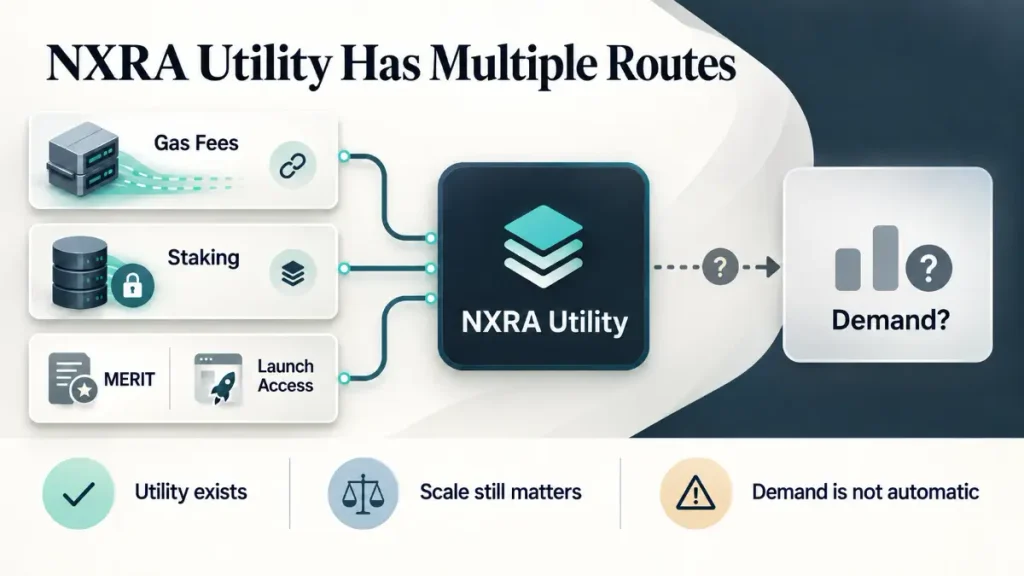
NXRA has several utility routes, but they do not all create the same kind of demand.
The clearest current route is network gas. Nexera Chain explorer data shows users paying transaction fees in NXRA. If chain activity grows, users and applications need NXRA to pay for execution. Low activity, however, can keep the fee-demand route economically small even when the network requires NXRA.
A second route is staking. Nexera Launch allows users to stake NXRA and earn MERIT, a reputation asset used within the Launch system. Longer or larger stakes can earn more MERIT. This can create a reason to lock NXRA when users value access, participation, or rewards available through the platform.
The value-capture path is indirect. Staking NXRA produces MERIT rather than automatically sending protocol revenue to NXRA holders. Nexera Launch describes Burn and Earn mechanics where users burn MERIT for project-token access or a share of selected platform growth pools. The strength of that model depends on actual startup activity, transaction volume, fees, and user demand for MERIT benefits.
Etherscan describes NXRA as an ecosystem utility token for reputation, governance, access, and transactions. Those functions matter, but utility labels alone do not establish economic demand. The relevant question is how often users must acquire or lock NXRA to access something they genuinely value.
This distinction also appears across infrastructure tokens. Product success and token success can diverge when users can consume a service without holding much of the native asset. Strong infrastructure usage therefore still requires a separate examination of token value capture.
Tokenomics: The Supply Story Changed Materially
A responsible NXRA supply analysis cannot assume that only about half of the token supply circulates while the rest is waiting to unlock.
During the February 2023 migration from legacy ALBT, Nexera published an NXRA distribution guide that listed a maximum supply of 850 million NXRA. Current market data now presents a different framework.
As checked in September 2026, CoinGecko showed about 1.347 billion NXRA total supply, about 1.246 billion estimated circulating supply, and a 2 billion theoretical maximum supply. Etherscan showed the same Ethereum token contract and a live supply near the current total.
Current total supply already sits far above the 850 million maximum that Nexera published in 2023. That means the supply framework changed materially after the migration announcement. This review did not find a current primary governance record that cleanly reconciles the move from 850 million to the present 2 billion maximum, so it does not invent a reason for the change.
Current circulation is also very different from the earlier 52 percent estimate. CoinGecko estimates that roughly 1.246 billion of 1.347 billion currently issued NXRA circulates, which equals about 92 percent of current total supply. Compared with the 2 billion theoretical maximum, circulating supply is about 62 percent.
The remaining difference between current total supply and the 2 billion maximum is not automatically a scheduled unlock. It is theoretical issuance headroom unless a verified schedule, governance decision, reward program, or mint plan establishes when and why additional tokens can enter supply.
NXRA Tokenomics
| Tokenomics Item | Current Position | Why It Matters |
|---|---|---|
| 2023 published maximum | 850M NXRA | Original migration documentation used a much smaller supply ceiling |
| Current maximum | 2B NXRA | Current market providers show a larger theoretical issuance limit |
| Current total supply | About 1.347B NXRA | Already exceeds the original 850M framework |
| Estimated circulation | About 1.246B NXRA | CoinGecko estimates that most currently issued supply circulates |
| Circulation versus current total | About 92% | Large locked-supply claims do not match current issued-supply data |
| Remaining theoretical headroom | About 653M NXRA | Possible future issuance is not the same as a verified unlock schedule |
| Ethereum contract | 0x644192291cc835A93d6330b24EA5f5FEdD0eEF9e | Current token remains identifiable on-chain |
| Network utility | Gas on Nexera Chain | Creates direct token use when chain transactions occur |
| Staking utility | Users can stake NXRA for MERIT on Nexera Launch | Can lock supply when platform benefits attract users |
| Main tokenomics gap | Supply expansion lacks a simple current primary reconciliation | Readers cannot safely infer future dilution from superseded schedules |
The key supply issue is not a known wall of locked tokens waiting to hit the market. The issue is that Nexera changed the published supply ceiling, current issuance now exceeds the original migration framework, and public material still does not explain future issuance clearly enough for a precise dilution forecast.
A stronger token case would pair the 2 billion ceiling with a current issuance policy, treasury balances, validator or ecosystem reward schedules, vesting data, and a clear explanation of who can authorize additional minting.
Security: Keep Two Incidents Separate
Nexera has a security history that deserves direct treatment, but the incidents need to stay separate.
The first major event was the BonqDAO exploit in February 2023. It affected legacy ALBT and helped trigger the transition to NXRA. Nexera designed the migration portal to distribute NXRA to eligible legacy holders under a snapshot and claim system.
A separate incident happened on 7 August 2024. According to Nexera’s post-mortem, an attacker compromised credentials used to manage Fundrs smart contracts. The attacker transferred 47.24 million NXRA from Fundrs staking contracts. Nexera reported that the attacker sold 14.75 million NXRA for about 449,000 dollars and that the project neutralized the remaining 32.5 million balance.
Nexera attributed the root cause to compromised operational credentials and malware rather than a flaw in the audited Fundrs contracts. That distinction matters. An audit can reduce code risk while leaving workstation security, private keys, upgrade authority, contract ownership, and incident response outside its scope.
The incident also demonstrates that NXRA had meaningful administrative controls. Nexera paused the token across several networks during the response. A pause function is not automatically a vulnerability. In this case Nexera used it defensively. It still means token transfers depend partly on privileged authority and operational security.
Readers should not treat a historical Token Sniffer score of 55 out of 100 as proof of critical risk. Automated scanners can flag proxy contracts, ownership, minting, or pause functions without establishing that an exploit exists. The correct review asks who controls those powers, whether multisigs or hardware keys protect access, and whether independent reviewers have assessed the current implementation.
Audit evidence is also component-specific. Nexera reported an Omniscia review of its Messaging Protocol, Teleport Protocol, and router contracts before a 2024 Bridge upgrade. Evergon later described audited gated contracts in its 2025 releases. Current Fraction Protocol documentation also warns that some development-phase contracts lack audits.
Cross-chain systems add another trust boundary. Nexera’s use of Chainlink CCIP and other messaging designs means the security model can extend beyond one Nexera contract. Readers should therefore evaluate cross-chain integrations as separate dependencies rather than fold them into one contract audit.
Thin NXRA Liquidity Is A Separate Market Risk
Nexera’s market position is much smaller than its infrastructure ambitions.
As checked on September 15, 2026, CoinMarketCap showed a market capitalization near 645,000 dollars with about 9,000 dollars in 24-hour volume, while CoinGecko showed roughly 640,000 dollars in market capitalization and about 9,300 dollars in 24-hour volume. Both providers therefore pointed to a thin market rather than a major valuation disagreement. CoinGecko also showed shallow market depth across tracked venues, reinforcing the liquidity risk.
Those figures change quickly, so readers should treat them as a dated snapshot rather than a permanent description. The structural point is more durable. A thin market can make larger trades expensive, increase slippage, reduce price discovery quality, and make the token more sensitive to individual buyers or sellers.
Low liquidity does not prove that ERC-7208, Evergon, or Nexera Chain has failed. It proves that current NXRA market demand is small. Product infrastructure and token liquidity are different measurements.
Price history is also secondary evidence. NXRA reached an all-time high around 0.286 dollars in March 2024 and has since fallen by more than 99 percent. That tells readers how dramatically market demand changed. It does not tell them why every product succeeded or failed.
The better question is whether new activity can create reasons to use NXRA that are stronger than speculative trading alone.
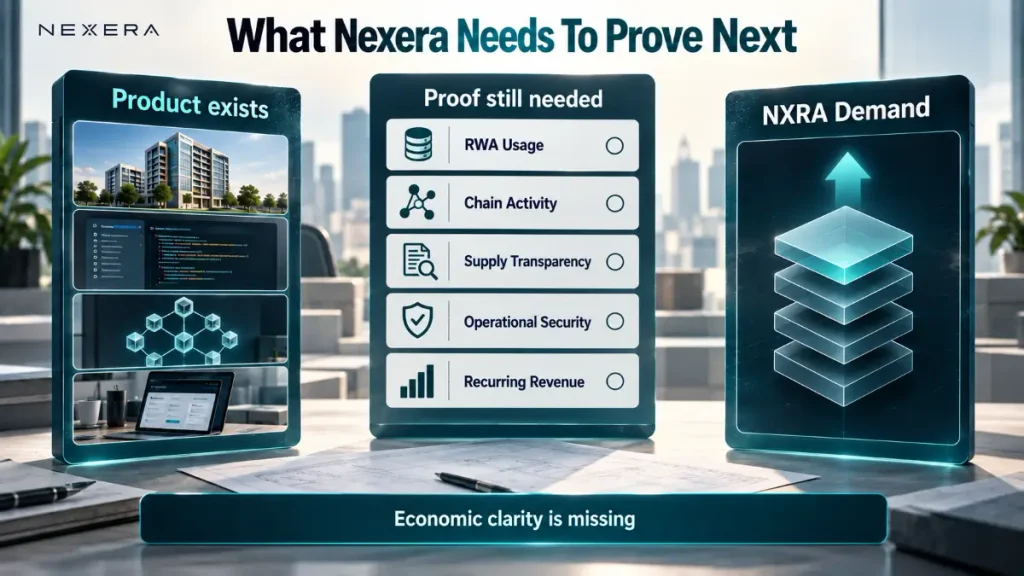
What Nexera Needs To Prove Next
The first requirement is measurable RWA usage. Nexera should make it easier to verify active issuers, tokenized value, funded sales, redemptions, secondary trading, and recurring fees. Partnership announcements are useful context, but production economics are stronger evidence.
The second requirement is current Nexera Chain activity. A live explorer should make recent blocks, daily transactions, active applications, validators, gas fees, and network revenue easy to reconcile. If the current Blockscout view is incomplete, the project should provide a clearer source.
The third requirement is NXRA value capture. Gas gives the token a direct role, and Launch staking can create locking demand. The missing piece is scale. Readers need to know how much NXRA users spend on fees, how much holders stake, how much economic activity produces MERIT benefits, and whether those mechanisms attract demand without relying on token incentives.
The fourth requirement is supply transparency. The move from an 850 million published maximum in 2023 to a current 2 billion maximum matters too much to leave to third-party market pages. A current primary tokenomics document should reconcile issuance, treasury holdings, reward schedules, mint authority, and remaining supply.
The fifth requirement is operational security. The 2024 incident showed that attackers can still reach audited systems through compromised credentials. Hardware security, multisig thresholds, upgrade controls, pause authority, and current audit scope are therefore as important as code quality.
The sixth requirement is evidence that tokenized products retain users after launch. Nexera has continued building, which is a meaningful positive. The next step is showing recurring demand rather than isolated deployments. Other tokenized-asset systems face the same distinction between launch activity and durable markets.
Nexera Review Verdict: Technology Ahead Of Token Evidence
Nexera has a technically substantial stack across tokenization and compliance infrastructure. ERC-7208 addresses a real smart-contract architecture problem by separating data from management logic. Evergon has continued receiving product updates. Nexera operates a dedicated chain environment, a compliance stack, fractionalization tools, and a Launch platform where NXRA has staking utility.
The strongest positive is continued infrastructure development. The project did not stop at a token narrative. It has built standards, contracts, product interfaces, and business-facing tools around tokenization and compliance.
The strongest limitation is economic proof. Public evidence does not yet make it easy to connect Nexera’s partnerships and product stack to recurring tokenized volume, protocol revenue, active chain demand, or sustained NXRA buying.
Tokenomics also needs better primary documentation. Current supply data contradicts the 850 million maximum published during the 2023 migration. Most currently issued NXRA appears to circulate, so current evidence does not support the claim that a large confirmed unlock is still pending. The more defensible concern is the larger 2 billion ceiling and the lack of a simple current explanation for future issuance.
Readers should judge security with the same precision. Nexera experienced a serious credential compromise in 2024, but the incident did not show that every audited contract had failed. The response also showed that administrators could pause NXRA transfers, which helped contain the incident while confirming that privileged controls matter.
Nexera therefore has a credible infrastructure thesis and an incomplete token thesis. A stronger NXRA case requires measurable chain activity, transparent supply governance, recurring tokenization economics, and evidence that product growth creates durable reasons to acquire or lock the token.
Until those links become easier to verify, Nexera’s technology is clearer than NXRA’s long-term value capture.
Frequently Asked Questions
Nexera builds blockchain infrastructure for tokenization, compliance, interoperability, identity, staking, and real-world asset markets. Its current stack includes ERC-7208, Evergon, Nexera Chain, compliance tooling, fractionalization infrastructure, and Nexera Launch.
ERC-7208 is the Nexera Standard for separating on-chain data storage from the logic that manages that data. This can make asset systems more modular, portable, and adaptable across different token interfaces and applications.
Users pay gas in NXRA on Nexera Chain and can stake NXRA on Nexera Launch to earn MERIT. Nexera also describes broader ecosystem functions around access, reputation, transactions, and governance. The economic importance of each function depends on actual usage.
Current market-data providers show a 2 billion NXRA maximum supply. Nexera’s 2023 migration documentation originally listed an 850 million maximum, so the supply framework changed materially after launch. A current primary reconciliation of that change remains an important transparency gap.
Current data does not support that claim. CoinGecko showed about 1.246 billion circulating from roughly 1.347 billion current total supply in September 2026. That means CoinGecko estimates that most currently issued NXRA already circulates. The gap to the 2 billion maximum is theoretical issuance headroom, not automatically a scheduled unlock.
Readers often confuse two different Nexera incidents. The 2023 BonqDAO exploit affected legacy ALBT and preceded the NXRA migration. In August 2024, an attacker used compromised operational credentials to transfer NXRA from Fundrs staking contracts. Nexera said the 2024 root cause was credential compromise rather than a smart-contract flaw.
Yes. Nexera maintains ERC-7208 documentation and reference implementations, Evergon, compliance and identity tooling, staking and fractionalization protocols, Nexera Launch, and Nexera Chain. What remains less transparent is the current commercial scale and the revenue those products generate.
No. A proxy contract creates upgrade and control considerations, but it is not proof of an exploitable vulnerability. Security depends on implementation, permissions, key management, upgrade controls, audit scope, and operational practices.

Founder & Managing Editor of CryptosMedia. Zahid Hussain leads evidence-based crypto research covering tokenomics, security, governance, adoption, and risk.
CryptosMedia separates verified facts from interpretation, avoids buy/sell recommendations, and updates reviews when major evidence changes.
1 thought on “Nexera Review: Can RWA Infrastructure Create NXRA Demand?”