
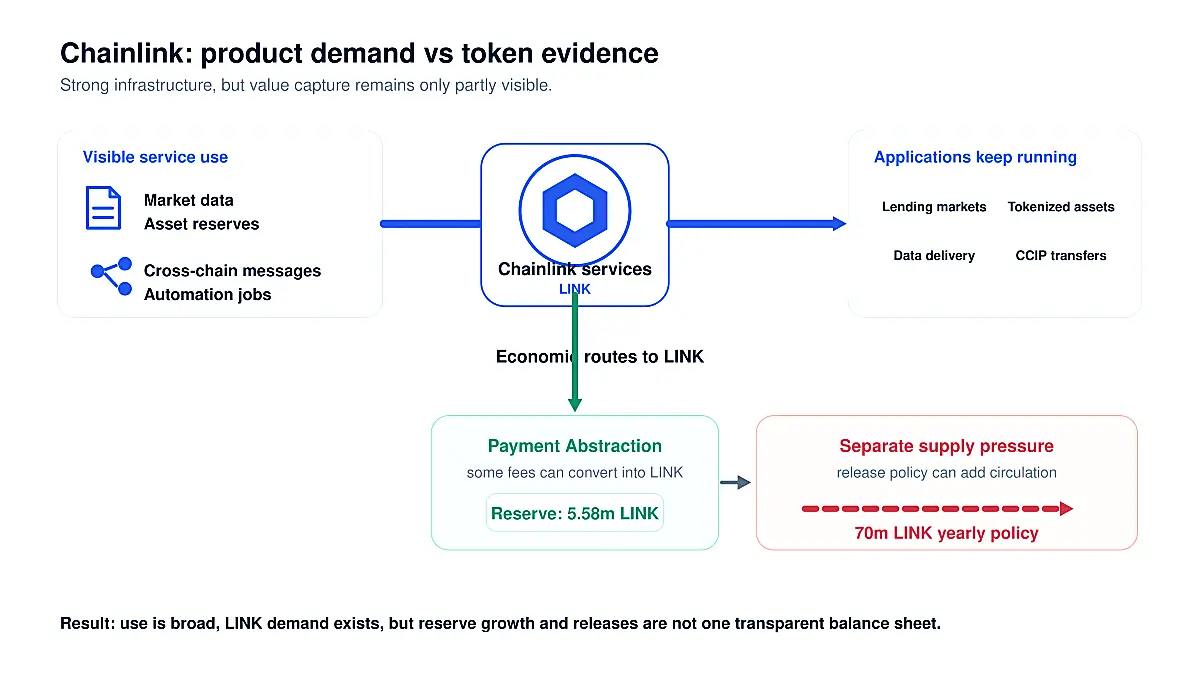
Oracle demand is easy to see. This Chainlink Review asks how much of that activity reaches LINK. Price feeds support lending markets, stablecoins, derivatives, and tokenized assets, while newer services move data and value across chains. Yet a useful network does not automatically produce a useful economic claim for its token.
This Chainlink Review follows that missing connection. It examines what customers use, how service payments can become LINK purchases, what staking actually protects, and whether Reserve growth can outweigh continuing supply releases. The evidence supports a strong infrastructure case. It does not support the simpler claim that every integration creates proportional value for holders.
More Than a Price-Feed Network
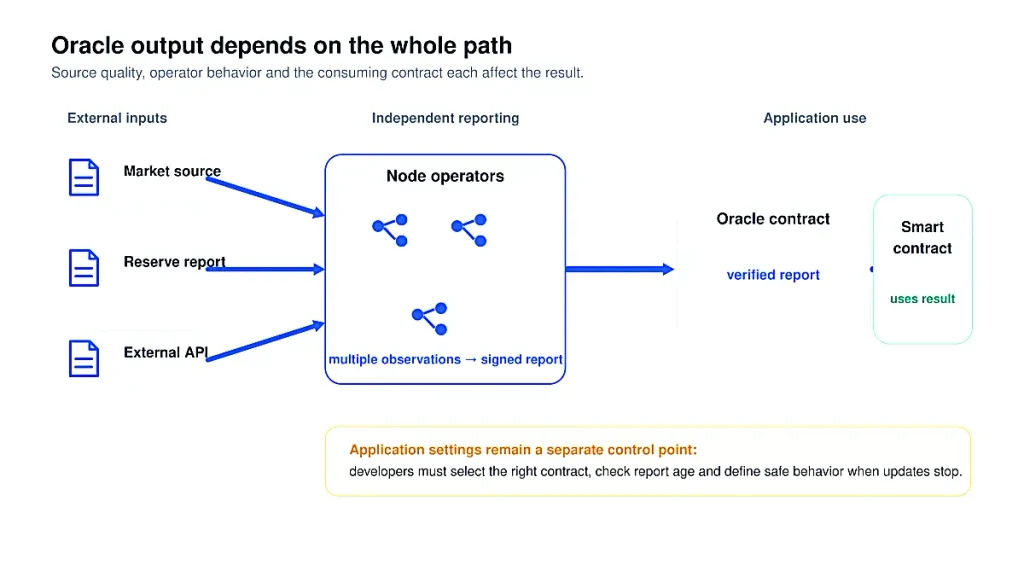
Smart contracts cannot fetch outside information by themselves. An oracle connects them to market prices, reserve reports, weather data, payment systems, or other external inputs. Chainlink usually distributes that work across data sources and node operators, then publishes a report that an application can verify and use.
Price feeds remain the best-known product, but the platform now covers several jobs. Data Streams delivers low-latency reports offchain for onchain verification. Automation triggers contract actions. Functions connects applications to external APIs and computation. Proof of Reserve supplies data about asset backing. CCIP carries messages and tokens between supported blockchains.
That range matters because adoption is not confined to one product. Chainlink’s Q2 2026 review reported $110 billion in total value secured, more than $7 billion in cross-chain token value migrated to CCIP during the quarter, and $4.90 billion in quarterly CCIP volume. These are project-reported usage measures. They are not audited revenue, profit, or money owed to LINK holders.
The distinction is central. A lending protocol may depend on a price feed while paying through an arrangement that outsiders cannot fully inspect. An enterprise may buy an offchain service without revealing its contract value. Adoption can therefore be real even when public data cannot show the margin, provider cost, or exact amount converted into LINK.
Where Service Demand Meets LINK
LINK has three visible economic roles. Service providers can receive it, selected oracle performance can be backed by staked LINK, and Payment Abstraction can convert supported fees or revenue into the token. Together, these mechanisms create demand routes. They do not create a complete financial statement.
Payment Abstraction reduces friction for customers that prefer another asset or fiat. The system can accept a supported payment, route the conversion through onchain infrastructure, and produce LINK in the background. The first live use involved Chainlink’s share of Smart Value Recapture fees. The project later expanded the model to supported onchain services and offchain enterprise revenue.
This design answers one old criticism: customers do not always need to hold LINK before using a service. It also creates a harder question. Public reporting does not reconcile gross customer payments, conversion costs, node rewards, staking rewards, operating expenses, and the amount retained in LINK across every product.
Reserve purchases are not token burns
The Chainlink Reserve stores LINK acquired through Payment Abstraction from supported revenue. Its dashboard recorded about 5.58 million LINK on 27 August 2026. That balance shows that purchases occurred, but the tokens still exist. Calling the Reserve a burn would be inaccurate.
The project said in August 2025 that it did not expect withdrawals for several years. That statement describes an expectation, not an irreversible rule. The Reserve contract includes a multi-day timelock before withdrawals, which can improve notice and review. It does not permanently remove the assets from circulation.
Reserve growth should also be compared with releases over the same period. A cumulative balance is a stock, while annual token releases are a flow. Placing the two figures side by side without matching dates can make demand look stronger or weaker than it is.
Staking Protects a Narrow Surface
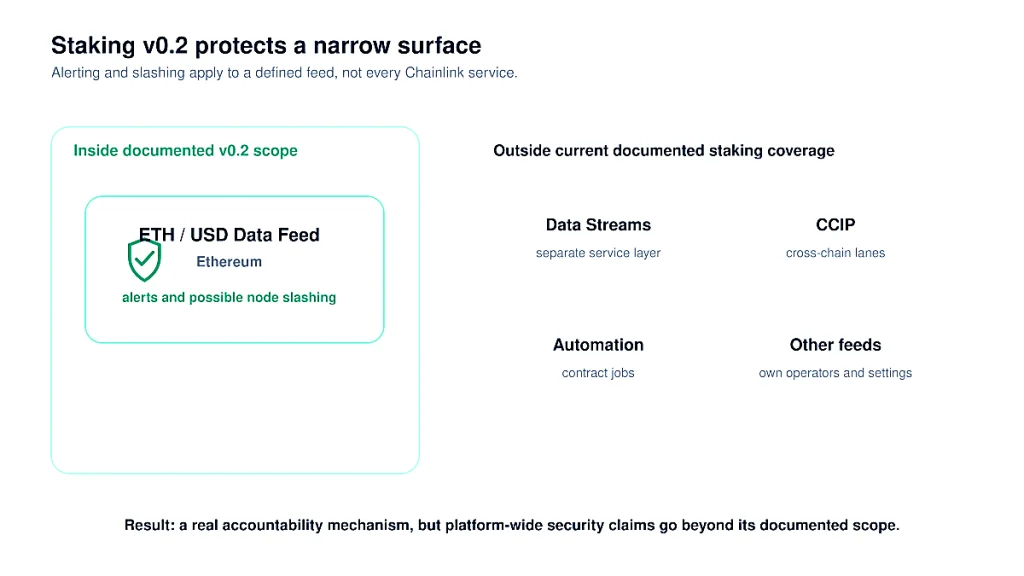
Staking v0.2 has a 45 million LINK cap. Community stakers received 40.875 million of that capacity, with the remainder allocated to eligible node operators. The design adds alerting and possible slashing, but its documented launch scope focuses on the ETH/USD Data Feed on Ethereum.
A valid alert can follow more than three hours without a valid report from that feed. In the documented launch design, each in-scope node-operator staker can lose 700 LINK, while a valid alerter can receive 7,000 LINK. Community stake is not slashable in v0.2.
Those conditions create accountability for a defined failure. They do not insure every price feed, Data Stream, Automation job, CCIP lane, or enterprise workflow. Chainlink describes broader coverage as a possible future upgrade. Until that expansion is live and documented, platform-wide staking claims overstate the mechanism.
Rewards need the same care. A staking return may include emissions rather than fees paid by customers. The long-term economic test is whether external service revenue can support security costs without relying heavily on unreleased tokens.
LINK Supply Keeps the Test Open
LINK has a fixed maximum of one billion tokens. The official circulating-supply page states that the current release schedule equals 7% of total supply each year. Its API reported 748,099,970.42 circulating LINK on 28 August 2026, leaving roughly 251.90 million outside circulation.
| Metric | Verified position | Practical meaning |
|---|---|---|
| Maximum supply | 1 billion LINK | The cap is fixed, but not all tokens circulate yet. |
| Circulating supply | About 748.10 million on 28 August 2026 | Roughly three quarters of the cap was circulating. |
| Current release policy | 70 million LINK a year | New circulation can create supply pressure without raising the maximum. |
| Staking v0.2 cap | 45 million LINK | Deposits can reduce liquid supply, but security coverage remains narrow. |
| Reserve balance | About 5.58 million LINK on 27 August 2026 | Purchases create demand, but the holdings are not burned. |
| Holder governance | No documented broad platform-wide vote | Official material reviewed does not give LINK holders shareholder rights or control over every service. |
A fixed cap prevents unlimited issuance. It does not prevent dilution before full circulation. At the stated pace, 70 million LINK may enter circulation in a year. To judge offsetting demand, analysts need Reserve purchases and staking changes measured across that same period.
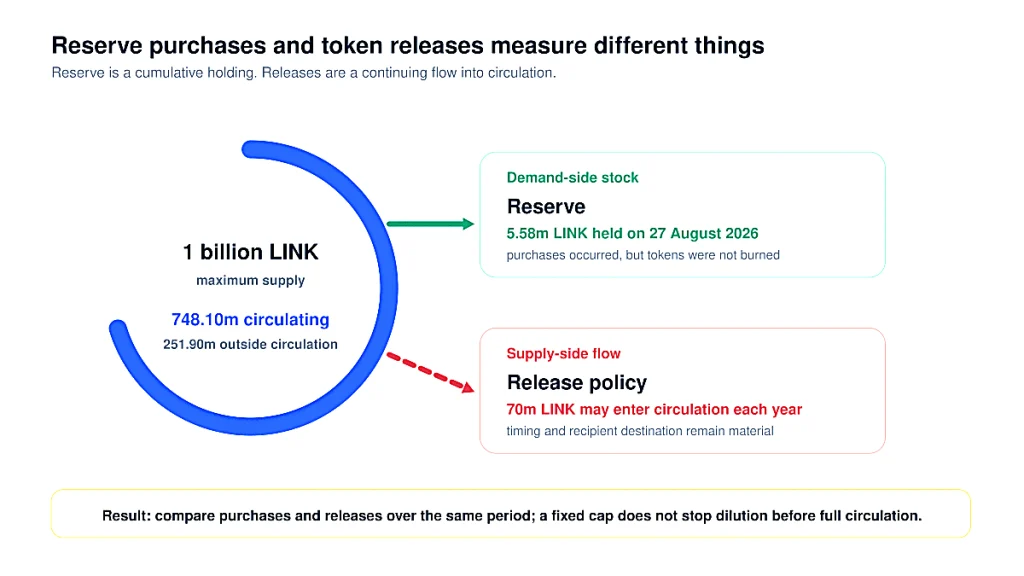
That comparison does not prove that released tokens will be sold. Some may fund node incentives, ecosystem activity, or long-term operations. The transparency gap lies in timing and destination. Public wallets identify non-circulating supply, but they do not provide a complete recipient-by-recipient forward schedule that readers can use to model market impact.
Decentralization Depends on the Exact Service
The phrase ‘decentralized oracle network’ can hide important differences. There is no single operator set or contract that protects every Chainlink product. Feed composition, data sources, update rules, and administrative permissions vary by asset, blockchain, and service.
A market feed can aggregate information at several levels. Data providers collect prices, node operators calculate observations, and an oracle contract combines signed reports. This reduces dependence on one exchange or server. It cannot eliminate thin markets, poor source coverage, stale values, or mistakes in the application that consumes the feed.
Developers still need to select the correct contract, check the report’s age, understand heartbeat and deviation settings, and define safe behavior when updates stop. Oracle quality is partly a network question and partly an integration question.
Push and pull models move responsibility
Traditional Data Feeds publish onchain when price deviation or time thresholds trigger an update. Data Streams takes a pull-style route, delivering frequent signed reports offchain for verification when an application needs them. The first model keeps a shared onchain value available. The second can support lower latency, but the application must manage retrieval, report age, ordering, and verification.
Pyth emphasizes first-party publisher data and supports pull and push delivery. Its design gives consuming applications different update duties, as explained in our Pyth Network review. Neither approach is automatically safer. The better fit depends on market speed, update cost, source quality, and the application’s failure controls.
CCIP Extends Utility and Consequence
CCIP moves the platform beyond reporting data. It carries messages and tokens between blockchains through supported lanes. That expands the addressable market, but a cross-chain instruction can have a larger consequence than a stale display value.
Each route introduces assumptions about source-chain finality, destination contracts, token pools, rate limits, oracle reports, and administrative intervention. Our Axelar token review shows a different cross-chain trust model, where validator and gateway design shape the risk.
Rate limits can contain losses, and emergency controls can stop activity. Those protections also create roles with meaningful authority. A proper review asks who can change limits, pause a lane, upgrade contracts, or control a token pool. It also checks whether the consuming application handles delayed, duplicated, or failed messages safely.
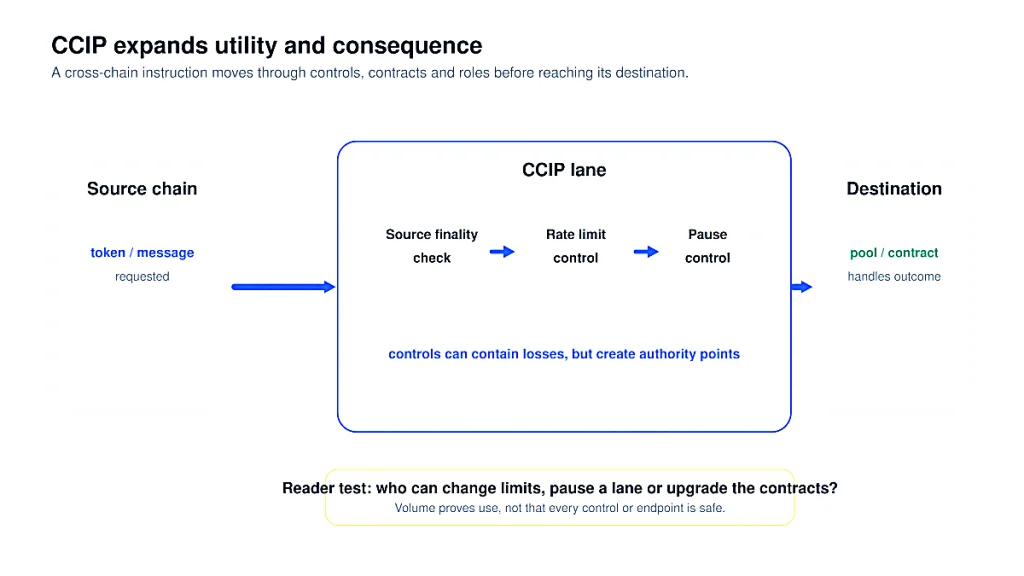
Volume cannot answer those questions. It proves that users moved value, not that the route was profitable or impossible to exploit. The endpoint and application design discussed in our LayerZero ZRO review offers another example of how interoperability systems divide responsibility differently.
Competition Is Not One Leaderboard
Oracle comparisons often collapse several problems into a single ranking. Data sourcing, delivery, cross-chain messaging, automation, token economics, and governance need separate tests.
Chainlink offers the broadest product set of the three systems considered here. Pyth has a sharper identity around financial data from approved first-party publishers. Supra combines push and pull oracle services with its own Layer-1, automation, and broader execution stack. That vertical model creates a different set of validator and ecosystem assumptions, covered in our Supra oracle review.
Breadth gives Chainlink more ways to win customers. It also makes a universal security or revenue claim less meaningful. Evidence from one service should not be used to certify another service with different operators, contracts, permissions, and failure modes.
Audits and Certifications Have Boundaries
Chainlink components have undergone professional audits and competitive reviews. Staking v0.2 received multiple assessments, and Payment Abstraction went through private audits and public competition. Chainlink Labs also reports a SOC 2 Type 2 examination covering CCIP and Data Feeds, including Price Feeds and Proof of Reserve.
Its security page listed the ISO 27001 certificate as expired on 24 June 2026, with recertification in progress when checked on 28 August. That is a status detail, not proof that the products became insecure on the expiry date.
An audit examines defined code at a point in time. It may not cover later upgrades, node operations, source quality, user interfaces, third-party integrations, or every deployment. SOC 2 evaluates specified controls and their operation. Neither form of assurance guarantees that the whole platform cannot fail.
What Would Make the Economics Easier to Judge
Four disclosures would close the largest gaps:
- Revenue, provider costs, and margins separated by service.
- A forward schedule showing the purpose and recipients of planned token releases.
- Reserve reporting that reconciles deposits, conversion costs, distributions, and withdrawals by period.
- A service-by-service staking map with exact alerting, slashing, and administrative conditions.
None would remove technical or market risk. They would let readers compare adoption, token demand, security expense, and new supply in compatible units.
Chainlink Review Verdict: Product Leads the Token Evidence
Chainlink solves a real infrastructure problem and serves more use cases than the label ‘price oracle’ suggests. Its reported adoption, expanding cross-chain activity, Payment Abstraction, and Reserve give LINK an economic role that many utility tokens lack.
The missing evidence sits between usage and holder outcomes. Public material does not reveal complete service-level economics. Reserve holdings remain movable tokens, staking protects a limited surface, and 70 million LINK can enter circulation each year under the current policy. Official material reviewed does not describe a broad platform-wide holder vote.
The result is not a verdict against the network. It is a boundary around what the evidence can prove. Product demand is visible. LINK demand exists through payments, staking, and Reserve purchases. The size, durability, and net effect of that demand remain harder to measure than the adoption headlines.
Frequently Asked Questions
Not always as the asset a customer submits. Payment Abstraction can accept supported alternative assets or fiat and convert the payment into LINK. Public reporting does not show the full conversion path and economics for every service.
No. Staking v0.2 documents a 45 million LINK cap and launch coverage tied to the ETH/USD Data Feed on Ethereum. Broader coverage remains a future expansion goal unless later documentation confirms a live change.
No. It can create market demand by acquiring LINK, but the tokens remain in existence. A burn would permanently destroy them.
The clearest measurable pressure is the current annual release policy, equal to 7% of maximum supply. The harder unknown is how future releases, Reserve purchases, staking deposits, provider rewards, and customer revenue interact over the same period.

Founder & Managing Editor of CryptosMedia. Zahid Hussain leads evidence-based crypto research covering tokenomics, security, governance, adoption, and risk.
CryptosMedia separates verified facts from interpretation, avoids buy/sell recommendations, and updates reviews when major evidence changes.
5 thoughts on “Chainlink Review: Does Oracle Demand Reach LINK?”