
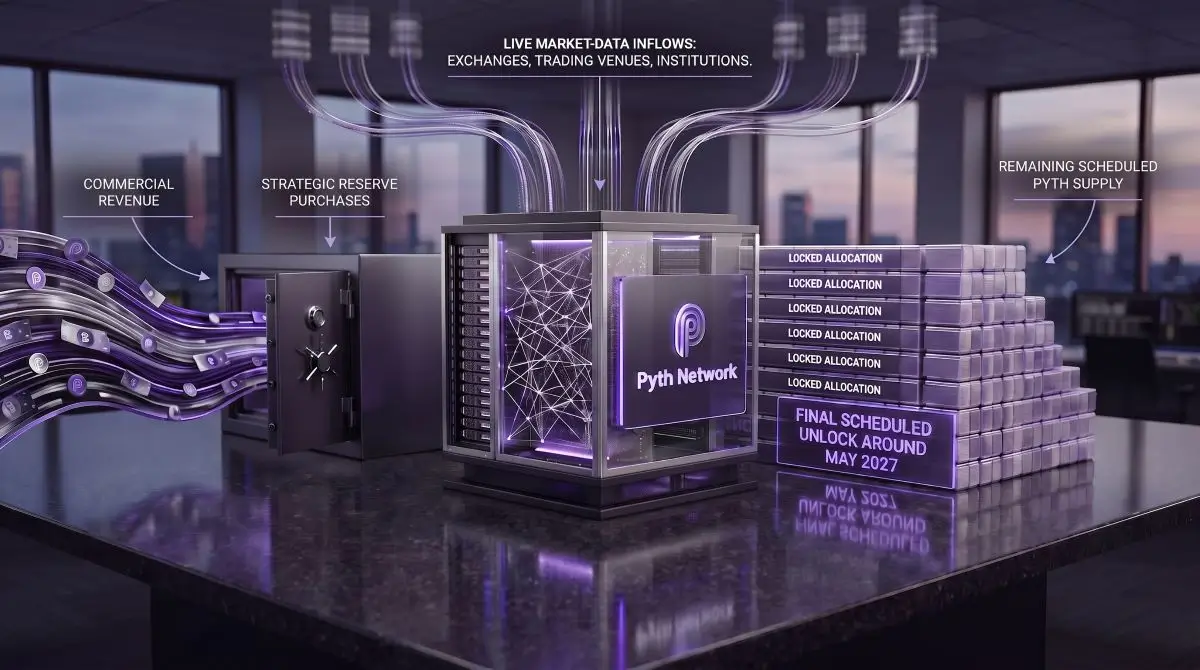
Oracle risk starts before a smart contract reads a number. Someone must collect market prices, reconcile disagreement, sign the result and deliver it fast enough for an application to trust. Pyth rebuilt much of that path in August 2026, while its commercial products began producing measurable revenue. This Pyth Network Review asks whether those changes strengthen PYTH itself or mainly strengthen the data business around it.
That distinction matters because the token now sits between several different forces. Pyth Pro brings paid data revenue. The DAO buys PYTH through a strategic reserve. Oracle Integrity Staking still exposes assigned stake to slashing. At the same time, 7.875 billion tokens circulate from a 10 billion maximum, and one final scheduled unlock remains.
Core Now Uses a Five-Router Quorum
Pyth distributes market data from publishers that include exchanges, trading firms and other financial institutions. Its public site reported more than 138 publishers and more than 3,000 price feeds at the start of September 2026. Those numbers show network breadth, but they remain project-reported metrics.
The larger change sits underneath the feeds.
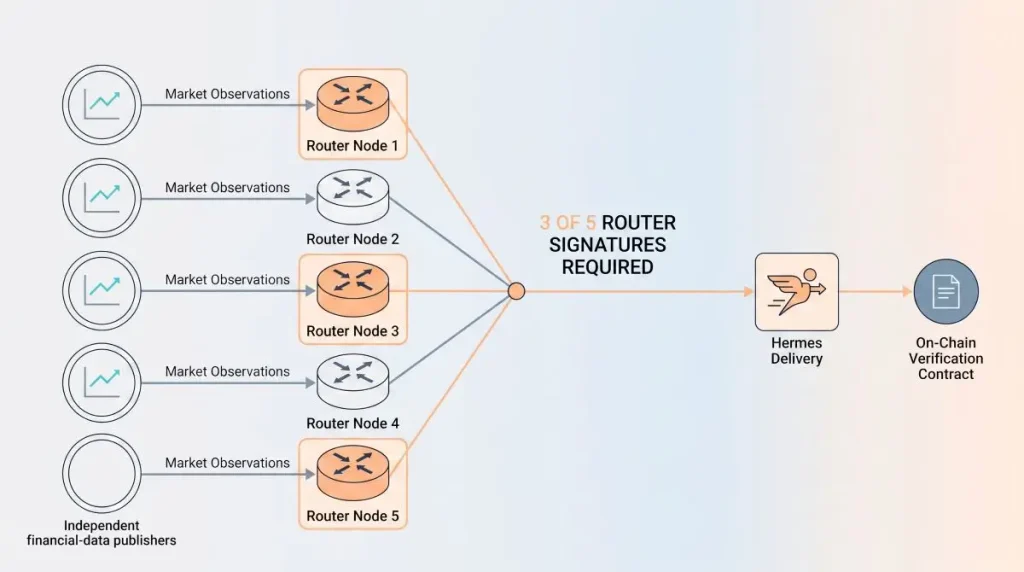
Pyth completed its Core upgrade on 26 August 2026. The new design replaced the legacy Pythnet and Wormhole signing path with five routers that independently compute aggregates and sign Merkle roots. On-chain contracts accept an update when at least three routers satisfy the quorum and the Merkle proof matches the requested price.
The post-upgrade Core architecture preserves the familiar contract interface and Hermes API while changing how the data reaches that interface. Most existing integrations avoided a complete application rewrite, although Hermes now requires an API key. Sui followed a separate manual upgrade path.
This migration changes the failure model rather than removing it.
The old route depended on Pythnet plus a 13-of-19 Wormhole guardian quorum. The new route depends on a three-of-five router quorum, Hermes delivery and the verification contract on the destination chain. Five operators can simplify coordination and reduce latency, but a smaller signing set also makes operator independence and correlated infrastructure failure more important questions.
Pyth describes the routers as independently operated. Users still need evidence about how independent their hosting, software operations and organizational control remain in practice.
Pull and Push Describe Delivery, Not Overall Safety
Pyth built its reputation around a pull-oracle model. An application can fetch a recent signed update from Hermes and submit that data on-chain only when it needs a price.
That design avoids paying to write every feed continuously to every supported chain.
Pyth also supports push-style consumption. The Pyth Data Association sponsors updates for selected feeds, and applications can run a Price Pusher that posts updates according to heartbeat or price-deviation rules.
So ‘pull versus push’ no longer gives a complete oracle comparison.
Our oracle delivery trade-offs review shows the same problem from another direction. Modern oracle systems can offer several delivery modes, while the real differences sit in aggregation, signer control, update conditions, verification and failure recovery.
A push feed can become stale. A pull integration can submit old data if the application sets weak freshness rules. Delivery style changes who triggers the update, not whether every dependency behaves correctly.
Upgraded Core Now Uses Pyth Pro Infrastructure
The upgraded Core interface still serves applications that need verifiable on-chain price data, while Pyth Pro offers lower-latency market data for institutional and advanced trading workflows. They are different consumption paths, but no longer separate underlying stacks: Pyth says upgraded Core leverages Pyth Pro architecture while preserving the Core contract and Hermes interfaces.
The distinction matters because marketing language around ‘1 millisecond’ can blur product boundaries.
Pyth Pro offers fixed-rate channels at 1 millisecond, 50 milliseconds, 200 milliseconds and 1 second, plus a real-time channel. A 1 millisecond channel describes the update schedule. It does not guarantee that every publisher observation reaches every customer with one millisecond of end-to-end latency.
Network transport, publisher timing, processing and the consuming application still add delay.
Confidence data also needs careful interpretation. Pyth’s confidence value reflects uncertainty or disagreement among contributing publishers around the aggregate price. It can widen during volatile markets, but it does not represent a fixed probability of loss or a guaranteed liquidation buffer.
Applications can also inspect publisher count and freshness timestamps. Those fields matter because a narrow confidence interval carries less meaning when too few publishers contribute fresh data.
| Component | Main role | Main dependency | What the feature does not prove |
|---|---|---|---|
| Pyth Core | Verifiable on-chain price delivery | Three-of-five router quorum, Hermes and target-chain contracts | That every router is operationally independent |
| Pyth Pro | Paid low-latency market data | Publisher coverage, network delivery and customer infrastructure | Universal one-millisecond end-to-end latency |
| Push feeds | Keep selected on-chain prices updated | Sponsored or application-run updater availability | That every feed stays fresh under all conditions |
| Confidence data | Shows dispersion around the aggregate price | Fresh publisher observations and adequate contributor count | A direct forecast of market volatility or loss |
| OIS | Adds staking and slashing around publisher accountability | Assigned stake and functioning slashing rules | Security for every router, API or consumer contract |
The table shows why Pyth needs more than one security label. Core, Pro, push infrastructure and OIS solve different problems.
Institutional Use Is Real, but Revenue Needs Its Own Evidence
Pyth has expanded far beyond its Solana origins.
Its public network pages reported 138-plus publishers and more than 3,000 feeds across crypto, equities, commodities, rates and other markets. An April 2026 KPI snapshot also listed 114 connected blockchains.
These figures demonstrate reach. They do not show how many integrations pay for data or how much revenue each product creates.
Kalshi provides a more concrete production example. In April 2026, the CFTC-regulated prediction market selected Pyth as a resolution source for commodity markets covering assets such as gold, silver, crude oil, natural gas, copper, corn, soybeans and wheat. Pyth Pro also supplies market data to Kalshi market makers.
That integration proves a real use case. It does not prove that every Pyth feed has institutional demand.
A different oracle control model also shows why market coverage should not become a speed leaderboard. Publisher selection, validator or signer control, automation and governance can create different failure paths even when two products deliver similar data.
Pyth Network Review: Revenue Is Now Measurable
Pyth’s strongest 2026 economic improvement comes from commercial reporting rather than integration counts.
DAO reporting for July listed $562,557 in gross revenue across Pyth Pro, Listing as a Service and index revenue sharing. The same report allocated $340,384 to the DAO and delivered that value as 7,662,509 PYTH using the July monthly price calculation.
Cumulative gross revenue since September 2025 reached about $2.50 million by the end of July, while the DAO share reached roughly $1.52 million.
These numbers matter because they measure reported commercial flows.
They still need boundaries. The DAO and operator published the figures, an audited consolidated financial statement did not. Gross revenue also differs from profit, and a PYTH-denominated distribution to the DAO does not create a cash dividend for token holders.
Revenue can strengthen the treasury without automatically strengthening every holder’s claim.
Strategic Reserve Purchases Create Demand, Not Burns
The Pyth DAO created a strategic reserve in December 2025 and authorized recurring open-market PYTH purchases under defined treasury rules.
June reporting recorded about 1.80 million PYTH returned to the DAO treasury after purchases. July reporting recorded about 1.14 million PYTH, while the August report published on 2 September recorded about 669,662 PYTH.
Those transactions create buy-side demand when the council executes them.
The acquired tokens still exist.
That difference matters because a reserve and a burn have different supply effects. A burn permanently removes tokens from circulation. A treasury purchase transfers ownership to the DAO unless governance later destroys or otherwise locks those tokens under stronger rules.
The reserve therefore creates a link between protocol revenue and PYTH demand, but governance controls the next step.
Analysts should also avoid double counting. Revenue distributions, treasury balances and reserve purchases can belong to the same economic flow. Treating each one as independent value creation would exaggerate the mechanism.
OIS Still Slashes Even Though Rewards Stopped
Oracle Integrity Staking changed materially on 22 April 2026.
Governance set the OIS reward rate to zero, so the protocol no longer distributes OIS rewards. Staking and slashing remain active, and delegators can still withdraw assigned stake. Governance staking follows a separate system.
OIS did not disappear. It changed from a rewarded accountability mechanism into one where assigned stake can still face slashing without the previous reward stream.
The staking-security distinction matters here. Staking participation, economic penalties and token-holder value capture answer different questions.
A slashing rule can discourage some bad behavior. It cannot prove that Hermes will stay online, that router operators will remain independent, or that an application will reject stale data.
OIS therefore supports one part of Pyth’s integrity model rather than the entire oracle stack.
PYTH Still Has One Large Supply Step Ahead
PYTH uses a fixed 10 billion maximum supply. The launch placed 1.5 billion tokens, or 15%, into circulation in November 2023. The remaining locked supply follows scheduled releases at 6, 18, 30 and 42 months after launch.
The official PYTH distribution schedule remains the cleanest reference for those tranches.
The 30-month unlock already occurred in May 2026. A 1 September 2026 snapshot showed about 7.875 billion PYTH circulating, leaving roughly 2.125 billion outside tracker-defined circulation. The final 42-month stage falls around May 2027 under the published schedule.
An unlock does not prove selling.
It changes how much supply can enter circulation. Wallet behavior, treasury transfers and market sales require separate evidence.
| Allocation | Share of maximum supply | Main supply consideration |
|---|---|---|
| Ecosystem Growth | 52% | Largest allocation and a major source of scheduled supply |
| Publisher Rewards | 22% | Supports data-provider and incentive programs |
| Protocol Development | 10% | Funds contributors and development |
| Private Sales | 10% | Investor allocation subject to the published lock schedule |
| Community and Launch | 6% | Launch allocation with no later vesting cliff |
The reserve does not cancel the remaining unlock automatically.
Recent monthly purchases ranged from about 0.67 million to 1.80 million PYTH from June through August. These monthly purchase flows should not be compared one-for-one with the 2.125 billion PYTH remaining outside circulation. A fair test needs cumulative reserve purchases, actual sales or transfers from each unlock tranche, and matching time periods.
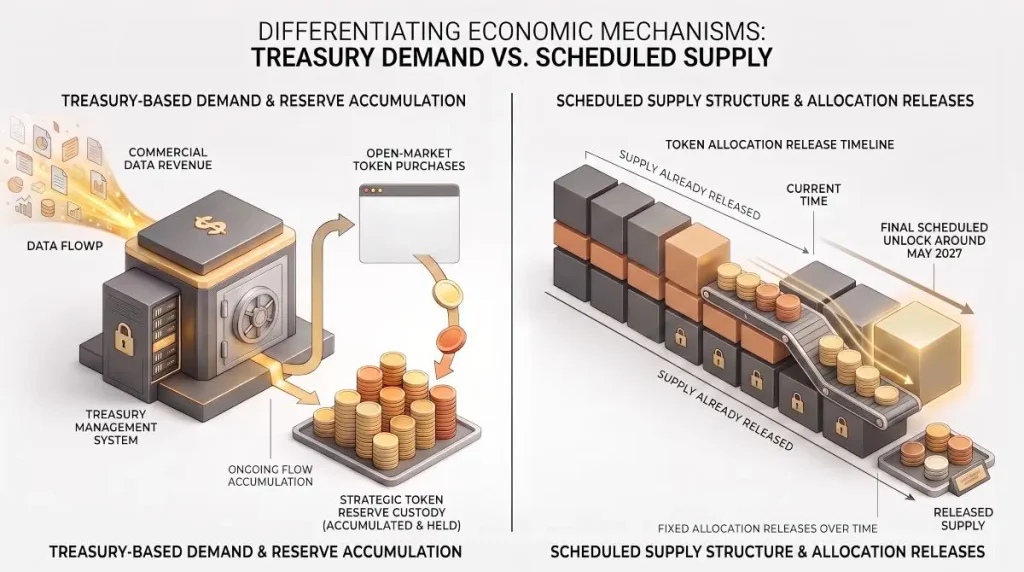
The same fixed-cap dilution problem appears across many token systems. A fixed maximum limits the eventual supply, but it does not remove dilution while scheduled allocations continue entering circulation.
Security Now Depends on Routers, Delivery and Consumer Rules
The August upgrade removed one major dependency and introduced another.
Pyth Core no longer relies on the legacy Wormhole guardian quorum for the upgraded path. Instead, five routers create signed aggregates and three signatures satisfy the quorum.
That can reduce complexity in one part of the stack. It also concentrates critical signing work into a smaller set.
The protocol therefore needs evidence on router independence, uptime and correlated failure.
Delivery matters as well. Hermes acts as the main API layer for Core consumers, and authentication became mandatory with the upgrade. Applications that depend on Hermes availability should plan for endpoint failures and stale data.
Pyth Pro’s 2026 incident history shows why operational scope matters.
On 14 August, a Pyth Pro API and WebSocket incident produced no prices during the affected window. On 29 July, an infrastructure-provider problem caused delayed updates, HTTP failures and WebSocket disconnections for roughly 39 minutes.
Those incidents affected Pyth Pro.
They do not prove that every Pyth Core contract stopped producing usable prices at the same time.
The distinction prevents an availability incident in one product from becoming a blanket security claim about the whole network.
Consumer applications carry responsibility too. Freshness checks, publisher counts and confidence thresholds only help when developers use them correctly.
Public Audit Coverage Needs Version Matching
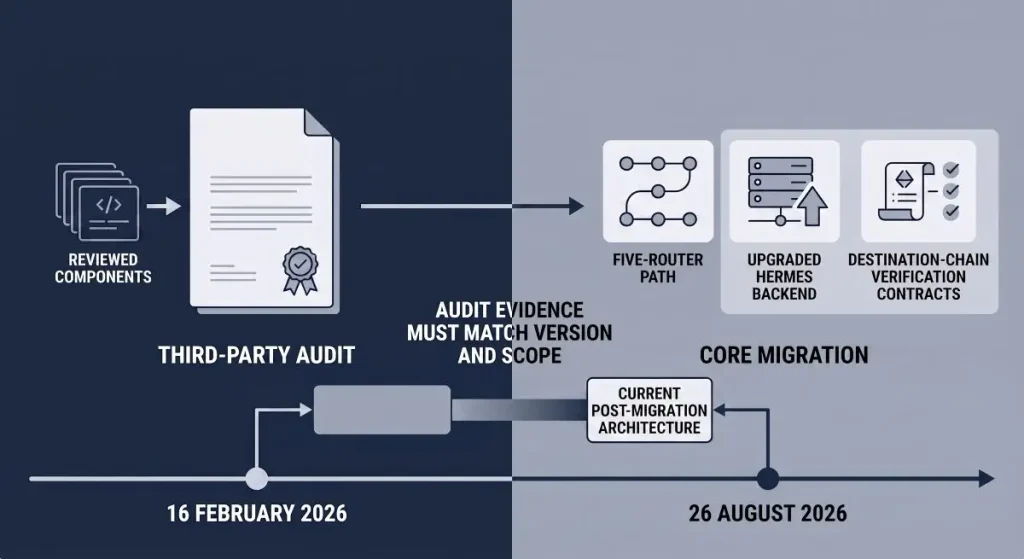
Pyth maintains a public repository of third-party audit reports and a bug bounty. The newest report listed in that repository is dated 16 February 2026, months before the 26 August Core migration.
That timing does not show that the upgraded system is unaudited. It means readers should verify the scope, commit and component covered by each report before applying older audit evidence to the five-router path, upgraded Hermes backend or current destination-chain contracts.
Governance Holds Real Operational Power
PYTH gives holders governance rights, but governance does more than debate abstract policy.
The Pyth DAO elects councils and votes on treasury and constitutional matters. An eight-member Pythian Council can execute delegated actions that include oracle-program upgrades, verification-program upgrades and network fee settings.
The DAO also uses council-controlled operational multisigs for reserve purchases and other approved actions.
This structure separates approval from execution.
The DAO can define parameters, while the council performs actions within those parameters. That arrangement improves operational speed, but it also makes council composition, multisig controls and delegated scope part of the decentralization analysis.
Commercial revenue does not bypass governance.
The DAO decides how treasury assets support reserves or other programs, and future votes can change those rules. PYTH therefore has genuine governance utility, but token holders do not receive an automatic contractual claim on Pyth Pro revenue.
What Would Strengthen the PYTH Case?
Pyth now has enough evidence to show that institutions will pay for at least some of its data products.
The next test concerns scale and persistence.
Paid revenue should continue growing across several reporting periods. Reserve purchases should reconcile cleanly with treasury funding. Router uptime should remain strong after the Core migration. OIS data should show how much stake remains assigned after rewards ended.
The final unlock also needs to sit in the same frame.
A rising reserve can improve treasury alignment while a large scheduled tranche still expands available supply. Neither number should appear alone.
Security evidence needs similar discipline. Audit claims should map to current routers, Hermes, verification contracts and supported chain versions rather than relying on one generic ‘audited’ label.
Verdict: Commercial Revenue Is Clearer, but PYTH Demand Still Needs Proof
Pyth has built a stronger business case than its old ‘fast Solana oracle’ label suggests.
The Core upgrade moved price aggregation onto a five-router architecture, Pyth Pro sells low-latency data, and regulated or institutional users provide credible evidence of real demand. Commercial reporting now gives readers revenue figures instead of forcing them to infer economics from integrations or total value secured.
PYTH captures part of that progress through governance, staking accountability and treasury purchases.
Strategic Reserve purchases create market demand but do not burn tokens. OIS rewards have ended even though slashing remains. About 2.125 billion PYTH still sits outside current circulation, with the final scheduled unlock around May 2027.
The five-router design also needs time in production. Lower latency and simpler routing do not prove operational independence or eliminate API risk.
Pyth therefore has a clearer commercial-revenue mechanism than it did a year ago, but the link from revenue to long-term PYTH demand remains indirect while scheduled supply continues to unlock.
The strongest future case would combine sustained paid revenue, reliable post-upgrade operation, transparent reserve accounting and supply absorption that does not depend on promotional assumptions.
Frequently Asked Questions
Pyth Core still supports the pull model that lets applications fetch and submit recent signed updates when needed. Pyth also provides push feeds and Price Pusher tooling for applications that want regular on-chain updates.
No. Pyth Pro offers a fixed-rate one-millisecond update channel. That describes update frequency, not guaranteed end-to-end delivery latency for every publisher, network path and customer.
No. OIS rewards dropped to zero in April 2026, but staking and slashing remain active. Governance staking operates separately.
No. The DAO buys PYTH on the open market and returns the acquired tokens to its treasury. Those purchases create demand, but the tokens continue to exist unless governance later removes them permanently.
The 30-month unlock occurred in May 2026. The published 42-month schedule places the final major tranche around May 2027.
No. The confidence value reflects uncertainty or disagreement around the aggregate publisher price. Applications should evaluate it alongside freshness and publisher-count information rather than treating it as a direct forecast of volatility or loss.

Founder & Managing Editor of CryptosMedia. Zahid Hussain leads evidence-based crypto research covering tokenomics, security, governance, adoption, and risk.
CryptosMedia separates verified facts from interpretation, avoids buy/sell recommendations, and updates reviews when major evidence changes.
5 thoughts on “Pyth Network Review: Can Revenue Offset PYTH Unlocks?”