
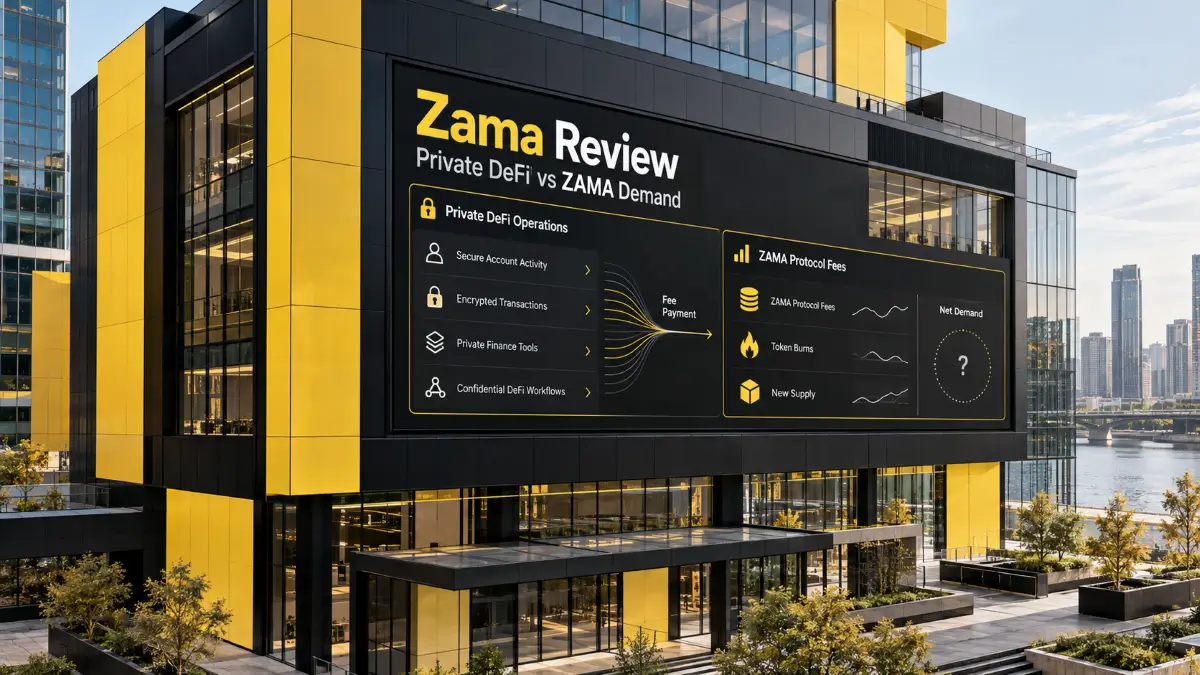
Zama brings confidential computation to applications on public blockchains. Its technology allows developers to process selected financial information without exposing the underlying data to everyone watching the chain. That capability has practical uses in payments, trading and asset management, but demand for private financial services does not automatically create lasting demand for ZAMA, the protocol’s token.
Zama has introduced confidential yield vaults built around Morpho infrastructure and a confidential swap service on Ethereum. Its token also has a defined economic role. Applications pay specified protocol fees in ZAMA, the protocol burns those fee tokens, and newly minted ZAMA rewards operators and stakers who support the network.
The relationship between these activities matters more than any single adoption milestone. Vault deposits are not protocol revenue, a published buyback policy is not a record of completed purchases, and staking does not permanently remove tokens from supply. This review examines where confidential-finance activity reaches ZAMA, where the connection remains indirect, and what evidence would establish a lasting economic effect.
Zama Adds Confidentiality to Existing Blockchains
Zama provides infrastructure for applications that need to process encrypted information on public blockchains. It is not a separate general-purpose Layer 1 that requires every application to leave Ethereum or another supported host chain.
The protocol uses fully homomorphic encryption, or FHE. This technology allows supported calculations to take place on encrypted values without requiring the computing service to read the underlying information first.
Consider a token transfer. A conventional public contract usually exposes balances and transfer amounts. A confidential application can instead check whether the sender has sufficient funds and update the relevant balances while keeping selected values encrypted.
This capability matters for businesses and individuals who want programmable financial transactions without revealing every position, payment amount or trading decision. It does not make an entire application anonymous. Addresses, transaction timing, interactions with other contracts and information disclosed outside encrypted fields may still reveal aspects of a user’s activity.
Why encrypted computation needs additional infrastructure
Ordinary blockchain execution cannot efficiently perform every substantial FHE calculation on its own. Zama divides confidential processing among host-chain contracts, specialized coprocessors, a Gateway and a threshold Key Management Service, or KMS.
Host-chain contracts register operations and enforce permissions. Coprocessors perform encrypted calculations, while the Gateway coordinates requests and responses. KMS participants support authorized decryption without placing the complete decryption key with one ordinary operator.
The official protocol documentation explains these components and their respective roles. Their separation allows applications to use confidential computation alongside existing blockchain infrastructure, although it creates operational dependencies that ordinary token transfers may not have.
A confidential application needs its contracts, permissions, computation services and decryption processes to work correctly together. Strong encryption cannot compensate for a contract that grants the wrong party permission to access sensitive data.

Confidential balances differ from hidden trading intent
Privacy can refer to several different features. A trading venue might conceal an order until execution, while a confidential token contract can protect selected account balances and transfer amounts. These are different protections with different limits.
An application that hides order intent may still expose positions or settlement information. Conversely, encrypting balances does not guarantee a trader receives a competitive quote or avoids poor execution.
Zama’s value proposition rests on allowing developers to process protected financial information. Whether that capability attracts recurring paying customers is a separate commercial question.
What the Confidential DeFi Launches Actually Demonstrate
Zama used confidential computation in its January 2026 public token auction. Participants could submit bids through an encrypted process, demonstrating that the technology could support a financial application with real assets at stake.
The auction was also part of ZAMA’s own distribution. Interest in buying a new token cannot establish recurring customer demand for the protocol’s broader services. A more useful test is whether people continue using confidential applications after a launch or incentive campaign ends.
Zama introduced its first confidential USDC yield vault in June 2026. The product added a confidential deposit interface to an existing lending strategy curated by Steakhouse Financial using Morpho lending infrastructure .
The distinction matters because confidentiality does not replace the underlying lending market. Depositors still depend on the strategy’s assets, collateral rules, liquidity and smart contracts. Zama adds a way to protect selected information about their positions.
Sixteen vaults broaden the available use cases
On September 15, 2026, Zama announced confidential access to 16 Morpho vaults across several assets and curators. Twelve provided confidential access to existing Ethereum strategies, while four had been created specifically for confidential deposits.
The expansion included strategies involving stablecoins, Bitcoin-linked assets and tokenized financial products. It gave users more ways to obtain confidential exposure without requiring the underlying lending strategies to migrate to a separate blockchain.
Independent coverage of the launch also reported Zama’s claim that its first vault had attracted more than $40 million in shielded total value locked within seven weeks.
That figure describes deposits reported for one product over a particular period. It is not the protocol’s revenue, the amount spent on ZAMA or the value of tokens removed through burns. Depositors retain economic exposure to the underlying financial strategy.
Deposits and fee-paying activity answer different questions
A vault can hold substantial assets while generating relatively few billable confidentiality operations. A smaller payment application might process frequent transactions and generate more fees. Neither outcome can be inferred from the total value deposited.
A useful adoption assessment needs to distinguish the assets held through a confidential interface from the number of repeat users and the services for which someone actually pays. It should also identify whether the application or a promotional program subsidizes those fees.
Confidential rewards provide another example. Zama announced a Merkl integration in September to distribute incentives through confidential tokens. That addresses a practical problem because public reward claims can reveal information about positions that users intended to keep private.
The integration adds functionality, but an incentive distributed to a vault user is not automatically income for the Zama Protocol. Its economic effect on ZAMA depends on the relevant fees and token mechanisms.
| Adoption Evidence | What It Demonstrates | What It Does Not Establish |
|---|---|---|
| January token auction | Encrypted bidding in a production application | Recurring demand from independent applications |
| First confidential vault | Deposits into a confidential financial product | Equivalent ZAMA purchases or protocol revenue |
| Sixteen Morpho vaults | More assets and strategies available through confidential interfaces | Sustained fee-paying activity across every vault |
| Confidential reward distributions | A way to reduce information leakage from incentive claims | Net token demand after incentives and emissions |
The adoption evidence supports a narrower conclusion than the headline deposit figures might suggest. Zama has functioning products and additional ways for users to access them. The resulting demand for its token still needs separate measurement.
How Paid Protocol Activity Reaches ZAMA
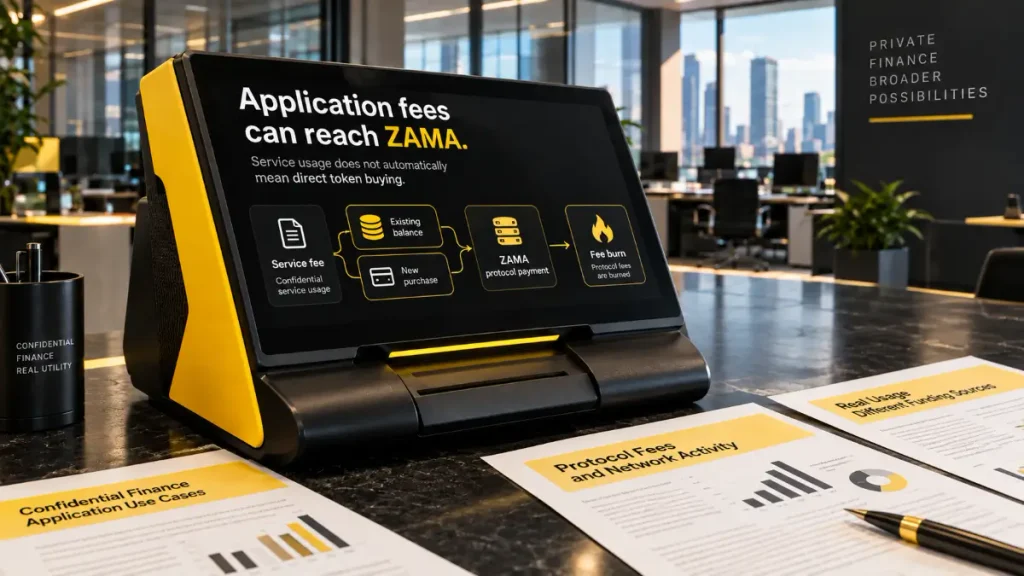
ZAMA launched on February 2, 2026. Under the published model, the token pays for specified protocol services and supports network operators through staking. Core fees collected in ZAMA are burned, while the protocol mints new tokens to reward operators and delegators.
The Zama Protocol litepaper identifies billable services including verification of proofs associated with encrypted inputs, decryption of encrypted values and bridging encrypted values between supported chains.
The protocol does not charge a separate fee for every underlying FHE computation performed by a coprocessor. That detail prevents a misleading estimate in which an analyst counts every encrypted calculation as a paying transaction.
Dollar-denominated fees change the demand calculation
Zama prices its specified protocol services in US dollars and collects payment in the corresponding amount of ZAMA. A price oracle determines the token conversion used for the charge.
This arrangement gives developers a more predictable dollar cost. It also means the number of tokens required for an unchanged service can fall when ZAMA’s market price rises, assuming the conversion mechanism updates as intended.
An increase in paid operations could raise aggregate fee expenditure. It would not necessarily produce a proportional increase in the number of tokens burned, because the token price, applicable service fees and customer discounts also matter.
The oracle creates another dependency. Incorrect or delayed price information could affect the token amount charged for a service. The wider importance of reliable price-oracle data becomes clear whenever a financial system uses an external price to calculate payments.
Zama’s documentation also describes subscription arrangements that can reduce fees for qualifying users. Published standard rates therefore should not be multiplied by raw transaction counts and presented as realized revenue.
An application can pay without making every user a token holder
The protocol allows a user, application or relayer to cover the relevant ZAMA-denominated fee. A wallet could offer confidential transfers while handling token payments behind the scenes.
That can make an application easier to use. Someone seeking a private payment may not want to acquire an additional token before each transaction.
The economic consequence is that application adoption and direct token-holder adoption can diverge. A service provider might buy ZAMA regularly to cover operating expenses, or it might spend tokens accumulated earlier. Both arrangements can result in fee tokens being burned, but they create different immediate patterns of market purchasing.
A recurring fee obligation establishes an economic use for the token. Measuring recurring market demand requires evidence about how applications obtain the tokens they spend.
Burns remove supply without guaranteeing net deflation
Under the core fee model, ZAMA paid to the protocol is burned rather than redistributed as those same fee tokens to stakers.
Burning gives paid usage a direct supply effect. It does not establish that total supply is shrinking because the staking system creates new tokens at the same time.
The relevant comparison is between completed burns and newly minted rewards over matching periods. Circulating supply needs a further adjustment for previously allocated tokens becoming available through vesting or other distributions.
Describing every fee burn as proof of durable token demand would skip these competing flows.
Confidential Swap Adds a Separate Buyback Mechanism
Zama announced Confidential Swap alongside the September vault expansion. The service uses a request-for-quotation approach designed to conceal selected trade details while market makers provide competing quotes.
Its official product page describes the service as live in private beta with invitation-based access. The launch should not be presented as unrestricted public availability.
The product addresses a different need from private vault deposits. A trader may want to exchange confidential assets without exposing the intended trade amount or direction before execution.
Execution quality still matters. Keeping an order private does not eliminate market-maker spreads, settlement risks or the possibility that a trade fails to complete.
Swap fees are not identical to core protocol fees
The Confidential Swap page states that 100% of swap fees go toward buying back and burning ZAMA.
This describes a different economic route from the core protocol model. Core service fees are already paid in ZAMA and burned. Swap fees can finance market purchases of ZAMA before the purchased tokens are burned.
The published policy does not reveal, by itself, how much fee revenue has been collected, how many tokens have been purchased or how much has actually been burned.
A reliable accounting would separate swap revenue from core protocol fees and reconcile each purchase with the relevant burn. Otherwise, combining the two routes could count the same economic activity more than once.
Wider product revenue has competing uses
In a September 16 interview , Zama CEO Rand Hindi described a broader revenue strategy involving payments, swaps and other confidential financial services.
He discussed using revenue to encourage adoption as well as fund buybacks and burns. He also indicated that attracting liquidity could take priority over larger near-term buybacks.
That wider strategy should not be treated as proof that every category of revenue currently flows straight into token purchases. Product-level fee policies, management plans and completed transactions are different forms of evidence.
| Economic Route | Published Mechanism | Evidence Needed to Measure Its Effect |
|---|---|---|
| Core protocol services | Fees paid in ZAMA are burned | Actual fee receipts and completed burns |
| Confidential Swap | Swap fees fund ZAMA buybacks and burns under the stated product policy | Collected fees, executed purchases and completed burns |
| Broader product revenue | Revenue may support adoption incentives and buybacks | Actual allocation between competing uses |
| Staking | Newly minted ZAMA rewards operators and delegators | Actual issuance during the same reporting period |
The routes establish how activity could affect the token. They do not yet supply a single reconciled measure of net economic demand.
Staking Supports the Network but Creates New Tokens
Zama uses delegated proof-of-stake to support its operating infrastructure. Its initial operator arrangement comprises five FHE coprocessor operators and 13 KMS operators.
Coprocessors perform encrypted calculations, while KMS participants support key management and authorized decryption. Operators stake ZAMA, and other token holders can delegate to their pools.
Staking gives the token an operational role beyond fee payment. It may also reduce the amount immediately available for trading while users maintain their positions.
Neither effect is equivalent to burning. A staked token continues to exist, and the holder may retain economic exposure through a staking share.
The reward source matters more than the displayed yield
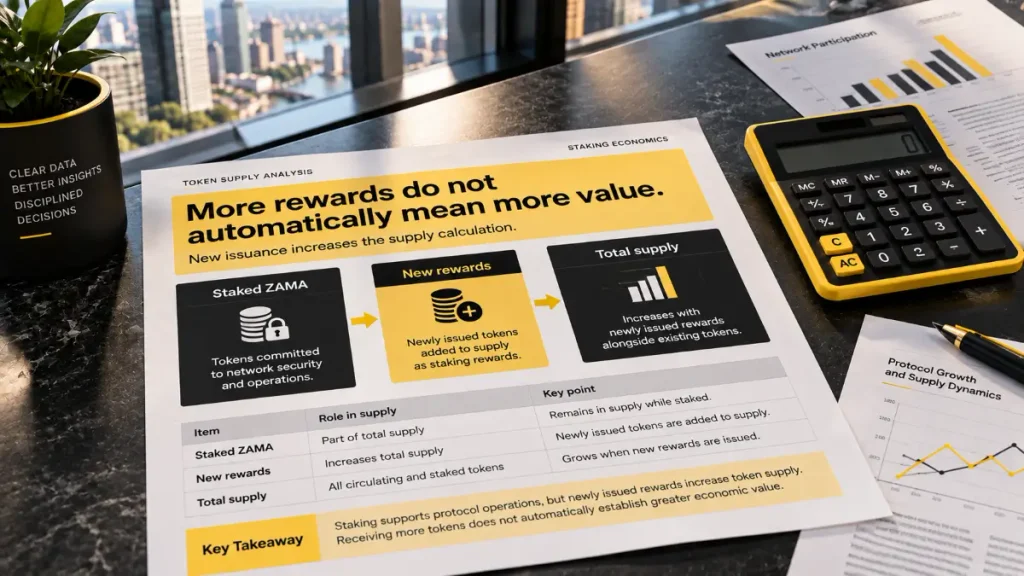
Zama’s published staking model initially sets annual issuance at 5% of total token supply, subject to governance changes. Of the reward allocation, 60% goes to the KMS group and 40% to the coprocessor group.
Operators receive commissions under the applicable rules, while delegators receive their share of the remaining rewards. These tokens come from protocol issuance rather than redistribution of the core fees that the protocol burns.
The distinction matters whenever users interpret staking rewards as investment income. Receiving additional tokens does not establish that the holder’s economic position improved after supply growth, token-price movements and other costs.
A transferable staking share may provide another way to manage a position, but it should not be confused with ownership of a separate revenue-producing business.
Zama’s staking documentation describes operator-specific shares and withdrawal conditions, including a cooldown for redeeming the underlying stake. Transferability does not guarantee immediate redemption at a stable market price.
Governance can alter future economic conditions
The published issuance rate and reward allocation describe the protocol model at a given time. Governance can change relevant settings, which means an analysis based on launch parameters should not be treated as a permanent forecast.
Zama’s litepaper also describes operator participation in adopting protocol updates and handling selected emergency actions. A majority of operators must adopt ordinary updates, while individual operators have limited emergency powers that require broader participation to reverse.
Those arrangements create meaningful operational questions. Readers need to know who can change fees, introduce supported chains, alter reward settings and respond to suspected abuse.
Staking establishes an incentive for operators to participate. It does not eliminate coordination risk, administrative authority or the possibility that governance changes the token’s future economics.
ZAMA Tokenomics: Initial Allocation Is Not a Supply Cap
ZAMA launched with an initial allocation of 11 billion tokens. The published model also includes ongoing staking issuance and fee burning, so the initial allocation should not be presented as an immutable maximum supply.
Zama’s official auction materials identify the original token supply, while the litepaper provides the allocation categories and their release conditions. The distribution assigned 20% to public sale, launch campaigns and liquidity combined. Other allocations have different lockups, cliffs and release schedules.
A percentage outside the initial circulating allocation is not a single block scheduled to unlock on one date. It is also not evidence that every recipient will sell the moment tokens become transferable.
| Tokenomics Item | Published Position | Why It Matters |
|---|---|---|
| Initial allocation | 11 billion ZAMA | Starting allocation, not a permanent supply ceiling |
| Public sale | 12% | Initially available under the published distribution |
| Launch campaigns and liquidity | 6% and 2% | Complete the initial 20% allocation |
| Treasury and growth | 20% and 10% | Different release schedules affect future availability |
| Team | 20% | Long-term allocation with a one-year cliff |
| Venture and angel investors | 20% and 10% | Separate vesting terms create future distribution events |
| Staking issuance | Initially 5% annually | Creates new tokens to reward network participants |
| Core protocol fees | Paid in ZAMA and burned | Removes tokens through paid service activity |
The original allocations explain who may receive tokens. They do not establish how much is currently liquid or what recipients have done with their distributions.
Issuance, vesting and burns must remain separate
Staking issuance creates new tokens. A vesting release makes previously allocated tokens available under the applicable conditions. Burning removes tokens.
Those processes affect supply differently and should not be added together without identifying the measure being calculated.
For changes in total supply, the starting relationship is:
Net token creation = newly minted tokens − tokens burned.
Circulating supply is different. Previously locked tokens may become available for trading without being newly minted, while staked tokens can remain part of total supply despite being less immediately liquid.
A holder who sees a rising circulating-supply figure cannot assume every additional token came from staking rewards. Conversely, a large burn should not be compared with an unrelated historical unlock figure to support a claim of net deflation.
Why a supply calculation needs matching dates
Consider an illustrative period in which a protocol mints 100 million tokens and burns 30 million. Its total supply would increase by a net 70 million tokens during that period.
If 200 million previously allocated tokens also became available for trading, the change in circulating supply could differ substantially from the change in total supply.
This is a hypothetical example, not a statement about Zama’s actual issuance or burns. It shows why tracking only one supply measure can distort the economic picture.
A sound assessment needs matching dates, clear definitions and figures for completed transactions. Estimated circulating supply from a market tracker can be useful, but it cannot substitute for a ledger showing actual mints, burns and allocation releases.
Security Depends on More Than Strong Encryption
Zama’s confidentiality architecture creates protections for selected data, but financial applications still depend on contract logic, access permissions, operators and the underlying assets they handle.
An application can encrypt a balance correctly while granting excessive permissions to another contract. It may protect transaction amounts while exposing useful information through timing, account activity or associated reward claims.
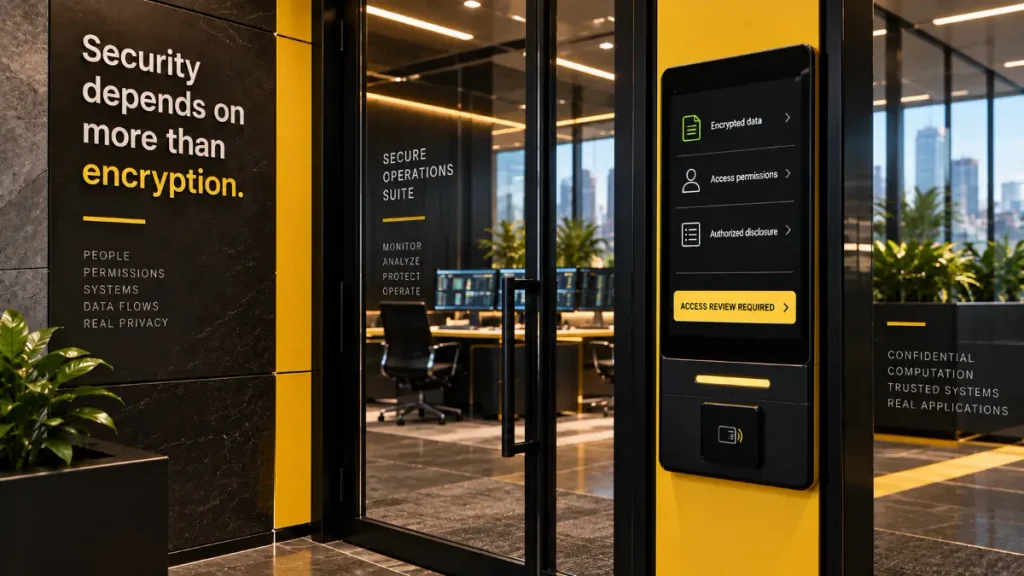
Developers therefore need to examine what their application reveals through every permitted operation, not merely whether it stores a value in encrypted form.
Access controls can become a privacy weakness
Zama’s access-control documentation describes permissions that determine which accounts or contracts can use encrypted values and which parties may decrypt them.
Those permissions are necessary because applications must selectively reveal information to authorized participants. Incorrect authorization rules can also expose data or allow someone to infer a protected value through repeated interactions.
For a confidential financial product, the relevant security boundary includes wallet connections, deposit and withdrawal logic, operator responses, decryption permissions and the underlying financial strategy.
A confidentiality layer cannot prevent ordinary lending losses, faulty collateral assumptions or a market disruption that affects an asset held in a vault.
Audits apply to defined code and versions
OpenZeppelin published its Zama Confidential Fungible Token Audit on March 18, 2026. The report identifies a particular repository, commit and collection of contracts reviewed during May 2025.
It records nine findings, seven marked resolved, with no critical, high or medium findings in that particular report. These details are more informative than describing a project as audited without identifying the work performed.
The report does not certify every Zama component, every later deployment or every financial product built with its technology. A confidential vault also relies on its lending strategy, asset integrations and operational controls.
Users assessing a specific application should examine that application’s current contracts, permissions and relevant audit scope. Published reviews of one contract library cannot establish the safety of an entire changing ecosystem.
What Would Demonstrate Lasting ZAMA Demand?
Zama’s confidential-finance products provide a setting in which recurring economic demand could develop. Its fee and burn model establishes a route through which paid services can affect token supply.
The unresolved issue is the scale of that effect after new issuance and other available supply are considered.
A meaningful operating record would report billable protocol activity, effective fees and completed core-fee burns over a consistent period. Confidential Swap would need a separate record of collected fees, executed ZAMA purchases and completed burns.
The same reporting window should include staking issuance, applicable reward settings and releases of previously allocated tokens. Without those figures, readers cannot distinguish fee-funded supply removal from broader changes in available tokens.
Repeat paying users matter more than headline deposits
A large vault can demonstrate demand for confidential exposure without generating proportionate fees. An application that processes repeated payments may create a different economic profile even if it holds fewer assets.
Future reporting should distinguish new deposits from repeat fee-paying activity. It should also identify whether applications subsidize users, how service discounts affect effective revenue and whether activity continues when promotional rewards decline.
These measurements would clarify where the demand comes from and whether customers continue paying for the underlying confidentiality service.
Buyback execution must be visible
Published policies describe what a product intends to do with its fees. They do not replace evidence of purchases and burns that have taken place.
A useful reconciliation would show the amount of swap revenue allocated to token purchases, the tokens acquired and the final burn transactions. The reporting should distinguish those purchases from core fees that were already paid directly in ZAMA.
This would help determine whether Confidential Swap contributes a separate source of purchasing demand rather than merely adding another description of the same token mechanism.

Final Assessment
Zama provides a functioning confidentiality protocol with financial applications that extend beyond its initial token auction. Confidential Morpho vaults offer users access to existing lending strategies while protecting selected information about their positions. Confidential Swap adds a private-beta trading product with a separately described fee-funded buyback mechanism.
ZAMA has documented roles in service payments and staking. Core protocol fees create a direct burn route, while the operator reward system introduces new tokens. Confidential Swap offers another possible connection between product revenue and token purchases.
What remains unproven is the lasting net economic result. Reported vault deposits do not measure protocol revenue. Staking participation does not permanently remove supply, and a published buyback policy does not establish the amount already purchased or burned.
The central test is a consistent record connecting repeat paid confidentiality usage to actual ZAMA purchases and burns, measured against staking issuance and changes in available supply over the same periods. Until that record is available, product adoption should not be presented as proof of lasting net token demand.
Frequently Asked Questions About Zama
No. Zama provides confidentiality infrastructure for applications on existing supported blockchains. Its Gateway coordinates specialized protocol operations rather than serving as a replacement destination for every application.
Fully homomorphic encryption allows supported calculations to take place on encrypted data without the computing service first reading the underlying values. Applications still need correct permissions and secure surrounding infrastructure.
No. An application or relayer can cover protocol fees on a user’s behalf. The service provider may still need ZAMA to settle its obligations, but individual users do not necessarily need to hold the token.
The core protocol model burns fees collected in ZAMA. The Confidential Swap product describes using swap fees for buybacks and burns. Zama’s CEO has discussed allocating broader product revenue between adoption incentives and buybacks, so these categories should not be treated as one identical revenue stream.
The official product page describes Confidential Swap as live in private beta with invitation-based access. Its launch announcement does not establish unrestricted access for every user.
No. Staking rewards come from newly minted tokens under the published model. Whether total supply rises or falls depends on actual issuance relative to completed burns.
No. The figure refers to assets reportedly deposited into a confidential yield vault. It does not establish the amount paid in protocol fees, the number of ZAMA tokens purchased or the number burned.

Founder & Managing Editor of CryptosMedia. Zahid Hussain leads evidence-based crypto research covering tokenomics, security, governance, adoption, and risk.
CryptosMedia separates verified facts from interpretation, avoids buy/sell recommendations, and updates reviews when major evidence changes.