
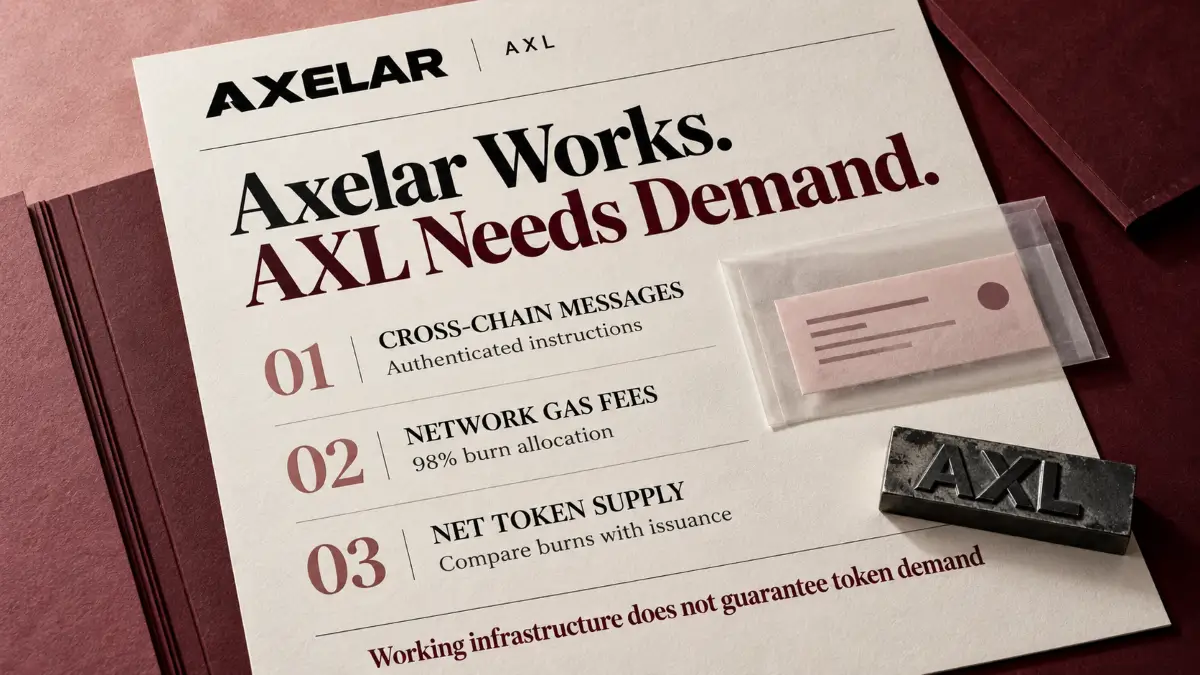
Moving tokens between blockchains creates more than a transport problem. Someone must authenticate the source event, authorize the destination action and keep token accounting consistent throughout the journey. This Axelar Token Review examines those responsibilities alongside AXL’s economics. Axelar supplies working interoperability infrastructure, but its technical reach does not establish the safety of every connected application or the financial benefit of holding its token.
Current records show both expansion and retrenchment. Axelar announced Solana mainnet support in June 2026, while governance approved discontinuing three less active integrations. Its fee-burning model creates an economic link to usage, yet the Secret bridge incident demonstrates why individual contracts still need scrutiny. Evaluating Axelar means following those details through to execution, operating costs and measurable token demand.
Cross-chain applications involve market, software, governance and liquidity risks. This review provides education, not personalized investment advice. Participation can expose assets to losses or delayed access. Documentation and audits cannot guarantee future performance.
Sources include public documentation, governance records, technical reports, network parameters and market-data services. Project announcements do not independently prove commercial revenue, complete security coverage or future AXL demand. Editorial judgments remain distinct from dated observations.
Quick Verdict
Axelar has a practical purpose beyond moving wrapped tokens. General Message Passing supports cross-chain instructions, while Interchain Token Service helps issuers coordinate token deployments. AXL participates in network security, governance and operating economics. Those functions give the token a clearer role than a purely promotional asset.
The assessment remains high risk. Every route combines several systems, and a sound verification network cannot repair an application that authenticates the wrong source or mishandles minting rights. Fee burns also need comparison with issuance and operating subsidies. My conclusion is that Axelar merits infrastructure-level analysis, while the token thesis still needs sustained paid usage and transparent supply accounting.
Key Takeaways
Axelar’s Place in a Cross-Chain Transaction
Axelar operates a separate proof-of-stake network built with the Cosmos SDK. Applications use its gateways and related services to exchange messages across supported chains. Native AXL belongs to that network, while wrapped representations make the asset usable in other environments.
Instructions Travel Further Than Tokens
Transferring a token alone does not tell the destination contract which account to credit or which operation to perform. Cross-chain instructions supply that context. The receiving application must then authenticate the sender and determine whether the requested action belongs within its permissions.
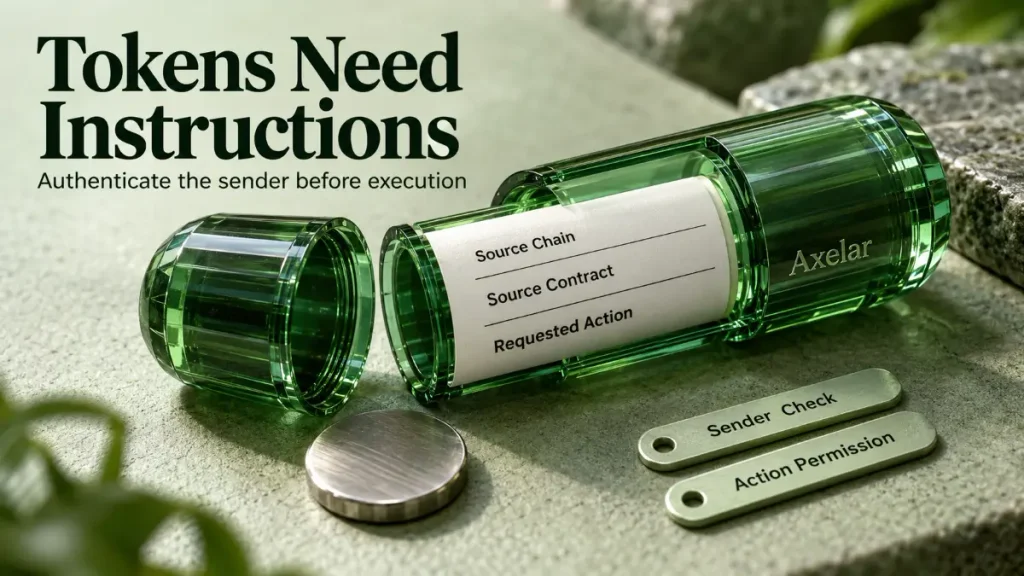
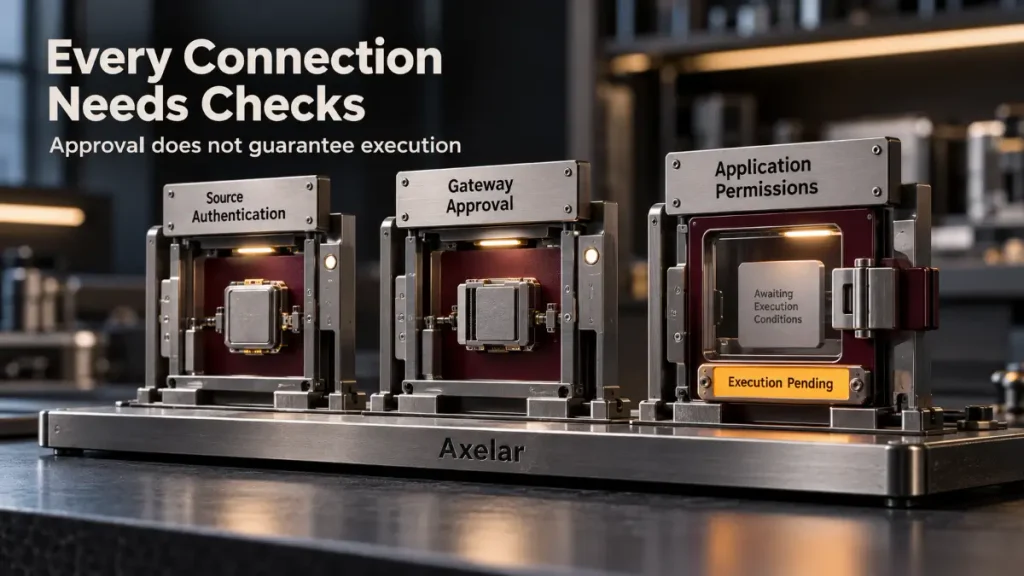
Axelar’s General Message Passing addresses this communication problem. In the documented EVM flow, an application submits a destination and payload through a source gateway. Network participants validate the event, signatures authorize the message, and a relayer submits the approval. An executor then calls the destination application, which checks gateway approval before running its own logic.
The receiving contract should also check the expected source chain and source application. Gateway approval and application authorization answer different questions. For example, an application should not accept a privileged instruction merely because some contract on an approved chain sent it. Authentication must connect the message to the intended sender and permitted operation.
That sequence creates useful composability. It also creates several checkpoints. Correct message approval establishes that the network accepted a particular instruction. It does not establish that the receiving application has sensible business rules, adequate collateral or a safe upgrade administrator. My reading is that Axelar can reduce integration work while leaving application design firmly within the developer’s responsibility.
Source Confirmation Is Only the First Receipt
Cross-chain activity does not behave like a single transaction inside one execution environment. Source confirmation, message processing, destination approval and the final application call can complete at different times. Axelar’s documentation includes monitoring and recovery procedures for messages that encounter insufficient gas or other execution problems.
Consider a lending application receiving collateral from another blockchain. Its interface might show a successful source transaction before the destination contract credits the borrower. That first receipt confirms one stage, while the lending position depends on completion at the destination. Interfaces should distinguish approval from execution and explain the next available recovery step.
Completion estimates should therefore cover the full route. Reliable recovery tools and clearly separated transaction states matter alongside headline throughput.
Minting Rights Shape the Token Route
Interchain Token Service organizes token operations through managers. Official documentation describes native interchain tokens, mint-and-burn variations, lock-and-unlock managers and a version that accommodates transfer fees.
With a lock-and-unlock arrangement, a home-chain manager can hold tokens while another chain uses a corresponding representation. A mint-and-burn arrangement instead requires the relevant authority to destroy units in one environment and create them in another. Neither approach removes the need to verify manager addresses, supply coordination and control over privileged roles.
Axelar’s January 2025 release note describes the ITS Hub as a CosmWasm contract on its network that routes token operations across integrations. This shared routing point connects different deployments, making hub behavior part of the route’s software dependencies. Its position in the architecture alone cannot establish single-company custody or eliminate governance risk. Researchers still need to identify who can change the contract, which checks it applies and how connected token managers enforce those decisions.
Connection Rules Vary Across Amplifier
Interchain Amplifier separates several responsibilities through contracts for verification, routing and proof construction, together with relaying infrastructure. Its integration guide explains that developers can use or customize verification logic. A standard voting verifier is one option, while the framework also accommodates other verification approaches.
Each integration therefore needs its own verifier arrangement, supported messages, confirmation policy and deployed contracts. Researchers should identify which operators verify the source event and how the destination accepts their proof. Axelar’s general network description supplies context, while the route’s configuration establishes the actual trust assumptions.
Connection speed only helps when operators can maintain the resulting system. Consistent deployment records should identify funding, monitoring responsibilities and suspension authorities.
Who Authorizes Each Step
A validator count cannot explain every interoperability decision. Identifying each layer’s responsibility provides a more useful starting point.
Quadratic Votes Stop Short of Block Consensus
Axelar’s security documentation makes an important distinction. Quadratic voting applies to validation and processing of cross-chain requests, using the square root of stake to weight the relevant votes. Underlying block production and rewards follow standard stake-weighted proof of stake.
The quadratic mechanism reduces the marginal influence that additional stake gives a large participant within its stated scope. It does not prove that operators are independent, that delegations are evenly distributed or that infrastructure has no shared failure points. Those properties need separate observations.
Where Cobalt Sends Network Gas Fees
Axelar announced the completed Cobalt upgrade on February 25, 2025. Its published policy sends 98% of AXL network gas fees to a burn address and 2% to the community proposals grant pool. Gas services can abstract payments so users start with a source-chain token rather than manually acquiring every required gas asset.
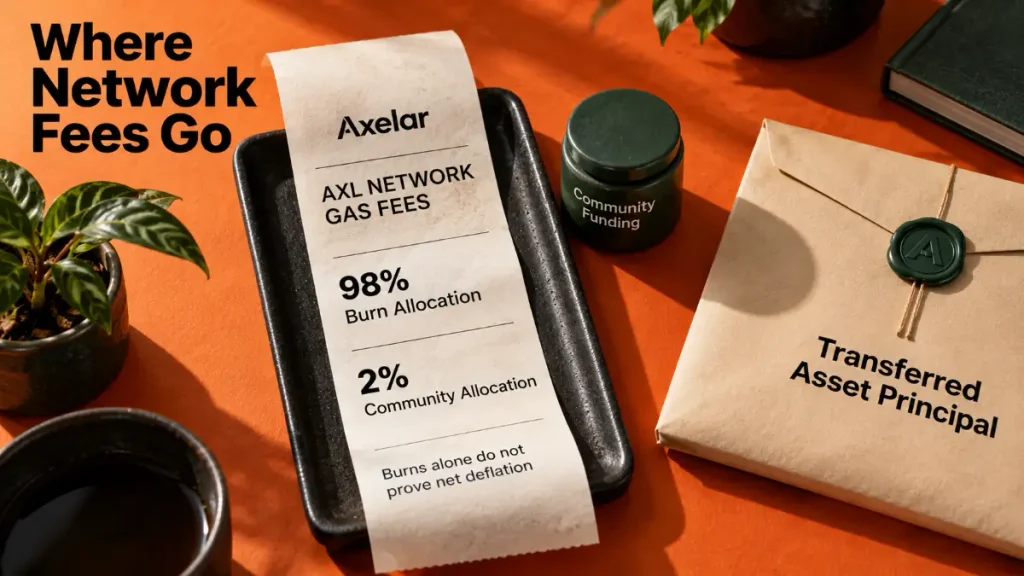
The percentage needs careful interpretation. A large transfer does not burn 98% of its principal. Neither does the policy mean 98% of every amount an interface charges reaches the burn mechanism. Destination execution expenses and other service costs belong in their appropriate categories.
Supply contracts only when eligible destruction exceeds new issuance over the measurement period. Even then, price also depends on liquidity, holder behavior and demand. Cobalt provides a mechanism worth measuring. It does not turn transaction growth into a guaranteed financial return.
Verifier Costs Put Expansion to the Test
The Cobalt announcement also describes new chain connections funding verifier reward pools from existing AXL, instead of automatically extending the earlier inflation-based connection model. That creates a potential reason for integrators to obtain and allocate tokens.
However, funding a pool and generating external revenue are different events. Existing treasury tokens can finance activity without new customers purchasing AXL. Reward distributions can later become liquid balances, while any future replenishment depends on who pays and why.
Customer-funded demand needs separation from foundation subsidies and recycled incentives. Repeated pool funding by economically active integrations would carry more weight than a one-time allocation supporting an unused connection. Technical capacity can expand without improving the token’s economics.
Axelar’s May 13, 2026 announcement proposed discontinuing Flow, Berachain and Plume integrations. It cited little sustained activity and foundation subsidies covering verifier costs. Governance proposal 468 subsequently passed, according to the reviewed on-chain proposal record.
That evidence supports a narrower statement than saying the network completed every operational shutdown step. Proposal passage and final route status are different observations. Users still need the current interface, configuration and any migration notices for the specific connection.
The broader lesson is economic. Each integration can add monitoring work, infrastructure costs and software exposure before it attracts meaningful demand. Removing underused connections can improve resource discipline, but it also challenges the assumption that a growing chain count always strengthens AXL. In my assessment, recurring fee-paying activity relative to its support cost is a more useful expansion measure.
Tokenomics
Axelar began with one billion AXL at genesis. Official historical allocations assigned 17% to the core team, 12.5% to company operations, 29.54% to backers, 5% to the community sale and 35.96% to community programs. Those percentages describe the starting allocation, not today’s ownership distribution or a fixed supply ceiling.
On October 18, 2026, CoinMarketCap reported 1,249,534,381 circulating AXL. CoinGecko displayed approximately 1.25 billion circulating and 1.258 billion total. Market-data definitions and retrieval timing can differ, so those figures should retain their source and date.
Current Issuance Needs More Than an Old Rate
Cobalt’s launch article quoted 4.8% inflation at the time. Governance proposal 294 subsequently passed in March 2025, describing a reduction from 4.8% to 3.8% through removal of the 1% base component.
Fresh mainnet queries illustrate the problem with copying a single field. The standard mint endpoint returned zero, while the separate reward module still exposed an external-chain voting inflation parameter. That does not establish zero aggregate issuance. A complete calculation needs the active reward rules, relevant participation and actual token movements.
This review therefore does not present 3.8% as the current effective inflation rate or claim that burns exceed issuance. Comparing matching periods of gross minted rewards, verifiable burns and total-supply changes would resolve that question. Circulation changes also need separation from minting because transfers of previously restricted units can alter circulation without creating new tokens.
Seven Days Between Unbonding and Access
Native AXL supports delegation and governance participation. Rewards compensate network participation under the applicable rules, while validator commissions affect the amount reaching delegators. Nominal reward rates do not reveal a participant’s economic result after supply changes, fees, downtime and market movements.
Two mainnet endpoints returned an unbonding time of 604,800 seconds during this review, equal to seven days. Delegators therefore need to plan for delayed access after starting the native unbonding process. Exchange products, liquid-staking services and other wrappers can impose different exit conditions.
Slashing also needs precise language. Published network parameters distinguish double-signing and downtime penalties. They do not justify saying that every incorrect cross-chain report instantly destroys a large portion of stake. Delegation creates exposure to the relevant validator rules and operating performance. Evaluating commission alone misses those responsibilities, while a staking yield should never substitute for a review of custody and withdrawal access.
Check the Network Behind the AXL Ticker
Native AXL is the coin used on Axelar’s own chain. The ERC-20 representation commonly called wAXL operates on EVM networks. Axelar’s official configuration lists Ethereum’s representation at 0x467719aD09025FcC6cF6F8311755809d45a5E5f3.
Holding that representation in an Ethereum wallet does not automatically delegate native AXL to an Axelar validator. Governance access, conversion and staking depend on the supported route or service. Exchanges may display AXL as the trading symbol while accepting only particular deposit networks.
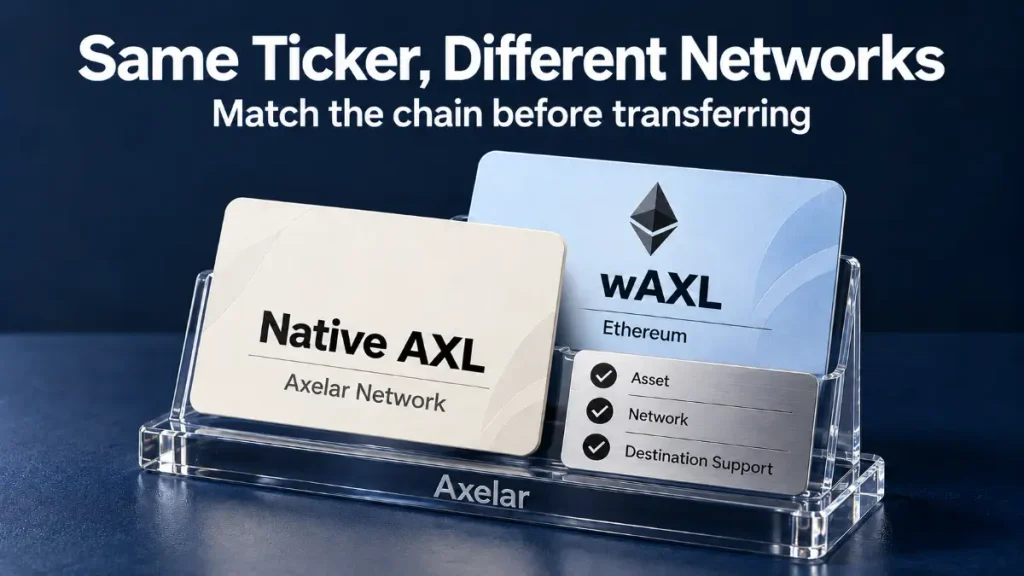
The practical identity check combines asset, chain, contract or denomination, and destination support. Matching a ticker alone is insufficient. Wrapped-token accounting also means researchers should avoid adding every chain’s displayed representation to native supply without reconciling backing or burn-and-mint movements. Otherwise, the calculation can count one economic unit repeatedly.
XRPL and Solana Bring Access, Then a Usage Test
Ripple’s launch announcement dates the XRPL EVM Sidechain mainnet to June 30, 2025, with an Axelar bridge connecting it to XRP Ledger. The sidechain is a distinct blockchain with EVM execution. This does not mean XRP Ledger itself became an EVM chain.
Axelar separately announced Solana mainnet integration on June 3, 2026, covering messaging and asset transfers. Its release also identified access through its own interface and Squid. These announcements establish published integration milestones, rather than a promise that every asset can move instantly across every connected chain.
Commercial relevance requires another layer of observation. Useful measures include completed messages, recurring applications, destination failures, transfer concentration and fees attributable to those routes. A connection serving many independent applications offers a different demand profile from one dominated by a temporary campaign. That distinction matters more than adding every announced ecosystem to a headline count.
Bank Pilots Leave Revenue Questions Open
Axelar’s November 2023 account of work with Onyx by J.P. Morgan and Apollo describes a proof of concept for portfolio management across blockchains. That is meaningful experimentation. It does not establish continuing production volumes, recurring customer payments or token purchases by those institutions.
Deutsche Bank’s June 18, 2025 DAMA 2 announcement similarly describes a blueprint developed with Memento Blockchain and Interop Labs. The design includes managed token issuance through Axelar. The bank’s accompanying publication described the targeted MVP mainnet launch as non-commercial.
These records show that institutional teams evaluated relevant infrastructure. They do not make AXL equity in those institutions or assign tokenholders a share of their assets. Stronger commercial evidence would identify production deployment, repeated transactions and how associated payments reach Axelar’s economics. Until those observations exist for the claim under examination, institutional interest should remain a development signal rather than a revenue estimate.
Circle’s Deal Separates the Developer From AXL
On December 15, 2025, Circle announced an agreement to acquire the Interop Labs team and proprietary intellectual property. The announcement explicitly excluded Axelar Network, its Foundation and the AXL token, which would continue independently under community governance. It also identified Common Prefix as taking over Interop Labs’ Axelar activities.
The wording matters. The reviewed announcement described an agreement and an expected closing period. It does not, by itself, verify the transaction’s eventual completion. More importantly for token analysis, acquiring a contributor’s business does not create an automatic payment right for holders of an independently governed token.
Common Prefix’s subsequent stewardship roadmap supplies a separate continuity signal. It discusses co-staking other assets, institutional readiness and exploring gas subsidies through optional use of idle gateway capital. Those are development proposals, not capabilities this review independently verified as deployed. Any yield-generating use of gateway assets would require its own custody, liquidity and loss-allocation analysis. Funding, shipped software and operating results determine whether the roadmap improves the network over time.
Authentication Must Hold From Source to Destination
Block consensus, external-event voting and gateway authorization can follow different rules. Security analysis therefore needs the chain, contract and parameter involved, rather than one percentage applied across every component. Safety concerns unauthorized actions, while liveness concerns continued processing. A system can preserve its authentication rules during an outage and still impose serious delays on users. That delay can matter financially when collateral, repayments or time-sensitive instructions depend on the destination call.
Axelar’s published defenses include key rotation, rate limits, open-source review and application-level controls. These measures can address different failure modes, but none provides universal protection. A limit only helps where it applies and at the configured level. Rotation only helps when replacement keys and operating procedures remain secure.
The review should therefore start with the intended route and assets. What source events can authorize minting? Who controls changes to a token manager? How does the confirmation policy handle a source-chain reorganization? Which alerts reveal an abnormal increase in redemptions? Answering those questions is more useful than treating decentralized as a complete security assessment.
Economic security also involves more than multiplying token price by bonded supply. Investigators need the relevant attack path, available penalties, effective control and potential loss. I treat those as analytical questions rather than a verified monetary guarantee. A broadly distributed network can still depend on an application with concentrated permissions or insufficient monitoring.
What Failed in the Secret Connection
Common Prefix’s June 19, 2026 postmortem describes an exploit on June 10 involving a modified ICS-20 contract deployed on Secret Network. The contract failed to authenticate the source channel before minting Secret-wrapped representations. The attacker created unbacked balances and redeemed them through the legitimate connection, draining approximately $4.67 million in corresponding escrowed assets.
The report confines the impact to the affected Secret connection and associated tokens, stating that Axelar’s core protocol and other escrow accounts were unaffected. Secret’s own report likewise distinguishes the integration failure from both networks’ core protocols. Their accounts differ in how they describe monitoring and response, so those operational claims require attribution rather than an assumed shared conclusion.
My assessment is that this boundary prevents two misleading interpretations. The incident does not demonstrate that Axelar validators collectively approved a fabricated consensus history. It also cannot serve as reassurance for affected holders merely because the base protocol remained intact. They depended on the complete bridge integration, including its source authentication and escrow accounting.
Recovery Still Needs Executable Decisions
Axelar proposal 490 passed in July 2026 as a signaling proposal concerning stolen funds. Its text explicitly states that it carries no automatic on-chain action. It records support for freezing identified funds and later recustody through a subsequent binding process.
That status cannot establish that funds actually froze, moved to a distributor or reached affected users. Those outcomes need execution records and a distribution reconciliation. This review does not verify a completed reimbursement program.
The same discipline applies to recovery designs in historical whitepapers. Descriptions of emergency keys or possible fallback committees do not establish a working recovery route for every current gateway. For a specific deployment, the relevant evidence consists of actual code, current authorities, activation conditions and operational records. Recovery language should describe demonstrated capabilities without promising that technical or governance action will restore every loss.
Match Security Reports to the Running Version
Axelar’s public audit repository contains reports for several components and integrations, including work attributed to NCC Group, Ackee Blockchain, OtterSec and Code4rena. The scopes span different repositories and dates. An audit of one gateway or token service does not automatically cover another chain’s custom contract.
Code4rena’s report for its August 2024 review, published in January 2025, lists two high-severity and two medium-severity findings. That historical record demonstrates scrutiny and findings in the reviewed code. It does not establish that those findings remain exploitable in today’s deployment or that subsequent versions contain no new defects.
Upgrade Votes Carry Operational Consequences
Axelar’s EVM governance documentation describes gateway changes through network governance and timelocked contracts. Other service-governance paths include additional execution arrangements. Reviewing those controls requires the correct deployed contract and its current parameters.
Governance can provide transparency and shared decision-making. It can also change fees, supported connections and software behavior. A timelock gives observers time to inspect a scheduled action, but meaningful oversight still depends on participation, clear proposal descriptions and tools that reveal what the payload does.
For an application operator, monitoring governance belongs beside monitoring transactions. An upcoming upgrade or connection retirement can affect service availability even when no attacker appears. For tokenholders, the same process influences incentive budgets and future supply policy. I would judge governance by the clarity of its records and execution, rather than assuming every passed proposal improves either security or token economics.
Final Assessment: Paid Usage Must Support the Token Case
Axelar addresses a real coordination problem. Its messaging tools, token managers and integration framework support applications that need to operate across different blockchain environments. Documented deployments and public technical reviews give researchers substantive material to examine.
AXL’s financial case requires an additional test. Recurring customer activity must create enough token use, funded security participation or fee destruction to matter relative to issuance, subsidies and liquid supply. An impressive list of connections cannot settle that calculation.
The most constructive interpretation is conditional. Better route-level disclosures, reconciled emissions and burns, sustained independent customers and clearer incident follow-through would strengthen the assessment. Continued dependence on incentives or unclear deployment controls would weaken it. Axelar can remain useful infrastructure while its token economics still demand closer measurement.
How the Review Handles Incomplete Records
This review checked public records on October 18, 2026. Sources included developer documentation, official configuration, governance proposal records, component audit publications, incident reports and market-data displays. Two mainnet endpoints independently returned the same seven-day unbonding parameter.
This work did not include a new code audit, full validator-ownership investigation, executable trading quotes or aggregate issuance reconciliation. Announcements and proposals retain their stated scope. They do not prove completed commercial activity.
Key Questions About Axelar and AXL
What does Axelar do beyond token bridging?
General Message Passing carries instructions that connected applications can authenticate and execute across chains.
Does every user need to hold AXL?
No. Gas services can abstract payments into the required network assets behind a source-chain payment.
Does the 98% burn apply to transferred funds?
No. The documented policy concerns AXL network gas fees, not the value of assets crossing chains.
Is AXL currently net deflationary?
This review did not verify that conclusion. Matching-period issuance and burn records are necessary.
Is one billion AXL a hard cap?
No. One billion describes genesis supply. Reviewed tokenomics do not specify a fixed maximum.
How long does native AXL unbonding take?
Mainnet endpoints returned seven days during this review. Other services can impose different terms.
Did the Secret incident compromise Axelar’s core consensus?
The published postmortems describe an integration-contract exploit and state that Axelar’s core protocol remained unaffected.
Did proposal 490 automatically reimburse users?
No. Its text records non-binding recovery intent and explicitly requires further action.
Did Circle’s announced agreement include AXL?
No. Circle expressly excluded Axelar Network, its Foundation and the AXL token from that transaction.
Does a live integration prove token demand?
No. Recurring use, actual fees, security funding and supply movements determine its economic significance.

Founder & Managing Editor of CryptosMedia. Zahid Hussain leads evidence-based crypto research covering tokenomics, security, governance, adoption, and risk.
CryptosMedia separates verified facts from interpretation, avoids buy/sell recommendations, and updates reviews when major evidence changes.
4 thoughts on “Axelar Token Review: Fee Burns and Bridge Accountability”
Comments are closed.