
Pendle Token changes how DeFi manages yield by splitting assets into principal and yield tokens. Unlike simple staking platforms, it creates a dedicated derivatives market to hedge against interest rate volatility. As of June 10, 2026, the protocol secures $3.68 billion in TVL, proving its role in complex institutional strategies. This audit examines the underlying yield-splitting math, the vePENDLE governance model, and the systemic smart contract risks inherent in its layered architecture.
The Audit Methodology
This structural analysis verifies official on-chain contract data via Etherscan, aggregates market statistics through CoinMarketCap, and evaluates security profiles via Token Sniffer and CertiK. Ground-level architectural data regarding automated market maker (AMM) routing was cross-referenced directly with the protocol’s developer documentation. All financial metrics, supply structures, and liquidity concentrations reflect the network state on June 10, 2026.
What Pendle Token Actually Does
Pendle operates as a yield-trading protocol that allows users to tokenize and trade future yield. It ingests a yield-bearing asset-such as staked ETH (stETH)-and structurally separates it into two distinct smart contract tokens: the Principal Token (PT) and the Yield Token (YT).
The Mechanics Of Token Splitting
- Principal Token (PT): Represents the underlying principal of the deposited asset. It allows users to secure a guaranteed fixed yield. Buyers purchase PT at a mathematical discount to its face value, ensuring they can redeem it 1:1 for the underlying asset exactly at the contract’s maturity date.
- Yield Token (YT): Represents the exclusive rights to all future yield and airdrop points generated by the underlying asset until maturity. YT enables speculation on floating rates. If the actual yield or point accumulation exceeds the market’s implied pricing, YT buyers capture the upside. At the exact moment of maturity, the YT ceases to generate revenue and its financial value permanently drops to zero.
A Practical Restaking Example
Consider holding one staked ETH token. Depositing this into the Pendle ecosystem triggers the smart contract to mint one PT and one YT. You can immediately sell the YT to a speculator to lock in fixed cash returns, or you can hold both to continue earning the base network rewards. This dual-sided flexibility attracts both conservative capital looking for predictable bonds and aggressive traders seeking leveraged exposure.
The Custom V2 AMM Mechanics
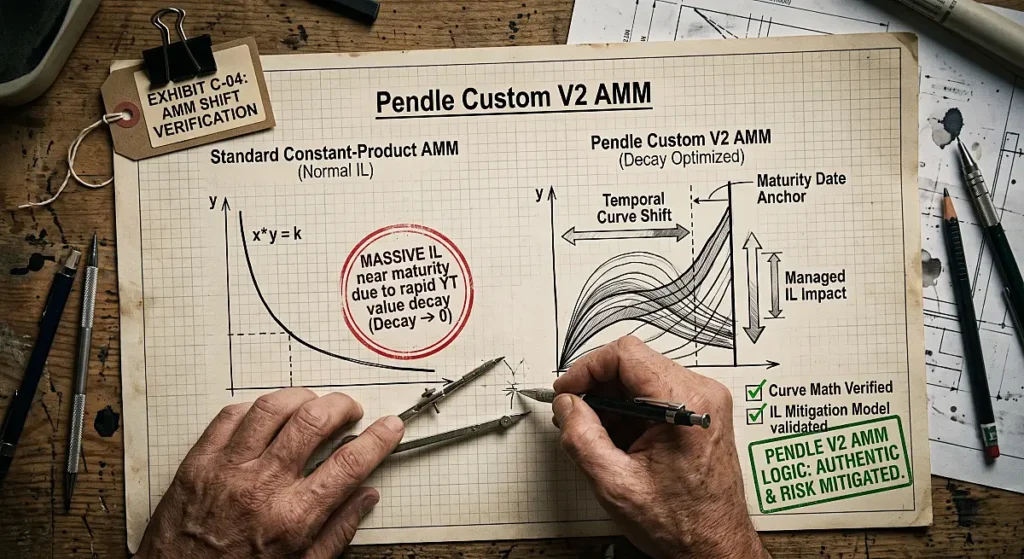
Standard constant-product automated market makers fail when handling time-decaying assets; a normal AMM forces massive impermanent loss as the YT value decays toward zero. To engineer around this structural flaw, Pendle runs a custom V2 AMM built specifically for yield derivatives.
The AMM pairs highly correlated assets-routing trades exclusively between the underlying token and the Principal Token. By shifting the liquidity curve mathematically as the maturity date approaches, the system maintains deep liquidity pools while heavily reducing impermanent loss for liquidity providers (LPs).
The vePENDLE Token Utility
The native PENDLE token functions as the governance and cash-flow engine of the network. However, its utility unlocks strictly when users lock their tokens within the protocol’s escrow contracts for periods spanning from one week to two years, generating vePENDLE (vote-escrowed PENDLE).
Structural Benefits And Revenue Sharing
Holding vePENDLE activates three financial mechanics:
- Boosted LP Yield: Liquidity providers receive up to a 2.5x boost in their annual percentage yields (APY) when holding a proportional balance of vePENDLE.
- Emissions Voting: The protocol distributes weekly PENDLE token incentives to bootstrap specific liquidity pools. Holders use their vePENDLE weight to direct these emissions to their preferred market pairs.
- Protocol Revenue Sharing: Pendle extracts a 3% fee from all yield captured by YT. The protocol treasury routes this revenue, alongside a portion of AMM swap fees, directly back to voting vePENDLE holders.
Tokenomics And Supply Structure
Evaluating token distribution demands examining the circulating supply on-chain to determine whether supply structures represent public market liquidity or concentrated developer hoarding.
| Tokenomics Factor | Verified Supply Facts | Strategic Significance |
|---|---|---|
| Total Supply | 281.52 Million PENDLE | Definitive upper boundary of tokens currently minted. |
| Circulating Supply | 170.65 Million PENDLE | Total volume actively trading and flowing in the public market. |
| Market Capitalization | $213.62 Million | Current network valuation based strictly on circulating units. |
| Protocol TVL | $3.68 Billion | Capital locked across the system, indicating high structural utilization. |
| On-chain Holders | 71,401 to 156,303 Wallets | Etherscan registers ~71k direct Ethereum wallets; aggregators show broader cross-chain reach. |
| Wallet Concentration | Smart Contract Dominated | Top two holding wallets contain ~35% of total supply. |
Contract Lockup Verification
A forensic breakdown of the supply concentration confirms the top two on-chain wallets hold roughly 35% of the total supply. However, these represent the systemic vePENDLE locking contract and the sPENDLE staking contract. They are not single human whales hoarding tokens. This verifiable on-chain lockup proves real community participation, showing users actively locking supply for governance and yield rather than waiting to dump on retail buyers.

Ecosystem And Real Adoption
Pendle’s adoption scaled rapidly to $3.68 billion in TVL primarily through strategic integrations with Liquid Staking Tokens (LSTs) like Rocket Pool and Liquid Restaking Tokens (LRTs) like ether.fi and Renzo.
The platform captured immense market share by transforming into the primary secondary market for loyalty points. Because YT strips and concentrates all underlying attributes of a deposited asset, traders utilize it as a highly capital-efficient proxy to speculate on future protocol airdrops. The protocol decentralizes its execution layer across Ethereum, Arbitrum, and BNB Smart Chain to capture multi-ecosystem liquidity.
Security And Audit Signals
For complex DeFi derivative systems, security stands as the heaviest operational variable.
- Token Sniffer Score: 86/100. The contract source code is verified, ownership is renounced, and the deployer retains zero special permissions to halt trading or modify user balances.
- CertiK Security Rating: 4.6 / 5.
Systemic Composability Risk
Standard smart contract audits do not eliminate compounding composability risk. Pendle’s architecture stacks directly on top of external yield generators. A single user position inherently relies on the security of base Ethereum, the EigenLayer restaking framework, a specific LRT provider (e.g., ether.fi), and finally Pendle’s V2 AMM. If any foundational layer suffers an exploit, economic de-peg, or smart contract crash, the Pendle pools sitting above it face immediate insolvency.
Main Strengths And Red Flags
Core Strengths
- Organic Cash Flow: The protocol rejects infinite token inflation; vePENDLE rewards stem from actual swap fees and a 3% minting fee on generated yield.
- Impermanent Loss Mitigation: The custom V2 AMM successfully isolates yield volatility from principal volatility, fixing the problem of time-decaying asset management.
- Definable Market Fit: It bridges the traditional finance interest rate swap model on-chain, creating functional fixed-income architecture for institutional capital.
Red Flags And Risks
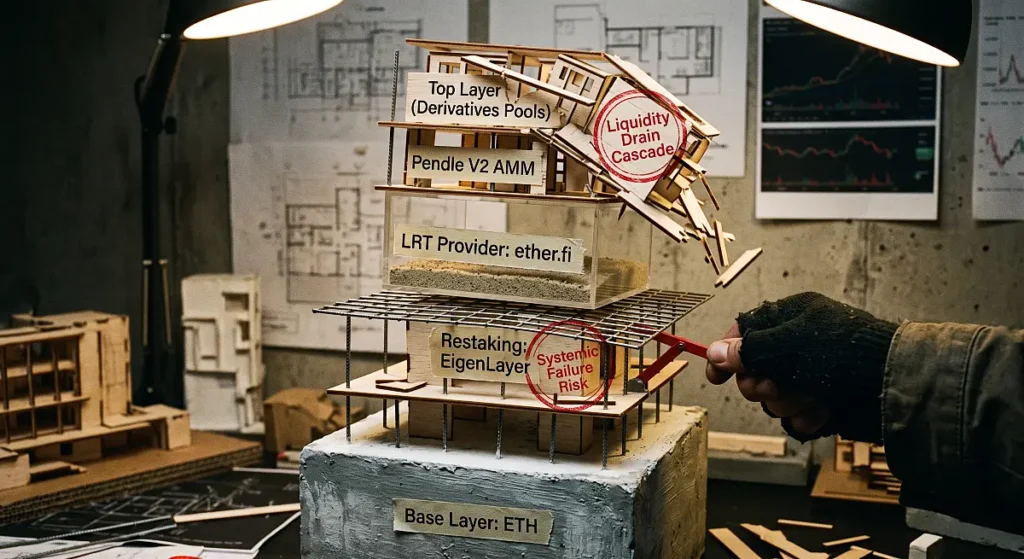
- Compounding Composability Risk: Multi-layered smart contract dependencies create a fragile architecture where an external protocol failure instantly compromises Pendle deposits.
- YT Value Decay: Yield Tokens are guaranteed wasting assets. By maturity, their value reaches zero. Inexperienced users often purchase YT without calculating the 100% loss of principal if implied yields drop.
- DeFi Literacy Barrier: Executing profitable trades requires deep mathematical understanding of implied yield, principal discounts, and AMM routing curves.
Competitor And Category Context
Traditional finance relies heavily on over-the-counter (OTC) interest rate swaps to manage risk. Basic DeFi lending protocols like Aave only offer variable rates. Pendle brings fixed and floating rate swaps directly on-chain. While other protocols have attempted fixed yields, Pendle completely dominates the current market share for tokenized points and liquid restaking derivatives. It fills a massive structural gap for institutional capital entering the crypto sector.
What Readers Should Verify
Before committing capital, users must manually verify four critical data points:
- The Maturity Date: Check the exact expiration of the PT or YT contract. Asset value decay accelerates rapidly near the end of the lifecycle.
- Underlying Protocol Audits: Review the specific security profiles of the base LRT/LST issuers providing the underlying yield.
- Implied Vs. Real APY: Compare the current implied yield of the YT asset against the actual historical underlying APY to avoid overpaying during airdrop hype.
- Pool Liquidity Depth: Verify the specific AMM pool concentration to prevent severe slippage during execution.
Common Questions About Pendle Token
What Is The Core Difference Between PT And YT?
PT (Principal Token) represents the underlying asset minus its future yield, allowing users to buy it at a discount and secure a fixed rate. YT (Yield Token) represents only the fluctuating yield and external points stream, carrying higher speculative risk because its exact value drops to zero at maturity.
Does Pendle Token Operate Its Own Blockchain Network?
No. Pendle operates as a decentralized suite of smart contracts deployed natively on top of existing blockchains, including Ethereum, Arbitrum, and BNB Chain.
What Happens To A vePENDLE Balance When The Lock Duration Expires?
Once the chosen lock duration (spanning up to 2 years) expires, the tokens unlock. The user can withdraw their base PENDLE supply, but their voting power and share of protocol revenue instantly drop to zero until a new lock is executed.
Is Pendle Entirely Immune To Impermanent Loss?
No AMM is immune to extreme market shocks. However, because Pendle’s V2 AMM pairs highly correlated assets and actively shifts the pricing curve anchor point over time, impermanent loss is drastically lower than in standard constant-product pools.
Does This Audit Give Investment Advice?
This content does not provide buy, sell, or hold advice. Readers must independently study the protocol’s composability risks, tokenomics, and AMM mechanics before committing capital.
The Veteran Observation

Pendle engineers a highly sophisticated utility that cleanly solves extreme yield volatility within decentralized finance. By separating principal from yield, it services two distinct market profiles simultaneously: conservative capital looking for predictable bonds via PT, and aggressive capital seeking leveraged exposure to airdrops via YT.
The verified revenue-sharing model through vePENDLE proves the protocol built an organic engine linking token utility directly to platform volume. However, the ultimate operational trade-off is extreme composability risk. Because the protocol sits on top of highly experimental restaking networks, users absorb a combined stack of smart contract dangers. Total mastery of time-decaying asset mechanics remains mandatory before engaging with this market.

Founder & Managing Editor of CryptosMedia. Zahid Hussain leads evidence-based crypto research covering tokenomics, security, governance, adoption, and risk.
CryptosMedia separates verified facts from interpretation, avoids buy/sell recommendations, and updates reviews when major evidence changes.
2 thoughts on “Pendle Token Forensic Audit: Yields & Risks”