
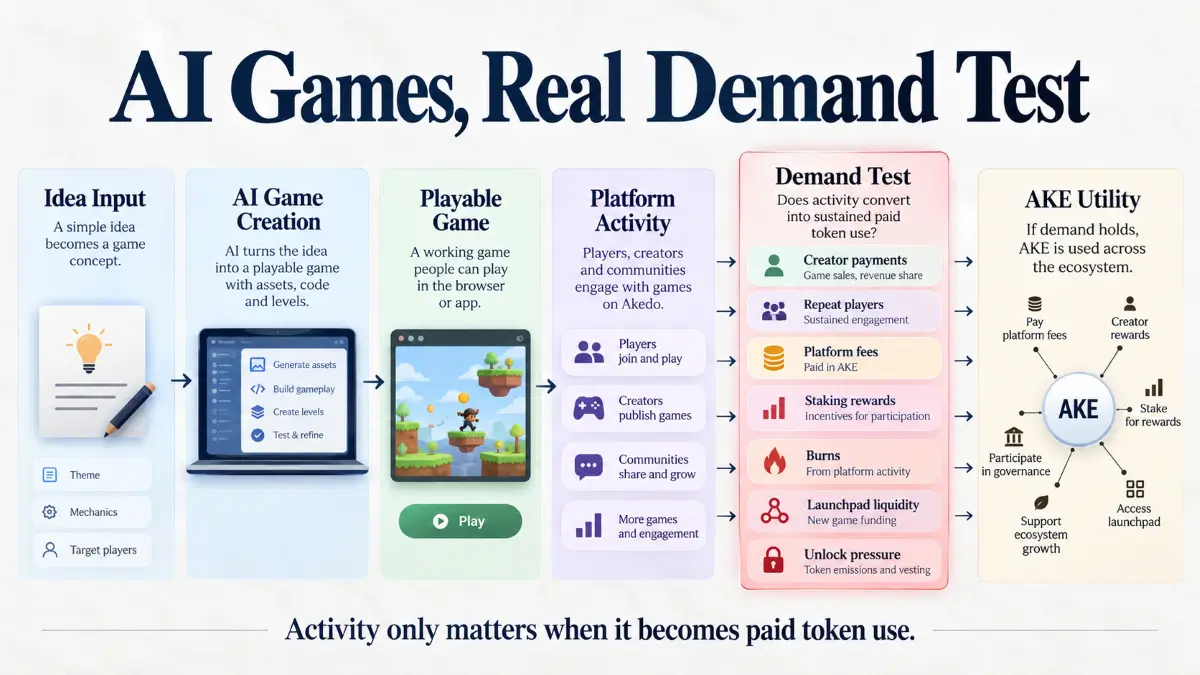
AI-generated games sound powerful because they reduce the distance between an idea and a playable product. Akedo is trying to turn that promise into a crypto economy where creators build games, players interact with them, and AKE sits inside payments, staking, rewards, burns, and launchpad liquidity.
This Akedo review focuses on the real question: can AI-generated game activity create durable AKE token demand, or does the token mainly depend on hype, incentives, and market cycles? The answer is not automatic. Akedo has a clear product idea, but AKE still needs repeat spending, transparent fees, player retention, and demand strong enough to absorb future supply.
Quick Verdict
Akedo has a stronger token-demand setup than many broad AI tokens because AKE is tied to creation prompts, publishing, staking, burns, and launchpad liquidity. That gives the token a visible role inside the platform rather than only a market narrative.
The risk is that visible utility does not automatically become net demand. AKE needs repeat creator spending, real player retention, transparent fee flow, and demand strong enough to absorb future unlocks. Until those signals are proven, Akedo remains an early, high-risk AI gaming thesis.
Key Takeaways on Akedo and AKE Demand
Akedo At a Glance
What Akedo Actually Does
Akedo is trying to make game creation easier through AI. Instead of requiring every creator to write code, design maps, define rules, balance gameplay, and create story structure manually, the platform uses specialized AI agents to assist with different parts of game generation.
That idea matters because game creation has always had a barrier: time, skill, team size, and money. If a creator can describe a game with natural language and generate a playable result quickly, Akedo can attract users who would never build inside a traditional game engine.
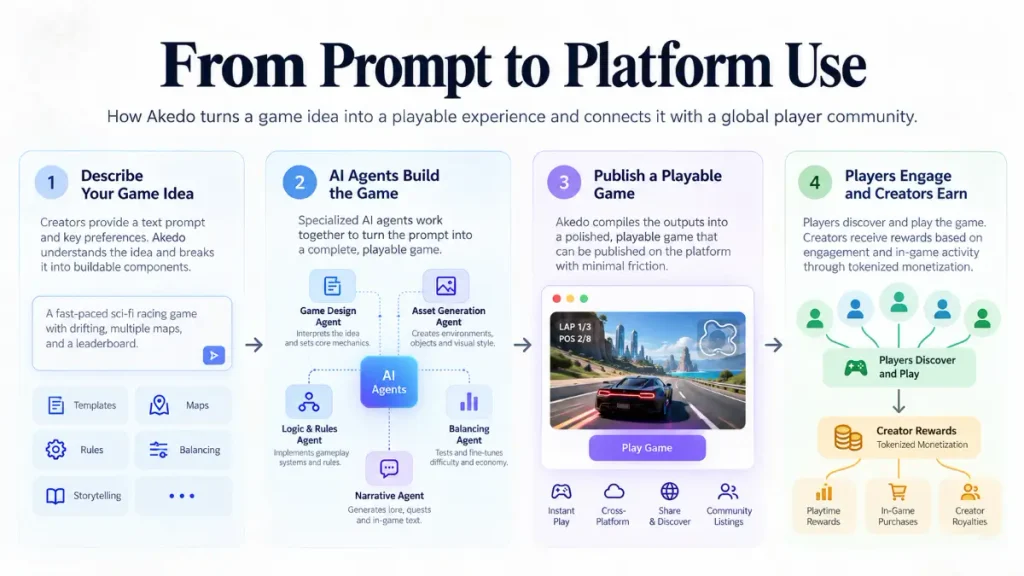
The platform’s stated structure includes templates, prompt-based game creation, game publishing, player participation, creator rewards, and tokenized monetization. In plain terms, Akedo wants to become a creation-and-distribution layer for AI-generated games.
But there is a difference between “users can create games” and “AKE captures value.” The first is a product claim. The second is a token-economics claim. This article focuses on the second because crypto investors often confuse platform usage with token demand.
The Main Misconception
The biggest mistake is assuming that every AI-generated game automatically helps AKE. It does not.
A game can be created without becoming valuable. A user can test a prompt once and never return. A player can open a game for rewards and leave when incentives fall. A creator can publish low-quality content that creates activity but not durable demand.
Akedo’s token thesis needs more than game count. It needs paid prompts, paid publishing, promotion demand, active players, recurring creator behavior, and fees that can flow into staking rewards or burns.
That is why the right question is not “Can Akedo create games?” The better question is “Can Akedo create games people want to use often enough that AKE becomes economically necessary?”
AI Game Activity Is Not Token Demand
AI activity can look exciting on the surface. More prompts, more games, more creators, and more players can all create the appearance of growth. But token demand only appears when activity forces users to acquire, spend, stake, hold, or pair the token in a meaningful way.
For AKE, the most important pathway is creator spending. If creators need AKE to prompt, publish, promote, or monetize games, then creator activity can create demand. If most activity is subsidized, free, or reward-driven, the link becomes weaker.
The second pathway is player engagement. If players use AKE-related points, in-game items, enhancements, multiplayer participation, or ecosystem rewards, then gaming activity can create token circulation. But player rewards can also become sell pressure if users mainly farm and exit.
The third pathway is platform fees. If Akedo produces protocol fees and a portion of those fees is burned or distributed to stakers, then real usage can create a stronger value loop. But that loop needs reporting. Without visible fee data, the market must rely on claims rather than measurable economics.

How Akedo’s System Model Works
Akedo has a multi-sided model. Creators need tools. Players need enjoyable content. Stakers need fee flow. The platform needs revenue. Token holders need demand stronger than emissions, incentives, and unlock pressure.
That structure can become powerful if each side improves the other. More creators can produce more games. More games can attract more players. More player activity can create more revenue. More revenue can support staking rewards, burns, and platform growth.
But multi-sided platforms are difficult to build. A weak link can damage the whole loop. If games are poor, players leave. If players leave, creators lose motivation. If creators stop publishing, token utility weakens. If rewards dominate usage, sell pressure can rise.
Akedo is not just competing with crypto games. It is also competing with normal mobile games, web games, Roblox-like creation platforms, AI tools, and every low-friction entertainment app fighting for user attention.
Mechanism and Value Path
Creation Tools and Product Evidence
Akedo’s creation model is its most important product layer. The platform describes a process where users select templates, enter natural-language settings, and use AI agents to generate game elements such as maps, enemies, rules, weapons, obstacles, messages, and narratives.
That is a real product direction because many people want to create but cannot code. AI lowers the barrier. Templates also matter because an empty canvas is hard for non-technical users. A guided template can make creation faster and more repeatable.
The question is quality. AI-generated content can be fast, but speed does not guarantee fun. Games need balance, replay value, polish, and social loops. If Akedo produces many low-quality games, activity numbers may rise but player retention may stay weak.
The second issue is originality. If many creators use similar templates, games can feel repetitive. That creates a risk where the platform grows in quantity but not in meaningful engagement. For AKE demand, quality matters more than raw output.
Player Activity and Retention Risk
Gaming projects often overestimate activity. A user can play for rewards, points, tasks, airdrops, or speculation. That creates traffic, but it may not create durable demand.
Akedo needs players who return because the games are enjoyable, not only because rewards exist. Repeat play is the bridge between product activity and token strength. If users only visit during campaigns, the token-demand case becomes weaker.
Player-side token systems can be useful, but they must be balanced carefully. If rewards are too generous, emissions can become sell pressure. If rewards are too small, users may not care. If rewards are confusing, mainstream users may ignore them.
The strongest version of Akedo would show growing player retention, creator revenue, game-level engagement, and fee generation. The weaker version would show many games created but few games that players actually want to revisit.
Evidence vs Token Demand
How AKE Demand Can Form
AKE demand can form through several routes, but not all routes are equally strong.
The cleanest route is creator spending. If creators need AKE for prompts, publishing, promotion, or monetization, then more serious creators can create recurring token demand. This is better than vague governance utility because it ties the token to an actual action.
The second route is platform fee flow. If users spend AKE and part of that fee is burned or distributed to stakers, then usage can feed into token economics. This gives AKE a stronger claim than a token that only exists for voting or rewards.
The third route is launchpad activity. If new game tokens launched through Akedo are paired with AKE, ecosystem growth can increase AKE’s liquidity role. But this route is riskier because token launches can attract speculation faster than real gaming communities.
The fourth route is staking. Staking can reduce liquid supply and reward long-term participants. But staking is not automatic value capture. If rewards come mostly from emissions, it can recycle supply. If rewards come from real protocol fees, the model becomes healthier.
Token Utility and Value Capture
AKE has more visible utility than many early-stage AI tokens. It is connected to creation, publishing, staking, burns, and liquidity pairing. That gives the token multiple possible sources of demand.
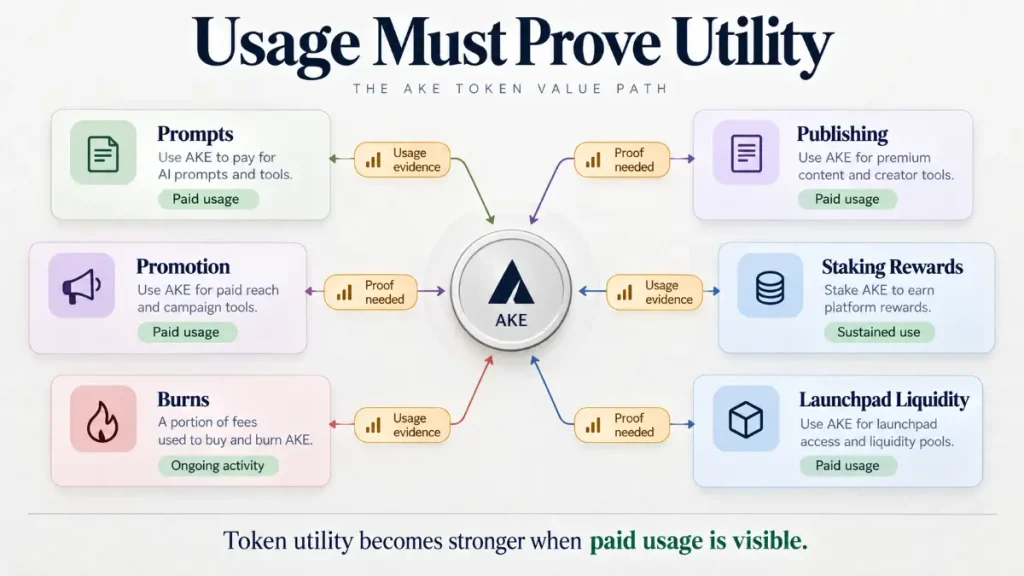
Still, the quality of those utilities matters. A cheap prompt fee can create usage but may not create large demand unless the number of users becomes meaningful. Publishing fees can matter more if serious creators publish often. Promotion spend can become useful if the platform has enough player attention to make promotion valuable.
Burns can support token economics, but burns do not magically create value. A small burn against a large supply may have limited impact. A burn funded by real fees is stronger than a burn funded by temporary incentives, but the size and consistency matter.
Staking can also help, but it must be evaluated carefully. If staking rewards are connected to protocol revenue, that is healthier. If rewards mainly depend on emissions or incentive pools, then staking can hide supply pressure rather than remove it.
Tokenomics and Supply Pressure
AKE has a large maximum supply of 100 billion tokens. Large supply is not automatically bad, but it makes percentage ownership, unlocks, market cap, and fully diluted valuation important.
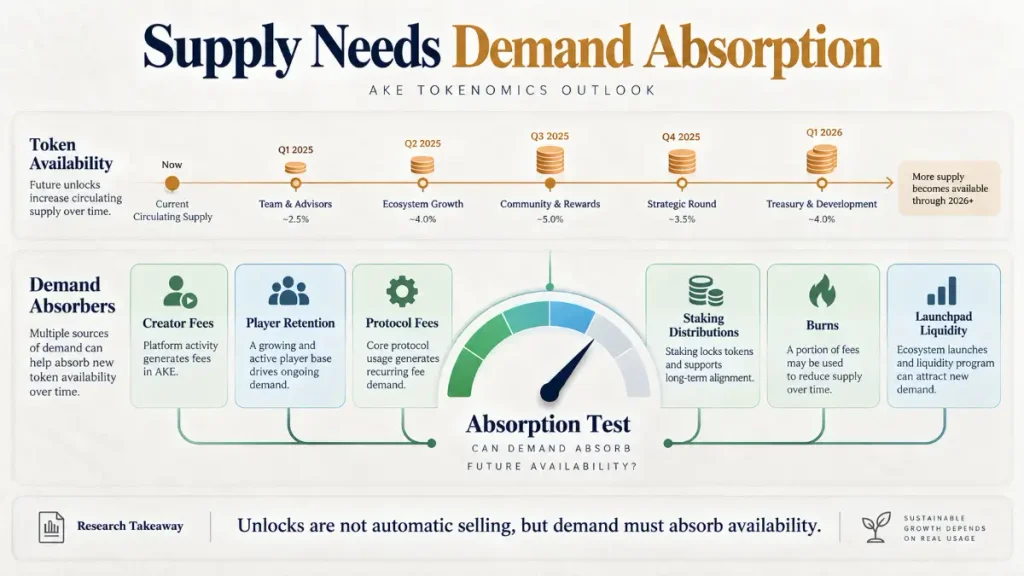
The key issue is vesting. If a meaningful share of supply remains locked and enters the market over time, demand must absorb that availability. Unlocks do not always create selling, but they increase the possibility of selling because more tokens become movable.
Investors, contributors, advisors, ecosystem rewards, player rewards, creator rewards, and marketing allocations all matter. Some allocations may support growth. Others may create pressure if recipients sell into liquidity.
The right approach is not panic. The right approach is monitoring. AKE needs real usage growth, fee growth, and retention strong enough to offset unlocks. Without that, the market can price the project based on future dilution risk rather than current product promise.
Tokenomics and Supply Table
Security and Governance Risks
AKE runs as a BEP-20 token on BNB Smart Chain. That gives it access to a large ecosystem, wallets, exchanges, and low-fee activity. It also means users must evaluate smart-contract risk, bridge exposure, token permissions, liquidity concentration, and exchange dependency.
A recent independent audit was not confirmed during this research pass. That does not prove the token is unsafe, but it does mean readers should be careful. Contract verification, ownership permissions, admin controls, upgradeability, minting rules, pausing powers, and liquidity structure should be checked before serious exposure.
Governance is also important. If the project depends heavily on the founding team, centralized product decisions, and platform-managed token economics, then users are relying on execution trust. That is common in early-stage app tokens, but it should not be confused with mature decentralization.
Gaming economies also carry abuse risk. Bots, farming, fake engagement, low-quality game spam, and reward extraction can distort activity. Akedo must show that its activity is real, repeatable, and economically useful.
Case For Akedo
The strongest case for Akedo is that it sits at the intersection of two major themes: AI creation and gaming. If the product works, the market is easy to understand. People want to create games faster, and AI can reduce the technical barrier.
AKE also has several possible value paths. It is not limited to a vague governance promise. Creation fees, publishing fees, staking, burns, and launchpad liquidity give the token a clearer role inside the platform.
The creator economy angle is also meaningful. If creators can publish games quickly and monetize through ads, tokens, rewards, or revenue sharing, Akedo can appeal to users who are not traditional developers.
The best version of Akedo is a platform where creators repeatedly spend AKE, players return to games, protocol fees grow, burns become visible, and staking rewards reflect real platform activity.
Case Against Akedo
The weak case is that Akedo may become another incentive-driven crypto gaming platform. Many GameFi projects create temporary activity through rewards but fail to keep users when incentives decline.
AI-generated games also face a quality problem. Fast creation can produce more content, but more content is not always better content. If games feel repetitive, shallow, or low-retention, activity may not support token demand.
Supply pressure is another serious issue. A large max supply and multi-year unlocks mean AKE needs continued demand growth. If the market values the project mainly on narrative, unlocks can become more painful during weak periods.
There is also transparency risk. The token-demand thesis becomes much stronger when users can see fees, burns, staking distributions, creator activity, game retention, and launchpad performance. Without that, the project relies more on story than evidence.
What Would Strengthen the Thesis
Akedo would become more convincing if it publishes clear platform metrics. The most important metrics are not only users or games created. They are paid prompts, paid publishing, active creators, returning players, game retention, protocol fees, burn amounts, staking distributions, and launchpad liquidity quality.
Creator-level evidence would help too. If serious creators are earning revenue from games built on Akedo, that supports the platform thesis. If most creators are only chasing rewards, the token case is weaker.
Game-level quality evidence matters. The project needs examples of games that players return to, share, and spend inside. A library of low-retention games would not support AKE demand strongly.
Finally, security transparency would help. Public audits, clear contract permissions, fee reporting, token unlock dashboards, and governance documentation would reduce uncertainty for readers and researchers.
Final Assessment
Akedo has a strong narrative, but the narrative is not enough by itself. AI-generated game creation can reduce friction for creators, yet AKE becomes more interesting only if that activity turns into repeat token spending, real fees, meaningful burns, useful staking rewards, and liquidity demand that survives beyond incentives.
The thesis is still conditional. Akedo can build a stronger token-demand story if creators and players use the platform because it is useful, not only because rewards or speculation exist. The token has visible utility, but utility still has to become net demand.
The biggest risk is cosmetic activity. A platform can show many games, many prompts, and many users while still failing to create durable token value. AKE needs evidence that paid usage and fee generation are growing faster than supply pressure.
The clean verdict is balanced: Akedo is worth watching as an AI-gaming token-demand experiment, but AKE should be judged by measurable usage, fee flow, retention, burn size, staking distributions, and unlock absorption, not by the excitement of AI-generated games alone.
Why Trust This Review
This review separates product activity from token demand. It does not assume that AI, gaming, staking, burns, or listings automatically create value. The analysis focuses on mechanisms, supply pressure, evidence gaps, and the conditions that would make AKE demand stronger or weaker over time.
Key Questions About Akedo and AKE Demand
Is Akedo only an AI gaming project?
Does game creation automatically increase AKE demand?
What is AKE used for?
What is Akedo’s strongest demand path?
What is the biggest risk for AKE?
Do AKE burns guarantee value?
Is staking enough to support AKE?
Why do token unlocks matter?
What evidence should readers watch next?
Is AKE a low-risk token?

Founder & Managing Editor of CryptosMedia. Zahid Hussain leads evidence-based crypto research covering tokenomics, security, governance, adoption, and risk.
CryptosMedia separates verified facts from interpretation, avoids buy/sell recommendations, and updates reviews when major evidence changes.