
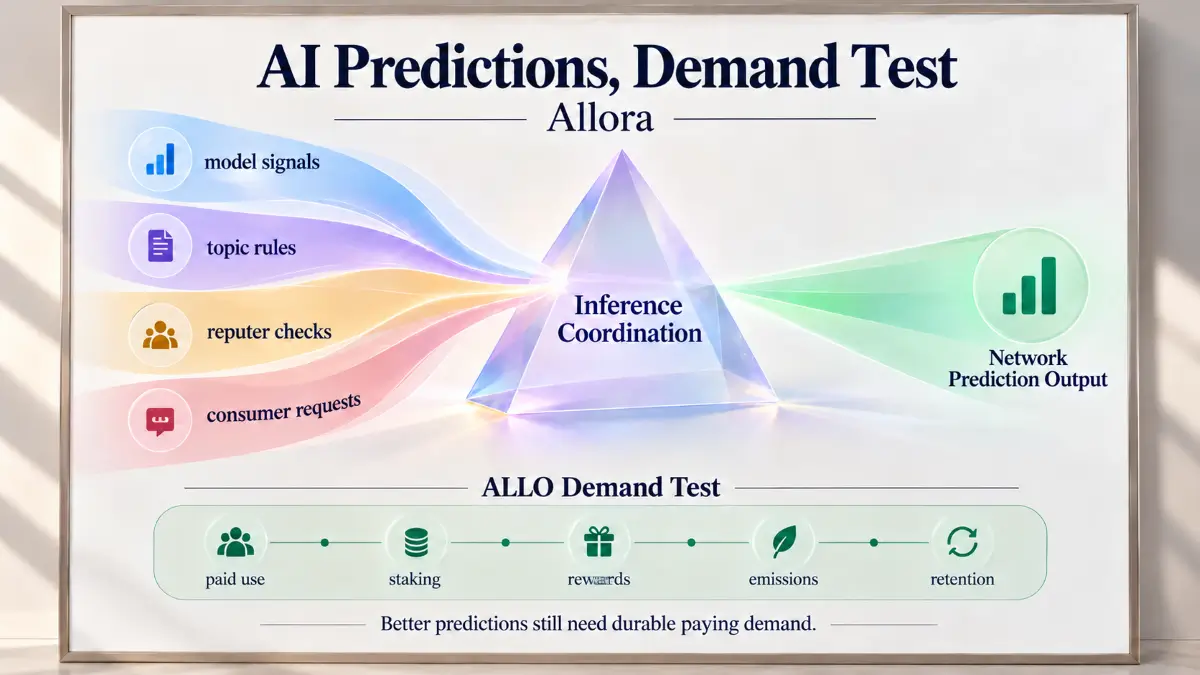
Allora spent much of 2026 turning prediction research into a more structured model pipeline. Forge added worker promotion rules, managed hosting, broader prediction formats, and new forecasting topics, while external applications continued testing whether coordinated model output can improve real decisions. That progress gives this Allora review something more useful to examine than an AI narrative alone.
Economic proof is harder. Useful predictions can attract models and applications, while ALLO rewards can keep contributors active, but neither automatically proves durable token demand. The stronger test is whether consumers repeatedly pay for intelligence, whether fees reduce reliance on new issuance, and whether demand can absorb staking incentives and future token releases.
Disclaimer
This Allora review is for research and education only, not financial, staking, legal, tax, or technical-audit advice. Supply, unlocks, rewards, staking rules, audits, bridge risks, and market conditions should be rechecked.
Disclosure
This review uses public Allora documentation, tokenomics, market data, security references, network updates, and integrations. CryptosMedia did not audit the code, operate validators, or independently verify model performance.
Quick Verdict
Allora’s strongest point is its specific product model. Instead of asking users to trust one prediction model, the network coordinates workers, forecasters, reputers, validators, and consumers around defined topics. Forge also gives model builders a visible route from experimentation toward live network participation.
The main uncertainty sits between prediction activity and economic demand. Consumers can pay ALLO for inferences, but Allora also distributes protocol emissions. A busy network can therefore produce many predictions and reward many contributors before customer-funded economics become large.
Supply is the other major test. ALLO has a defined one-billion-token maximum, yet significant backer and contributor allocations approach their first major vesting stage. Strong prediction utility will matter more for the token if paid usage and staking needs can grow alongside that additional availability.
Key Takeaways
Allora at a Glance
Research takeaway: Allora already has a defined product and participant model rather than only an AI-token concept. The harder question is whether useful intelligence produces enough paid demand to support the token economy as incentives and supply evolve.
From Many Models to One Signal
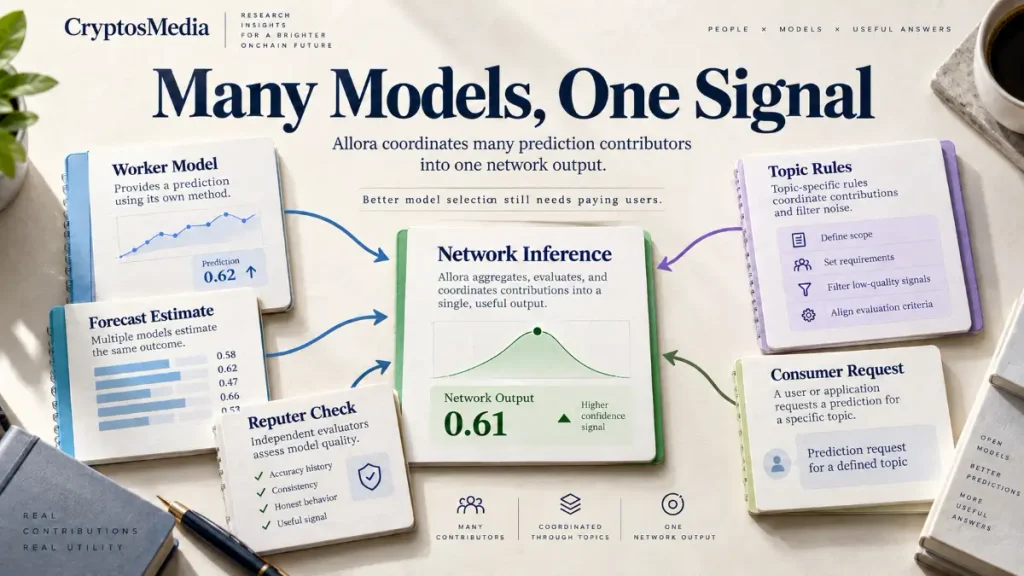
Allora organizes prediction work into topics. A topic defines the problem models are expected to solve, the timing of submissions, the evaluation framework, and the conditions under which contributors receive rewards.
Workers provide inferences. In a financial topic, that could mean forecasting a future return, price movement, volatility measure, probability, or other measurable output.
Forecasters add context by estimating how well individual workers may perform. That matters because the model that performed best in one market regime may not remain the best model after conditions change.
Reputers evaluate worker output after ground truth becomes available. Their reports help the network determine which contributions improved the final result. Reputers also stake ALLO, creating an economic commitment around the evaluation layer.
Validators secure the Cosmos-based appchain and process state transitions. Consumers sit at the opposite end of the system. They use the resulting intelligence and represent the clearest source of service demand because they can pay for inferences.
Allora therefore is not simply a marketplace where independent AI models list predictions. Its mechanism tries to coordinate their relative usefulness and synthesize a stronger network output.
That distinction matters because network value can come from better model selection rather than from one model always being right.
Accuracy Is Only Half the Economic Story
Prediction networks live or die on output quality. If Allora repeatedly produces weak signals, token mechanics cannot turn those signals into a durable service.
Strong forecasting evidence still needs careful interpretation. Model performance is normally measured against particular targets, time windows, loss functions, and market conditions. A model that performs well on an eight-hour crypto-return topic may provide little value on another asset or time horizon.
Allora’s 2026 promotion and relegation framework makes this limitation more visible. Workers are evaluated per topic rather than receiving a universal quality label. Directional accuracy, correlation, error improvement, bias, forecast scale, and participation can all matter when deciding whether a model deserves stronger network participation.
That is a healthier framework than treating every submitted model equally.
Economic value begins one step later. An application has to find the network inference useful enough to integrate, keep using, and eventually pay for. A statistically interesting forecast that nobody values economically remains product research rather than meaningful customer demand.
This is one of the most important distinctions in the Allora thesis. Good predictions support the product. Paid predictions support the economic model.
How Prediction Value Moves Through Allora
Research takeaway: Allora links model performance, economic security, and consumer payments inside one coordinated system. Strong token economics still require the consumer side to become important enough that paid demand is not overshadowed by incentive distribution.
Forge Shows a Real Supply Side
Forge has become one of the strongest pieces of Allora’s product evidence.
Recent public snapshots showed around 20 active testnet topics and roughly 1.9 thousand workers. Broader Forge statistics have also reported more than 2,400 models, which is why worker counts and model counts should not be treated as interchangeable measurements.
Worker promotion also became more structured in 2026. Instead of moving models toward mainnet through an informal judgment, Allora introduced topic-specific statistical gates. Promotion requires evidence that a worker contributes useful forecasting skill, while relegation uses a higher threshold to reduce the risk of removing models because of short noisy periods.
Managed Worker Hosting lowered another barrier. A builder can package a compatible model and use Forge for deployment, runtime management, signing, monitoring, and related infrastructure rather than assembling every operational component separately.
That can increase the number of models able to participate. It does not improve a weak model automatically, and it does not guarantee that a worker earns rewards.
Forge also expanded the kind of problems Allora can support. Mainnet v0.17 introduced classification and multi-output topic structures, allowing the network to return labeled probabilities or multiple values instead of only one numerical output.
Recent gold, silver, and oil triple-barrier topics push experimentation beyond crypto prices. These commodity topics belong in the testnet-evidence category rather than the proven commercial-adoption category.
Forge therefore strengthens the case that Allora can attract and evaluate model supply. It says much less about what external customers are willing to pay.
Practical Usage Matters More Than Partnership Counts
External integrations provide a better test because another application has to decide that Allora’s output is useful.
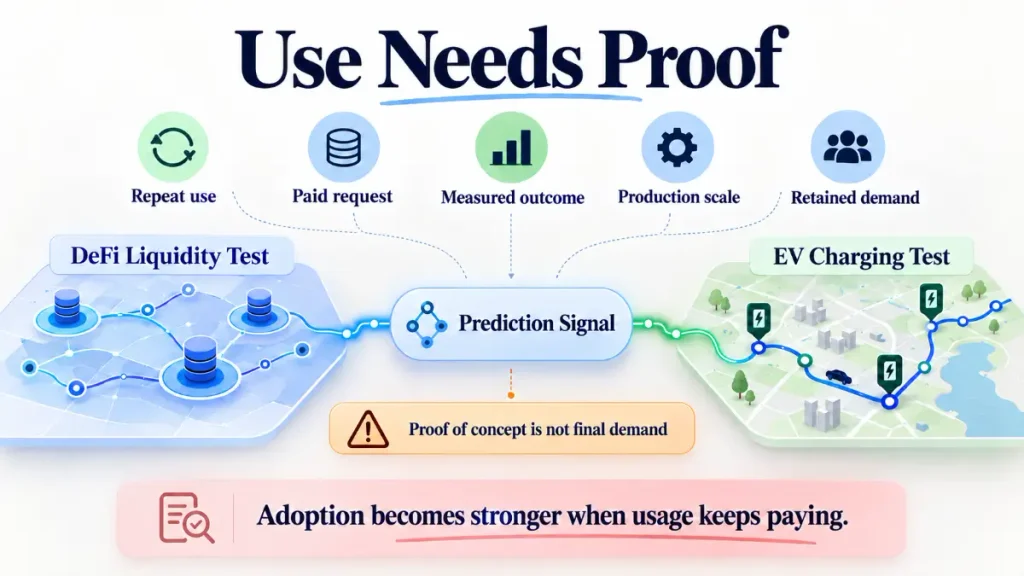
Image #4
Steer Protocol is one of the clearer examples. Its public material describes using Allora prediction feeds inside AI-assisted liquidity strategies. Price forecasts can influence how liquidity ranges are adjusted instead of leaving the strategy entirely reactive to past market movement.
Steer has also published testing around strategies using Allora data. That is stronger evidence than a simple partner announcement because it gives the prediction feed an operational purpose.
Even here, caution remains necessary. Strategy testing does not establish universal forecasting performance, and an integration does not reveal how much ALLO demand the application creates.
Another 2026 example involves Pairpoint by Vodafone. Allora and Pairpoint described a proof of concept around EV route and charging optimization, where different prediction topics could help estimate energy consumption, charger availability, and pricing.
The words proof of concept matter. This is evidence that Allora’s model-coordination design is being explored outside crypto-native trading, but it is not evidence of large production revenue or enterprise-scale deployment.
That distinction keeps the adoption thesis useful without turning partner names into economic proof.
Evidence Versus ALLO Demand
Research takeaway: Evidence for model development and real application experiments is meaningful. The missing economic layer is transparent recurring demand from consumers who continue paying because the intelligence improves decisions they care about.
Where ALLO Demand Actually Begins
ALLO has more than a governance label.
Consumers can use it to pay for network inferences. Workers and reputers can face token-based registration costs when participating in topics. Reputers and validators stake ALLO, while holders can delegate stake to network participants.
The inference-payment route is the cleanest demand path because it connects a customer directly to a service.
Participation fees may also create demand when valuable topics attract workers competing for access. Their importance depends on scale and frequency.
Staking works differently. Reputers and validators may need ALLO to secure their roles, and delegated tokens can reduce immediately liquid supply. Yet existing tokens can repeatedly circulate through staking without requiring equivalent new acquisition from outside the system.
Rewards should not be counted as demand merely because recipients receive ALLO. Demand describes why someone wants to acquire or use the token. Reward distribution describes how the protocol compensates participants.
A stronger economic loop would connect all of these components. Good topics attract skilled models, better intelligence attracts consumers, consumers pay meaningful fees, fees help compensate contributors, and staking protects the system supporting those transactions.
Pay-What-You-Want Changes the Test
Allora’s inference market does not impose one rigid service price. Consumers can choose how much ALLO they are willing to pay for an inference.
That can lower the barrier to experimentation and allow different topics to discover different economic values.
The mechanism also contains an important discipline. Official documentation states that when users pay zero fees to a topic, its weight tends toward zero. Participants in that topic receive no rewards from it, while token emissions shift toward other topics.
This means usage without willingness to pay cannot indefinitely carry the same economic importance inside the system.
The mechanism is interesting, but it does not automatically create high-value demand. Consumers may use predictions while consistently assigning very small fees. In that case, the network can show usage without developing a large customer-funded economy.
The better signal is not merely how many inferences users request. It is whether applications voluntarily assign meaningful value to those requests and continue doing so over time.
Rewards Need Two Different Ledgers
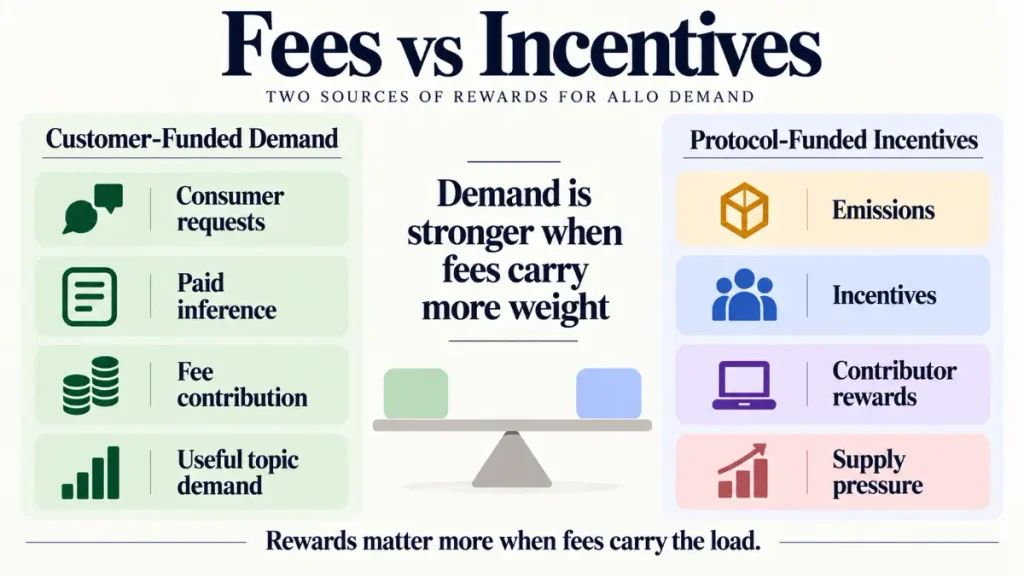
Allora contributor rewards can draw from transaction fees, inference-request fees, and inflationary token rewards.
Those sources should never be collapsed into one revenue number.
A consumer paying for intelligence introduces economic value from outside the contributor reward loop. Newly minted ALLO creates compensation through issuance.
Emissions can be useful during an early network stage. Model builders, reputers, and validators incur real costs before customer demand necessarily becomes large enough to fund the complete system.
The long-term question is whether customer fees take on a larger role as the network matures.
Allora’s tokenomics puts fees and emissions into the participant reward model while tying issuance to economic activity. That gives the thesis a measurable direction rather than making rising rewards sufficient evidence by themselves.
Rising rewards alone are weak evidence. Rising rewards alongside increasing fee contribution would be much stronger.
Utility Does Not Settle Value Capture
ALLO has clear utility across the network. Few questions remain about whether the token can be used.
The unresolved issue is how economically intensive those uses become.
One consumer making an occasional low-value request creates limited demand. A production application continuously buying predictive intelligence creates a very different economic profile.
Likewise, a handful of workers paying registration costs creates less demand than a competitive market where profitable topics repeatedly attract new participants.
Token utility therefore defines possible demand routes. User behavior determines whether those routes become economically important.
Supply Pressure Approaches a More Important Stage
Official tokenomics sets ALLO’s maximum supply at 1 billion.
The original distribution assigns 31.05% to early backers, 21.45% to network emissions, 17.50% to core contributors, 9.35% to the Foundation, 9.30% to the community, 8.85% to ecosystem and partnerships, and 2.50% to Allora Prime staking rewards.
Backers and core contributors together represent 48.55% of maximum supply.
Both groups have a three-year release structure. Their tokens remain locked for the first 12 months, then 33% becomes available, with the remaining amount vesting linearly during the following 24 months.
Because ALLO launched on November 11, 2025, the first anniversary makes November 2026 an important supply checkpoint.
Unlocking should not be described as automatic selling. Recipients may hold, stake, delegate, transfer, or sell.
It does change potential availability.
Current supply reporting also deserves unusual care. During this review check, CoinMarketCap reported approximately 200.5 million ALLO circulating. CoinGecko showed about 255 million. Token unlock tracking separately reported roughly 255 million tokens unlocked.
These numbers do not necessarily measure the same thing. Unlocked tokens are not automatically part of public circulating float, and data providers use different methodologies.
That distinction is important enough that the article should preserve the disagreement instead of selecting whichever number appears more convenient.
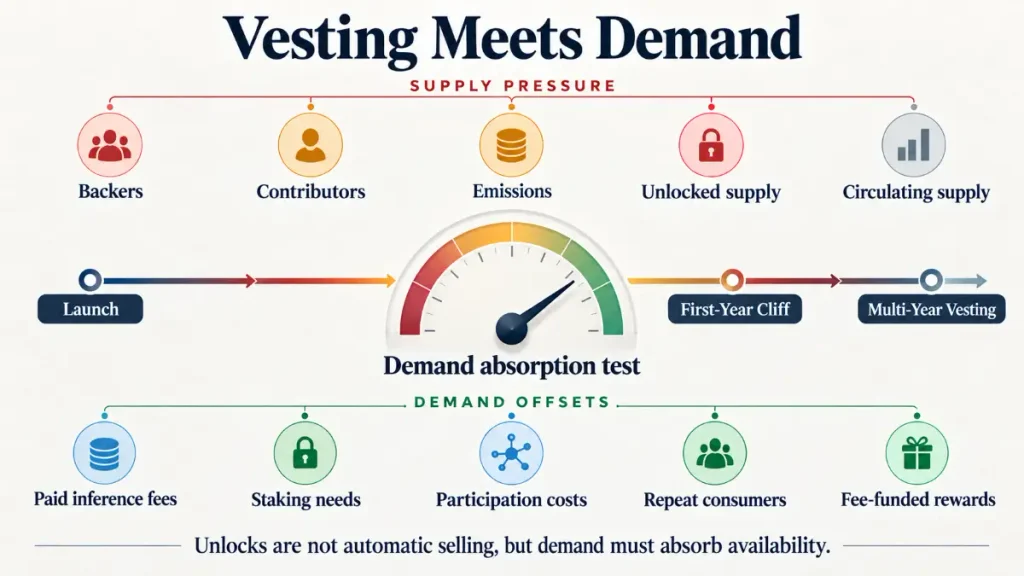
ALLO Supply Pressure
Research takeaway: The one-billion cap limits ultimate issuance but does not eliminate near-term dilution and vesting pressure. Paid inference demand and genuine staking needs become more important as larger allocations begin moving through their release schedules.
Security Extends Beyond Smart Contracts
Allora’s risk surface includes its appchain, staking logic, economic parameters, bridges, model evaluation, ground-truth systems, and participant behavior.
A public Sherlock audit record exists for Allora’s 2024 code review scope. That is meaningful security evidence, but readers should not translate one review into a permanent claim that every later network version has been fully audited.
Audit scope matters because software evolves. A review covering an earlier chain or inference implementation does not automatically cover every later feature, deployment, contract, or bridge.
Prediction integrity introduces risks that conventional contract audits cannot solve. Ground truth can be difficult to define, models may converge on similar errors, and unusual market regimes can make historical performance less useful.
Reputer incentives also matter because inaccurate evaluation can influence which workers receive economic weight. Stake raises the cost of careless behavior, but staking does not guarantee perfect judgment.
ALLO’s multichain availability adds bridge assumptions as well. Moving representations between the native network and external chains introduces additional infrastructure that users should distinguish from the security of the Cosmos appchain itself.
Security therefore needs two separate lenses: software security and prediction-system integrity.
Why the Allora Thesis Has Substance
Allora targets a genuine problem. An application that wants predictive intelligence normally has to select models, source data, operate inference infrastructure, monitor performance, and adapt when conditions change.
A network that makes models compete and adjusts their influence according to observed performance can reduce part of that burden.
Forge strengthens the supply side by giving builders clearer testing, deployment, and evaluation paths. Promotion rules also create a standard a model must meet before gaining a stronger production role.
External use cases show that predictions can leave the Allora interface and influence real applications. Steer is particularly useful evidence because the forecasts serve a defined operational function rather than existing only as a demonstration.
ALLO also has a direct payment role. That gives the token a clearer potential value path than an AI token whose only function is governance or speculative incentives.
The project case therefore has substance. The token case still depends on economic scale.
Where the Thesis Is Still Weak
Customer economics remain less transparent than contributor activity.
Workers, topics, stakes, rewards, and emissions can be observed relatively easily. Comparable evidence showing recurring fee revenue, unique paying consumers, and the share of rewards financed by customer payments remains more important to the token thesis.
The Pay-What-You-Want model adds uncertainty because usage can grow without proportional fee growth.
Emissions may also create an attractive environment for model builders before external demand catches up. That can be rational during network development, but it becomes a weakness if incentives remain the dominant economic engine for too long.
Supply creates another challenge. Almost half of maximum supply went to backers and core contributors combined, and their release schedules become more relevant after the first year.
Finally, predictive intelligence carries inherent model risk. Financial markets change regime, new data can break assumptions, and yesterday’s best model can become tomorrow’s weak contributor.
What Would Strengthen the Evidence
Transparent inference-fee reporting would make the biggest difference.
A dashboard separating customer fees from emissions would allow readers to see whether model activity is becoming an actual service economy.
More third-party applications should also show repeat usage rather than only integration announcements. Production deployments that continue paying for predictions because the outputs improve measurable decisions would carry much more weight than partner logos.
Forge growth would become stronger evidence if testnet competition consistently produces useful mainnet workers and those topics attract paying consumers.
A rising share of contributor rewards funded through fees rather than new issuance would be another strong signal.
Supply reporting also needs to remain clear as the November vesting stage approaches. Circulating, unlocked, staked, delegated, and vested tokens should not be blended into one number.
What Would Weaken the Thesis
Rising inference counts alongside stagnant customer fees would be an important warning.
So would a network where most useful topics depend heavily on emissions even after applications have had time to adopt the product.
Pay-What-You-Want activity concentrated around negligible payments would suggest that users like access to predictions more than they value them economically.
Persistent failures during changing market regimes would weaken the product case, while weak ground-truth systems or concentrated evaluation power could damage confidence in model ranking.
Large increases in available supply would become more difficult to absorb if these economic weaknesses appeared at the same time.
Final Assessment
Allora has developed beyond the stage where it should be judged as a generic decentralized-AI narrative.
Its architecture has clear roles, Forge gives model contributors a structured operating environment, v0.17 expanded the range of prediction tasks the network can express, and real integrations provide evidence that external applications can use its outputs.
The product case and token case are still different.
Useful predictions can make Allora valuable even if many contributors are paid through emissions. ALLO becomes economically stronger when consumers need the intelligence enough to pay for it repeatedly, participation creates genuine token requirements, and staking secures meaningful activity rather than mainly circulating incentives.
The approaching vesting stage makes that distinction more important. A one-billion maximum supply provides a ceiling, but a ceiling alone does not determine near-term supply pressure.
The clearest monitoring set is therefore not price or partnership count. It is paid inference fees, recurring consumers, fee-funded reward share, active mainnet topics, reputer and validator stake, Forge-to-mainnet progression, prediction quality across changing regimes, and the amount of ALLO entering practical circulation as vesting advances.
Allora does not need every model to win. Its thesis works if coordinated intelligence remains useful enough that customers repeatedly place economic value on the network’s output.
That remains the strongest test for ALLO demand.
Why Trust This Review
This review separates four things that are easy to confuse: model activity, prediction usefulness, protocol rewards, and external token demand.
Primary evidence includes Allora documentation, tokenomics, Forge activity, network release information, and public security records. External evidence is considered where it adds independent context to integration, supply, and security claims.
Project-reported partnerships and research are treated as supporting evidence rather than independent proof. Supply-provider disagreement is also preserved instead of forcing one figure into the article.
No claim is made that CryptosMedia personally tested Allora models, operated network infrastructure, audited its code, or independently reproduced its prediction results.
Key Questions About Allora and ALLO Demand
What does Allora Network do?
Allora coordinates multiple machine-learning contributors and combines their work into network inferences that applications can consume.
What is ALLO used for?
ALLO supports inference payments, topic participation, staking, delegation, and network reward distribution.
Do accurate predictions automatically create ALLO demand?
No. Useful predictions become stronger token-demand evidence when consumers repeatedly pay meaningful fees for them.
What is Allora Forge?
Forge is Allora’s environment for building, evaluating, deploying, and competing prediction workers across defined topics.
Who evaluates Allora’s predictions?
Reputers compare worker output with ground truth and help determine contribution quality, while staking adds an economic commitment to that role.
How are inference fees priced?
Allora uses a Pay-What-You-Want model, allowing consumers to choose how much ALLO they assign to an inference request.
Are contributor rewards the same as network revenue?
No. Rewards can include customer fees and newly issued ALLO, so the source of compensation matters.
What is ALLO’s maximum supply?
Official tokenomics sets the maximum supply at 1 billion ALLO.
Why is November 2026 important?
Major backer and core-contributor allocations reach the first stage of their 12-month vesting cliff around the first anniversary of ALLO’s launch.
What would provide the strongest evidence for ALLO demand?
Recurring paid inference fees, repeat consumers, higher fee-funded rewards, useful mainnet topics, sustainable staking demand, and transparent supply reporting would strengthen the thesis most.

Founder & Managing Editor of CryptosMedia. Zahid Hussain leads evidence-based crypto research covering tokenomics, security, governance, adoption, and risk.
CryptosMedia separates verified facts from interpretation, avoids buy/sell recommendations, and updates reviews when major evidence changes.