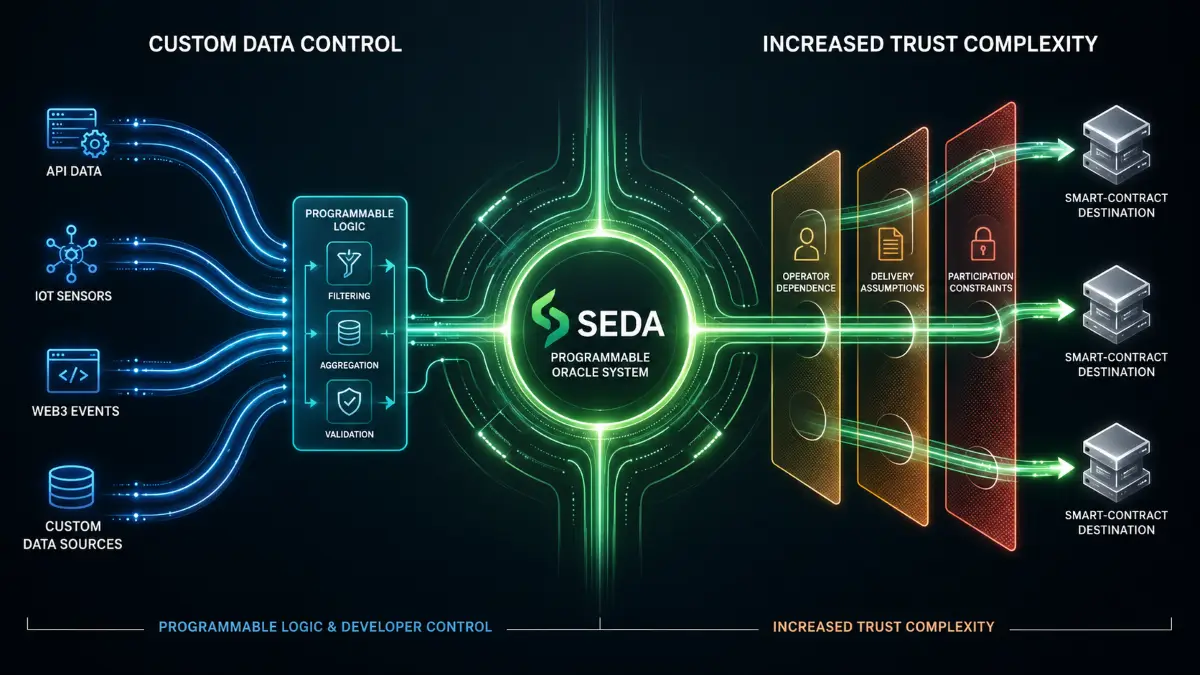
This SEDA Protocol Review examines the unusual freedom SEDA gives developers for an oracle network. They can choose the source, define the calculation, set the replication level, and decide how the result reaches another chain. That flexibility is the product. It is also the risk surface.
The review follows each handoff from source to destination. The aim is not to ask whether SEDA can move data. It can. The useful question is whether an application can explain who supplied the data, how SEDA processed it, who relayed the result, and what the receiving contract accepts as valid.
SEDA Lets Developers Program the Oracle Itself
SEDA is an application-specific Layer 1 for programmable oracle infrastructure. It uses Cosmos SDK and CometBFT for the base chain. Oracle Programs define the instructions used to retrieve, filter, aggregate, calculate, and return external data.
That is different from asking a network for one predefined market feed.
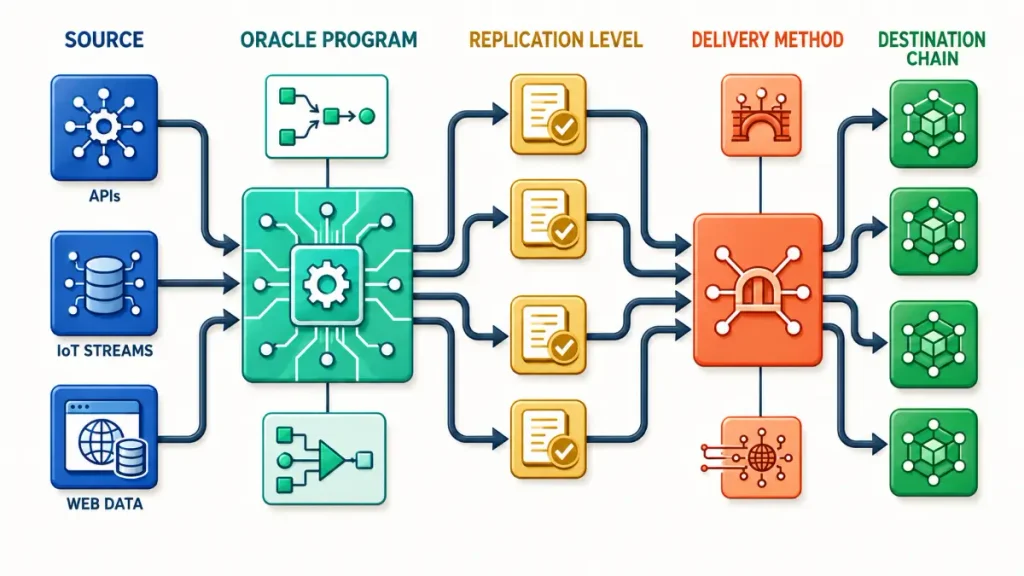
A builder can request public API data, use private data through a proxy, combine several sources, or apply custom logic before the result reaches an application. The Oracle Program documentation describes these programs as WASM-based instructions that tell the network what to query and how to process the response.
The flexibility can support markets that do not fit a standard feed. It can also move more responsibility toward the builder.
A well-secured network cannot make a weak source reliable. It cannot fix a bad weighting rule. It cannot reject an economically strange answer unless the Oracle Program or receiving application defines that rule.
One Data Request Crosses Several Trust Boundaries
A SEDA data request does not travel through one component.
A Solver can relay the request to SEDA. Overlay Nodes query the sources named by the Oracle Program. The tally phase applies the program’s calculation rules. Validators coordinate the chain state and sign data batches. A Solver then returns the result to a destination-side Prover Contract, where an application can consume it.
Each step solves a different problem.
| Layer | Main job | Main question |
|---|---|---|
| SEDA Chain | Consensus, batching and canonical state | How distributed is validator control? |
| Oracle Program | Source selection and computation | Are the rules appropriate and inspectable? |
| Overlay Network | External data retrieval | Who operates the nodes, and how many sources are queried? |
| Solver Network | Request and result relay | Can delivery fail, stall, or become concentrated? |
| Prover Contract | Destination verification | Which signer, proof and upgrade rules apply? |
| Receiving application | Final acceptance decision | What happens when data is stale, missing, or implausible? |
Oracle security is not one signature. It is a chain of decisions.
That same distinction appears in our cross-chain verification analysis. A result can be authentic while the system around it still contains weak assumptions.
Source Quality Remains Outside Consensus
External data creates a problem that blockchains cannot solve through consensus alone.
If ten nodes read the same incorrect API, consensus can faithfully agree on the wrong answer.
SEDA gives Oracle Programs tools to reduce that risk. Builders can select several sources. They can choose a replication factor. Overlay Nodes can query independently and commit results before revealing them.
Those controls help only when the configuration uses them well.
A program that depends on one exchange still inherits that exchange’s outage risk. Poor weighting can still distort a multi-source result. Private providers can still publish bad values.
Developers should be able to explain their endpoints, missing-data rules, outlier handling, and fallback logic. Customization is valuable when those rules are clear. It becomes another trust layer when they are not.
The comparison with a more standardized oracle model is useful here. A fixed or established feed can reduce configuration freedom. SEDA moves in the opposite direction and gives builders more control over the feed itself.
Neither approach removes the need to inspect the exact feed.
The Overlay Network Has Its Own Decentralization Question
SEDA’s base chain and its Overlay Network should not receive one shared decentralization label.
The chain uses proof of stake. Validators produce blocks and participate in batch signing. The MiCA material describes an active validator set capped at up to 100, selected by delegated stake.
The Overlay Network performs a different job. Its nodes fetch the external data requested by Oracle Programs.
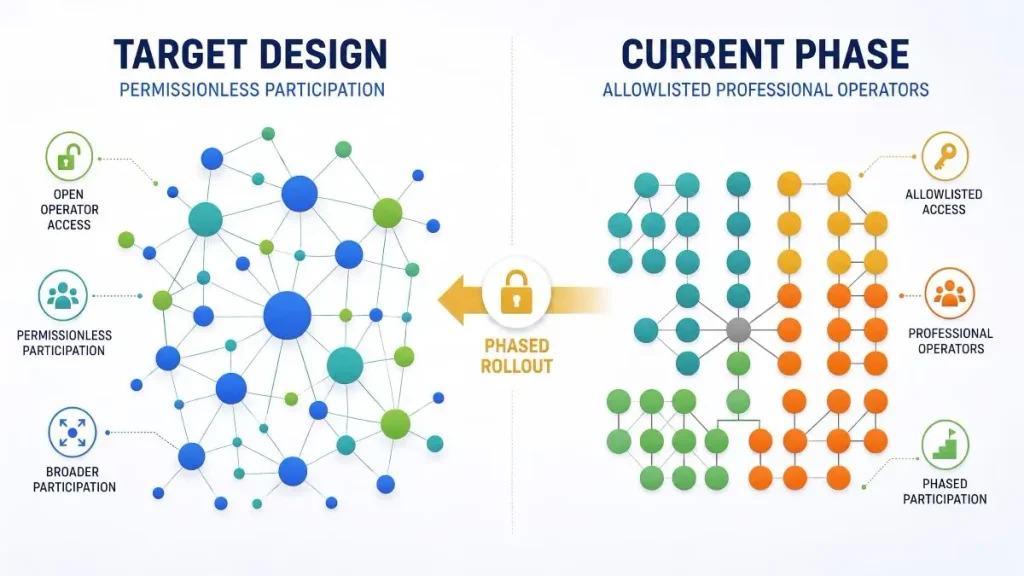
SEDA documentation describes the long-term Overlay model as permissionless.It also says the rollout occurs in phases, with phase one using an allowlisted group of professional validator companies.
A staged rollout can explain both statements.
Secret committees and commit-reveal can reduce some coordination risks. They do not prove that operators have independent ownership, infrastructure, or incentives.
The useful measurements are operator count, stake concentration, committee diversity, and the process for adding or removing participants.
Solvers Move Results, but They Do Not Make Results True
The Solver Network connects SEDA with destination chains.
Solvers watch for requests, quote the cost of relaying them, submit requests to SEDA, and return completed results to Prover Contracts. The model lets independent Solver operators compete.
A requestor can settle with a Solver in a currency that the Solver accepts. The Solver still needs SEDA inventory to pay the network-side execution costs.
That detail matters for token analysis later. It also matters for reliability.
A Solver outage can interrupt delivery without changing the truth of the underlying data. A destination contract can also contain its own verification or upgrade risk.
Our interoperability risk review makes the same distinction. Transport security and source truth are separate problems. A valid proof of delivery does not prove that the original API was accurate.
SEDA FAST Changes Latency, Not the Meaning of Trust
SEDA FAST provides a lower-latency delivery path for Oracle Programs.
SEDA’s delivery documentation says endpoint latency can be as fast as 50 milliseconds in internal benchmarks. That is not an end-to-end guarantee.
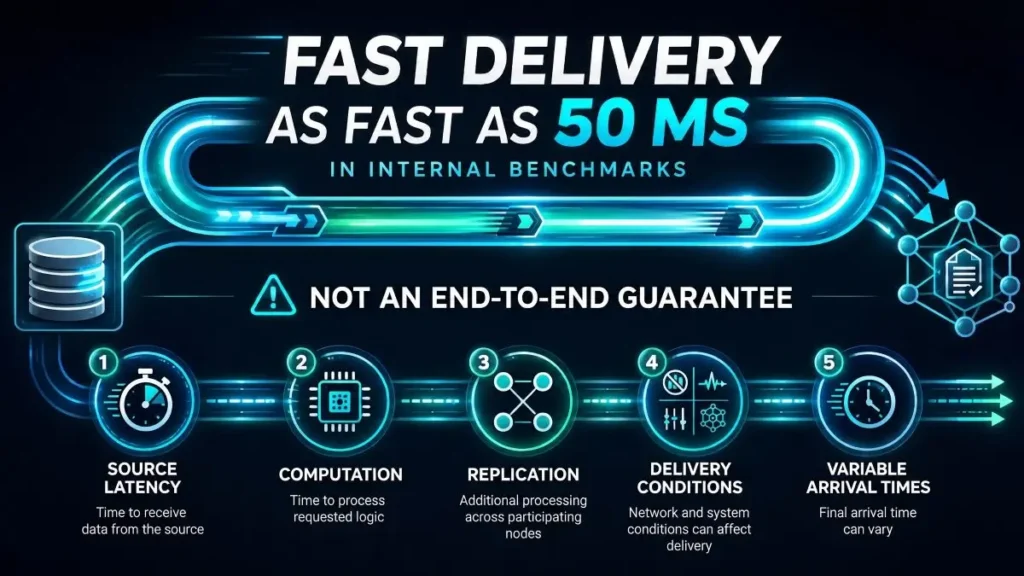
Readers should not convert speed into a broader security claim.
A fast response can still come from a weak source. A signed response can still contain a calculation that the receiving application should reject. Network latency also differs from the total time between a real-world event, source publication, data retrieval, processing, delivery, and application action.
FAST therefore changes one part of the path.
FAST does not turn SEDA into a separate asset. Core remains the onchain path. Source, operator, and application risk still exist.
The same caution applies when comparing SEDA with a multi-service oracle network. Headline speed means little without the exact delivery path, signer model, source set, and application rules.
The 2025 Sherlock Audit Found Serious Issues Before Launch
Audit language needs particular care with SEDA.
Sherlock’s public 2025 review did not report a clean codebase with no high-severity findings. Its final report recorded 19 high-severity and 15 medium-severity issues in the reviewed scope.
That sounds severe because it is material security evidence.
The other half of the evidence also matters. The report summary listed zero high or medium issues in the category ‘not fixed and not acknowledged.’ Individual findings show remediation discussions and linked fixes for issues involving chain halts, batch-signature validation, withdrawals, gas handling, and other protocol paths.
Readers should therefore avoid two opposite mistakes.
First, the audit does not prove SEDA was unsafe at launch. It happened before the full feature launch and drove remediation.
Second, the audit does not prove the current network is safe. Sherlock reviewed particular repositories, commits, contracts, and assumptions.
Sherlock’s public 2025 review is useful because it exposes actual failure modes rather than offering an audit badge.
Trail of Bits also reviewed earlier token-migration, staking, and vesting components. That scope is narrower than the later full-feature audit.
Audit evidence should follow the component and version.
SEDA Token Demand Can Be Direct or Indirect
The SEDA token supports proof-of-stake security, governance, network execution, and participation by infrastructure operators.
Validators and delegators use SEDA for staking. SEDA also plans to use staked tokens for Overlay participation as that layer moves toward its permissionless model.
Builders pay network costs associated with Oracle Program deployment and data-request execution.
The Solver path adds an important nuance. A requestor does not always need to hold SEDA directly. A Solver can accept another currency from the requestor, then use its own SEDA inventory to interact with the network.
This can improve user experience. It also means end-user adoption and direct end-user token demand are not the same metric. Demand can appear one layer behind the user through Solver replenishment.
Useful evidence would show Solver inventory turnover, execution costs, staking demand, and real data-request volume.
Burns Link Usage to Supply, but Inflation Still Matters
SEDA began with a genesis supply of one billion tokens.
Official token information says previous financing-round tokens have completed vesting and now circulate. That removes a large class of future financing-round unlock risk.
It does not create a fixed supply.
SEDA uses governance-defined inflation to support validators and delegators. The public material does not state a permanent hard maximum. Network execution can push the other way because data requests create deterministic SEDA burns.
| Supply mechanism | Current documented position | What it means |
|---|---|---|
| Genesis supply | 1.0B SEDA | Starting supply, not a permanent cap |
| DAO Treasury | 43.5% at genesis | Governance controls a large ecosystem allocation |
| Initial circulating allocation | 25.8% at genesis | Large share entered circulation early |
| Contributors, advisors and early backers | 18.1% combined at genesis | Official docs now describe prior financing rounds as fully vested |
| Team | 12.6% at genesis | Team distribution remains relevant to concentration analysis |
| Inflation | Governance-defined | Supply can expand |
| Data-request burn | Deterministic execution-linked burn | Usage can remove SEDA from supply |
| Fixed maximum | None stated in current public material | Burn does not turn the token into a fixed-cap asset |
This creates a real usage-to-token link, but the size of the effect remains the key question.
A burn can be small. Inflation can exceed it. Treasury distribution can increase available supply, while staking locks tokens without destroying them.
The correct comparison is issuance versus burn over the same period, alongside staking and treasury flows.

Treasury Size Makes Governance More Than a Voting Feature
The genesis allocation placed 43.5% of SEDA in the DAO Treasury.
That does not mean the full treasury amount circulates freely. It does mean governance decisions can materially shape ecosystem funding and token distribution.
SEDA governance follows the Cosmos model. Token holders can delegate to validators, and validators vote on proposals that can change network parameters.
Governance therefore affects more than branding.
It can influence inflation settings, upgrades, treasury deployment, and the economic environment around validators and builders.
A large treasury can fund growth for years. It can also create concentration questions when voting power or turnout is weak.
Proposal turnout, validator voting power, and major treasury outflows matter more than the percentage alone.
Large Data Coverage Is Not the Same as Large Usage
SEDA’s current documentation advertises access to more than 11 million symbols across markets that include equities, commodities, crypto, private equity, real estate, prediction markets, options, foreign exchange, and Treasury rates.
That is a coverage claim.
Writers should not report that figure as 11 million actively consumed feeds.
The project also highlights session-aware equity use cases for extended or continuous markets. These examples show why programmable logic can matter beyond a simple spot-price endpoint.
Adoption still needs separate evidence: recurring requests, paying applications, burn, Solver activity, uptime, and Oracle Programs that real applications continue to use.
A large data catalog proves availability.
Repeated paid or fee-generating consumption proves demand.
What Would Strengthen the SEDA Case?
SEDA’s technical concept is already clear enough.
The next improvement is evidence density.
Major integrations should expose the Oracle Program ID, source set, replication factor, fallback logic, delivery path, and destination-side freshness rules. Overlay participation should become easier to measure as the network progresses beyond staged allowlisting.
Token analysis needs the same transparency.
The explorer can show requests and burn. Readers also need an easy way to compare burn with inflation, staking participation, treasury movement, and Solver inventory demand over matching periods.
Security evidence should stay version-specific. Future audits should map directly to current Core contracts, Prover deployments, Overlay code, and major upgrades.
Those disclosures would make SEDA easier to judge without relying on marketing language.
SEDA Protocol Review Verdict: Programmability Is the Advantage and the Burden
SEDA solves a real oracle problem.
Some applications do not need another standard price feed. They need custom sources, custom calculations, private data, or a delivery path that can reach several chains.
Oracle Programs give builders that freedom.
The cost is responsibility.
Source choice, replication, computation, Overlay participation, Solver delivery, Prover verification, and application acceptance rules all affect the final result. A signed answer can still be a bad answer if one of those decisions is weak.
SEDA’s security record also deserves a balanced reading. The 2025 Sherlock review found many high and medium issues before launch, while the report documents extensive remediation. That is stronger evidence than either calling the protocol unaudited or calling it proven safe.
The token model has a measurable connection to usage. Network execution burns SEDA, infrastructure participants need token inventory, and staking secures the chain. At the same time, governance-defined inflation and a large treasury make isolated burn figures incomplete.
SEDA is therefore most convincing as programmable data infrastructure.
Its long-term quality will depend on how clearly developers expose their configurations, how widely the retrieval and validation layers decentralize, and whether real request activity becomes large enough to make the token mechanics economically meaningful.
Frequently Asked Questions
SEDA Protocol is a programmable oracle network. It lets applications define external data sources, processing rules, and delivery methods before using the result on supported blockchains.
No. SEDA FAST is a lower-latency delivery framework within the SEDA ecosystem. It uses Oracle Programs and does not create a separate cryptocurrency.
No. SEDA can coordinate retrieval, computation, signing, and delivery. Source quality and application acceptance rules still matter.
SEDA describes permissionless participation as its target design. Current documentation also describes a phased rollout that begins with an allowlisted group of professional operators. Developers should check the live participation model when evaluating an integration.
Current public material does not state a permanent fixed maximum. Governance-defined inflation can increase supply, while data-request execution can burn tokens.
SEDA’s current token information says previous financing-round tokens have completed vesting and now circulate. Treasury and other governance-controlled balances remain separate supply considerations.
Yes. The 2025 public report recorded 19 high and 15 medium findings in scope. Its summary also listed zero high or medium issues as both unfixed and unacknowledged. The audit remains evidence for specific reviewed code, not a permanent safety guarantee.

Founder & Managing Editor of CryptosMedia. Zahid Hussain leads evidence-based crypto research covering tokenomics, security, governance, adoption, and risk.
CryptosMedia separates verified facts from interpretation, avoids buy/sell recommendations, and updates reviews when major evidence changes.
3 thoughts on “SEDA Protocol Review: Custom Data, Hidden Trust Trade-Offs”