
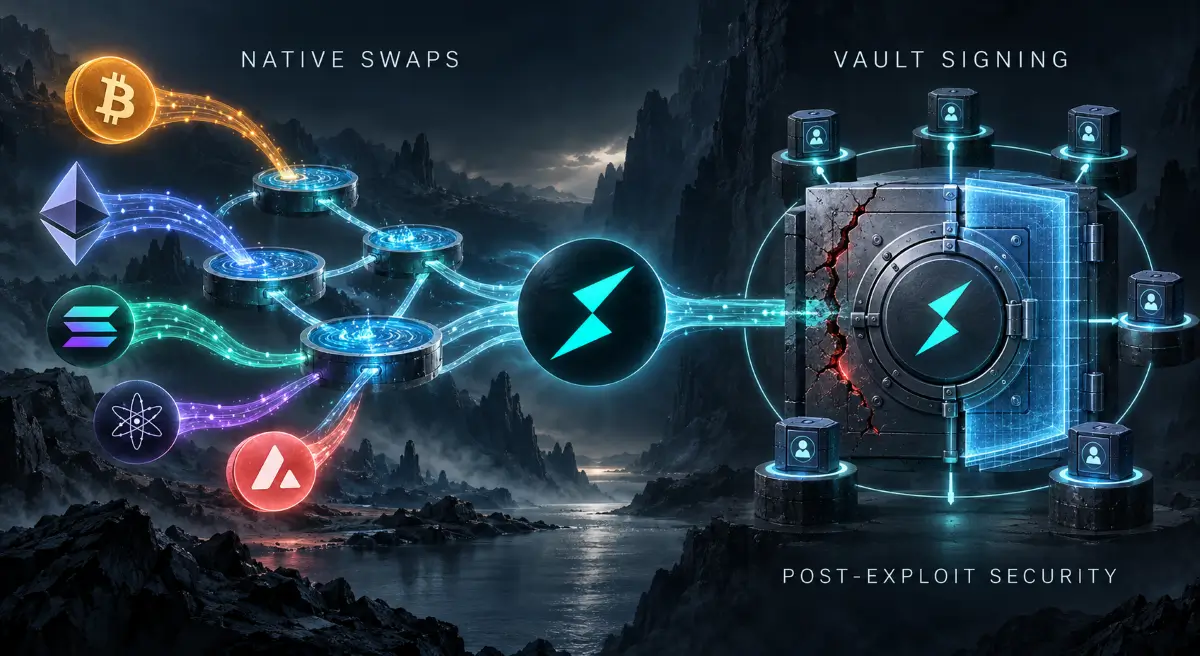
THORChain’s May 2026 vault exploit did not begin in its swap logic. A malicious validator exploited three weaknesses in the GG20 threshold-signing implementation and eventually reconstructed one Asgard vault key. This THORChain Review looks at what changed after that failure: signer hardening, solvency controls, validator churn, RUNE supply, and the dependencies that still matter.
Trading returned in June. v3.20 later restored validator churn, followed by v3.20.1 on 27 August. The documented exploit path has been patched, but GG20 still appears in THORChain’s production vault-signing architecture for relevant ECDSA paths. Recovery is measurable. The signer remains the core security test.
Native Swaps Move Trust Into Vault Signing
THORChain coordinates liquidity across independent blockchains so users can exchange supported native assets without relying on wrapped versions.
A BTC-to-ETH swap illustrates the difference. Users send native BTC into a THORChain-controlled inbound vault, the protocol prices and routes the trade, and a validator committee authorizes the outbound asset on the destination chain.
That removes dependence on a wrapped-token issuer, but it does not remove trust from the system.
During settlement, protocol vaults hold native assets. Validators jointly control spending authority through threshold cryptography, while chain observers, signing software, liquidity pools and emergency controls all sit inside the broader security boundary.
This model differs from cross-chain messaging designs, where a protocol may only deliver a message and leave asset control to another application. THORChain directly manages vaults containing native assets.
No single honest validator should possess a complete vault key. May’s exploit mattered because the attacker found a way around that assumption.
What the May Exploit Actually Broke
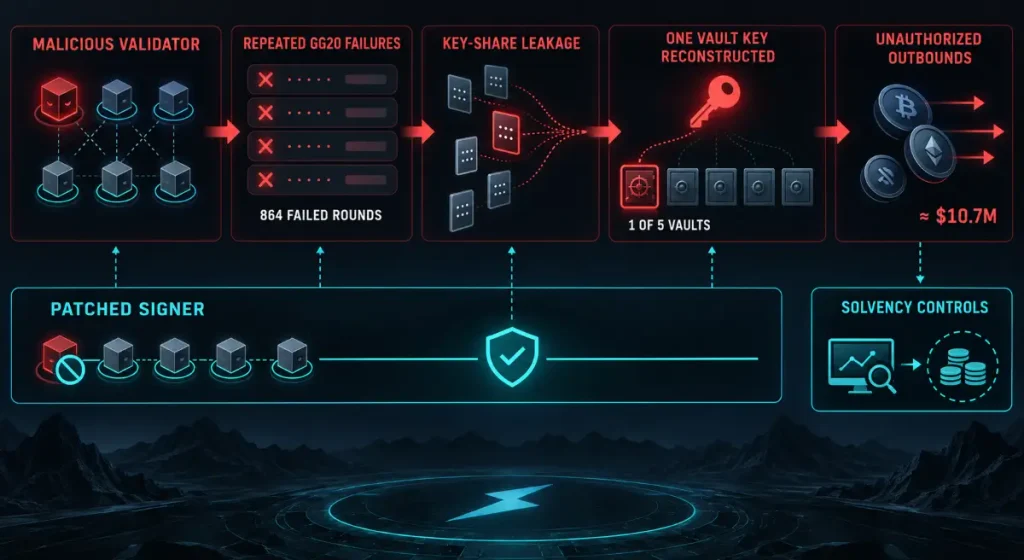
A malicious node entered the active validator set on 13 May 2026 and joined one of five Asgard vault committees.
Over roughly two and a half days, the operator deliberately generated 864 failed GG20 signing rounds. Repeated failures were not merely operational noise. They created enough interactions to exploit weaknesses in THORChain’s threshold-signing implementation.
The attack combined three implementation problems: incomplete validation of Paillier cryptographic material, information leakage during a masking step, and a weak proof condition that allowed invalid inputs through.
None was enough on its own.
Together, repeated signing attempts leaked small pieces of information about other validators’ key shares. Eventually, the attacker reconstructed the affected vault’s ECDSA private key.
Once that happened, the security model changed completely. Destination chains did not see an attacker bypassing THORChain consensus. They saw mathematically valid signatures produced by a valid private key.
Approximately $10.7 million left the affected vault. Four other Asgard vaults were not compromised, while signature paths outside the vulnerable GG20 route were not exposed to this specific exploit.
THORChain’s technical exploit report documents the interacting weaknesses and subsequent mitigations.
| Attack stage | What happened | Why it mattered | Post-exploit response |
|---|---|---|---|
| Validator entry | Malicious operator joined the active set | Permissionless participation cannot identify intent | Security work focused on signer validation and monitoring |
| Key setup | Malformed cryptographic material entered the protocol | Existing validation was incomplete | Stronger modulus validation and proofs |
| Repeated signing | 864 failed rounds were forced | Retries leaked useful information | Vulnerable proof paths were hardened |
| Key reconstruction | One vault key was recovered | Threshold approval was no longer required | Documented exploit chain was patched |
| Unauthorized outbounds | Destination chains accepted valid signatures | Detection came after signing authority was lost | Solvency controls limited further damage |
Solvency Controls Contained Damage, but Did Not Prevent the Failure
THORChain already compared observed vault balances with the balances its internal accounting expected.
Unauthorized withdrawals created a mismatch. Solvency controls detected the divergence and began halting affected routes. Node operators later added manual pauses and governance actions until the network reached a controlled halt.
Containment mattered. One vault was compromised rather than all five.
Prevention and containment are still different security functions.
Once the attacker possessed a reconstructed private key, Bitcoin, Ethereum and other destination chains could not distinguish the malicious signature from an authorized one. Solvency monitoring could identify disappearing assets, but it could not invalidate signatures that had already been accepted.
Similar validator-control trade-offs appear elsewhere in crypto. Fast emergency intervention can limit damage, but emergency authority does not remove the weakness that made intervention necessary.
What the Patch Fixed – and What It Did Not
THORChain first focused on restoring a safe operating path. Version 3.18.1 addressed immediate signer risk, while later releases carried additional recovery and migration work.
Trading returned around 22 June after roughly five weeks of disruption.
Signer patches strengthened validation around the three weaknesses used in the attack. Breaking any one part of that exploit chain would have prevented the documented key-recovery method, the patched implementation addresses all three.
That is meaningful remediation.
It is not proof that threshold signing can never fail again.
Complex cryptographic software can contain unknown implementation flaws even when its underlying mathematics remains sound. A security patch closes a known path. It does not prove the absence of every future path.
Production evidence therefore matters more than a statement that the incident has been fixed.
GG20 Still Matters After the Exploit
THORChain has not completed a network-wide replacement of GG20.
Current THORNode architecture still describes GG20 within vault management for relevant signing paths. Alternative schemes such as DKLS and FROST matter because they can reduce dependence on the cryptographic family involved in May’s incident where appropriate.
Development work is not the same as production migration.
The accurate post-exploit claim is narrower: THORChain patched the vulnerable GG20 implementation, restarted the network, and continues work on alternative threshold-signature systems.
My review gives more weight to whichever signer actually controls production vaults than to a future migration plan.
v3.20 Restored Churn, but Recovery Is Still Being Tested
The v3.20 tag was published on 19 August, with mainnet activation following later in the month, v3.20.1 was released on 27 August.
Restoring validator churn was especially important. THORChain had paused normal rotation during recovery, leaving vault committees and validator participation more static than usual.
By THORChain’s 4 September network report, the active set stood at 87 nodes, with 80 more in standby and 83.47 million RUNE bonded, rotation had returned to its normal three-day cadence.
August also showed why a restart should not be confused with the end of stabilization. Contributors continued investigating upgrade-related reliability issues, while some newer integrations and application-layer features required additional work.
A separate Rujira application issue does not mean native THORChain swaps suffered the same cryptographic failure again. It does show that a large protocol upgrade creates new software boundaries to test.
Each new chain, signing path and application feature expands the operational surface.
Native Pricing Avoids One Oracle Dependency, Not Liquidity Risk
Normal THORChain pools derive swap prices from their own balances rather than asking a conventional external oracle for the current BTC or ETH price.
Arbitrageurs help bring pool prices back toward broader markets when they drift.
That design removes one common oracle dependency, but users can still receive poor execution.
Shallow liquidity increases slippage. Destination-chain fees, affiliate charges, outbound costs and congestion can reduce final output. Streaming swaps may improve execution by splitting a large order into smaller trades, but they cannot create liquidity that does not exist.
These onchain exchange execution risks should remain separate from uptime. A protocol can function exactly as designed while a user still receives an unattractive price.
Quoted output matters more than a claim that the network stayed online.
RUNE Still Has Utility, but Demand Is Not Automatic
RUNE remains central to THORChain’s traditional economic design.
Validators bond it. Liquidity pools pair external assets with it. The protocol uses RUNE for settlement, security incentives and fee distribution.
THORChain’s economic-security model has historically targeted bonded RUNE at roughly twice the value of non-RUNE assets held in liquidity pools. Including the RUNE side of those pools produces the familiar three-to-one description.
That relationship is a protocol design target, not a valuation law.
A falling RUNE price changes the dollar value of bonds. Liquidity providers can leave. Pool depth can shrink. New routing mechanisms can also change how much RUNE exposure each additional dollar of volume requires.
May’s exploit exposed another limitation: economic collateral can punish bad behavior, but a validator bond cannot repair signing software that leaks private-key material.
Security engineering and token incentives support each other. Neither substitutes for the other.
RUNE Supply Fell, but Burns Are Only One Part of Value Capture
RUNE no longer follows the old 500 million maximum-supply story.
ADR-023 removed roughly 64.9 million non-circulating RUNE from the Reserve and reset MaxRuneSupply to 360 million. Continued protocol burns can reduce effective supply further. The official RUNE supply restructure describes that change as a supply simplification rather than a change to THORChain’s native-swap mechanism.
Total RUNE supply stood around 354 million near the start of September 2026. Large scheduled investor unlocks are no longer the main dilution issue.
Revenue allocation matters more now.
System income supports several groups and mechanisms, including RUNE burning, TCY stakers, network participants and protocol development. New protocol-owned liquidity also means older descriptions of revenue allocation should not be treated as the whole current picture.
| Economic mechanism | Current role | What it supports | What it does not prove |
|---|---|---|---|
| Validator bonds | Economic collateral | Node incentives and security | Protection from software flaws |
| RUNE-sided pools | Settlement and liquidity | Demand linked to pool depth | Guaranteed token appreciation |
| RUNE burns | Supply reduction | Deflation when system income exists | Cash paid directly to holders |
| TCY revenue share | Claim on system income | THORFi restructuring | Exclusive value capture by RUNE holders |
| Protocol-owned liquidity | Network-owned pool capital | Liquidity and capital efficiency | Identical RUNE demand from every trade |
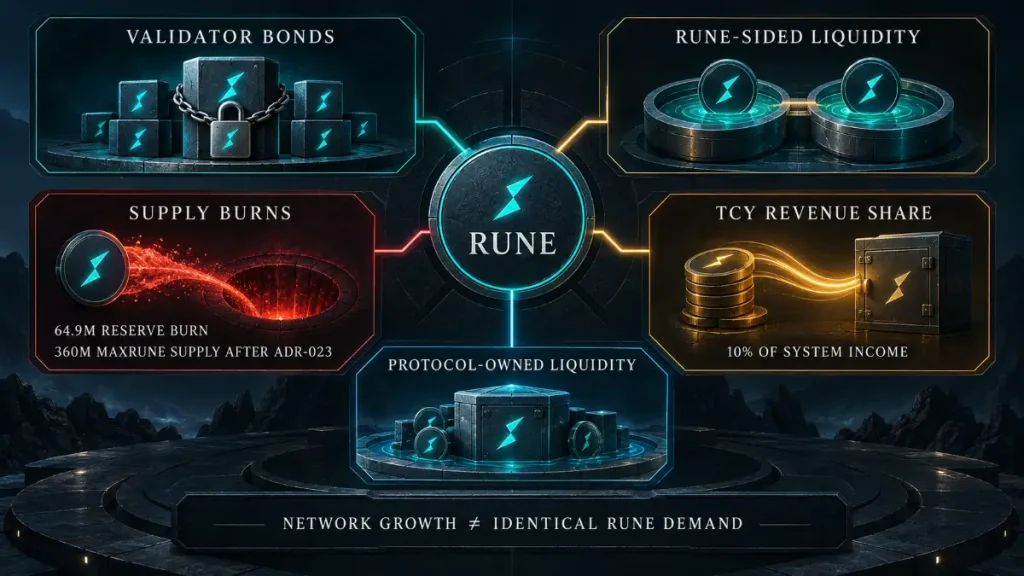
Burned RUNE disappears from supply. Holders do not receive that RUNE as cash flow.
Those are different forms of economic value.
TCY Still Claims Part of System Income
The 2026 vault exploit should not be confused with THORChain’s earlier THORFi crisis.
Lending and Savers were paused in January 2025 after liabilities became unsustainable. Restructuring created TCY with a fixed supply of 210 million tokens.
Staked TCY receives a share of THORChain system income in RUNE.
That claim remains relevant to RUNE analysis because rising network revenue does not flow only toward RUNE burns, validators or liquidity providers.
Higher system income can strengthen THORChain while still being divided across several stakeholders.
POL and Stable Reserve Change the Simple RUNE Demand Story
Protocol-owned liquidity adds another layer to THORChain economics.
As of THORChain’s 4 September network report, the current node-set parameter routed 20% of system income into protocol-owned pools, that rate is controlled by node vote rather than hardcoded.
Rather than relying entirely on outside liquidity providers, the protocol can own part of the liquidity supporting its markets. That may improve depth and capital efficiency, but it also changes how system income and pool ownership should be interpreted.
Stable Reserve creates a similar question.
v3.20 introduced infrastructure for more efficient stablecoin routing, but code availability should not be treated as proof of meaningful adoption. Reserve balances, routed volume and actual fee generation matter more than the existence of a feature.
If newer routing paths reduce the need to move every trade through traditional RUNE-sided pools, network usage can grow without producing identical RUNE demand per dollar of volume.
That does not make the feature negative. It means product growth and token value capture need separate measurement.
The same issue appears across cross-chain security models: better user experience can move trust and value-capture points rather than eliminate them.
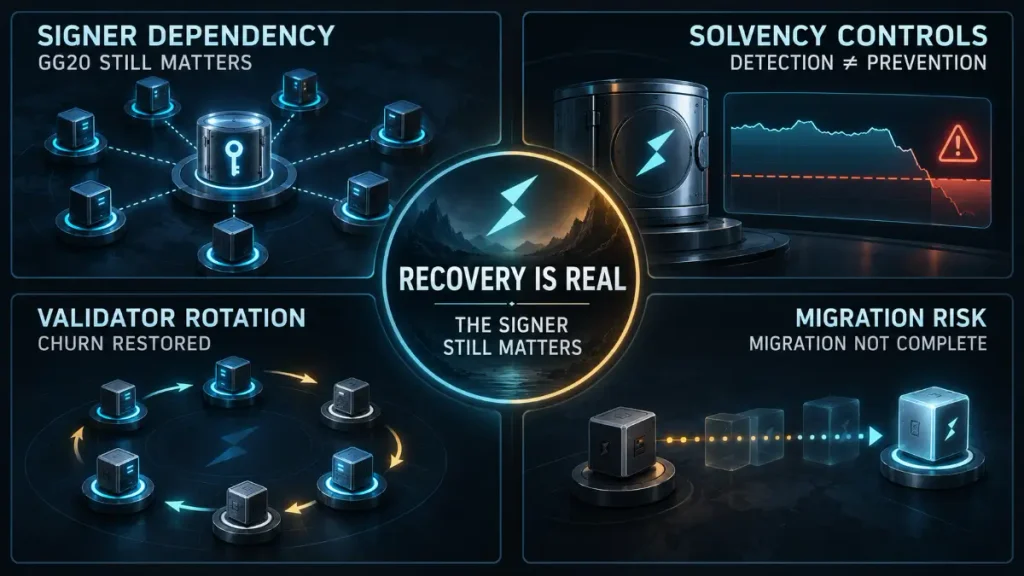
My Verdict: Recovery Is Real, but the Signer Still Matters
THORChain still solves a difficult problem.
Users can exchange native assets across separate chains without relying on a wrapped-token issuer, while RUNE continues to support settlement, liquidity and validator security.
May’s exploit changed how that advantage should be described.
Threshold custody spreads signing authority across validators, but the protection only works when the implementation preserves the secrecy of those distributed key shares. One malicious validator should not be able to spend a vault alone. GG20 implementation flaws created a path around that assumption.
THORChain patched the documented exploit family, restored trading and brought validator churn back.
Those changes deserve weight.
So do the remaining dependencies.
GG20 still appears in production architecture. Alternative signing schemes remain migration work rather than a completed replacement. Solvency controls provide valuable containment, but they cannot replace signer security. New chains and liquidity mechanisms also continue to expand the software and economic surface.
RUNE’s position is similarly mixed. Supply has fallen, burns continue to create deflationary pressure, and major investor unlocks are no longer the central risk. TCY still claims part of system income, while protocol-owned and alternative routing mechanisms can improve THORChain without guaranteeing the same RUNE demand from every new trade.
My review therefore finds THORChain materially stronger than it was immediately after the exploit, but not returned to a pre-exploit risk model.
The documented attack is patched. Long-term confidence now depends on production signer reliability, healthy vault solvency, normal validator rotation and eventually reducing dependence on the cryptographic path that failed.
Frequently Asked Questions
No. The attack targeted THORChain’s GG20 threshold-signing implementation. Repeated malicious signing rounds exploited three implementation weaknesses until enough key material leaked to reconstruct one Asgard vault key.
THORChain reported approximately $10.7 million lost from one Asgard vault. Four other Asgard vaults were not compromised by the same attack.
Not completely. The vulnerable implementation was patched, but GG20 still appears in THORChain’s production vault-signing architecture for relevant paths. Alternative systems such as DKLS and FROST remain migration options rather than a completed network-wide replacement.
No. ADR-023 removed roughly 64.9 million non-circulating Reserve RUNE and reset MaxRuneSupply to 360 million. Continued burns can reduce effective supply further.
Usually no. Users can enter with one supported native asset and receive another, while THORChain uses RUNE internally for settlement, liquidity and network-security functions.

Founder & Managing Editor of CryptosMedia. Zahid Hussain leads evidence-based crypto research covering tokenomics, security, governance, adoption, and risk.
CryptosMedia separates verified facts from interpretation, avoids buy/sell recommendations, and updates reviews when major evidence changes.
1 thought on “THORChain Review: What Changed After the Vault Exploit?”