
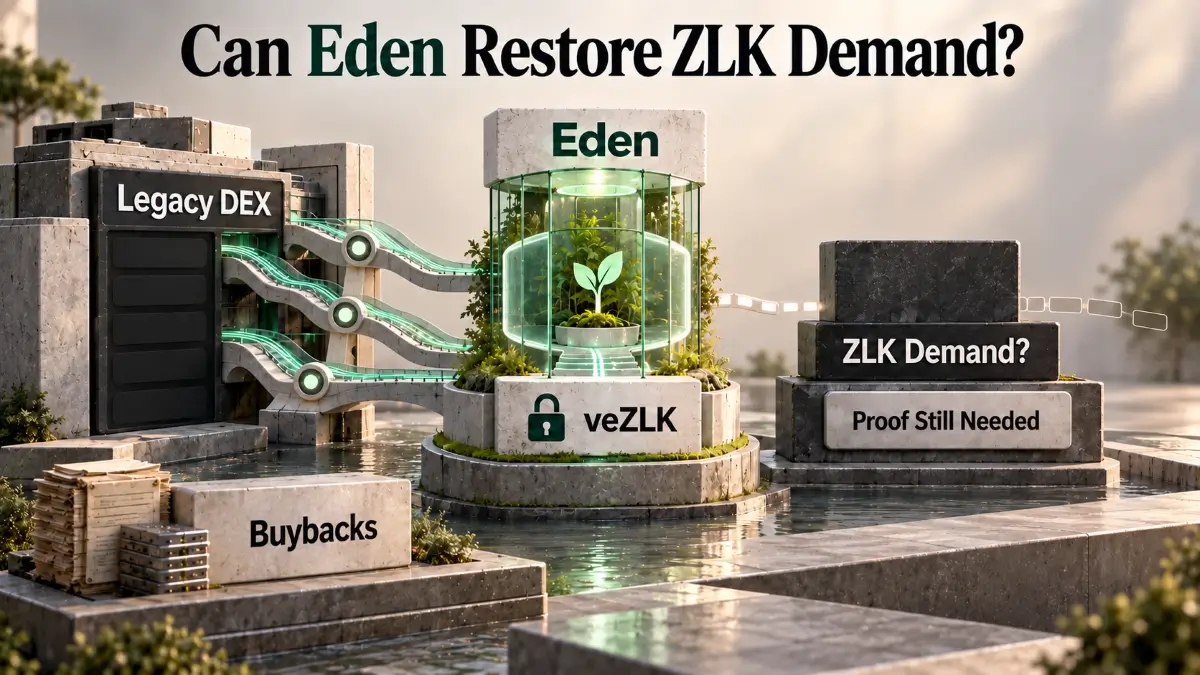
Zenlink built its reputation as cross-chain DEX infrastructure for the Polkadot ecosystem. The original idea was practical. Parachains could integrate exchange functions instead of building every swap, liquidity, and routing component from scratch. That infrastructure still exists, but the token question has changed.
This Zenlink Crypto Review focuses on whether ZLK has a credible demand route in 2026. Legacy DEX activity is now very small. Zenlink Eden adds a newer yield marketplace, veZLK locking, fee sharing, and liquidity incentives. Historical buybacks also show that Zenlink once converted protocol fees into ZLK purchases and burns. The unresolved issue is whether current activity is large enough to make those mechanisms economically meaningful.
Price history alone cannot answer that question. A large drawdown shows that market demand weakened. It does not prove that software stopped working, that every market is inactive, or that audited contracts became unsafe. The useful test is narrower. Zenlink needs recurring usage, fee generation, ZLK locking, and transparent token capture that outsiders can measure today.
This article is for research and education only. It does not provide financial advice or a buy or sell recommendation. Liquidity, token supply, protocol activity, and fee data can change.
Zenlink Still Solves a Real Infrastructure Problem
Zenlink built its protocol as a cross-chain DEX network for Polkadot and related parachains. Its architecture includes Substrate modules, EVM contracts, routing tools, liquidity pools, and front-end infrastructure. The goal is to let different chains add exchange functionality while making liquidity easier to route across the ecosystem.
That design remains technically relevant. Multichain markets still fragment liquidity across networks, pools, and execution environments. Zenlink tries to reduce that fragmentation through shared DEX components and routing rather than asking each parachain to rebuild the same stack.
This creates the same type of dependency seen in other cross-chain DEX systems. The protocol can improve routing and composability, but users still depend on underlying chains, liquidity pools, cross-chain messaging, asset contracts, and the quality of each connected market.
Readers therefore should not judge Zenlink only by whether its original Polkadot thesis sounded ambitious. The stronger question is whether enough users and liquidity still move through the system to support fees and token demand.
Current DEX Activity Is Thin, Not Zero
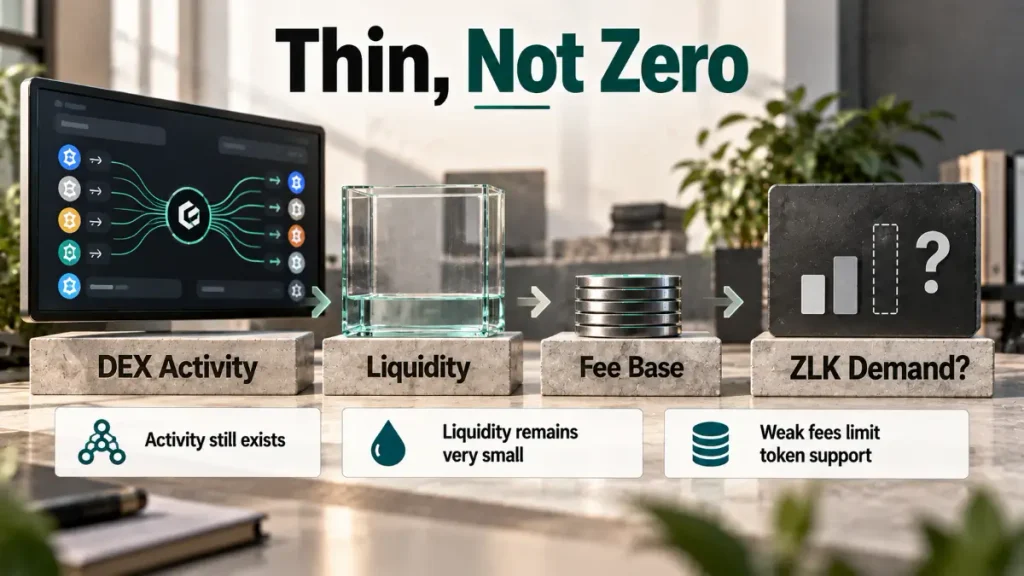
As checked on September 15, 2026, current Zenlink DEX data showed about $3.28 million in combined TVL, roughly $226,575 in 30-day DEX volume, around $183,864 over seven days, and about $3,394 over 24 hours. About $3.2 million of TVL was on Bifrost, with smaller balances on Moonriver, Moonbeam, and Astar. Recent DEX volume was also attributed to Bifrost.
Those figures rule out a simple zero-activity claim. They also expose the more important weakness. Liquidity and trading remain small relative to major decentralized exchanges, while most measured TVL is concentrated on Bifrost.
Low liquidity affects more than appearances. It can increase price impact, reduce route quality, make larger trades harder to execute, and shrink the fee base available for token-level value capture. A protocol can remain technically operational while becoming economically marginal.
That distinction also matters when comparing activity with token demand. Nonzero transactions prove that somebody still uses the system. They do not prove that ZLK receives meaningful demand from that activity.
The data is also volatile. A 30-day number can include brief bursts of trading that do not represent stable daily usage. Zenlink needs sustained liquidity and recurring volume rather than occasional activity if the DEX layer is expected to support long-term token economics.
DefiLlama attributes the recent DEX volume to Bifrost, while Zenlink Eden is live on Moonbeam. The measured legacy DEX activity therefore should not be used as a proxy for Eden adoption. The two product layers need separate usage, liquidity, and fee metrics.
Eden Changes How ZLK Can Capture Value
Zenlink Eden gives the project a newer product direction. Official documentation describes Eden as a permissionless yield marketplace on Moonbeam. Users can bring supported yield-bearing assets into the system, wrap them into standardized yield assets, and split them into Principal Tokens and Yield Tokens.
Principal Tokens represent the principal component of a yield-bearing asset. Yield Tokens represent its future yield. This structure lets users separate principal exposure from yield exposure, trade implied yield, or provide liquidity around those positions.
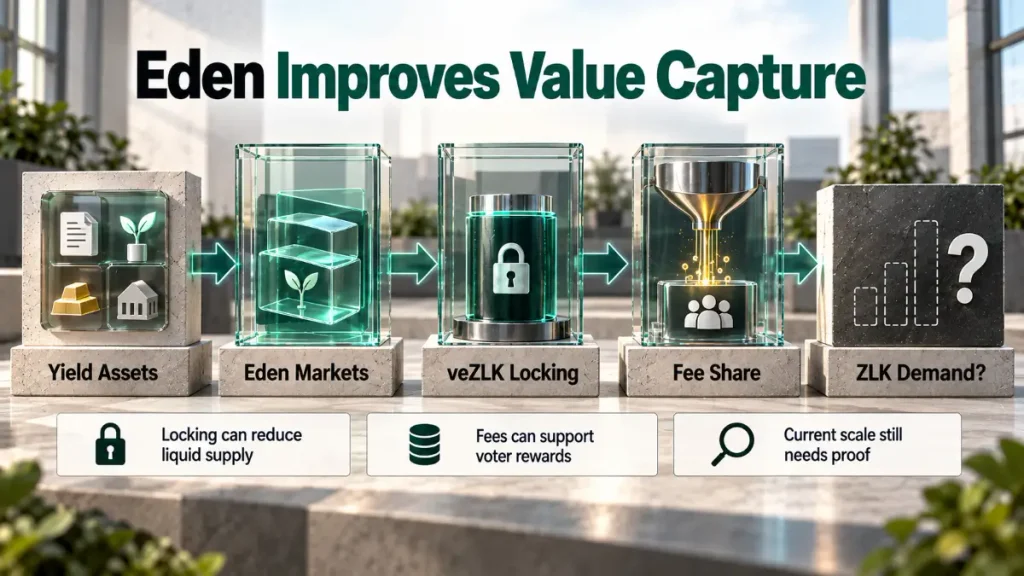
Eden also introduces veZLK. Users can lock ZLK for periods ranging from one week to two years. Longer locks create more veZLK and more voting power. veZLK can also boost liquidity rewards and qualify voters for protocol fee distributions.
This changes the ZLK thesis in an important way. Legacy ZLK utility leaned heavily on incentives, governance, and the older DEX economy. Eden gives holders a reason to remove ZLK from liquid circulation for a fixed period and links that commitment to voting power and fee participation.
The fee route is clearer than a generic governance claim. Zenlink Eden charges a 3 percent fee on yield earned through YT, while PT trades can generate trading fees tied to implied yield. Current fee documentation allocates 40 percent of relevant trading-fee revenue to veZLK voters, 20 percent to LPs, and 40 percent to the Zenlink treasury.
The documentation separates the 3 percent YT fee from trading-fee revenue. The published 40, 20, and 40 percent split is described for protocol revenue from trading fees. The reviewed material does not state as clearly that every YT-fee dollar follows the same distribution path, so this article does not assume that all Eden fees automatically reach veZLK voters.
That structure resembles other fee-funded value capture models. The mechanism can create useful token demand when users want voting power, reward boosts, or fee participation. It does not prove that demand is large today.
The missing evidence is scale. Public documentation explains how veZLK works, but current independent figures for total ZLK locked, active voters, Eden TVL, recurring Eden fee revenue, and fee distributions are not easy to verify. A working mechanism without measurable adoption remains an incomplete token case.
Eden Is Permissionless for Users but Not Fully Permissionless in Pool Creation
Zenlink calls Eden a permissionless yield marketplace because users can access the protocol without asking for account approval. That description works for user access. It should not be stretched into a claim that every part of market creation is permissionless.
Current fee documentation states that the Zenlink team currently deploys the pools. The pool deployer also determines the relevant PT trading-fee percentage.
This creates an administrative boundary inside a product that otherwise promotes permissionless access. It does not make Eden unsafe. It tells readers where control still exists.
A protocol can let traders and liquidity providers interact without permission while retaining team control over which markets become available and how certain pool parameters are established.
That control becomes more important when fee sharing depends on the pools that exist. If veZLK voters can only vote on deployed markets, the economic value of veZLK partly depends on the quality, depth, and activity of those markets.
This makes veZLK governance meaningful but bounded. Voters can direct incentives across available pools, while team deployment still determines which pools exist. Token voting therefore does not by itself prove protocol-wide decentralized control.
Historical Buybacks Show Real Execution
Zenlink has stronger historical value-capture evidence than many low-liquidity tokens. Its official buyback records document ten buyback rounds from 2021 Q4 through 2024 Q1 and Q2. The general model used 30 percent of the Transaction Fee Fund Pool for buybacks, while the first round used a much larger share of protocol fees.
Zenlink published buyback amounts, spending, addresses, and burn records. The mechanism therefore moved beyond a roadmap promise. Zenlink repeatedly bought ZLK from the market and burned it.
ZLK Buyback and Burn Record
| Period | ZLK Bought and Burned | Approximate Spend | What It Shows |
|---|---|---|---|
| 2021 Q4 | 206,681 ZLK | $850,000 | First round used a much larger share of protocol fees |
| 2022 | 2,440,778 ZLK | $395,000 | Four quarterly rounds continued the mechanism |
| 2023 | 1,042,140 ZLK | $21,600 | Buybacks continued while dollar spending fell sharply |
| 2024 Q1 and Q2 | 355,375 ZLK | $8,000 | Current official record ends with this round |
| Cumulative through round 10 | 4,044,974 ZLK | About $1.275M | Buybacks removed roughly 4 percent of original maximum supply |
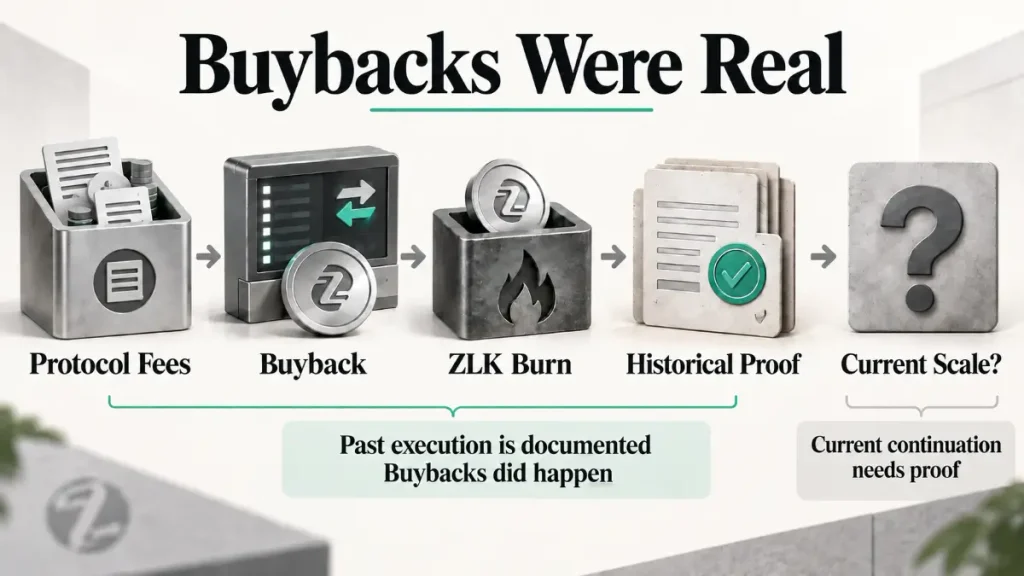
The table reveals both strength and weakness. Zenlink proved that fee-funded buybacks could happen. Later rounds required much less dollar spending because ZLK traded at a much lower price. A large number of tokens burned at a low price does not automatically mean that protocol revenue remained strong.
The current official buyback record ends with round 10 covering 2024 Q1 and Q2. It does not show a later round. This does not prove the mechanism stopped. It means readers should not assume that the earlier quarterly cadence continued without newer records.
That reporting gap is now one of the most important ZLK questions. Historical execution is useful evidence, but current token value depends on what the protocol is doing now.
Tokenomics: Fixed Maximum Supply Removes One Risk
The official ZLK tokenomics set a maximum supply of 100 million ZLK across the Kusama and Polkadot ecosystems. Zenlink originally split issuance between those ecosystems while applying the same distribution rules.
Community allocation accounts for 50 percent of maximum supply. The documented breakdown assigns 25 percent to liquidity mining, 15 percent to trading mining, 5 percent to the DAO treasury, and 5 percent to community incentives.
Early investors received 26 percent. The team received 20 percent. The Zenlink Foundation received 4 percent. Investor allocations followed finite linear release schedules. The team allocation followed a 24-month release schedule after an initial two-month period with no unlocks.
Those published schedules do not show a new investor or team cliff arriving in 2026. That does not mean current circulation can be reconstructed perfectly from the old schedule. Community incentives use non-linear distribution, treasury tokens can move when allocated for ecosystem purposes, and the published tokenomics document does not provide a live 2026 supply reconciliation.
As checked on September 15, 2026, CoinMarketCap displayed about 37.83 million ZLK in total supply and 16.03 million ZLK as self-reported circulating supply. Those figures are useful market-data observations, but they do not reconcile every chain, incentive allocation, treasury movement, and burn. Zenlink’s official documentation does not provide a current live supply ledger, so this article does not treat the 16.03 million figure as independently verified circulation.
ZLK Tokenomics
| Tokenomics Item | Current Position | Why It Matters |
|---|---|---|
| Maximum supply | 100M ZLK | Published tokenomics set a fixed upper issuance boundary |
| Community allocation | 50% | Funds liquidity, trading, treasury, and community incentives |
| Early investors | 26% | Published release schedules were finite |
| Team allocation | 20% | Published 24-month schedule does not show a new 2026 cliff |
| Foundation | 4% | Reserved allocation remains part of supply structure |
| Legacy buybacks | About 4.045M ZLK burned through round 10 | Historical fee-funded token removal is verifiable |
| Eden incentives | Existing Community allocation | Eden does not introduce a separate maximum supply |
| veZLK | ZLK locked from 1 week to 2 years | Can reduce liquid supply and create governance demand |
| Eden voter share | 40% of relevant trading-fee revenue | Gives locked ZLK a direct fee participation route |
| Current total supply | 37.83M ZLK shown by CMC on Sep 15, 2026 | Reported total supply is below the maximum but does not prove liquid supply |
| Current circulation | 16.03M ZLK self-reported on CMC | No official live reconciliation was verified |
| Main tokenomics risk | Thin activity limits fees, locking, and future buyback power | Fixed supply alone cannot create demand |
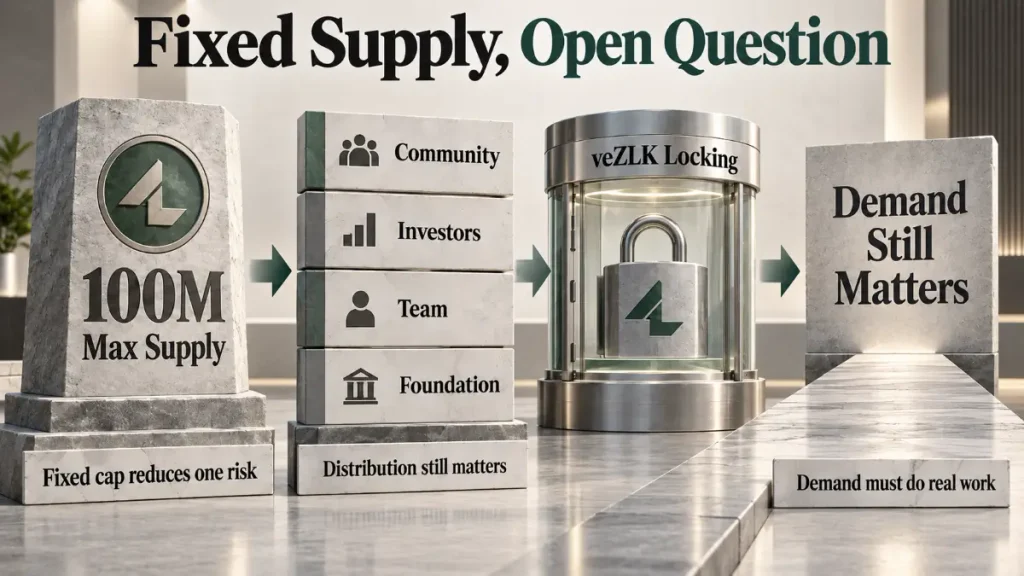
A fixed maximum supply removes the risk of an open-ended inflation schedule. It does not remove distribution risk. Community incentives, treasury use, and previously allocated tokens can still affect liquid supply before the full maximum becomes economically relevant.
The more important question is whether Eden locking and protocol fees can absorb enough available ZLK to matter. If fee generation remains small, a fixed cap cannot substitute for demand.
Security Evidence Exists but Its Scope Is Old
As checked on September 15, 2026, CoinMarketCap displayed a 2.8 CertiK rating for ZLK. That score does not prove that Zenlink has critical exploitable vulnerabilities. A rating is not the same as a smart-contract audit finding, exploit report, or proof that funds are exposed.
Zenlink does have documented independent audits for older DEX components. SlowMist reviewed the Standard AMM EVM contracts in October 2021 and the Standard AMM Substrate implementation in November 2021. PeckShield reviewed the Hybrid AMM in May 2022 and the Stable AMM Substrate Pallet in August 2022.
Those reports matter because they show that parts of the legacy DEX stack received external review. Their age and scope also matter. They do not automatically cover every current deployment, new integration, cross-chain dependency, front-end change, or Eden contract.
Zenlink Eden creates a separate audit question. Its FAQ says Eden is a fork of Pendle and points users toward Pendle’s audit history. The reviewed Zenlink material does not identify a completed independent audit dedicated to current Zenlink Eden deployments.
A fork can inherit useful engineering and tested patterns. It can also introduce different configuration, deployment, integration, admin, and third-party risks. Upstream audits therefore reduce uncertainty without proving that every forked deployment is safe.
Eden Adds More Than Smart-Contract Risk
Eden depends on yield-bearing assets and external protocols. A user may start with an asset from another Polkadot ecosystem protocol, move it across XCM, enter Eden on Moonbeam, convert it into standardized yield form, split it into PT and YT, and then trade or provide liquidity.
Each layer adds a failure boundary. The underlying yield protocol must function correctly. Cross-chain asset movement must work. Eden contracts must calculate principal, yield, maturity, fees, and redemption correctly. Pools need enough liquidity for users who want to trade before maturity.
These are similar to wider interoperability dependencies where risk extends beyond one contract. Zenlink can write correct code and still inherit failure from a connected protocol, cross-chain messaging path, underlying asset, or liquidity venue.
The current team-controlled pool deployment process adds another operational dependency. Users do not need permission to trade, but the set of available markets still depends on deployment decisions made by the team.
Development Is Uneven, Not Clearly Abandoned
Public development evidence does not support a simple abandoned-project label. Zenlink’s GitHub organization shows that the main interface repository received an update on January 19, 2026. Its Astar indexer also received an update on January 15, 2026.
At the same time, many older core repositories show much older activity. The public roadmap also focuses on milestones from 2021 through 2023 rather than presenting a detailed current 2026 roadmap.
That combination suggests uneven maintenance rather than a clean binary conclusion. Some front-end and indexing work continued into 2026. Public evidence does not show broad, rapid development across every legacy component.
Eden documentation remains available and describes the product as live on Moonbeam. The stronger evidence gap is economic. Zenlink needs current Eden TVL, fee revenue, veZLK locking, active market counts, and voting participation that outsiders can verify without relying on product descriptions alone.
What Zenlink Needs to Prove Next
The first requirement is current Eden usage. Zenlink should make active markets, TVL, volume, fee revenue, veZLK locked, voting participation, and fee distributions easy to verify. Those metrics would show whether Eden has become an economic product rather than only a functioning design.
The second requirement is current token capture. Historical buybacks are well documented, but the public record reviewed here stops at round 10. New buyback and burn reporting would show whether current DEX and Eden activity still reaches ZLK through direct market purchases and permanent token removal.
The third requirement is liquidity recovery. Limited and concentrated legacy DEX liquidity can weaken routing, user experience, and fee generation. Zenlink does not need to compete with the largest global DEXs to remain useful, but it does need enough depth for its routing and market infrastructure to work at practical trade sizes.
The fourth requirement is clearer supply reporting. A fixed 100 million maximum is easy to understand. Current circulating and total supply should be just as easy to reconcile across networks, treasury balances, incentives, and burns.
The fifth requirement is current security scope. Legacy AMM audits remain relevant to the code they reviewed. Eden adds yield tokenization, external protocols, cross-chain movement, veZLK, fee distribution, and team-deployed pools. A dedicated review of the current Eden system would give readers stronger evidence than inherited confidence from an upstream project.
Zenlink Crypto Review Verdict: Mechanism Ahead of Demand
Zenlink still has more substance than a price chart suggests. Its original cross-chain DEX stack remains identifiable, independent data shows nonzero trading activity, historical buybacks prove that protocol fees once reached ZLK through market purchases and burns, and Zenlink Eden adds a newer locking and fee-sharing model.
Eden improves the token design. veZLK can remove tokens from liquid circulation for up to two years. Voters can receive part of relevant trading-fee revenue, and liquidity providers can use veZLK to boost incentives. These mechanisms give ZLK clearer utility than a token used only for generic governance.
The weakness is current scale. Legacy DEX liquidity remains small relative to major DEXs and is heavily concentrated on Bifrost. Eden adoption is difficult to measure from independent public data. Current official buyback records do not verify activity after the 2024 Q1 and Q2 round. Older security audits also do not establish full coverage for Eden.
That leaves Zenlink in a more nuanced position than a price-only reading suggests. The technology has not simply vanished, and zero activity is inaccurate. The harder problem is that working mechanisms still need measurable demand.
ZLK can build a stronger case if Eden generates recurring fees, meaningful veZLK locking, active markets, and transparent token capture. Until those numbers become visible at useful scale, the design is easier to verify than the economic recovery.
Frequently Asked Questions
Zenlink is a cross-chain DEX network built around the Polkadot ecosystem. Its infrastructure includes exchange modules, EVM contracts, routing tools, liquidity markets, and Zenlink Eden on Moonbeam.
Zenlink Eden is a yield marketplace that separates yield-bearing assets into principal and yield components. Users can trade those components, provide liquidity, and use veZLK for voting, reward boosts, and fee participation.
ZLK supports protocol incentives and governance. Eden adds veZLK, which requires users to lock ZLK for a chosen period and can provide voting power, liquidity reward boosts, and access to part of relevant trading-fee revenue.
Yes. Zenlink’s published tokenomics set the maximum supply at 100 million ZLK. Historical buybacks and burns removed about 4.045 million ZLK through the documented rounds, but they did not change the published 100 million maximum supply.
Yes, but activity remains small relative to major DEXs. On September 15, 2026, DefiLlama showed about $3.28 million in TVL and $3,394 in 24-hour DEX volume, with most TVL and recent volume concentrated on Bifrost. That confirms activity without proving strong adoption.
Yes. Zenlink’s official buyback record documents ten rounds through 2024 Q1 and Q2. Those rounds bought and burned about 4.045 million ZLK in total. The current record does not show a later round.
Several legacy Zenlink DEX components received audits from SlowMist and PeckShield between 2021 and 2022. Zenlink Eden says it is a fork of Pendle and refers to Pendle’s audit history, but the reviewed Zenlink material does not identify a completed independent audit dedicated to current Eden deployments.
No. A third-party rating is not the same as an audit finding. Security conclusions should come from actual audit scope, findings, remediation evidence, exploit history, and current system dependencies.

Founder & Managing Editor of CryptosMedia. Zahid Hussain leads evidence-based crypto research covering tokenomics, security, governance, adoption, and risk.
CryptosMedia separates verified facts from interpretation, avoids buy/sell recommendations, and updates reviews when major evidence changes.
3 thoughts on “Zenlink Crypto Review: Can Eden Restore ZLK Demand?”