

Somnia entered 2026 with a different problem from the one it was built to solve. The Layer 1 had focused heavily on gaming and metaverse applications, but the project shifted toward DeFi, prediction markets and agent-native products at the start of the year. This Somnia Review tests whether that pivot has created durable network demand and whether growing activity creates meaningful demand for SOMI.
The strongest evidence now comes from working products rather than throughput claims. dreamDEX is processing meaningful spot volume, Prophecy Social has attracted users, USDso provides a native stablecoin rail, and Somnia Agents are live. The weakness is breadth. Current independent data shows modest DeFi value and activity concentrated heavily in one exchange.
Token supply also changed as a near-term risk. On September 1, investors, team members, launch partners and advisors agreed to delay their first SOMI unlock by nine months. That removed a large September 2026 release, but it did not reduce the one billion token allocation or make the future dilution disappear.
The DeFi Pivot Fits Somnia’s Original Architecture
Somnia mainnet is an EVM-compatible Layer 1 designed for high transaction throughput and fast finality. Instead of abandoning that architecture when its strategy changed, the project redirected it toward markets where frequent state changes can matter more.
That makes the DeFi pivot more than a branding exercise. Order books, prediction markets and autonomous agents can all produce repeated onchain actions. The same performance advantage is relevant to other attempts at high-throughput EVM execution, but raw speed is not the useful test. What matters is whether applications generate activity people continue to use.
Somnia’s architecture separates high-volume data processing from final consensus. Its documentation describes optimized EVM execution, custom storage and a modified PBFT proof-of-stake system. Those design choices can increase capacity, but benchmark capacity should not be confused with current economic demand.
The pivot therefore creates a better test for the network. Somnia no longer needs to prove only that it can process large transaction counts. It needs to show that applications worth using can turn that capacity into recurring economic activity.
High Transactions Do Not Yet Prove Broad User Demand
Independent chain data shows why the distinction matters. Around September 11, DefiLlama reported roughly 2.13 million transactions in 24 hours, about 489 active addresses, around $2.69 million in DeFi TVL and approximately $1.87 million in stablecoin market capitalization.
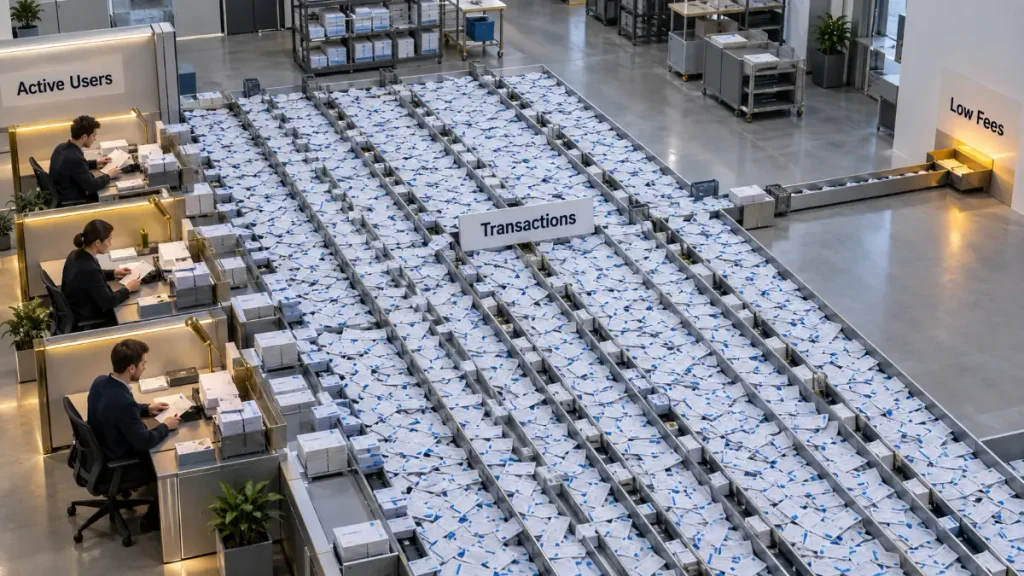
The transaction and address figures should not be divided into a precise transactions-per-user metric because different datasets can use different definitions. They still reveal an important tension. Automated strategies, agents and repeated contract calls can create enormous transaction counts without requiring enormous numbers of individual users.
Network fees tell the same story from another direction. DefiLlama reported around $275 in daily chain fees and about $138 in chain revenue in the same snapshot. Somnia can process a large amount of activity while charging very little for each action.
That is useful for applications, but it limits how much token value a transaction creates. High throughput becomes economically important for SOMI only when enough paid activity accumulates over time.
| Evidence | What It Shows | What It Does Not Prove |
|---|---|---|
| 2M+ daily transactions | Somnia is processing substantial onchain activity | Millions of separate users are active |
| Around 500 reported active addresses | User breadth remains modest in current independent data | Every transaction comes from a small human user base |
| About $2.7M DeFi TVL | Live DeFi capital exists on the network | Somnia already has a large DeFi economy |
| Around $1.9M stablecoin market cap | Stablecoin liquidity is developing | Deep settlement liquidity is already established |
| Low daily chain fees | Execution remains very cheap | High transaction count already creates large SOMI burn |
This is the first important result of the review. Somnia has real network activity, but transaction count is currently much stronger evidence of computational use than of broad economic adoption.
dreamDEX Is the Strongest Evidence Behind the Pivot
dreamDEX currently provides Somnia’s clearest independent evidence of DeFi traction. DefiLlama reported roughly $61.9 million of 30-day spot volume and about $1.55 million in TVL. Cumulative tracked volume had reached more than $133 million.
The concentration is just as important as the volume. Total Somnia DEX volume over 30 days was around $62.36 million, while dreamDEX accounted for about $61.93 million. That means almost the entire tracked trading economy was concentrated in one venue.
This is meaningful traction, but it is not yet diversified demand. One successful exchange can prove that Somnia’s infrastructure works for active trading while leaving the wider ecosystem relatively small.
dreamDEX also uses an onchain central limit order book rather than relying only on a standard AMM structure. That connects naturally with Somnia’s performance thesis because an order book can require frequent updates and execution. Similar questions matter when evaluating onchain order-book markets. Large trading activity is useful evidence, but the path from that activity to the native token still needs to be examined separately.
DefiLlama currently reports zero trading fees for dreamDEX itself. That means headline trading volume should not be treated as direct protocol fee revenue.
Somnia still benefits when applications consume network gas. The economic link is simply much smaller than assuming that every dollar of DEX volume becomes value for SOMI.

Prediction Markets and Agents Broaden the Product Story
Prediction markets provide a second test of the pivot. Somnia reported that Prophecy Social had reached 33,100 users by September 1, alongside 1.3 million predictions. These figures are project-reported rather than independently measured chain-wide adoption, so they should be treated differently from DefiLlama trading data.
The underlying use case is still relevant. Prediction markets can require frequent updates, external information and automated settlement. Agent-native applications can add another layer of repeated machine activity.
That makes agents a better fit for Somnia than simply attaching an AI label to a token. Autonomous applications can benefit from cheap and frequent onchain execution. The remaining question is whether those agents perform economically useful actions that create recurring demand rather than simply increasing transaction counts.
SomniaLend adds lending to the same ecosystem. Together, trading, credit, prediction markets and agent activity give Somnia more product depth than it had as a gaming-first story.
The limitation remains scale. Current chain TVL is still small, so the existence of several product categories should not be confused with a mature financial ecosystem.
USDso Helps DeFi, but It Also Shows Why Usage Is Not SOMI Demand
USDso gives Somnia a stable financial asset for trading, lending and settlement. It is built on Frax’s frxUSD infrastructure, while Somnia states that reserve yield can be routed toward protocols where USDso is deployed. Cross-chain movement uses LayerZero.
That structure can help Somnia because DeFi applications need stable collateral and quote assets. Traders do not need to take SOMI price risk simply to price another asset.
It also reveals an important value-capture limit. An ecosystem can grow through stablecoin trading, lending and settlement without requiring users to hold a large SOMI balance. SOMI remains necessary at the network layer for gas and staking, but application value does not flow one-for-one into native-token buying.
USDso also adds dependencies outside Somnia. Frax infrastructure matters for issuance, redemption and reserves. LayerZero matters for cross-chain movement. A successful stablecoin can strengthen the ecosystem while introducing risks that the Somnia base chain does not control directly.
This is why network usage and token demand need separate analysis.
Somnia Review: SOMI Has Utility, but Value Capture Is Still Small
SOMI is not merely a governance token. It is used for network gas and validator staking, while holders can delegate tokens to validators. Somnia documentation states that a validator requires five million SOMI to operate a node.
Gas provides the clearest recurring value route. Somnia distributes 50% of gas fees to validators and permanently burns the other 50%. More paid network usage therefore creates more SOMI burn.
The mechanism is real. Its current economic weight is small.
If daily chain fees are only a few hundred dollars, the burned half is also small when measured against a one billion token supply. Millions of cheap transactions can therefore look impressive operationally without creating large token destruction.
Staking creates a second route. Validators need SOMI, and delegators can supply part of the required stake. Rewards can come from both fee income and treasury incentives. That distinction matters because treasury-funded rewards redistribute allocated supply rather than proving that network fees can independently support validator economics.
SOMI therefore has genuine utility, but the token thesis depends on scale. Network use must grow enough for gas burn and staking demand to become meaningful beside continuing token distribution.
SOMI Tokenomics: Fixed Supply, Burn and Delayed Unlocks
SOMI has a stated maximum allocation of one billion tokens. The original distribution assigned 27.925% to the community and 27.345% to the ecosystem. Team, launch partners, investors and advisors together received 44.73%.
Only 16.02% of the original allocation was scheduled to be available at TGE. Community and ecosystem tokens then release over time, while insider groups originally had 12-month cliffs followed by longer vesting schedules.
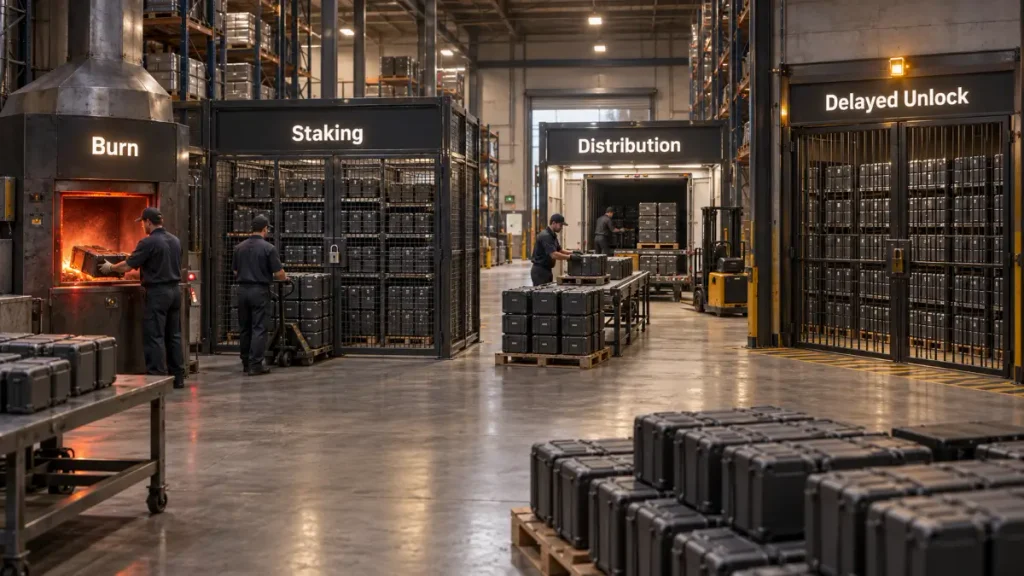
This creates a token model with both supply sinks and supply releases. Gas burn permanently destroys SOMI. Validator staking can remove tokens from liquid circulation for periods of time. Against those forces, community and ecosystem allocations continue entering the system, while insider allocations will eventually begin vesting.
Circulating supply also needs caution. CoinGecko currently reports around 160.2 million SOMI circulating, while CoinMarketCap reports about 243.23 million. That gap is too large to treat either figure as universally settled.
The disagreement does not alter the maximum allocation. It does affect current market-cap and dilution calculations, which is why circulating supply should be dated and attributed rather than presented as a fixed fact.
| Tokenomics Item | Published Position | Economic Meaning |
|---|---|---|
| Maximum allocation | 1,000,000,000 SOMI | Defines the stated supply ceiling before gas burns reduce total supply |
| Community | 27.925% | Supports users, validator rewards, liquidity and community programs |
| Ecosystem | 27.345% | Funds ecosystem development, partnerships and Foundation activity |
| Team | 11% | Large long-term contributor allocation with delayed vesting |
| Launch partners | 15% | Significant early ecosystem allocation |
| Investors | 15.15% | Future investor releases remain a potential supply source |
| Advisors | 3.58% | Smaller insider allocation under the revised vesting schedule |
| TGE allocation | 16.02% | Shows how much of original allocation was scheduled to be available initially |
| Validator requirement | 5,000,000 SOMI | Creates direct staking demand for validator participation |
| Gas to validators | 50% | Converts paid network use into validator compensation |
| Gas burned | 50% | Permanently removes part of every gas fee from supply |
| Original insider cliff | 2 September 2026 | Would have released 127.4M SOMI under previous schedule |
| Revised insider cliff | 2 June 2027 | Delays team, partner, investor and advisor releases by nine months |
The table shows why SOMI tokenomics cannot be reduced to one bullish or bearish number. Fixed allocation and gas burn provide supply discipline, while large community, ecosystem and insider allocations continue to create future distribution.
The important question is net economic pressure. Somnia needs enough recurring gas consumption and staking demand to absorb or offset tokens becoming liquid over time.
The Nine-Month Re-Lock Removes an Immediate Supply Shock
The September 1 decision materially changed the near-term token picture. Team members, launch partners, investors and advisors extended their lock by nine months. Their first unlock moved from September 2, 2026 to June 2, 2027.
Under the previous schedule, 127.4 million SOMI would have been released at the September cliff. That represented about 12.7% of the full one billion allocation. The release will no longer happen in September 2026.
This is economically relevant because those holders accepted another nine months without the scheduled liquidity event. It gives the DeFi strategy more time to develop before the first major insider cliff.
It does not create permanent scarcity.
All of those tokens still exist. The first release has moved to June 2027, and vesting continues after that date. Foundation and community schedules were not included in the announced re-lock.
The distinction is similar to the supply question in token unlock schedules. Delaying an unlock changes timing and near-term sell-pressure risk. It does not burn the tokens or prove that future supply will be absorbed.
Somnia therefore gained time, not immunity from dilution.
Circulating Supply Is Still a Transparency Problem
CoinGecko currently lists about 160.2 million SOMI as circulating. CoinMarketCap lists about 243.23 million. Both show a one billion total and maximum supply, but they disagree materially about how much is circulating.
That difference is more than 83 million SOMI. At this stage of the token schedule, it materially changes reported market capitalization and the percentage of supply considered liquid.
Different data providers can apply different circulation rules to ecosystem, treasury, community and unlocked balances. The disagreement alone does not prove that either provider is acting incorrectly.
It does show that investors and researchers need a clearer reconciliation. A useful issuer disclosure would map the one billion allocation into locked tokens, circulating tokens, treasury balances, staked SOMI and other restricted balances at a specific date.

Until that reconciliation exists, using one circulating-supply figure without attribution creates false precision.
Governance Remains Foundation-Led During the Transition
Somnia describes governance as a progressive decentralization process. Its published roadmap separates bootstrap, transition and mature phases rather than claiming full token-holder control from launch.
The transition phase covers roughly six to 24 months after mainnet. During that period token holders can participate in proposals, but the Foundation board retains ultimate control over fund allocation. The mature design is intended to delegate more power while keeping emergency override capability for extreme cases.
That structure should be described for what it is. Somnia has a decentralization roadmap, but current governance should not be treated as fully decentralized merely because SOMI has a governance role.
Foundation control can help a young network make fast decisions. It also creates an administrative dependency until more authority moves into functioning governance bodies.
The relevant future evidence is not another roadmap statement. It is whether real proposal and decision-making power moves beyond the Foundation in practice.
Security Evidence Is Stronger Than a Generic Audit Badge
Somnia has meaningful base-layer security evidence. Hacken reviewed both the PBFT consensus implementation and staking-related smart contracts before mainnet. The protocol review identified a critical state-divergence issue along with other problems, and the critical issue was resolved before launch.
The staking audit also identified high-severity issues that were addressed. That is more useful than simply stating that Somnia is audited because it shows what was examined and what kinds of weaknesses were found.
Current ecosystem security still extends beyond the original base-chain review. dreamDEX, lending markets, USDso infrastructure, cross-chain components and prediction-market resolution create additional smart-contract and operational dependencies.
dreamDEX itself has undergone a separate Hacken review. The May 2026 final report recorded 31 findings, with 22 resolved, two mitigated and seven accepted. The presence of an audit improves visibility into known risks, but it does not prove the application cannot fail.
Validator economics also affect decentralization. A five million SOMI node requirement creates a meaningful barrier to independent participation, although delegation allows token holders to help validators meet the requirement.
Somnia’s security case is therefore reasonably concrete. Base-layer audits exist, application audits exist, and known findings have been documented. The remaining task is keeping security work aligned with a rapidly changing DeFi ecosystem.
What Would Prove the DeFi Pivot Has Durable Demand?
Somnia does not need another headline throughput benchmark. It needs broader economic evidence.
dreamDEX volume should remain active over time, but other applications also need to become meaningful contributors. A network where almost all DEX activity comes from one venue is more fragile than a network with several independent sources of demand.
DeFi TVL and stablecoin liquidity should also grow. The current numbers show functioning products, but they remain small compared with established DeFi networks.
User breadth is another test. Transaction activity becomes more convincing when active addresses, independent applications and paid economic interactions grow with it.
SOMI economics provide the most direct test. Gas fees and resulting burns need to rise enough to become material relative to continuing distribution. Validator staking should also represent genuine security demand rather than depending mainly on treasury-funded rewards.
The June 2027 insider cliff creates a clear deadline for that evidence. Nine extra months are useful only if Somnia uses them to build economic demand capable of absorbing future supply.
Governance should mature at the same time. Real authority moving away from Foundation control would make the decentralization thesis easier to verify.
Verdict: Real Pivot, Real Activity, Unfinished Token Proof
Somnia has made a meaningful strategic change. The network is no longer relying mainly on a gaming and metaverse story. dreamDEX has produced real trading volume, prediction markets and agents are live, USDso provides stablecoin infrastructure, and lending adds another financial use case.
The strongest evidence is dreamDEX. Its roughly $61.9 million of 30-day volume shows that Somnia can support an active onchain order book. The limitation is concentration. dreamDEX represents almost all tracked Somnia DEX volume, while total DeFi TVL remains below $3 million.
SOMI also has a clearer economic role than many application tokens. Validators need it, transactions consume it, and half of gas fees are burned. Those mechanisms directly connect network use with the native asset.
Scale is still the missing proof. Very low gas fees mean millions of transactions can generate modest fee value. Stablecoin activity can expand without requiring large SOMI holdings, treasury incentives can support staking rewards, and more than half of the original allocation belongs to community and ecosystem programs that continue distributing over time.
The nine-month insider re-lock improves the near-term setup. A 127.4 million SOMI cliff did not arrive in September 2026, giving the new strategy additional time to establish itself. The same tokens begin their revised schedule in June 2027, so the underlying long-term supply question remains.
The fairest conclusion is that Somnia has proved more than a performance benchmark but less than broad network demand. Its DeFi pivot has created genuine activity. The next stage is proving that activity can diversify across applications and create enough recurring gas, burn and staking demand to matter against future SOMI distribution.
Frequently Asked Questions
Somnia is an EVM-compatible Layer 1 blockchain designed for high-throughput and low-latency applications. The project shifted its 2026 focus toward DeFi, prediction markets, onchain credit and agent-native applications.
SOMI is Somnia’s native network token. It is used for gas and validator staking, and holders can delegate tokens to validators. Governance is intended to expand as the network progresses through its decentralization roadmap.
Yes. Somnia’s documented gas model sends 50% of network gas fees to validators and burns the remaining 50%. More paid network usage therefore creates more SOMI burn.
No. Team, launch partner, investor and advisor tokens were re-locked for another nine months. Their first unlock moved from September 2, 2026 to June 2, 2027. The tokens were delayed, not removed from supply.
dreamDEX is strong evidence of real trading activity. It processed about $61.9 million of tracked 30-day spot volume around this review, but it also accounted for almost all tracked Somnia DEX volume. That proves traction more clearly than ecosystem breadth.
There is a material data-provider disagreement. CoinGecko reports about 160.2 million SOMI circulating, while CoinMarketCap reports about 243.23 million. A current issuer reconciliation would make the supply picture clearer.
The biggest unresolved question is whether application growth creates enough native-token demand to absorb continuing distribution. Cheap gas, sponsored or stablecoin-based user experiences, treasury-funded staking incentives and the future June 2027 insider cliff can all weaken the connection between high activity and durable SOMI demand.

Founder & Managing Editor of CryptosMedia. Zahid Hussain leads evidence-based crypto research covering tokenomics, security, governance, adoption, and risk.
CryptosMedia separates verified facts from interpretation, avoids buy/sell recommendations, and updates reviews when major evidence changes.
1 thought on “Somnia Review: Real Network Demand After Its DeFi Pivot?”