
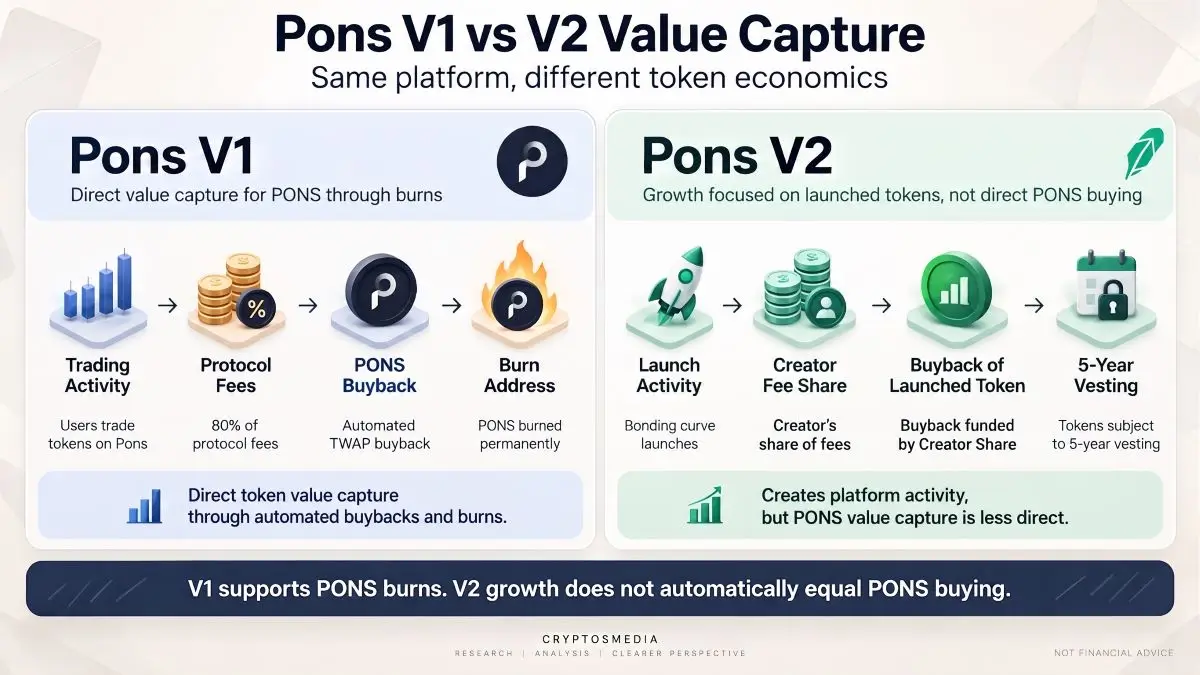
This Pons Review examines one question: Pons is generating real activity and fees, but how much of that growth creates direct demand for PONS? Pons grew quickly on Robinhood Chain during August and early September 2026. Users created more than 200,000 tokens in Bitquery’s measured period, trading reached billions of dollars, and protocol fees became large enough to attract wider market attention.
PONS also has a real buyback-and-burn mechanism. But that mechanism belongs mainly to pons v1. Pons v2 uses different fee and buyback rules. Its documented buyback buys tokens launched through v2, not PONS. This distinction matters because strong platform growth does not automatically mean strong PONS value capture.
How Pons Works
Pons is a non-custodial token launch protocol on Robinhood Chain. Users create and trade tokens from their own wallets. Pons does not need custody of user funds. Robinhood Chain is an Ethereum Layer 2 built with Arbitrum technology. It uses ETH for gas and supports EVM applications. Pons uses that environment to create token markets with fixed launch rules.
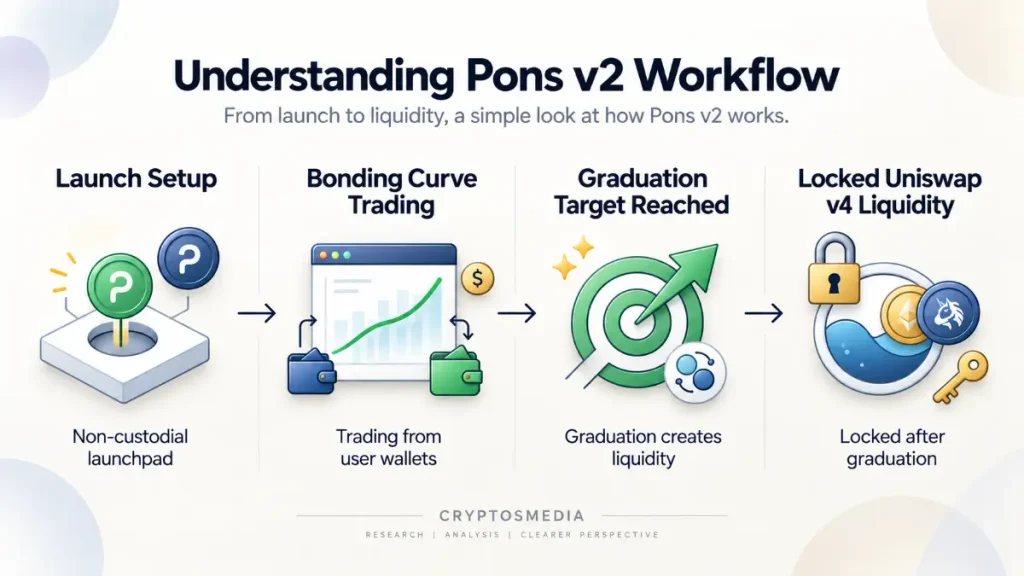
A normal pons v2 launch works like this:
- Creator chooses token details and launch settings.
- Token supply enters a bonding curve.
- Buyers and sellers trade against that curve.
- Successful launch reaches its graduation target.
- Protocol creates Uniswap v4 liquidity.
- Graduation liquidity remains locked.
Creator cannot later increase token supply or withdraw graduation liquidity through normal launch controls. That reduces some creator risks. It does not guarantee demand, liquidity or project quality.
Official pons documentation also says public v2 launching is currently restricted. Approved addresses can still launch while this restriction remains active. Pons therefore has a working product, but current access is not fully open.
Readers comparing base-layer assumptions can also see our Ethereum Layer 2 review.
Pons Review: V1 and V2 Use Different Economics
PONS launched through pons v1. V1 and v2 should not be treated as one economic system.
| Area | pons v1 | pons v2 |
|---|---|---|
| Initial market | Uniswap v3 liquidity | Bonding curve |
| Main quote asset | WETH | ETH or approved assets |
| Graduation | Same market continues | Moves to Uniswap v4 |
| Liquidity | Locked | Locked after graduation |
| Creator fees | Legacy structure | Set at launch |
| Buyback target | PONS | Launched token |
| Buyback result | PONS burned | Launch token locked |
| Current security review | Legacy system | Reviews still open |
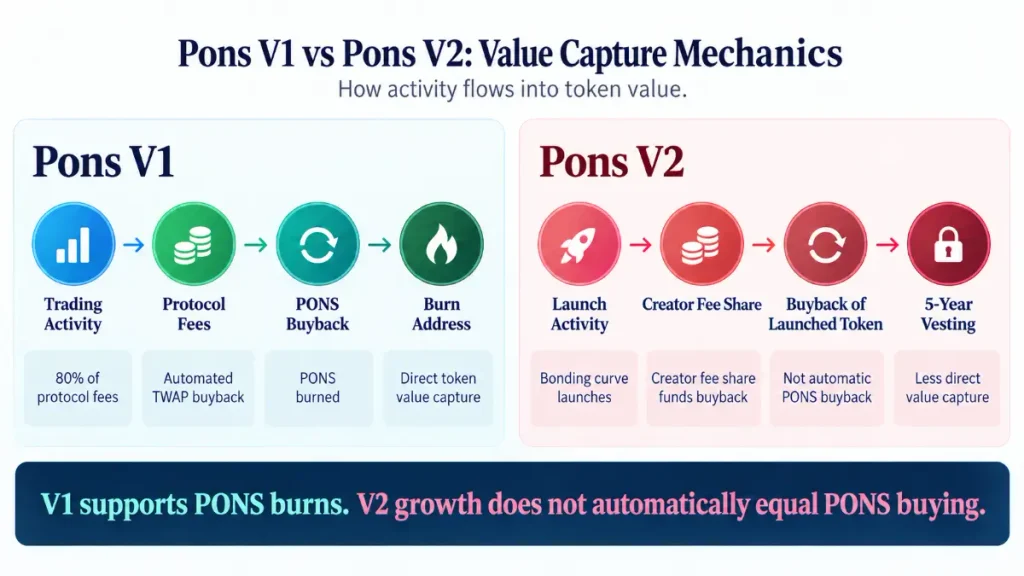
V1 creates a direct link between protocol activity and PONS. V2 does not create that same automatic link. This difference is central to PONS token economics.
Why the V1–V2 Split Matters
The first table shows why Pons activity should not be read as one single token-value story. V1 connects protocol fees to PONS purchases and burns, so higher v1 trading can create direct PONS demand. V2 works differently. Its launch flow uses bonding curves, graduates liquidity to Uniswap v4, and directs documented creator-fee buybacks toward the token launched through v2 rather than PONS.
That difference matters before looking at headline usage numbers. A surge in token creation, trading volume or creator fees can prove product activity without proving that the same activity is buying PONS. Platform traction and token value capture therefore need separate analysis. The next section looks at Pons usage data as evidence of product traction first, then measures that activity against the value-capture mechanisms described above.
Real Usage Exists
Bitquery reconstructed 32 days of pons activity from Robinhood Chain contract data between August 3 and September 3, 2026.
Its analysis found:
| Metric | Result |
|---|---|
| Tokens created | 207,893 |
| Tokens graduated | 3,228 |
| Graduation rate | 1.55% |
| Bonding-curve volume | $736 million |
| Post-graduation volume | $2.14 billion |
| Participating wallets | 314,736 |
| Wallets ending behind | 66.8% |
| Total fees measured | $11.8 million |
| Creator fees | $9.7 million |
Full methodology appears in Bitquery’s Pons investigation.
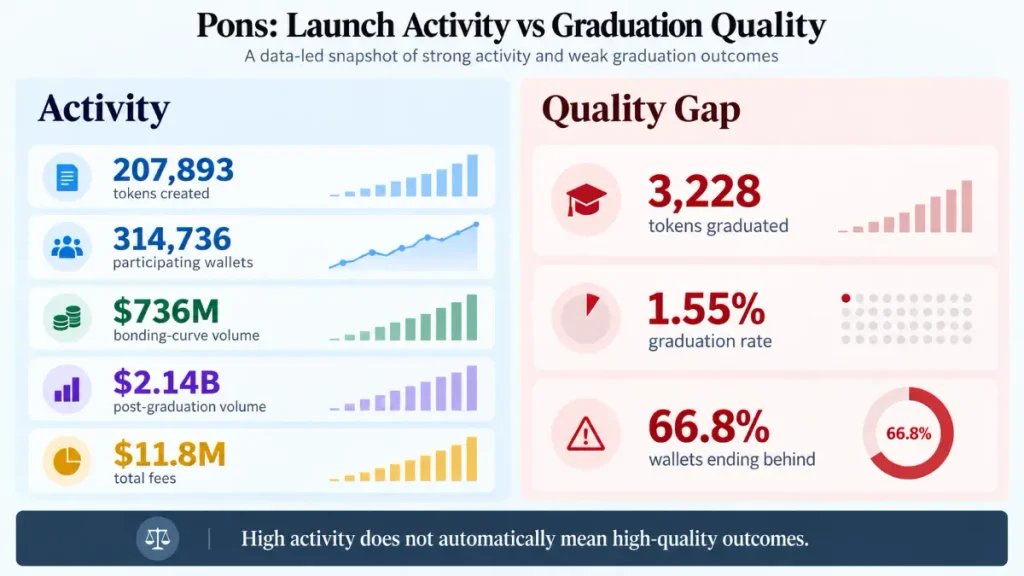
These numbers prove substantial product activity. They do not prove durable adoption. Only 3,228 of 207,893 measured launches graduated. That equals about 1.55%. Bitquery also found 66.8% of participating wallets ended its measured period with less value than they started with.
This creates an important distinction. High trading volume can generate strong fees while most launched tokens fail to develop lasting markets. Fee generation counts as proven activity. Long-term launch quality does not.
A similar distinction between trading volume and economic quality also matters in our Hyperliquid review.
V1 Gives PONS Direct Value Capture
Pons v1 has a clear PONS mechanism.
Current protocol policy routes 80% of v1 protocol fees into automated PONS purchases. Bought tokens move to a burn address. Remaining 20% supports infrastructure and team operations.
Flow is direct:
v1 trading → protocol fees → PONS purchases → burn
That is real token value capture. But one limitation remains. Pons documentation says this 80% allocation is not immutable yet. Project plans aim to automate and decentralize it further. Current policy can therefore support PONS demand, but investors should not treat 80% as an unchangeable rule.
PONS started with one billion tokens. Market data around September 7 showed roughly 712 million circulating after close to 288 million tokens had moved out of active supply through burns. Burning reduces supply. It does not guarantee higher price. Strong PONS economics still require enough buying demand to matter relative to selling pressure, liquidity and market valuation.
V2 Does Not Automatically Buy PONS
The token case becomes more cautious in v2. Although the protocol charges fees, its documented buyback works differently from v1.
Creator can enable a buyback for a token launched through v2. That mechanism uses part of creator fee revenue to buy that specific launch token. It does not buy PONS. Bought launch tokens then enter a vesting structure rather than a PONS burn address.
V2 also contains a buyback safety condition. Protocol can skip planned buyback when liquidity is too thin or expected price impact becomes too high. This protects execution from extreme market impact. It also means even launch-token buybacks are conditional.
A claim that all Pons fee revenue directly supports PONS would be wrong. Platform revenue and PONS demand are separate numbers unless onchain flows connect them. That gap is currently the biggest weakness in PONS value capture.
Tokenized Assets Give Pons a Different Market
Pons v2 does not require every launch to trade only against ETH. Protocol can approve other quote assets. Bitquery found a meaningful share of measured launches using tokenized stocks and other assets available on Robinhood Chain.
This creates a real product difference. Pons can support markets built around tokenized financial assets instead of operating only as another memecoin launchpad. Robinhood Chain’s Arbitrum-based design also makes our Arbitrum review useful background for readers comparing underlying infrastructure.
Product difference still needs durable demand. Useful evidence would include:
- repeat trading after launch
- retained liquidity
- more successful graduations
- active markets after incentives or hype fall
- recurring use of non-ETH quote assets
Launch count alone cannot prove this.
Security Reviews Remain Open
Pons v2 includes several useful controls. Token supply stays fixed after launch. Graduation liquidity remains locked. Creator tax has limits and launch settings cannot simply change after buyers enter. These controls reduce specific creator risks. They do not prove contract security.
Pons says SB Security, Dingbats and Pashov Audit Group are reviewing v2. Current documentation says those reviews remain open. No completed review means readers should not treat v2 as fully audited yet.
Relevant risks include bugs in:
- bonding-curve accounting
- fee routing
- graduation logic
- liquidity creation
- buyback execution
- administrative controls
Risk depends on actual contract behavior, not number of audit firms involved. Protocol control also matters.
Pons can currently limit new v2 launches to approved addresses. Some factory settings remain under administrative control. That does not mean administrators can freely rewrite every existing token. It does mean protocol access and some future configuration remain controlled. V2 is operational, but unfinished security reviews and active administrative controls still matter.
Copycat Tokens Remain User Risk
Pons can support multiple tokens with similar names or symbols. Name alone does not prove identity. Users should verify contract address before trading. Locked liquidity cannot solve copycat risk. Fixed supply cannot solve it either.
Users still face:
- fake branding
- thin liquidity
- high creator taxes
- failed launches
- sharp bonding-curve moves
- short-lived speculative demand
Our guide on fake crypto tokens explains contract checks and common imitation tactics.
Binance Futures Adds Trading Demand, Not Pons Utility
Binance Futures launched PONSUSDT perpetual trading on September 6, 2026 with leverage up to 20x. This increased visibility and derivatives access. It did not create new protocol utility for PONS.
Futures traders can take leveraged exposure without using Pons launchpad. This distinction matters. Market attention can push volume higher without changing platform revenue or PONS buyback mechanics.
PONS also moved sharply during early September. Price strength proves trading demand at that moment. It does not prove sustainable token value capture.
What PONS Needs to Prove Next
Future evidence should answer clear questions.
V2 revenue:
Does a defined share begin buying PONS onchain?
Security:
Do current v2 reviews close, publish findings and verify fixes?
Public access:
Does wider launch access return without weakening market quality?
Graduation quality:
Do more graduated tokens retain real liquidity and users?
V1 buybacks:
Does PONS burn continue at meaningful scale relative to protocol revenue?
Tokenized-asset markets:
Do non-ETH pairs keep volume after initial interest fades?
User results:
Does activity become less dependent on rapid speculative turnover?
These measures can strengthen or weaken future PONS assessment without relying on price predictions.
Verdict: Product Activity Is Real, Token Capture Is Incomplete
Pons has proved real usage. Bitquery found more than 200,000 launches, billions in trading volume and millions in fees during its measured period. PONS also has real value capture through v1 buybacks and burns. Those facts deserve credit.
V2 creates uncertainty. Its documented buyback purchases launched tokens rather than PONS. Published mechanics do not show every v2 protocol fee creating direct PONS buying pressure. Security reviews also remain open. Launch access currently depends on approved addresses, while some protocol settings remain under administrative control.
My Pons Review therefore separates product success from token success. Pons has proved it can attract users and generate fees. PONS has proved direct value capture through v1. V2 has not yet proved that its growth creates comparable PONS demand. That is the main issue to watch.
Frequently Asked Questions
Pons is a non-custodial token launch protocol on Robinhood Chain. V2 uses bonding curves and moves successful launches into locked Uniswap v4 liquidity.
No. Pons is a separate protocol that operates on Robinhood Chain.
Pons v1 currently routes 80% of protocol fee revenue into PONS purchases and burns. Documentation says this percentage is not immutable yet.
Not automatically under published v2 mechanics. V2 buybacks purchase each launched token, not PONS.
Current documentation says three independent security reviews remain in progress. Final reports have not yet closed those reviews.
PONS started with one billion tokens. Around September 7, roughly 712 million remained in circulating supply after close to 288 million tokens had been counted as burned.
Binance Futures supports PONSUSDT perpetual trading. This does not mean Binance Spot lists PONS.

Founder & Managing Editor of CryptosMedia. Zahid Hussain leads evidence-based crypto research covering tokenomics, security, governance, adoption, and risk.
CryptosMedia separates verified facts from interpretation, avoids buy/sell recommendations, and updates reviews when major evidence changes.