
MarsCoin gained attention for a reason most meme tokens do not have: holders can receive SPCXB, a tokenized security linked to underlying SpaceX securities. This MarsCoin Review examines whether that reward mechanism creates durable value or adds another layer of risk.
That connection is where MarsCoin becomes more complicated. MarsCoin can generate SPCXB rewards through trading taxes, yet reward flow depends on taxable activity, Flap infrastructure and access to a separate tokenized security. Binance Spot and Futures listings brought much deeper market access in September 2026, but exchange volume should not be confused with reward generation or durable token demand.
MarsCoin Turns Trading Activity Into SPCXB Rewards
MarsCoin is a meme token that runs on BNB Chain. Several crypto assets use similar Mars-themed names, so contract verification matters. Binance opened MARSCOIN Spot trading on September 4, 2026 after Futures trading had started three days earlier.
MarsCoin does not operate its own blockchain or application network. It uses BNB Chain for execution and Flap infrastructure for token, market, tax and reward mechanics. Readers comparing token-level activity with base-chain design can use our BNB review for wider network context.
Core idea is simple: MarsCoin trades, transaction taxes collect value, and its reward system converts that activity into SPCXB distributions for eligible holders. Official MarsCoin site lists 3% buy tax and 3% sell tax and says both help fund the SPCXB reward vault. Its live dashboard also displays recent SPCXB vault payouts.
That makes the reward mechanism observable rather than purely promised. It still does not mean every dollar of MARSCOIN trading volume sends three cents into SPCXB rewards.
Tax Collection Changes With Trading Route
Flap contract design is important because MarsCoin does not run one simple tax rule across every possible venue. Flap’s FlapTaxTokenV3 interface supports separate buy and sell tax rates, a tax processor and dividend tracking contract. It applies token-level tax to relevant DEX pool trades after migration, while bonding-curve trading uses a separate Portal tax path.
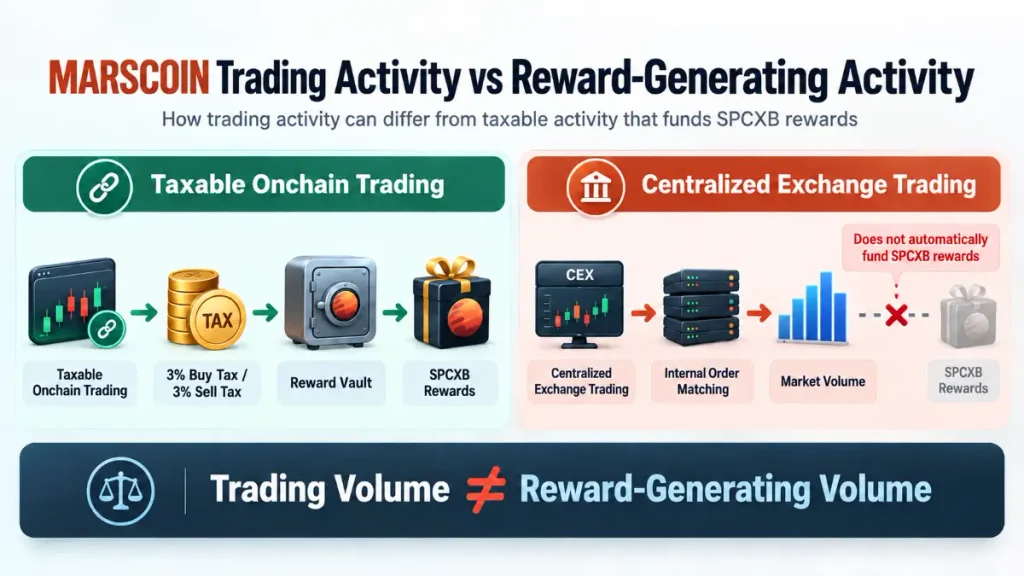
This distinction becomes more important after major exchange listings. A centralized exchange can match thousands of trades inside its internal ledger without recording one BNB Chain token transfer for every buyer and seller. High Binance volume can therefore prove strong market activity without proving equal growth in MarsCoin’s onchain tax revenue.
MarsCoin economics should be judged using two separate numbers: total market trading and taxable activity feeding reward infrastructure. Combining them would overstate value capture.
The mechanism can be summarized like this:
| Mechanism | What it creates | What it does not prove |
|---|---|---|
| MARSCOIN trading | Market activity and liquidity | Sustainable holder demand |
| Taxed Flap activity | Revenue for configured tax flows | Same tax capture from every exchange trade |
| SPCXB vault funding | Asset available for holder rewards | Guaranteed reward rate |
| SPCXB distribution | Measurable holder benefit | MARSCOIN ownership of SpaceX |
| Binance Spot access | Easier MARSCOIN trading | More onchain reward revenue |
| Binance Futures | Leveraged price exposure | MARSCOIN utility |
MarsCoin therefore has real economic plumbing, but headline volume alone cannot measure how productive that plumbing is.
SPCXB Is Separate From MARSCOIN
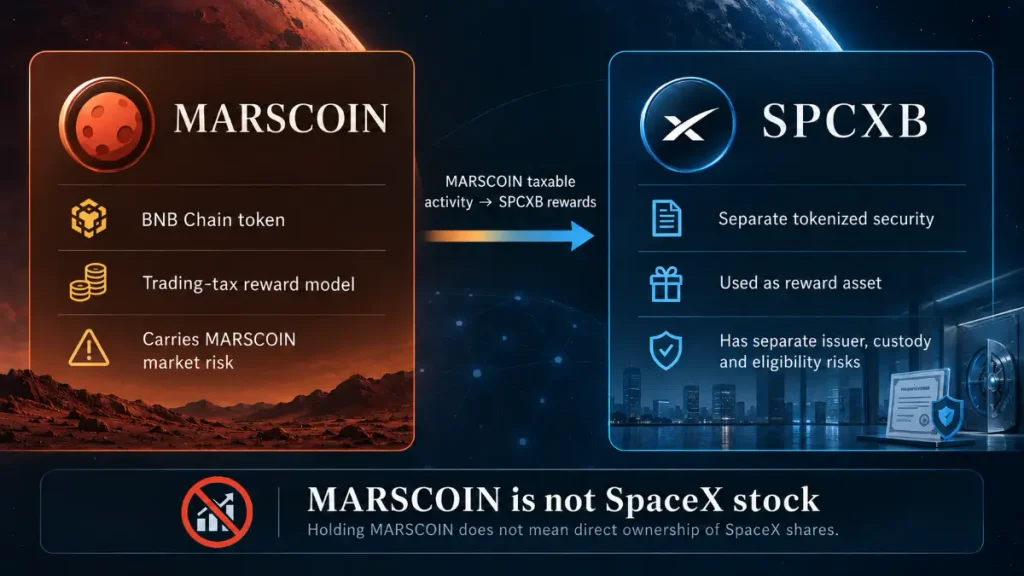
SPCXB gives MarsCoin its most unusual feature. Binance describes SPCXB as a bStocks tokenized security issued by BTech Holdings Limited. It represents an interest connected with underlying securities held by issuer arrangements, but holders do not directly own SpaceX shares simply by holding SPCXB. Binance’s SPCXB announcement also lists BNB Chain contract 0xbe9D156892E55e7154BcD3cB0FEA677F9D3103E1.
That separation should remain clear. MARSCOIN is not SpaceX stock, not SPCXB, and not documented as a claim redeemable one-for-one for SPCXB. MarsCoin uses SPCXB as both a quote asset and a reward asset within its design.
This creates a different risk profile from a normal meme token. MarsCoin holders depend partly on another asset whose availability can involve issuer, custody, regulatory and jurisdiction rules. Binance itself warns that bStocks carry liquidity, issuer, custody, operational, technology and regulatory risks and are limited to eligible users in permitted jurisdictions.
A more direct tokenized-asset infrastructure model appears in our Nexera review. MarsCoin uses tokenized financial exposure inside its reward design; it does not itself provide broad RWA infrastructure.
Rewards Are Real, but Yield Is Not Free
SPCXB payouts can look like passive yield, but their economic source is still trading activity.
When users trade through taxed routes, part of transaction value moves into configured reward mechanics. Holders receiving SPCXB are therefore benefiting from activity funded by transaction costs. More taxable volume can strengthen reward flow, but higher tax also creates extra friction for traders entering or leaving taxed markets.
A 3% buy tax and 3% sell tax should not be viewed only as holder income. They are also costs built into applicable trading routes. Slippage, market movement and other fees can add further cost.
Reward value also moves with SPCXB itself. A MarsCoin holder can face MARSCOIN price risk while reward value changes with separate SPCXB market conditions. One reward mechanism therefore introduces two market exposures rather than removing risk.
This does not make rewards artificial. It means reward quality should be measured by net economics: taxable volume, actual SPCXB acquired, distribution reliability and value received relative to costs paid by market participants.
Distribution Also Depends on Where MARSCOIN Is Held
Binance’s earlier Alpha arrangement shows why holding location matters. For onchain Binance Wallet holders, Flap distributed rewards to wallet addresses under its rules. Alpha 2.0 users required Binance to receive Flap rewards through a treasury address and then calculate eligible distributions using holding snapshots.
Binance changed calculation rules for September, requiring more than 10,000 units on a given day before that day would count toward valid holdings under its Alpha reward framework. Rewards also remained subject to eligibility for bStocks products.
MarsCoin later moved from Binance Alpha to full Spot listing, so investors should not automatically assume old Alpha rules describe every current Binance holding route. What matters is the broader lesson: token-level reward mechanics and exchange-level distribution are different layers.
A holder should verify current venue rules rather than assuming that simply seeing MARSCOIN in an account guarantees identical SPCXB treatment everywhere.
Binance Changed Liquidity Faster Than Utility
Binance Futures launched MARSCOINUSDT perpetual trading on September 1 with leverage up to 20x. Three days later, Spot markets opened for MARSCOIN/USDT, MARSCOIN/USDC and MARSCOIN/TRY, with Seed Tag applied.
Those listings materially changed accessibility. Futures traders can take leveraged exposure, while Spot users can buy actual MARSCOIN without using Flap directly. Binance also added MARSCOIN to products including Simple Earn, Convert and Margin after Spot listing.
None of this changes MarsCoin’s core reward mechanism automatically. Futures volume can rise without anyone holding MARSCOIN onchain. Spot turnover inside exchange books can also rise without every matched trade passing through the Flap tax processor.
This is similar to the distinction discussed in our Hyperliquid review: market activity can be real and substantial without proving equivalent token value capture.
MarsCoin now has stronger market access than it had before September. Whether that access creates lasting demand after listing excitement fades remains a separate question.
MARSCOIN Tokenomics: Fixed Supply, Tax-Funded Rewards
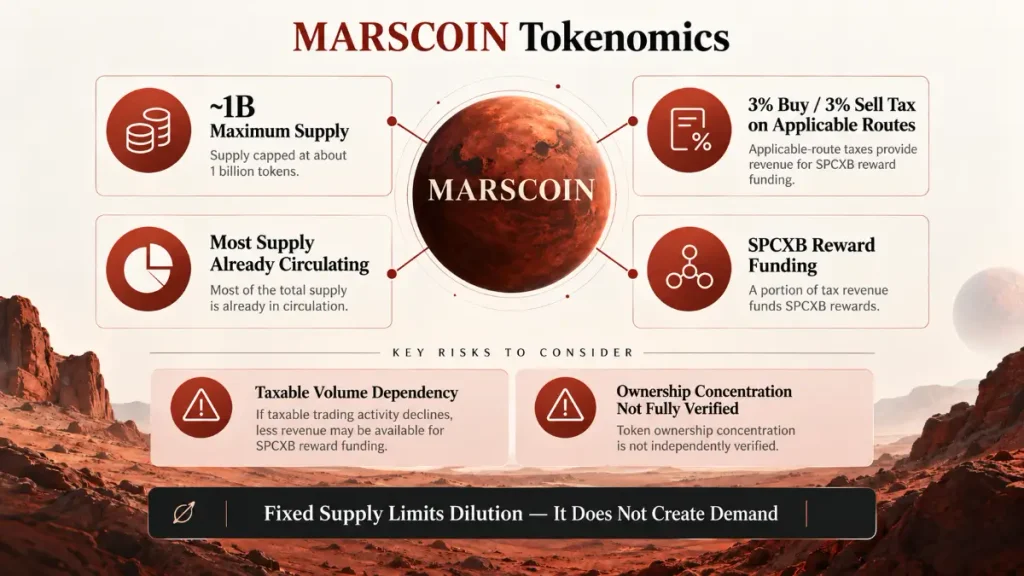
MARSCOIN has a simpler supply structure than many low-float crypto launches. Current market data shows about 1 billion tokens in circulation from a maximum supply of about 1 billion. This limits conventional dilution risk because no major public multi-year unlock schedule has been verified.
Its economic model depends more on trading activity than on future token emissions. MarsCoin lists a 3% buy tax and 3% sell tax on applicable routes, with taxable activity helping fund SPCXB rewards. This creates a direct link between trading and holder rewards, but it also means reward strength depends on enough taxable volume continuing to pass through supported routes.
Fixed supply does not guarantee strong demand or balanced ownership. A conventional public allocation schedule showing detailed team, investor and treasury shares has not been verified, so raw wallet balances should not be treated as proof of insider concentration. MarsCoin therefore has limited visible unlock risk, while taxable volume, reward sustainability and ownership distribution remain more important tokenomics questions.
| Tokenomics Area | Current Position | Why It Matters |
|---|---|---|
| Maximum supply | About 1 billion MARSCOIN | Limits conventional supply expansion |
| Circulating supply | About 1 billion MARSCOIN | Large future unlock pressure appears limited |
| Buy tax | 3% on applicable routes | Adds trading cost while supporting reward mechanics |
| Sell tax | 3% on applicable routes | Creates exit friction while contributing to reward flow |
| Holder reward | SPCXB | Gives eligible holders a separate reward asset |
| Reward source | Taxable trading activity | Reward strength depends on continued taxed volume |
| Major unlock schedule | No major public schedule verified | Reduces visible vesting-related dilution risk |
| Team and investor allocation | Detailed public allocation not verified | Ownership concentration cannot be judged from allocation data alone |
| Core value-capture route | Trading tax → SPCXB reward funding | Connects taxable activity with holder rewards |
| Main tokenomics risk | Weak taxable volume or concentrated ownership | Fixed supply alone does not create durable demand |
Security Depends on Flap and Reward Infrastructure
MarsCoin uses standardized Flap tax-token infrastructure instead of building a large custom DeFi protocol. That reduces some project-specific code surface, but dependencies remain.
Flap contracts include tax processing, dividend tracking, pool-state transitions and vault interfaces. Tax revenue can move through processor logic before reaching configured recipients or vaults. A failure in those components can matter even if MARSCOIN supply itself remains fixed.
CertiK currently gives MarsCoin a partial Skynet rating and shows verified-contract monitoring signals, but its MarsCoin page lists audits as unavailable. CertiK monitoring does not count as a completed independent audit.
That leaves security assessment narrower than marketing claims such as ‘contract verified’ can imply. Relevant questions include whether tax processing behaves as expected, whether the reward vault receives correct amounts, whether SPCXB distributions remain reliable, and whether connected Flap contracts retain expected permissions.
MarsCoin is not technically as complex as a lending protocol or cross-chain bridge. Its strongest feature still depends on several contracts working together.
Contract Identity Matters After Rapid Growth
Fast listings often bring copycats. Binance’s official announcement gives one clear reference point: MARSCOIN contract on BNB Smart Chain is 0xFe189E97832DA1573e4e4Ff034F4fFC3a15c7777.
Do not identify MARSCOIN by name, ticker or logo alone. Users moving MARSCOIN between wallets or DEXs should compare the full contract address before approving a swap.
Our fake crypto tokens guide covers this problem in more detail. Mars-themed naming makes contract verification especially useful because similar names already exist across crypto markets.
What Must SPCXB Rewards Prove After Listing Hype?
MarsCoin has already proved it can attract traders. Better evidence now needs to show whether rewards remain active after launch and listing attention fades.
Useful future checks include:
- taxable onchain volume remains active after listing excitement falls
- SPCXB vault receives meaningful recurring funding
- reward distributions stay transparent and verifiable
- exchange-held users receive clear current guidance on eligibility
- MARSCOIN liquidity remains deep relative to valuation
- reward activity does not depend mainly on short speculative turnover
- Flap tax and vault infrastructure receives stronger independent security review
- wallet attribution improves enough to judge real ownership concentration
These measures are more useful than predicting price. They test whether the reward mechanism stays economically relevant.
Verdict: Real Rewards Do Not Remove Meme-Token Risk
MarsCoin has more substance than a meme token built only around a name. Its SPCXB reward system is real, transaction taxes are visible, Flap provides working infrastructure, supply is already close to fully circulating, and Binance has added major Spot and Futures access.
But its strongest feature also creates its strongest dependency. Reward value relies on taxable trading activity and a separate tokenized security. Large centralized-exchange volume does not automatically feed reward vault, while SPCXB introduces issuer, custody and jurisdictional considerations outside MARSCOIN itself.
My MarsCoin Review gives most weight to whether taxed trading keeps producing meaningful SPCXB rewards after exchange-driven attention fades. MarsCoin has proved it can distribute an external asset to holders. It has not yet proved that this structure creates durable MARSCOIN demand once speculative turnover and listing attention fall.
Fixed supply helps. Binance access improves liquidity. SPCXB rewards create a measurable reason to hold. None of these factors alone proves sustainable value.
Main test is simple: can MarsCoin keep generating meaningful SPCXB rewards from genuine taxable activity after current market attention cools? If that becomes clear over several months, its token case will be easier to judge.
Frequently Asked Questions
MarsCoin is a BNB Chain meme token that uses Flap infrastructure and rewards eligible holders with SPCXB generated through its tax and vault mechanism.
Use Binance’s official listing announcement and compare full BNB Smart Chain contract before transferring or trading MARSCOIN.
MarsCoin website lists 3% buy tax and 3% sell tax. Flap infrastructure can process tax differently depending on whether trading occurs during bonding-curve phase or through relevant DEX pools.
No. MARSCOIN is separate from SPCXB and does not represent direct SpaceX ownership. SPCXB itself is a bStocks tokenized security with its own issuer and regulatory structure.
Not necessarily in the same way. Onchain taxed routes can fund reward mechanics, while centralized exchanges may match trades internally. Total exchange volume should not be treated as equal to taxable Flap volume.
CertiK currently provides monitoring information and a partial rating, but its MarsCoin page lists audits as unavailable. A completed standalone independent MarsCoin audit was not verified during this review.
Yes. Binance Futures launched MARSCOINUSDT perpetual trading on September 1, 2026 with up to 20x leverage. Binance Spot followed on September 4 with MARSCOIN/USDT, MARSCOIN/USDC and MARSCOIN/TRY markets and Seed Tag applied.

Founder & Managing Editor of CryptosMedia. Zahid Hussain leads evidence-based crypto research covering tokenomics, security, governance, adoption, and risk.
CryptosMedia separates verified facts from interpretation, avoids buy/sell recommendations, and updates reviews when major evidence changes.