
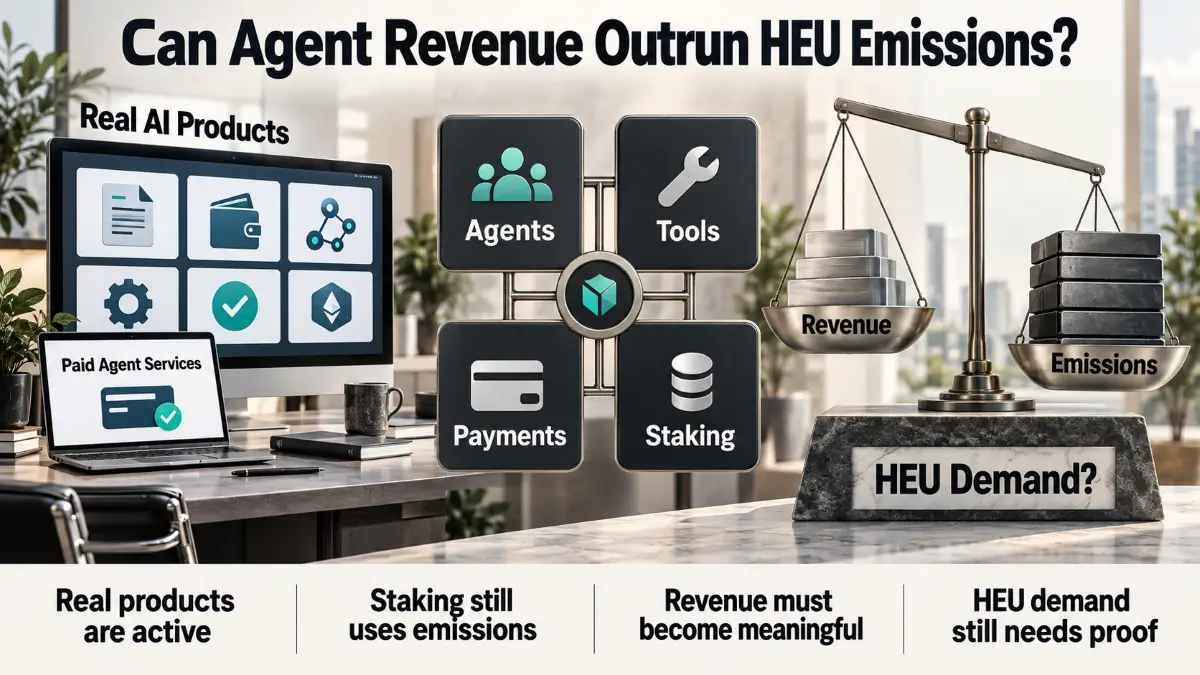
Heurist has changed significantly from the decentralized AI mining network described in many older summaries. This Heurist AI Review focuses on its current economic problem. Heurist now operates AI agent infrastructure, crypto research tools, x402 payment services, staking, and an expanding agent marketplace, while HEU still relies heavily on emission-funded rewards.
That creates a more useful question than short-term price performance. Can real agent usage and protocol revenue grow fast enough to support HEU demand while staking rewards, treasury vesting, team vesting, and the long Mining and Staking allocation continue releasing supply?
Current evidence gives Heurist more substance than a token built around an AI label. Mesh lists live agents, tools, data providers, API access, MCP support, and x402 payments. Development also continued through 2026. The weakness sits in token capture. Several product flows can use USDC rather than HEU, while staking still offers a high base reward funded through protocol emissions.
This article is for research and education only. It does not provide financial advice or a buy or sell recommendation. Supply figures, staking rewards, protocol activity, and product economics can change.
Heurist Has Moved Beyond Its Original Mining Story
Heurist originally built a decentralized AI inference network where GPU providers supplied compute for open-source models. Its early network attracted a large number of GPU participants and processed substantial inference activity during the project’s mining and testnet phases.
That is no longer the complete Heurist story.
The current product stack includes Heurist Mesh, Ask Heurist, Heurist Finance, Heurist Chain infrastructure, an x402 Facilitator, and tools for autonomous AI agents. Official tokenomics now state that the earlier mining phases have ended and mining is no longer available.
Heurist therefore looks less like a pure decentralized AI compute network and more like infrastructure for AI agents that need crypto data, tools, APIs, payments, and execution.
The Heurist Mesh acts as a marketplace for specialized crypto and finance agents. Its public interface has listed dozens of data providers and deployed agents alongside a larger library of tools. These remain project-reported product counts rather than independent adoption metrics, but they show an operating software layer rather than a roadmap-only product.
Mesh also exposes agents through REST APIs and MCP. Outside applications can call specialized tools for token data, wallet analysis, blockchain intelligence, market research, and other crypto-focused tasks.
The key economic question is no longer whether Heurist can run AI workloads. It is whether this growing software layer creates enough demand that reaches HEU.
Agent Usage Does Not Automatically Create HEU Demand
A working AI product does not guarantee native-token demand.
Heurist Mesh supports x402 pay-per-use access for selected services. Autonomous agents can pay with stablecoins such as USDC on Base. Ask Heurist also supports paid usage after free credits run out.
This improves usability. An AI agent does not need to acquire a volatile token before it can purchase a small service.
It also creates a tokenomics trade-off.
A USDC payment can prove real product demand without creating an immediate HEU market purchase.
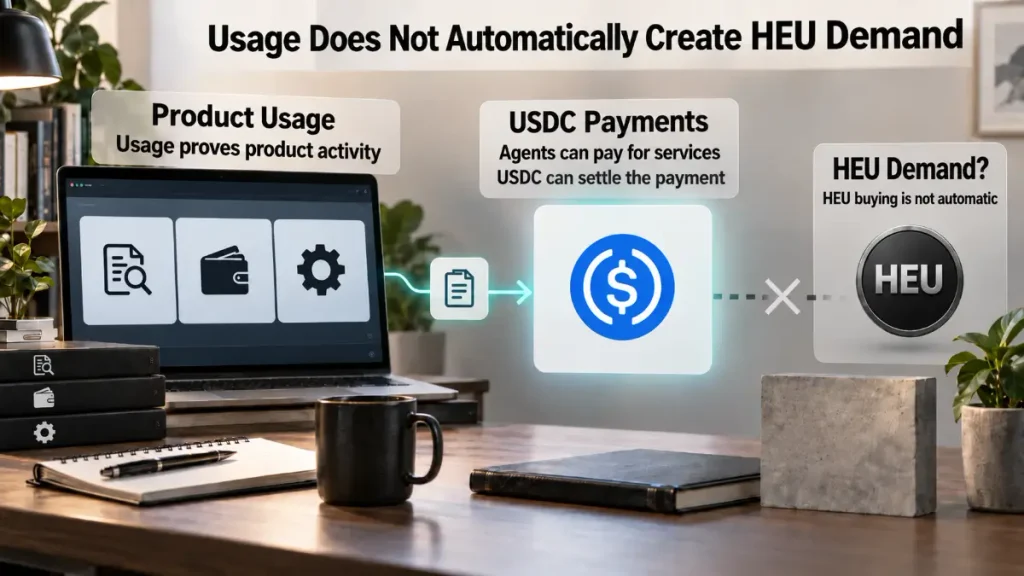
This distinction also appears in other AI agent payment networks. Protocol usage and native-token demand can move together, but they are not the same metric.
HEU still connects to the ecosystem in several ways. Users can stake the token. Holding or staking HEU can increase usage limits in Ask Heurist. The token also supports governance and sits inside the planned Heurist Chain economy.
The challenge is measuring which of those roles creates actual demand today.
Staking Connects HEU to Both Emissions and Revenue
HEU staking gives Heurist one of its clearest value-capture mechanisms.
Users stake HEU and receive stHEU, which represents their staking position. Heurist separates staking rewards into two economic sources.
The first source is a 50 percent base APR funded by protocol emissions.
The second is a variable reward component funded by protocol revenue from API credit purchases.
That difference is important.
Emission-funded rewards redistribute part of the token allocation to stakers. Revenue-funded rewards come from people paying to use Heurist products.
If the revenue-backed component grows over time, staking could become less dependent on HEU distribution and more closely tied to real demand.
Current public reporting does not make that transition easy to measure. Heurist explains the mechanism, but it does not provide a simple live breakdown showing how much staking reward came from token emissions and how much came from protocol revenue.
How Heurist Usage Connects to HEU
| Product or Mechanism | Current Economic Flow | HEU Connection |
|---|---|---|
| Heurist Mesh | API access and x402 payments | Usage can generate protocol revenue |
| Ask Heurist | Free access plus paid usage | Holding or staking HEU can increase usage limits |
| HEU staking | Tokens locked for stHEU | Creates locking demand but base rewards use emissions |
| Revenue rewards | API credit revenue | Connects paid product usage to stakers |
| Heurist Chain | HEU planned as gas asset | Could create direct transactional utility |
| x402 Vending Machine | USDC used during launches | Successful graduation can create direct HEU purchases |
| Governance | HEU participation | Adds control utility without guaranteeing market demand |
The strongest part of this model is the revenue component. The weakest part is the lack of a public dashboard that separates emission rewards from revenue-backed rewards.
The x402 Vending Machine Creates a Direct HEU Buy Route
One newer product creates a more direct route from outside capital into HEU.
Heurist’s x402 Vending Machine allows AI services and projects to launch tokens through a standardized process. Users initially participate with USDC.
When a launch successfully completes its public allocation, the system converts 100 percent of the raised USDC into HEU through Uniswap V3. It then pairs the acquired HEU with the newly launched token for liquidity.
That creates a clear sequence:
USDC raised → HEU purchased → HEU placed into liquidity
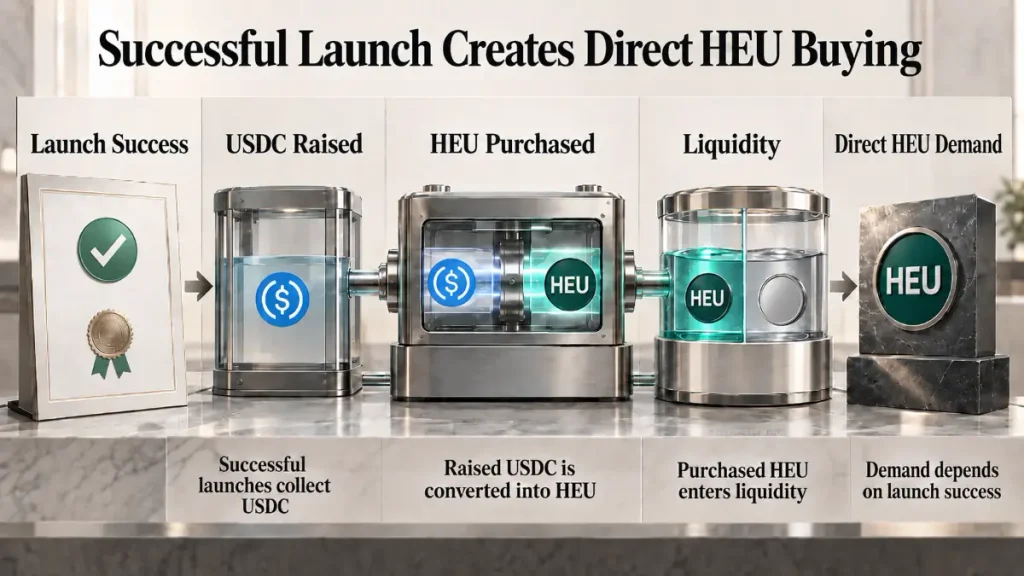
This mechanism matters because users do not need to enter with HEU for the system to produce HEU market demand.
The weakness is adoption data.
A mechanism that can buy HEU only matters economically if enough launches reach graduation and attract meaningful capital. Public documentation explains how the process works, but current aggregate data for total USDC converted into HEU remains difficult to verify.
This type of machine-to-machine commerce also overlaps with the wider autonomous machine economy, where software can discover services, pay for them, and interact with blockchain infrastructure without manual approval for every transaction.
HEU Tokenomics: Fixed Cap, Long Distribution
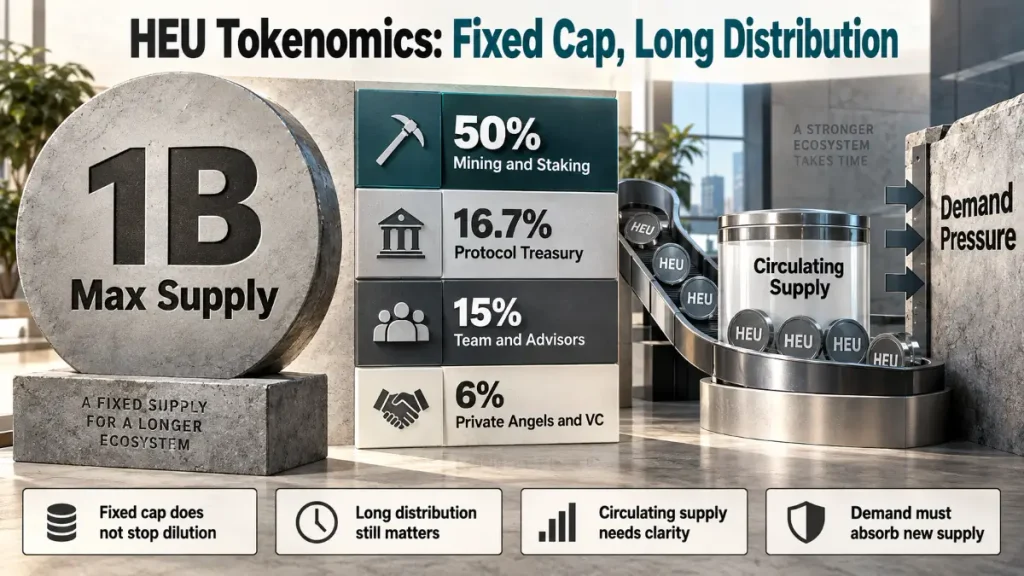
The official HEU tokenomics set maximum supply at 1 billion HEU.
A fixed maximum removes the risk of unlimited issuance beyond the published allocation. It does not prevent circulating supply from expanding for years while previously allocated tokens vest or enter staking rewards.
The largest allocation is 50 percent for Mining and Staking. This allocation follows a long release schedule and remains the most important supply bucket.
The Team and Advisors allocation is 15 percent.
Private Angels and VC investors receive 6 percent.
The Protocol Treasury receives 16.7 percent.
Smaller allocations cover Season 1 testnet miners, liquidity, marketing, NFT holders, KOLs, and grants.
The gap between maximum and circulating supply does not prove that almost 90 percent of HEU remains locked or is waiting to enter the market. Current supply data is too inconsistent for that conclusion.
As checked on September 15, 2026, CoinGecko displayed roughly 276.7 million HEU circulating, while CoinMarketCap displayed roughly 110.48 million and labeled that figure self-reported.
That gap is too large to ignore.
Different providers can use different circulation methodologies, especially when a token exists across multiple networks and interacts with staking, treasury, bridge, and vesting contracts.
The correct conclusion is therefore not that almost 90 percent remains locked. The correct conclusion is that HEU has a fixed 1 billion maximum supply, a long distribution schedule, and a current circulating-supply figure that needs better reconciliation.
HEU Tokenomics
| Tokenomics Item | Current Position | Why It Matters |
|---|---|---|
| Maximum supply | 1B HEU | Sets the published lifetime ceiling |
| Mining and Staking | 50% | Largest allocation and major long term supply source |
| Team and Advisors | 15% | Scheduled distribution remains relevant |
| Private Angels and VC | 6% | Adds another vesting stream |
| Protocol Treasury | 16.7% | Long treasury distribution can affect future float |
| Season 1 Testnet Miners | 5% | Historical distribution bucket |
| Liquidity | 2.8% | Supports market liquidity |
| Marketing | 1.85% | Smaller fully allocated supply bucket |
| Base staking reward | 50% APR from emissions | High yield carries a token supply cost |
| Variable staking reward | Funded by protocol revenue | Gives usage a stronger economic link to HEU |
| Mining status | Ended | Old GPU mining thesis no longer explains current network economics |
| Current circulation | Major tracker disagreement | Exact liquid supply needs qualification |
| Main tokenomics risk | Emissions and vesting outrun revenue backed demand | Product growth may not translate into stronger HEU economics |
A fixed cap helps only if demand grows while supply enters circulation.
HEU therefore does not need to solve unlimited inflation. It needs to prove that product revenue, staking demand, ecosystem utility, and direct HEU purchases can absorb distribution from existing allocations.
A 50 Percent Staking APR Needs Economic Context
A 50 percent base APR can attract attention, but the source of that reward matters more than the headline percentage.
Heurist funds the base reward through protocol emissions.
This means staking creates two opposing forces.
Users lock HEU and reduce immediately transferable supply.
The protocol distributes additional HEU as rewards.
The net effect depends on how much HEU remains locked, how quickly rewards compound, how much eventually becomes liquid, and whether outside demand grows fast enough to absorb those tokens.
The revenue-backed reward component is economically stronger because paid product usage funds it.
If API and agent revenue eventually becomes a larger share of total staking rewards, HEU would rely less heavily on its token allocation to keep staking attractive.
That shift would be one of the clearest signs of improving token economics.
Current public reporting does not yet make the ratio between emission-funded and revenue-funded staking returns easy to verify.
Mining Has Ended, So Heurist’s Economic Model Has Changed
Many older descriptions still frame Heurist as a decentralized GPU mining network.
That description is now outdated.
The project’s official tokenomics state that its main mining phases have completed and mining is no longer available. Heurist still has a history in decentralized compute and has worked with infrastructure providers, but its current strategy focuses much more on agents, tools, APIs, payments, and staking.
That makes Heurist different from a pure decentralized compute marketplace.
Historical GPU participation remains useful evidence. It shows that Heurist successfully attracted compute providers during its earlier network stage.
It does not prove that GPU mining currently drives HEU utility.
For a 2026 review, paid AI usage, x402 transactions, HEU staking, agent activity, and protocol revenue matter more than old miner counts.
Product Development Still Looks Active
Heurist does not look technically abandoned.
Its public development repositories have continued receiving updates in 2026 across the agent framework, Mesh integrations, MCP tools, finance products, and x402 infrastructure.
The current Mesh interface also presents functioning agents, tools, data providers, and service integrations rather than only future product promises.
That is a meaningful positive signal.
Commercial adoption still needs evidence from paid usage and protocol revenue.
Code commits measure development activity.
Tool counts measure product breadth.
Neither tells readers how many users pay for services, how much x402 payment volume flows through the system, how much revenue the protocol earns, or how much of that revenue reaches HEU stakers.
Heurist would strengthen its token case by publishing those economic metrics alongside its product metrics.
Google Cloud Support Should Not Be Treated as an Investment
Heurist joined the Google Cloud Startup Program and reported receiving $350,000 in cloud credits.
That support has practical value. Cloud credits can reduce infrastructure costs and give a startup access to tools and technical resources.
It should not be described as Google investing $350,000 in Heurist.
It is also not an endorsement of HEU, an audit of the protocol, or proof that the token has product-market fit.
This distinction matters because startup-program support validates eligibility for a program, not a crypto token’s economics.
Heurist can benefit from cloud infrastructure support while HEU still needs independent demand and transparent value capture.
Security Needs Better Evidence Than a Rating
A low CertiK-related score does not prove critical smart-contract vulnerabilities.
Security conclusions need evidence from audit scope, findings, and current contract controls.
A project rating can combine many signals. It is not the same as a completed smart-contract audit with defined scope, findings, severity levels, and remediation evidence.
As checked in September 2026, CertiK monitored Heurist through its security platform, but its project profile did not show a completed CertiK audit.
That means readers should not convert a score into claims about specific vulnerabilities.
The HEU token also requires more nuanced analysis.
As checked in September 2026, CertiK’s automated token scan identified minting capability and ongoing ownership privileges on the Ethereum-side HEU contract. The same scan did not flag several common token risks such as honeypot behavior, blacklisting, modifiable transfer taxes, pausing, or self-destruction.
Mintability is not automatically a flaw.
HEU still needs a mechanism to issue allocated tokens under its published 1 billion supply framework.
The important questions are who controls that authority, what operational limits apply, and whether actual issuance matches published tokenomics.
This is where a current independent audit and clearer administrative documentation would improve confidence.
Holder Concentration Needs Wallet Labels
Automated Ethereum token data can make HEU holder concentration look extreme.
That metric needs context.
HEU operates across multiple networks, including Ethereum, Base, and ZKsync. Large addresses can represent bridges, staking contracts, vesting contracts, treasury wallets, liquidity infrastructure, or other protocol-controlled accounts.
A large wallet therefore does not automatically represent one insider or investor.
The concentration is still worth monitoring.
The better solution is transparency.
Heurist could publish a labeled supply dashboard that separates treasury balances, staking contracts, bridge custody, vesting allocations, circulating supply, and unlocked wallets.
That would make holder concentration and current supply much easier to interpret.
Circulating Supply Remains a Real Transparency Gap
Current market trackers do not agree on HEU circulating supply.
The difference is not small enough to dismiss as rounding.
One major provider has shown circulation around 277 million HEU. Another has shown roughly 110 million and labels that number self-reported.
That discrepancy affects market capitalization, circulating ratios, supply-overhang calculations, and any claim about how much HEU remains locked.
The smaller tracker figure alone cannot support a claim that almost 90 percent of supply remains locked or unavailable.
The provider gap needs reconciliation before making a precise circulation claim.
A better conclusion is that Heurist has a well-defined maximum supply but weaker current circulation transparency.
A canonical onchain supply dashboard would solve much of this problem.
What Heurist Needs to Prove Next
The first metric is protocol revenue.

Heurist should make paid API volume, x402 settlement volume, business revenue, and revenue distributed through staking easier to verify.
Product activity tells readers that software works.
Revenue tells them whether users pay for it.
The second metric is the composition of staking rewards.
A large emission-funded APR can bootstrap participation, but it does not prove economic sustainability. A growing revenue-funded component would provide much stronger evidence.
The third metric is HEU-specific demand from agent commerce.
USDC payments make Heurist services easier to use, but they can bypass direct HEU demand. The project needs measurable evidence for mechanisms that convert agent activity into HEU buying, locking, gas usage, or revenue for HEU stakers.
The Vending Machine offers one direct route because successful launches convert raised USDC into HEU. Aggregate data on successful launches and total HEU purchased would make this mechanism easier to judge.
The fourth metric is supply reconciliation.
A gap of well over 100 million tokens between major circulating-supply estimates weakens market analysis. Heurist should give trackers one reproducible supply source.
The fifth requirement is security evidence.
Open-source development and automated monitoring are useful, but an independent audit covering current staking contracts, payment infrastructure, token controls, and other value-handling components would provide much stronger evidence.
Heurist AI Review Verdict: Product Ahead of Token Capture
Heurist looks stronger as a software project than its market history alone might suggest.
Mesh operates as an agent and tooling layer. Ask Heurist has paid usage paths. x402 supports machine-readable payments. Development continued into 2026. Mining has ended, but the project did not disappear with it.
HEU also has more utility than a simple reward token.
Staking locks HEU.
Holding or staking can increase product access.
Protocol revenue can contribute to staking rewards.
Successful Vending Machine launches can create direct HEU purchases.
The remaining issue is whether product growth can offset token distribution pressure.
A 50 percent base staking APR still comes from protocol emissions. Half of maximum supply belongs to the Mining and Staking allocation. Other allocations continue through their published distribution schedules. At the same time, several agent services can accept USDC without requiring users to acquire HEU.
Product growth can therefore happen without equal growth in HEU demand.
The strongest part of the token thesis is protocol revenue. If paid agent usage increases and revenue-backed staking rewards become meaningful relative to emission-funded rewards, HEU gains a much stronger economic connection to Heurist’s products.
Public reporting has not demonstrated that transition clearly enough yet.
Heurist does not need another AI narrative. It needs measurable evidence that agents are paying, revenue is growing, HEU is being locked or purchased because of that activity, and real revenue is becoming more important than token emissions.
Frequently Asked Questions
Heurist builds crypto-focused AI agent infrastructure, research tools, APIs, payment services, and related blockchain products. Its current ecosystem includes Mesh, Ask Heurist, finance tools, x402 services, and Heurist Chain infrastructure.
HEU supports staking, governance, ecosystem utility, and planned network functions. Holding or staking HEU can also increase usage limits in some Heurist products.
Yes. Official tokenomics set maximum supply at 1 billion HEU.
Heurist currently documents a 50 percent base staking APR funded through protocol emissions. Stakers can also receive a variable reward component tied to protocol revenue from API credit purchases.
Not in the same form as its earlier mining phases. Official tokenomics state that mining has ended. Current development focuses more heavily on AI agents, APIs, payments, finance tools, and staking.
No. Some x402 services use stablecoins such as USDC. Product usage only creates HEU demand when another mechanism converts that activity into HEU purchases, locking, gas usage, or revenue that benefits HEU stakers.
CertiK monitors Heurist through its security platform, but its current project profile does not show a completed CertiK audit. A security rating should not be treated as a smart-contract audit.
The available evidence supports a different description. Heurist reported receiving $350,000 in Google Cloud credits through the Google Cloud Startup Program. Cloud credits are infrastructure support, not the same as a $350,000 equity investment.

Founder & Managing Editor of CryptosMedia. Zahid Hussain leads evidence-based crypto research covering tokenomics, security, governance, adoption, and risk.
CryptosMedia separates verified facts from interpretation, avoids buy/sell recommendations, and updates reviews when major evidence changes.
1 thought on “Heurist AI Review: Can Agent Revenue Outrun HEU Emissions?”