
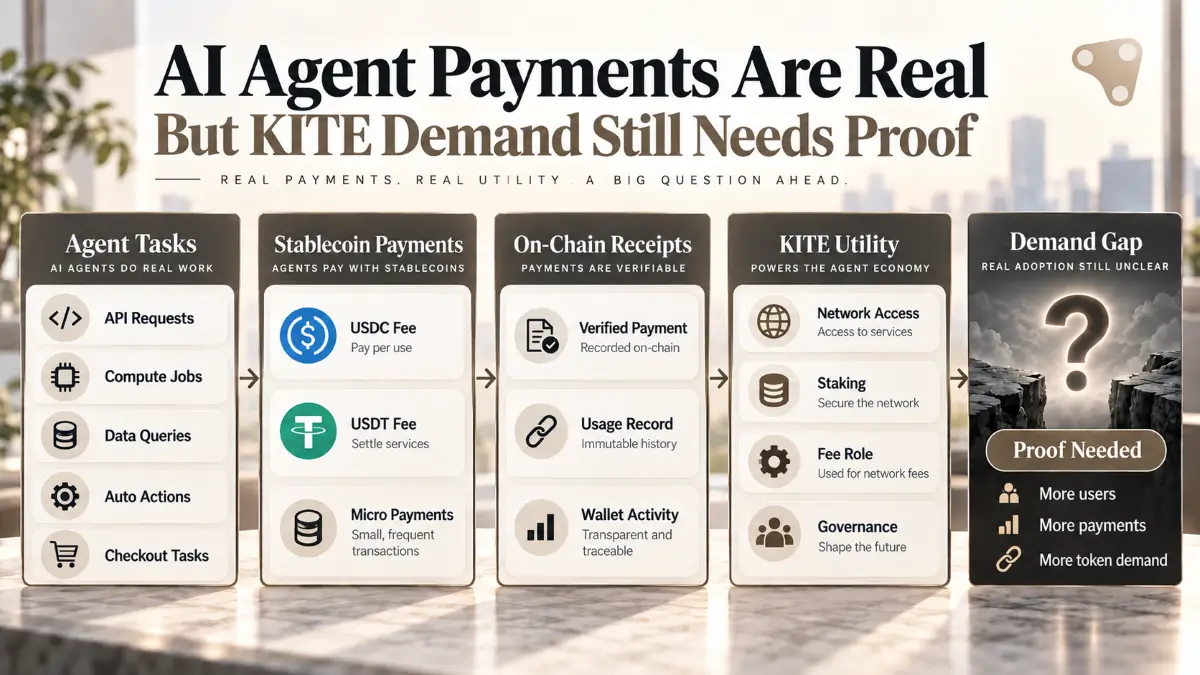
Kite is one of the more interesting crypto projects in the AI-agent sector because it is not only using AI as a market label. CoinMarketCap lists the asset as Kite with ticker KITE, while official docs use KiteAI Mainnet as the network name. This review covers Kite with ticker KITE, not any similarly named KITEAI token.
This Kite Review asks a simple question. AI agents may need wallets, identity, spending limits, payment rules, and verifiable receipts. But does that activity create lasting demand for KITE, or does most of the value stay with apps, stablecoins, merchants, and service providers?
Kite’s strongest idea is easy to understand. Today’s internet was built around humans clicking buttons, approving payments, and checking every purchase manually. AI agents may need a different flow. They may need to pay for APIs, data, commerce actions, software tools, and digital services without asking a human to approve every small step.
Kite’s answer is an agent-focused payment network, Kite Agent Passport, programmable spending rules, stablecoin payment support, and token-based incentives. That gives Kite a more serious thesis than many simple AI narrative tokens.
The risk is also clear. A useful payment idea does not automatically make a token valuable. KITE becomes stronger only if agent payments, service activity, module participation, staking, builder access, and protocol revenue create real reasons to hold, lock, stake, or use the token.
This review is for research and education only. It is not financial advice or a buy or sell recommendation. Crypto market data changes quickly, so price, rank, volume, and supply figures should be treated as dated snapshots.
Main Coin Data and Technicals
Kite’s live market data is already shown in the price widget above, so this section avoids repeating price, rank, volume, and circulating-supply figures that change quickly.
The fixed details are simple. The project is Kite, the token ticker is KITE, the network name used in official docs is KiteAI Mainnet, and the official maximum supply is 10 billion KITE.
Kite Is Project Name, KITE Is Token
Naming clarity matters here. The correct subject is Kite with ticker KITE. The network name in official docs is KiteAI Mainnet, but the token should be written as KITE, not KITEAI.
That distinction is important because crypto has many similar names, copied tickers, and low-liquidity lookalike tokens. A reader checking CoinMarketCap, an exchange, or a wallet should understand that this review is about Kite and its KITE token.
Using the project name clearly helps avoid confusion with similarly named tokens and keeps the review focused on Kite with ticker KITE.
Kite still belongs in the AI-agent payment category. The project’s official materials describe infrastructure for autonomous agents, identity, payments, governance, and verification. The point is not to remove the AI context. The point is to keep token naming clean.
AI Agents Create Payment Problems
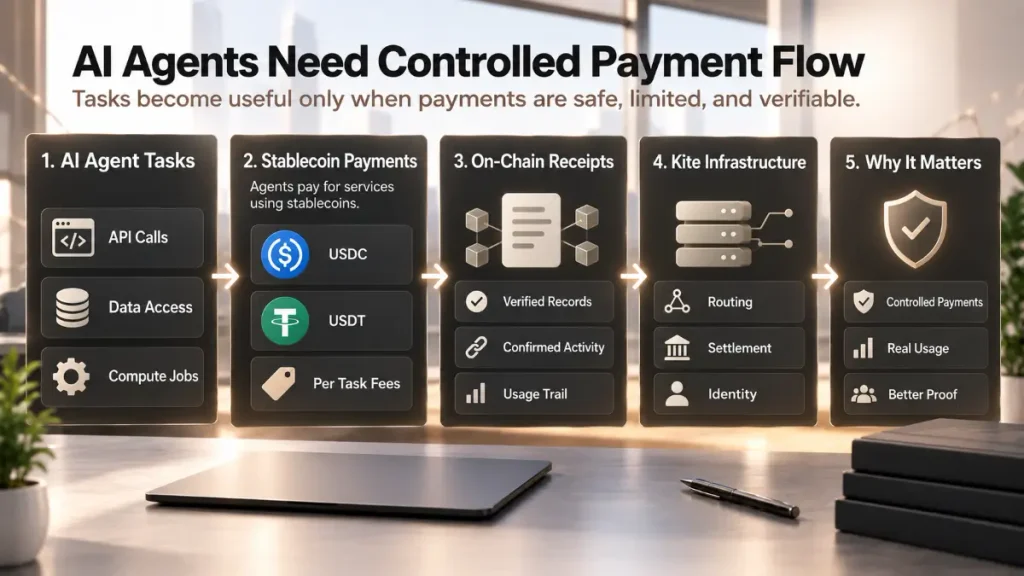
Kite starts from a real problem. AI agents cannot operate like normal human users forever. A human can approve a card payment, sign a wallet transaction, or check a checkout screen. An agent may need to perform many small actions across digital services.
That creates a hard balance. Too much manual approval makes agents slow and less useful. Too much freedom creates spending risk. Users need limits, merchants need proof, and developers need payment flows that agents can use safely.
Kite Agent Passport is designed around this gap. Kite docs describe Agent Passport as a way for autonomous AI agents to pay for services with identity, funded wallets, spending rules, and verifiable receipts.
The simple idea is strong. A user can approve a limited session, set a budget, and allow an agent to act within those rules. The agent can then pay for an approved service without asking for every small payment again.
That is more useful than a broad AI story. It gives Kite a specific infrastructure problem to solve.
Agent Passport Is Core Product Signal
Kite Agent Passport is the most important product signal because it shows how the payment thesis could work in practice.
A user does not need to give an agent unlimited wallet control. Instead, the agent can receive permission for a defined task, a defined budget, and a defined time window. That gives the agent room to act, while still keeping user control in place.

For service providers, this model can also help. A service can ask for payment, check the agent’s authorization, verify proof, and then deliver access. That is a cleaner flow than trusting a random automated request.
Kite docs also connect this system to x402-compatible agent payments and verifiable message passing. That matters because payment standards can make integrations easier across APIs, tools, and services.
This is where Kite overlaps with wider verification infrastructure. In the same way that SEDA Protocol Review explains why data and execution need trust boundaries, Kite needs to prove that agent identity, payment approval, and settlement can work reliably.
Payment Standards Improve Kite Case
Kite becomes more credible when it connects agent payments to wider standards instead of staying inside a closed system.
Kite’s service-provider docs describe x402 and MPP support for agent payments. They show a flow where a service returns a payment request, the agent resolves payment through an approved session, and the service verifies the payment before delivering the response.
This matters because agent payments need interoperability. If every agent network uses a separate closed format, adoption becomes harder. If services can use payment patterns that developers already understand, adoption has a cleaner path.
This is not proof of mass adoption yet. It is proof that Kite is aiming at a real payment workflow rather than only selling a token narrative.
The next step is measurable usage. Kite needs to show how many agents are paying, how many services are accepting payments, and how much real value moves through those flows.
Funding Adds Credibility, Not Proof
Kite has a strong funding story for a young crypto project. PayPal’s newsroom reported that Kite raised $18 million in Series A funding in September 2025, bringing total cumulative funding to $33 million at that time. The round was led by PayPal Ventures and General Catalyst.
That backing matters because payment infrastructure is not easy to build. Kite needs developers, integrations, security work, ecosystem support, and business relationships. Strong investors can help with those areas.
Kite later announced an investment from Coinbase Ventures to support agentic payments and x402 development. Kite’s current company page says total funding has reached $35 million. That adds credibility to the ecosystem story, but funding still does not prove product adoption or token demand.
But funding is not token demand. A project can raise money and still fail to create a strong token economy. KITE needs usage-based demand, not only investor validation.
The best way to read the funding is balanced. It supports Kite’s seriousness, but it does not prove that KITE will capture value from agent payments.
KITE Utility Has Several Demand Paths
KITE has a more detailed utility map than many AI tokens. Official tokenomics docs describe Kite as a Proof-of-Stake EVM-compatible Layer 1 for autonomous-agent payments and coordination. The same docs say KITE supports incentives, staking, and governance.
The first demand path is staking. Validators and delegators may use KITE to participate in network security and rewards.
The second demand path is ecosystem access. Kite docs say builders and AI service providers need KITE for eligibility inside the ecosystem. That can matter if the ecosystem becomes valuable enough for developers.
The third demand path is module liquidity. Official tokenomics docs say module owners with their own tokens must lock KITE into permanent liquidity pools paired with their module tokens. That can create a stronger link between module growth and KITE demand.
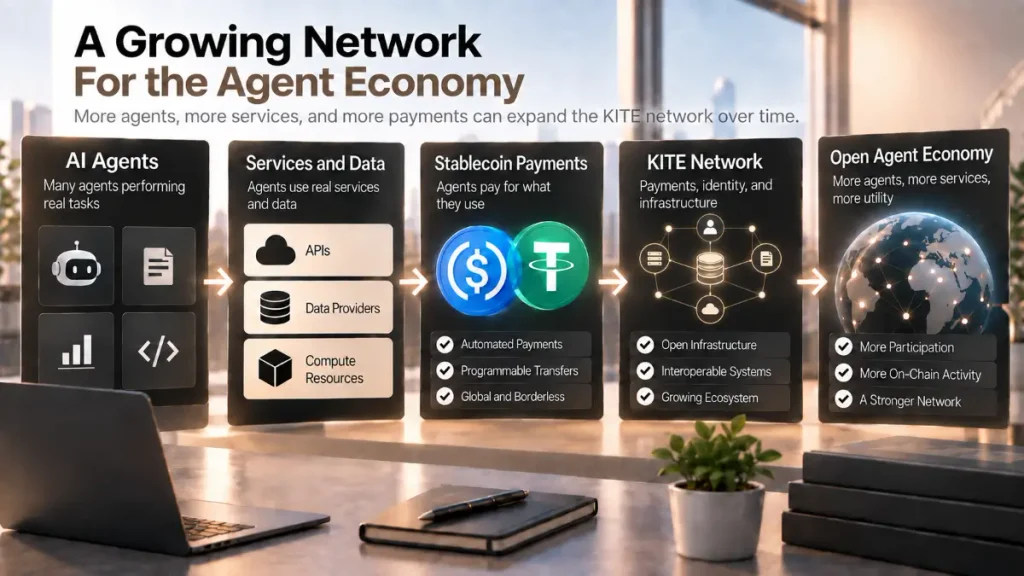
The fourth demand path is service revenue. Kite docs describe a model where protocol commissions from AI service transactions can be converted into KITE. In theory, this could connect real service usage to token demand.
That is the strong case. The open question is whether these demand paths become measurable in live usage.
Tokenomics: Supply, Allocation and Pressure
KITE has a capped total supply of 10 billion tokens. Official tokenomics docs list 48 percent for ecosystem and community, 20 percent for modules, 20 percent for team, advisors, and early contributors, and 12 percent for investors.
| Tokenomics Item | Current Position | Why It Matters |
|---|---|---|
| Maximum supply | 10,000,000,000 KITE | Sets full supply ceiling |
| Ecosystem and community | 48% | Largest pool for growth and user adoption |
| Modules | 20% | Supports AI services and module development |
| Team and advisors | 20% | Needs long-term alignment |
| Investors | 12% | Can add future distribution pressure |
| Main utility | Staking, governance, access, module liquidity, service commissions | Gives KITE several possible demand paths |
| Main risk | Usage may lag supply pressure | Token demand must grow beyond narrative interest |
This tokenomics structure is not automatically bad. A young Layer 1 needs incentives, builders, modules, validators, liquidity, and ecosystem funding.
The risk is timing. If KITE demand grows slowly while incentives and unlocks expand supply, price pressure can appear even if the product story sounds attractive.
That is why usage matters more than the headline supply number. The important question is whether agents, services, builders, modules, validators, and delegators create enough recurring KITE demand.
Market Activity Shows Attention, Not Proof
KITE has active market interest, but market volume should not be confused with product-market fit. Volume can rise because of AI narrative strength, exchange access, contract migration updates, short-term speculation, or social momentum.
A better test is whether real agents are paying real services in a way that touches KITE economics. That means looking at service payments, module launches, KITE locking, staking participation, transaction commissions, and builder demand.
This same issue appears in Hyperliquid HYPE Token Review. Usage and token demand move together only when the token has a measurable role in what users actually care about.
For Kite, the role is possible, but still needs proof. If agent payments grow while most value stays at the stablecoin or service-provider layer, KITE demand may not grow at the same speed.
That is the difference between attention and value capture.
Contract Swap Adds User-Side Risk
KITE has a recent contract migration issue that belongs in the risk section. CoinMarketCap shows a notice that Kite underwent a 1:1 Ethereum contract swap from an old contract to a new contract. Binance also announced support for the swap and temporarily suspended ERC20 deposits and withdrawals during the process.
This does not prove that Kite is unsafe. Contract swaps happen in crypto. But they do create practical risk for users because old contracts, exchange notices, wallet deposits, and explorer links can become confusing.
Readers should verify the current contract before deposits, withdrawals, bridging, or on-chain transfers. They should not rely on old screenshots or random social posts.
This risk connects with broader token movement issues discussed in LayerZero ZRO Token Review, where supported networks, bridge routes, and message paths can matter as much as the token itself.
For Kite, the clean approach is simple. Treat contract status as a live checklist item before moving funds.
Audits Help Code Layer, Not Whole System
Kite has audit coverage from Halborn across several smart contract areas. Halborn lists audits for the Kite token, GoKite contracts, staking and rewards contracts, and other Kite-related components.
That is a positive signal. It means important contracts have been reviewed by an external security firm. For a young network, that matters.
But audits should not be stretched beyond their scope. A smart contract audit does not prove that every agent payment will be safe, every service will be honest, every module will succeed, or every economic loop will create KITE demand.
Halborn’s staking and rewards audit also shows why scope matters. The report lists two critical findings, both marked solved, along with lower-severity findings. That supports the idea that audits can uncover serious code risk, not that all future risk disappears.
The correct conclusion is balanced. Audit coverage reduces some code uncertainty, but it does not remove product, market, migration, payment, or token-demand risk.
Stablecoin Payments Fit Agent Use Cases
Kite’s thesis is stronger because AI-agent payments may fit stablecoins better than traditional payment rails.
Agents can make small, frequent, automated payments across borders, APIs, data markets, software tools, and digital services. Card systems and bank rails were not designed for that exact pattern.
Kite’s agent-payment model uses funded wallets, approved rules, and verifiable receipts. That setup could make sense if agents need to pay per API call, per data request, per service response, or per automated task.
This is where Kite connects with Falcon Finance Review. Stablecoin infrastructure becomes more important when more digital users and automated agents need programmable dollar-like payments.
Still, the payment layer alone is not enough. Kite must show that this activity leads back to KITE through staking, access, modules, and service revenue conversion.
Strong Case for Kite
The strong case starts with the market problem. AI agents may need identity, permission control, payment rails, receipts, and verifiable settlement. Kite is building directly around that need.
The second strength is product focus. Kite Agent Passport gives the project a real workflow. It is easier to understand than a vague AI utility claim.
The third strength is token design. KITE has multiple possible demand paths, including staking, governance, ecosystem access, module liquidity, and service commission conversion.
The fourth strength is investor support. PayPal Ventures, General Catalyst, Coinbase Ventures, and other backers give Kite more credibility than many anonymous AI token launches.
The fifth strength is security visibility. Halborn audit pages do not remove all risk, but they show that contract review has happened across important areas.
Weak Case for Kite
The weak case is value capture. AI-agent payments may grow, but KITE may not capture enough of that growth.
Stablecoins can handle settlement. Apps can own user relationships. Service providers can capture revenue. Exchanges can capture trading interest. KITE only benefits strongly if it becomes necessary inside the workflow.
The second weak point is timing. Agent commerce is still early. Many agent systems remain experimental, and real payment behavior at scale is not yet proven.
The third weak point is supply pressure. KITE has a 10 billion max supply, and future demand must be strong enough to absorb incentives, unlocks, and selling pressure.
The fourth weak point is migration confusion. A recent contract swap means readers must verify the current contract before any transfer.
The fifth weak point is execution. Kite must turn docs, funding, and narrative into visible payment activity, module usage, service revenue, and KITE locking.
Evidence Table
| Evidence | What It Shows | What It Does Not Prove |
|---|---|---|
| KiteAI Mainnet | Live network information exists | Long-term user adoption |
| Agent Passport | Clear product around agent payments | Mass merchant adoption |
| x402 support | Payment standards are part of strategy | Universal payment acceptance |
| PayPal and General Catalyst funding | Serious investor support | Token demand |
| 10B max supply | Supply ceiling is clear | Future pressure is harmless |
| Halborn audits | Code review happened | Full system safety |
| Contract swap notice | Migration was important enough for exchange support | No user confusion risk |
| Market volume | Traders are watching KITE | Durable product demand |
Main Value-Capture Question
The whole Kite thesis comes down to one question. Does agent activity create KITE demand?
A strong outcome looks like this. Agents use Passport. Services accept agent payments. Builders hold KITE for access. Module owners lock KITE. Validators and delegators stake KITE. Service commissions create protocol revenue. Some of that activity flows back into KITE demand.
A weak outcome looks different. Agents may still use payments, but most value stays with stablecoins, service providers, apps, market makers, or external infrastructure. In that case, KITE remains near the story but does not fully capture the economics.
That is why Kite must be judged by measurable usage. More wallets, more social posts, and more exchange volume are not enough. The project needs proof that agent payments create repeat reasons to hold, stake, lock, or use KITE.
What Kite Needs to Prove Next
Kite needs to show real mainnet payment activity. Testnet interest and demos can support the early story, but mainnet economic usage matters more.
Kite should show how many real services accept agent payments, how often agents pay, and how much volume comes from service usage rather than ordinary token transfers.
Another useful metric is how much KITE is locked by module owners, how much validators and delegators stake, and whether builders hold KITE because ecosystem access is genuinely valuable.
Contract migration information also needs to stay simple and visible. New users should not have to guess which contract address is current.
Most importantly, Kite should report whether service revenues actually convert into KITE demand over time. That is the strongest part of the token model, and it needs visible proof.

Verdict: Strong Agent Payments Story, KITE Proof Still Needed
Kite has a strong narrative because agent payments are a real problem. Autonomous agents need identity, wallets, permission controls, payment rails, and verifiable receipts. Kite is building directly around that gap.
KITE also has a credible utility map. It can support staking, governance, ecosystem access, module liquidity, incentives, and possible value capture from service commissions.
But this review should stay balanced. Kite is not proven just because AI agents are popular. KITE becomes more convincing only when agent payments create measurable demand for the token.
For now, Kite is an interesting but high-risk agent payment project. The stronger case depends on real agent commerce, service-provider adoption, module locking, staking demand, and revenue conversion. The main risk is that the narrative moves faster than real KITE demand.
Frequently Asked Questions
Kite is a blockchain project focused on payment and identity infrastructure for autonomous AI agents. It uses KiteAI Mainnet and Kite Agent Passport.
KITE is used for staking, governance, ecosystem access, module participation, incentives, and possible value capture from service activity.
No. This review is about Kite with ticker KITE. Readers should avoid confusing it with similarly named tokens.
Kite Agent Passport gives AI agents identity, funded wallets, user-approved spending rules, and verifiable receipts for payments.
No. Agent payment growth helps KITE only if that activity creates real reasons to hold, lock, stake, or use KITE.
The biggest risk is weak value capture. Kite may build useful payment infrastructure, but KITE still needs proof that usage creates durable token demand.
Yes. CoinMarketCap and exchange notices show a 1:1 Ethereum contract swap process. Users should verify the current contract before transfers.
Halborn has published several Kite-related audit reports. These help the smart contract case, but they do not remove product, market, migration, or token-demand risk.
No. This review is research only. Readers should check market data, tokenomics, contract status, liquidity, staking data, and real usage before making any financial decision.

Founder & Managing Editor of CryptosMedia. Zahid Hussain leads evidence-based crypto research covering tokenomics, security, governance, adoption, and risk.
CryptosMedia separates verified facts from interpretation, avoids buy/sell recommendations, and updates reviews when major evidence changes.
1 thought on “Kite Review: Do AI Agent Payments Create KITE Demand?”