
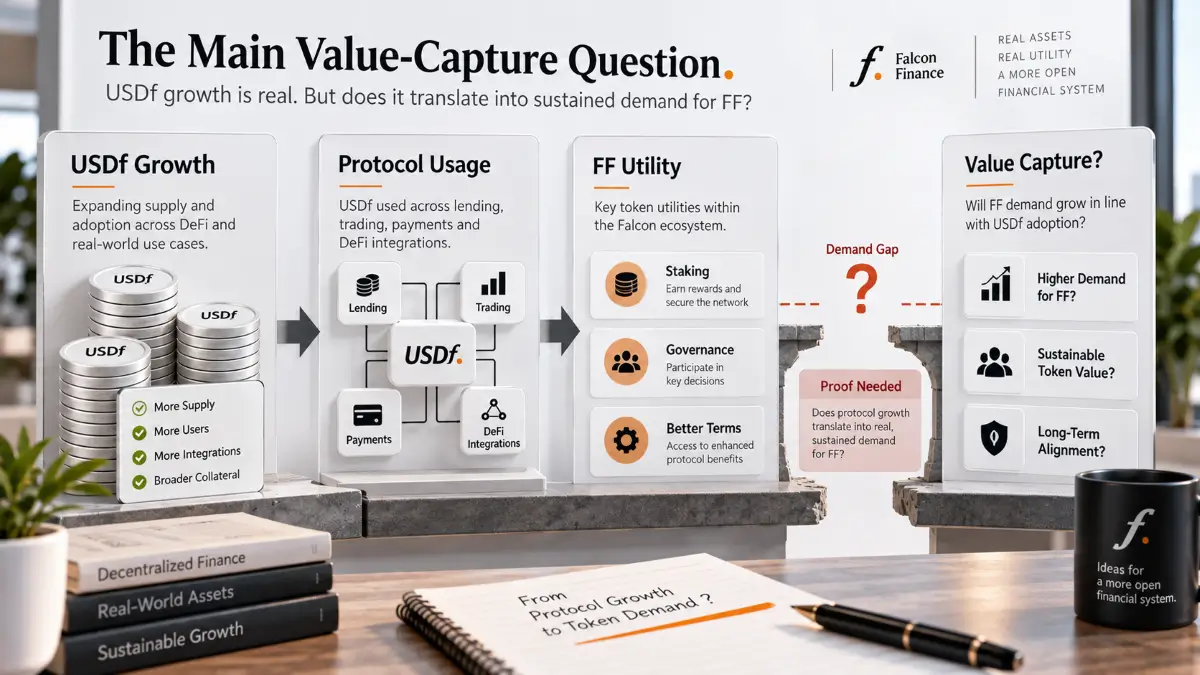
Falcon Finance is not trying to sell a normal stablecoin story. It is building collateral infrastructure around USDf, an overcollateralized synthetic dollar backed by eligible assets and supported by yield strategies, redemptions, audits, and a growing RWA plan.
This Falcon Finance Review asks a narrower question. USDf can grow, reserves can expand, and more collateral can enter the system, but how much of that activity creates durable demand for FF? That is the question that matters for the token.
The strongest verified case is USDf scale. Falcon reported $1.18 billion of USDf supply in its August 2026 update, with $1.67 billion of total reserves and a 141.6 percent backing ratio. The weakest point is not the product story. It is whether FF captures enough of that growth through staking, governance, access, better protocol terms, and user demand.
This review is for research and education only. It is not financial advice or a buy or sell recommendation. Market data can change quickly, so readers should treat dated figures as snapshots rather than permanent facts.
Main Coin Data and Technicals
Falcon Finance is a DeFi and synthetic dollar project built around USDf, its collateral-backed dollar product. FF is the native token, with a maximum supply of 10 billion FF. The token is listed on Ethereum, while Falcon products also connect with wider DeFi venues.
This section should be read together with the live price widget above. The widget covers market rank, price, volume, and live supply data, while this review focuses on the bigger question: whether USDf growth, collateral quality, RWA execution, staking, governance, and better protocol terms can create real demand for FF.
Falcon Finance Is Collateral Infrastructure, Not Just a Stablecoin Wrapper
Falcon Finance describes its system as universal collateralization infrastructure. In plain terms, users can deposit eligible assets and mint USDf, a synthetic dollar designed to stay close to one dollar while the deposited collateral supports the system.

That sounds similar to older stablecoin projects, but the risk model is different. A simple fiat-backed stablecoin depends mainly on cash, Treasury bills, banking partners, attestations, and redemption access. Falcon depends on collateral selection, overcollateralization, yield strategies, liquidity, redemption design, custody paths, and market confidence.
That makes the project more interesting and more complicated. USDf can become useful because it gives users dollar-like liquidity without forcing them to sell every underlying asset. But the system also has more moving parts than a plain reserve-backed coin.
This distinction matters for readers who compare Falcon with older reserve debates in stablecoins. A useful comparison is how stablecoin reserve trust depends on what backs the asset, who controls the reserve, and how clearly users can verify the risk.
USDf Growth Is the Strongest Evidence
The main reason Falcon Finance deserves attention is that USDf is no longer a tiny experiment. In its August 2026 update, Falcon reported $1.18 billion of USDf supply, $59.0 million of sUSDf, $1.67 billion of total reserves, a 141.6 percent backing ratio, and a $10 million insurance fund.
Those numbers create a serious product case. A synthetic-dollar system above one billion dollars can attract liquidity venues, integrations, collateral partners, and users who want dollar liquidity without selling all underlying exposure.
The caution is simple. USDf growth is not the same as FF value capture. USDf can grow because users want liquidity, yield, collateral flexibility, or DeFi access. FF benefits only when that growth creates a reason to hold, stake, use, or govern with FF.
That separation is the center of the article. Product traction can be real while token demand remains partly unproven.

What USDf Growth Actually Proves
USDf scale proves that Falcon has reached meaningful usage for its synthetic-dollar product. Market interest also shows users are willing to interact with a collateral system broader than one simple fiat reserve account.
However, USDf growth does not prove that FF receives direct value from every dollar of USDf supply. Reserve quality, strategy performance, and redemption speed still need separate judgment, especially during stressful market conditions.
That is not a reason to dismiss Falcon. It is a reason to judge the project in layers. First, check whether USDf has traction. Second, check whether collateral and redemption risk are controlled. Third, check whether FF has a strong claim on protocol activity.
The same type of separation matters in synthetic asset design, where product usage and token value can move together only when the economic link is strong enough.
FF Is Useful, but Utility Still Needs Demand
FF is not an empty token attached to a product. The official FF tokenomics post describes it as Falcon Finance’s native utility and governance token. It also says FF can support governance, staking, community rewards, privileged access, and better economic terms inside the protocol.
That gives FF a credible role. Users may want FF if holding or staking it improves their access to yield products, lowers protocol costs, improves minting terms, or gives them a stronger position in future Falcon activity.
The weak point is that utility is not the same as automatic demand. A token can have several functions and still struggle if users do not need those functions often enough, or if benefits are not valuable enough to offset supply pressure.
For FF, the key question is whether USDf users become FF users. If most USDf demand comes from people who only want a synthetic dollar and do not care about FF staking or governance, then USDf can grow faster than the token’s real demand.
Market Value Can Move Faster Than Token Proof
An early September 2026 market snapshot showed FF with a market value in the hundreds of millions and meaningful daily trading volume. That is large enough to show serious market interest, but not enough to prove durable token economics.
Market cap can price a future before that future is visible in live token demand. In Falcon’s case, traders may be pricing USDf scale, RWA expansion, exchange liquidity, yield products, and the idea that FF will become more important over time.
That is possible, but it still needs proof. The cleaner test is not whether FF traded actively for a day. The cleaner test is whether protocol usage creates repeat reasons to hold or stake FF after incentives, campaigns, and unlocks are considered.
Volume matters, but volume is not a business model. A token needs a stronger connection between product growth and token demand.
Tokenomics: FF Supply, Allocation and Unlock Risk
Falcon says FF has a maximum supply of 10 billion tokens. Its initial allocation gives 35 percent to ecosystem, 24 percent to foundation, 20 percent to core team and early contributors, 8.3 percent to community airdrops and launchpad sale, 8.2 percent to marketing, and 4.5 percent to investors.

That allocation is not automatically bad. Ecosystem and foundation reserves can fund growth, RWA adoption, integrations, audits, incentives, and liquidity. A young protocol often needs those pools to compete.
The risk is future distribution pressure. Team, contributor, investor, marketing, and ecosystem allocations can help the network, but they can also add sell-side liquidity over time. The official tokenomics post says core team and early contributor allocations have a one-year cliff and three-year vesting. Investor allocations also follow a one-year cliff and three-year vesting.
So the central tokenomics issue is not the 10 billion number alone. The real issue is whether Falcon can create enough recurring FF demand before future releases add more available supply.
| Tokenomics Item | Current Position | Why It Matters |
|---|---|---|
| Maximum supply | 10,000,000,000 FF | Sets the fully diluted supply ceiling |
| Ecosystem allocation | 35% | Supports growth, incentives, RWA adoption, and integrations |
| Foundation allocation | 24% | Funds risk management, audits, and long-term development |
| Core team and early contributors | 20% | Large allocation with one-year cliff and three-year vesting |
| Community airdrops and launchpad sale | 8.3% | Rewards early users and campaign participants |
| Marketing | 8.2% | Can support adoption but may increase future distribution |
| Investors | 4.5% | Smaller allocation but still subject to cliff and vesting |
| TGE circulating supply | 2.34B FF reported by Falcon | Shows that a meaningful part was liquid from launch |
| Main utility | Governance, staking, incentives, better terms, access | Gives FF a role inside the protocol |
| Main tokenomics risk | Value capture may lag USDf growth | USDf can grow without equal FF demand |
sFF Makes Staking More Concrete
Falcon’s staking design gives FF holders a clearer reason to lock tokens. Users can stake FF and receive sFF, the staked version of the token. Documentation describes sFF as a way to earn yield, receive boosted Miles multipliers, and keep governance rights once governance features are live.
This is useful because it can reduce immediate liquid supply and create a stronger link between long-term users and the protocol. If sFF benefits become valuable, staking can become more than passive loyalty.
The limit is that staking rewards are not the same as outside revenue. If rewards mainly come from token incentives, they can support participation for a while, but the system still needs durable demand from real usage.
A strong staking loop would look different. Users would hold or stake FF because better protocol terms are economically valuable, not only because rewards are temporarily attractive.
RWA Collateral Could Expand the Opportunity
Falcon’s RWA plan is one of the most important parts of the thesis. The August update described a regulated tokenization pipeline in El Salvador, led by a tokenized GPU forward that was still in structuring. Falcon said the asset was designed to trade first and could later become eligible collateral after enough market depth developed.
That is a serious idea because RWA collateral can expand Falcon beyond ordinary crypto deposits. If tokenized credit, tokenized commodities, GPU financing, tokenized stocks, or other assets become usable collateral, USDf could gain more ways to grow.

The wording matters. A pipeline is not the same as mature collateral. A tokenized asset must first exist, then trade, then show reliable liquidity, then become acceptable collateral without creating hidden risk.
That is why Falcon’s RWA story should be treated as promising but not complete. The future case is strong only if tokenized assets move from announcement to real trading depth and then to safe USDf minting.
This is where Falcon overlaps with wider tokenized asset infrastructure, where legal structure, liquidity, custody, valuation, and redemption design matter as much as the token itself.
Redemptions, Insurance and Risk Controls Matter
Falcon’s risk design includes overcollateralization, peg mechanisms, audits, reserve reporting, and an insurance fund. Those are positive signs, especially compared with projects that offer yield without showing much of the machinery behind it.
The insurance fund is still a buffer, not a guarantee. A $10 million fund can help absorb some stress, but it cannot prove that every collateral event, market shock, or liquidity problem will be harmless.
Redemption design is also important. Falcon documentation describes a 7-day cooldown for redemptions. That can give the protocol time to process requests and unwind active positions, but it also means users should not treat every redemption as instant cash access.
This creates a fair trade-off. Falcon may be able to use collateral more actively because it has processing time. Users accept more waiting risk in return for the benefits of the system.
Audits Reduce One Risk, Not Every Risk
Falcon documentation lists USDf and sUSDf smart contract audits by Zellic and Pashov, with no critical or high severity vulnerabilities identified in those reports. That is a positive signal for the smart contract layer.
But audits should not be stretched beyond their scope. A smart contract audit does not prove that collateral will remain liquid, that strategies will always perform, that custody decisions cannot fail, or that every operational process is decentralized.
The real Falcon security boundary includes smart contracts, oracles, custody paths, collateral choices, redemption timing, market-neutral strategy execution, multisig or admin controls, exchange exposure, and legal access to RWA assets.
That is the correct way to read the audit claim. It supports the code review layer. It does not make the whole financial system risk-free.
The Main Value-Capture Question
The strongest bullish path is clear. USDf keeps growing, sUSDf yield remains competitive, RWA collateral becomes usable, redemptions work through stress, more users need better minting terms, and FF staking becomes the easiest way to access better economics.
The weaker path is also clear. USDf grows, but most value stays with stablecoin users, collateral providers, external venues, market makers, and the broader protocol brand. In that outcome, FF remains useful, but not essential enough to capture the full growth of USDf.
That is why the title question matters. Does USDf growth reach FF? The answer depends on whether FF becomes economically necessary inside the system, not merely available.
This same issue appears across many crypto networks. Usage and token demand move together only when the token has a repeat, measurable role in the activity users actually care about.
What Falcon Finance Needs to Prove Next
Falcon has already shown more than many early DeFi and RWA projects. It has meaningful USDf scale, a live synthetic-dollar product, official tokenomics, a staking path, listed audits, exchange liquidity, and a real RWA expansion plan.
The next step is clearer token proof. Readers need better data on how many users stake FF, how much protocol activity uses FF benefits, how much demand comes from better minting terms, and how FF demand changes as USDf supply changes.
Falcon should also make the RWA path easier to measure. It should show which tokenized assets are live, which are trading, which have enough market depth, and which are accepted as collateral for USDf minting.
The market does not need a price forecast to judge the next stage. It needs measurable evidence that protocol scale creates durable token demand.
Verdict: Strong USDf Growth, Still-Unproven FF Capture
Falcon Finance has a stronger product story than many young DeFi tokens. USDf scale, overcollateralized design, reserve reporting, sUSDf, staking, audits, and RWA expansion give the project a real foundation.
FF also has a credible role. Governance, staking, incentives, better protocol terms, and privileged access are useful if real users value them enough to hold or stake the token.
The main risk is value capture. USDf can become useful even if FF demand grows more slowly. Falcon still needs to prove that FF is not only near a growing protocol, but important inside the protocol’s economics.
The conclusion is balanced. Falcon Finance has real traction through USDf and a strong RWA narrative. FF has a serious token case, but it still needs clearer evidence that USDf growth creates durable, recurring demand for FF.
Frequently Asked Questions
Falcon Finance is a DeFi protocol focused on collateral infrastructure. It lets users deposit eligible assets and mint USDf, an overcollateralized synthetic dollar.
USDf is Falcon Finance’s synthetic dollar. It is designed to stay close to one dollar and is backed by eligible collateral deposited into the Falcon system.
FF is Falcon Finance’s native utility and governance token. It can be used for governance, staking, incentives, better protocol terms, and ecosystem access.
No. USDf growth can strengthen Falcon’s product, but FF benefits only if users need to hold, stake, or use FF because the token gives meaningful economic access.
The biggest risk is weak value capture. Falcon may grow as a USDf and RWA collateral platform, while FF demand grows more slowly than the product.
Falcon documentation lists USDf and sUSDf audits by Zellic and Pashov. Those audits help the smart contract case, but they do not remove collateral, strategy, liquidity, custody, or redemption risk.
No. This review is research only. Readers should study the data, risks, unlocks, liquidity, and token utility before making any financial decision.

Founder & Managing Editor of CryptosMedia. Zahid Hussain leads evidence-based crypto research covering tokenomics, security, governance, adoption, and risk.
CryptosMedia separates verified facts from interpretation, avoids buy/sell recommendations, and updates reviews when major evidence changes.
1 thought on “Falcon Finance Review: Does USDf Growth Reach FF?”