Aave V4 Upgrade: The Hidden Smart Contract Risks Exposed

A close look at the technical lending environment and liquidity pools behind the Aave V4 upgrade.

The Aave V4 upgrade is changing how decentralized finance (DeFi) lending works, but it brings hidden dangers. DeFi platforms often show a perfect picture to the public with high profits and automated code. Behind the dashboard graphics lies a complex system of crypto smart contracts, liquidity pools, and economic incentives that need critical analysis. This article looks past the marketing to examine the core mechanics. We will look at the new architecture, recent exploits, the changes in Aavenomics 3.0, and the actual utility of the AAVE token. How I Audited This DeFi Project I evaluated the official documentation, historical whitepapers, smart contract reports, and live market data. To keep facts accurate, I treated all market cap, volume, and supply figures as time-sensitive based on July 9, 2026. I checked the mechanics of liquidity pools, the scope of safety reserves, and cross-referenced public auditing history with documented security incidents. I do not do simulated code deployments; my analysis relies strictly on verified on-chain events and official developer disclosures. The Evolution of DeFi Liquidity Pools Aave is a non-custodial liquidity protocol on multiple blockchains, mostly on Ethereum. It allows borrowing and lending without central middlemen, as smart contracts automatically manage all asset transfers. Shifting from ETHLend to a Unified Model Stani Kulechov originally launched the project in November 2017 as ETHLend. It started as a peer-to-peer lending system where the platform directly matched individual borrowers and lenders. This model was highly inefficient, suffering from low liquidity and long wait times. Kulechov’s team rebranded the project to Aave in early 2020. Under this new setup, the protocol dropped peer-to-peer matching for pooled liquidity. How Borrowing and Lending Works Natively Instead of waiting for a counterparty, lenders deposit assets into unified smart contracts called lending pools. Uncollateralized Liquidity via Flash Loans Aave’s secondary borrowing mechanic is the flash loan, which does not require collateral. A user can borrow any amount of available liquidity from a pool, provided they return the principal plus a 0.09% fee within the exact same blockchain transaction block. If the borrower fails to return the funds and fee within that single block, the system automatically reverses the entire transaction. While flash loans help with complex strategies like arbitrage, executing them safely requires advanced programming skills. AAVE Token Supply, Utility, and Market Value The AAVE token is an ERC-20 asset that serves as the administrative and security core of the protocol. The development team introduced it via a 100:1 migration from the original LEND token. On July 9, 2026, market data listed the Aave token price near $88.34 with a 24-hour trading volume of $239,107,333. The protocol maintains a verified circulating supply of 15,414,022.35 AAVE out of a hard-capped maximum supply of 16,000,000 AAVE. This capped supply makes the token non-inflationary. Tokenomics Factor Details Why It Matters Max Supply Capped at 16,000,000 AAVE Prevents long-term dilution from arbitrary minting. Circulating Supply 15,414,022.35 AAVE Minimizes the risk of massive unexpected supply unlocks. Safety Module Staking Backstop Reserve Funded by Stakers The protocol can liquidate staked AAVE to cover shortfalls. Value Recapture Burn Mechanisms and Automated Buybacks Links token demand directly to protocol usage. Core Utility Roles Exploring the Hub-and-Spoke Architecture The Aave V4 upgrade replaces the single-pool design with a Hub-and-Spoke model. The Liquidity Hub acts as the central ledger, while individual Spokes act as specialized lending markets. This structure allows Aave to isolate risk parameters for distinct asset classes. Inside the Global Dollar Hub A primary component of the Aave V4 upgrade is the Global Dollar Hub, designed to aggregate stablecoin liquidity on Ethereum. This hub integrates stablecoins like GHO and USDG to facilitate lower-fee transactions and improve capital routing. GHO currently utilizes the Aave Savings Rate of 4.25% APY via Savings GHO to drive adoption. Targeting the Traditional Securities Market The Aave V4 upgrade explicitly bridges traditional Wall Street mechanisms with decentralized finance. The protocol integrates tokenized real-world assets and tokenized stocks on Aave Horizon. Through integrations like mGLOBAL, institutional users can deposit tokenized private credit or treasury bills as collateral to borrow stablecoins. Security Audits and Real Vulnerabilities Aave possesses one of the more seasoned security profiles in DeFi, backed by an annual SOC 2 Type 2 security audit and formal verification by Certora. No protocol is entirely risk-free. Aave has suffered substantial stress events that users must evaluate. The Legacy V3 Bridge Exploit In mid-2026, a critical bridge vulnerability caused a massive panic, leading to an $8.45 billion emergency withdrawal. While the protocol survived this liquidity shock, the event highlighted the systemic risks present in cross-chain bridge dependencies. The KelpDAO Bad Debt Incident On June 17, 2026, an exploit involving KelpDAO generated $230 million in bad debt directly on Aave’s balance sheet. This crisis forced the protocol to overhaul its asset listing standards and lead a $320 million ETH recovery effort to cover the shortfall and protect depositors. These incidents demonstrate that even a formally verified protocol remains vulnerable to external integrations. Governance Dynamics and Centralization Risks The Aave Decentralized Autonomous Organization theoretically governs the protocol as holders vote on proposals. However, the reality of its governance reveals central points of failure. Comparing Aave V4 with Competitors To evaluate Aave’s market position, it is useful to compare its core variables against other prominent lending protocols like Maker and Compound. Metric Aave Maker (Sky) Compound Primary Category Multichain Pooled Lending Stablecoin Debt Ingestion Ethereum Pooled Lending Total Value Locked $12.94 Billion Varies Lower than Aave Token Capping Hard Cap of 16M AAVE Variable Hard Capped Primary Token Utility Governance, Safety Module Governance, Burn Mechanism Governance Only Major Deficit Risk Third-Party Smart Contract Exploits Undercollateralized Peg Failures Liquidity Utilization Locks DeFi Investor Checklist: What to Verify Independently Before depositing assets or holding AAVE, I recommend verifying the following on-chain metrics: Deciding If Aave’s Ecosystem Aligns with Your Focus This Guide Is Most Useful If You Are: Extra-Careful Readers Should Slow Down If You Are: Common Questions About the Aave Protocol Is the AAVE token inflationary? No. The AAVE token … Read more

Optimism L2 Network Review: OP Risks & Utility

An industrial hardware node displaying the Optimism logo representing the Optimism L2 network review and its core scaling technology.

This Optimism L2 network review breaks down whether the underlying blockchain actually builds real institutional adoption or just recycles retail trading hype. Crypto scaling projects often pitch themselves as the ultimate solution to high network fees. Optimism operates as an Ethereum Layer-2 scaling network, attempting to process transactions faster and cheaper off-chain while relying on the Ethereum mainnet for security. Looking beyond the OP price charts, this analysis explores the project’s core technology, expanding enterprise ecosystem, tokenomics, security signals, and the main risks you should understand. My Research Method for This Optimism L2 Network Review I reviewed this project by analyzing its official documentation, token utility, and the underlying supply mechanics of the OP token. My research included checking the OP Stack open-source repository, official announcements from the Optimism Collective, and market data from verified exchanges. I evaluated security claims surrounding its rollup architecture and compared Optimism to competing Layer-2 blockchains. I treated all market figures as time-sensitive and checked them strictly on the listed data date. What the Optimism Layer-2 Network Actually Does Optimism is a Layer-2 network operating on top of the Ethereum mainnet. Its primary function is to divert transaction traffic away from Ethereum, processing those actions off-chain to reduce network congestion and drastically lower user fees. The developers achieve this using a technology called an ‘optimistic rollup’. The system assumes that transactions processed on Layer-2 are valid by default. To save digital space and computational power, the network compresses, or ‘rolls up’, only the most essential transaction data—such as the sender, recipient, and amount, and sends it back to the Ethereum mainnet for permanent recording. The OP Stack and Enterprise Adoption Optimism is no longer just a single standalone blockchain. It is evolving into a web of interconnected networks known as the ‘Superchain’. This entire vision relies on the OP Stack, Optimism’s open-source, modular, MIT-licensed development framework. Instead of building competing infrastructure from scratch, massive corporate entities and cryptocurrency projects are using the OP Stack to deploy their own custom Layer-2 blockchains. This is one of the clearest indicators of the network’s actual utility. Current platforms operating on this framework include: A crucial economic driver of this model is that Superchain participants share 15% of their sequencer revenue back with the Optimism Collective, creating a unified and sustainable revenue stream for the broader ecosystem. Token Utility: What Does OP Actually Do? Many retail users assume they need the native token of a network to pay for transactions. On Optimism, this is not the case—users still pay transaction gas fees in Ethereum (ETH). The OP token serves strictly as a governance asset. The project operates under the Optimism Collective, which governs through two distinct bodies: This structure isolates OP as an economic and voting tool rather than a strictly operational asset required to use the network. Tokenomics, Supply, and Inflation Optimism’s supply model is clearly defined, but its ongoing unlocks create a long-term inflation dynamic. Readers checking this should also review our general guide to crypto tokenomics to understand how inflation impacts governance tokens. Tokenomics Factor Details Why It Matters Total / Max Supply 4,294,967,296 OP The hard cap ensures a predictable maximum limit, though an ongoing 2% annual inflation rate applies. Circulating Supply ~2.15 Billion OP Roughly 50% of the total supply is actively circulating in the market as of the data check date. Ecosystem Fund 25% Supports governance (5.4%), partners (5.4%), and seed programs (5.4%). RetroPGF Allocation 20% Used to retroactively fund public goods and reward ecosystem developers. User Airdrops 19% Distributes tokens directly to network users. Several airdrops have already occurred. Core Contributors 19% Allocated to the founding team and core developers. Investors 17% Tokens reserved for early financial backers of the project. The tokenomics are easier to evaluate because the project cleanly separates supply allocation among airdrops, retroactive funding, and investor shares. The primary research concern is whether the ongoing distribution of the remaining 50% locked supply will outpace the real market demand for a governance token. Security Models and the 7-Day Withdrawal Friction Because Optimism uses optimistic rollups, it relies heavily on a ‘proof of fault’ (or fraud proof) security model. When a transaction occurs on Layer-2, it is assumed valid and published to Ethereum. However, the network enforces a 7-day challenge period. During this week-long window, any network participant can flag a suspicious transaction and submit a proof of fault. If the transaction is proven fraudulent, the sequencer faces a financial penalty, and the user who caught the error receives a reward. While this creates a strong economic incentive for honest behavior, it introduces a massive friction point for everyday users: withdrawing native funds back to the Ethereum mainnet requires waiting 7 days for the challenge period to clear. Third-party liquidity bridges exist to bypass this wait, but using them requires understanding smart contract bridge risks since you must trust entirely separate smart contracts. Historical Market Context On June 26, 2026, market data sources listed OP trading near $0.10, with a circulating market capitalization of approximately $215 million. The token previously traded in the $1.50 to $4.00 range and reached an all-time high of $4.85 in March 2024. However, continuous token unlocks and severe market pressure have driven heavy volatility over its multi-year history, drastically reducing its price. Past performance does not guarantee future results, and readers should verify current market data before relying on any number. Main Strengths Main Risks and Red Flags How Optimism Compares to Competitors Compared with similar projects, Optimism has secured clearer framework adoption via the OP Stack, but faces stiff competition in total network liquidity. Metric Optimism (OP) Arbitrum (ARB) Polygon (MATIC/POL) Layer-2 Technology Optimistic Rollup Optimistic Rollup Sidechain / zkEVM Token Utility Governance / Funding Governance Gas Fees / Governance Development Framework OP Stack (“Superchain”) Arbitrum Orbit Polygon CDK Withdrawal Time to L1 7 Days 7 Days Minutes to Hours Readers should verify the current TVL metrics of these networks before relying on ecosystem claims, as liquidity shifts quickly between Layer-2 chains. Common … Read more

Aptos Crypto Ecosystem Review: RWA & Adoption

Industrial blockchain server node mounted on a concrete wall displaying the Aptos network emblem.

Evaluating the Aptos Crypto Ecosystem requires looking past the surface level of marketing, logos, and short promises. The harder question is whether the underlying token actually does something useful. Aptos launched with massive venture capital backing and technology inherited from Meta’s abandoned Diem project. Recently, the narrative around the chain has shifted heavily toward institutional infrastructure, with major players like BlackRock and Franklin Templeton deploying funds on the network. However, the token itself has historically faced aggressive inflation and massive unlock schedules that heavily diluted early buyers. This review breaks down the project’s core utility, the dramatic 2026 tokenomics overhaul, its shifting environment, security signals, and the main risks. My goal is to separate the institutional milestones from the token’s fundamental realities so you can evaluate the project clearly. My Research Method for This Review I reviewed this project by checking its official documentation, token utility, and tokenomics structure, paying close attention to the recent 2026 governance supply overhaul. My research also included evaluating the network’s ecosystem activity, institutional partnerships, and available market data from top platforms like CoinMarketCap and Binance. To assess safety, I analyzed security claims surrounding its smart contract language and compared Aptos to similar high-throughput Layer 1 blockchains. Finally, I treated all market figures as time-sensitive and checked them strictly on the listed data date. Core Technology Behind the Aptos Crypto Ecosystem Aptos Labs developed the Aptos Layer 1 Proof-of-Stake (PoS) blockchain. Mo Shaikh and Avery Ching, former Meta engineers from the Libra/Diem payments project, lead this team. To solve scalability issues, the network uses a parallel execution engine. Instead of processing transactions one after the other (sequentially), the network processes multiple transactions simultaneously. The project claims theoretical speeds of over 150,000 transactions per second (TPS), though practical, everyday usage numbers are often much lower. The developers built the network using Move, a programming language Meta designed specifically to ensure secure digital asset management. Token Utility: What Does APT Actually Do? Token holders use the APT token for three primary functions inside the ecosystem: Tokenomics, Supply, and the 2026 Overhaul Tokenomics has historically been the most criticized aspect of Aptos due to aggressive, uncapped inflation and a lack of transparency around early distribution. However, a major governance vote in February and March of 2026 completely restructured the supply mechanics. The tokenomics are now much easier to evaluate because the project established hard limits and deflationary mechanisms. Tokenomics Factor Details Why It Matters Max Supply 2.1 Billion APT The 2026 governance vote established a hard cap, meaning the protocol can never mint new tokens beyond this limit. Circulating Supply ~832.2 Million APT Roughly 39% of the hard cap is currently circulating in the market. Inflation / Rewards Cut to ~2.6% The network slashed annual staking rewards in half from 5.19%, drastically slowing the rate of new token creation. Burn Mechanism 100% of Transaction Fees Following the 2026 overhaul, the protocol raised gas fees 10× and now permanently burns all transaction fees to remove supply. Foundation Lockup 210 Million APT The Aptos Foundation locked 210 million of its own tokens into staking, removing them from circulating sell pressure. Major Unlock Cliff October 11, 2026 The 4-year vesting period for early investors ends here, dropping annual token unlocks by roughly 60% after this date. Ecosystem Activity and Real Adoption The broader ecosystem is currently splitting into two distinct stories. On the retail decentralized finance (DeFi) side, Total Value Locked (TVL) has contracted significantly, dropping from a peak of $1 billion down to around $242 million. However, institutional adoption and stablecoin activity are growing rapidly. The stablecoin market cap on Aptos recently crossed a new all-time high of $2 billion. Major traditional finance entities, including BlackRock and Franklin Templeton, have deployed institutional funds or tokenized real-world assets (RWAs) directly on the network. Furthermore, projects like Decibel (an on-chain perpetuals exchange) and Shelby (a verifiable data layer for AI) are driving new utility. While the network has processed over 5.4 billion lifetime transactions, its growth relies heavily on whether this institutional infrastructure translates into sustained on-chain demand. Security, Audits, and Technical Risks Security on Aptos relies heavily on the Move programming language. Meta built Move with custom resource types to prevent attackers from improperly cloning or deleting assets. The project also uses the “Aptos Move Prover” to formally verify smart contracts before they deploy. While the network has avoided major smart contract exploits since its launch, it did experience a 5-hour power outage in 2023, which contradicted early marketing claims of zero downtime. Recently, the network introduced “Confidential APT,” an opt-in privacy feature that encrypts transaction amounts and balances while keeping wallet addresses visible. Readers should monitor this closely, as privacy features often attract heavy regulatory scrutiny. Historical Market Context APT launched in late 2022 near $8 and quickly surged to an all-time high of $19.90 by January 2023, driven primarily by early NFT excitement. Since then, it has suffered a prolonged downtrend, dropping over 95% from its peak to an all-time low of roughly $0.60 in June 2026. As of June 22, 2026, the token trades near $0.67. The massive token unlocks have created severe supply pressure, making it difficult for the price to recover even when on-chain fundamentals improve. Past performance does not guarantee future results. Main Strengths Main Risks and Red Flags How Aptos Compares to Competitors Compared with similar projects, Aptos has clearer institutional RWA momentum but weaker retail mindshare. Metric Aptos (APT) Sui (SUI) Solana (SOL) Category High-Throughput Layer 1 High-Throughput Layer 1 High-Throughput Layer 1 Core Technology Move Language, Parallel Execution Modified Move Language, Object-Centric Rust Language, Parallel Execution Supply Model Capped at 2.1B (as of 2026) Capped at 10B Uncapped, Inflationary Main Use Case Focus Institutional RWAs, Stablecoins, AI Data Gaming, General DeFi DeFi, NFTs, General Ecosystem What Readers Should Verify Common Questions About Aptos What is the difference between Aptos and Sui? Both blockchains originate from Meta’s Diem project and use the Move programming language, but entirely different teams launched them. Sui … Read more

BNB Utility And Risks: A Deep Dive Into The Token Ecosystem

Physical server hardware alongside financial ledgers and tokenized asset storage representing network utility.

When Binance launched its native token in 2017, the premise was straightforward. Users simply had to hold the asset to get a discount on trading fees. Fast forward to today, and that simple mechanism has morphed into the economic backbone of a sprawling multi-chain infrastructure. To truly gauge where this asset stands, we have to look past the market hype. We must conduct a strict audit of its actual utility, its supply dynamics, and the looming regulatory shadows. This review breaks down the token’s current ecosystem. It covers everything from real-world asset integration to the centralization risks every holder needs to watch. What Is BNB And How Does It Work? The “Build and Build” name is not just marketing. It represents a significant technical pivot. What began as a standard token on Ethereum eventually migrated to its own dedicated infrastructure. Core Token Use Cases: Exploring BNB Utility A structural visualization of the network’s deep utility, showing how different ecosystem segments rely on the native asset. A project’s actual usage separates it from pure speculation. Understanding BNB utility and risks requires looking directly at holder activities. Token holders use the asset for several key functions: Tokenomics And Supply Structure Evaluating tokenomics clarifies whether inflation might outpace demand. The token launched with a total supply of 200 million. The network employs a strict deflationary mechanism. This permanently removes tokens from circulation. Tokenomics Factor Details Why It Matters Total Supply 134.78 Million BNB The max supply is actively decreasing. Circulating Supply 134.78 Million BNB Nearly 100% of the supply is currently circulating. Burn Mechanism Auto-Burn System The network destroys tokens each quarter based on activity. Holder Concentration High The top 5 holders control approximately 47.26% of the market. These tokenomics are generally easier to evaluate. Because the circulating supply equals the total supply, insider unlock risks are low. High wallet concentration creates a centralized supply dynamic. Readers evaluating BNB utility and risks must note this issue. Ecosystem Adoption: BStocks and AI Agents Developers are heavily utilizing the network to deploy tokenized real-world assets (RWAs) and decentralized AI agents. Ecosystem activity on the network goes beyond its origins. Currently, the network records over 3.5 million daily active users. It holds over $5.1 billion in Total Value Locked (TVL). Key Centralization Issues: Balancing BNB Utility and Risks Public security signals are critical for any Layer 1 asset. To fully grasp BNB utility and risks, consider these vulnerabilities: Final Takeaway The token has successfully outgrown its original identity. Today, it operates as the economic engine for a massive blockchain. Its clearest strength is the deflationary supply model. This pairs perfectly with deep existing usage. The biggest unresolved risk remains its deep ties to the centralized exchange. The network’s future depends heavily on the global regulatory landscape. Zahid Hussaincryptosmedia.com

Aerodrome Finance Review: Base Liquidity & Risks

Forensic audit of Aerodrome Finance smart contracts displaying veAERO locking logic, Base network liquidity blueprints, and verified token contract address.

This Aerodrome Finance review, audits the Base network’s liquidity engine. Base is a rapidly expanding Layer-2 blockchain. Sustained growth, however, requires deep capital markets. Aerodrome Finance serves as the primary liquidity hub for this ecosystem. It solves the liquidity problem, allowing users to trade digital assets without massive price slippage. This Aerodrome Finance review bypasses the surface-level yields to audit the exact smart contract infrastructure powering this exchange, the mandatory lock-up periods, and the massive centralization risks inherent to its supply model. DEX Category Comparison To evaluate structural market health, researchers must compare the protocol directly against its largest decentralized competitors. Feature Aerodrome Finance Uniswap Curve Main Network Base (Layer-2) Ethereum Ethereum Revenue Model 100% to Voters Shared with LPs 50% to Voters Governance Vote-Escrow Standard Voting Vote-Escrow Lock Period Up to 4 Years No Lock Required Up to 4 Years Primary Use Ecosystem Liquidity Token Swapping Stablecoin Swaps Core Architecture: Aerodrome Finance Review Insights Aerodrome is not a standard decentralized exchange. The primary function of this platform is concentrated capital retention. In cryptocurrency, liquidity dictates overall market health. Users swapping tokens on the network receive instant execution at fair market rates. The protocol achieves this stability by mathematically routing high-yield rewards directly to liquidity providers who park their capital inside the ecosystem. By optimizing the original Optimism-based model, the developers integrated the architecture directly with the broader Coinbase ecosystem. Tokenomics and the 4-Year Lock Evaluating the economic foundation of this system requires understanding the voting distribution model. The official smart contracts push users to lock their native AERO tokens for extended durations spanning up to four years. The absolute incentive here is voting power. Locking the asset generates veAERO (vote-escrowed AERO). This secondary asset provides strict governance weight, granting users the authority to direct weekly token emissions to specific liquidity pools. In return, these voters collect 100% of the trading fees and external bribes generated by their chosen pools. The Emission and Bribe Mechanics The underlying bribe cycle forms the concrete mathematical foundation of the project’s long-term utility. Aerodrome operates on a strict weekly emission schedule. New tokens are minted and distributed to users providing active liquidity. The specific pools receiving the largest share of these tokens are decided entirely by veAERO voters. External protocols require deep liquidity for their own tokens to survive on the Base network. To attract this liquidity, they pay direct bribes in USDC or Ethereum to veAERO holders. Bribes attract voters, voters direct the AERO emissions, and these emissions draw deeper liquidity from the open market. Historical Market Context The protocol launched on August 28, 2023, utilizing a highly equitable distribution model. The developers minted 500 million initial tokens and airdropped 200 million directly to the community to align cross-network governance. Looking at the June 2026 data, the AERO token trades near $0.41, with a circulating supply sitting at approximately 944 million. The asset previously hit an all-time high of $2.32 during peak speculative demand. This severe 80% price contraction from the top serves as a standard market warning: buying into peak inflationary reward cycles often leads to heavy portfolio damage. Ecosystem Roadmap: The July 2026 Merger The core engineering team, led by verified founders Alex Cutler and Tao Watts, operates through Dromos Labs. Because the founders maintain public profiles and document code modifications openly, the proxy contract threat usually associated with anonymous teams is heavily reduced. Dromos Labs is currently executing a major structural upgrade. By July 2026, the roadmap dictates a complete merger between the Aerodrome and Velodrome networks into a single, cross-chain decentralized exchange. This strategic pivot transitions the platform from a Base-native application to a unified liquidity system designed to target the market share of legacy giants. Security Threats and Scam Alerts While official code scanners confirm the base contracts are clean, the broader Base ecosystem hosts active fraudulent copycat applications. Users must manually verify the exact official smart contract string (0x940181a94a35a4569e 4529a3cdfb74e38fd98631) before signing any execution approvals. Never execute transactions routed through unverified social media links. Final Verdict & Market Risks This analysis concludes that the protocol is a functional, high-yield capital engine essential to the Base network. The underlying mathematics behind the tokenomics require constant tracking. Entering a four-year capital lock without a deep understanding of the emission formula is a reckless allocation of capital. The most severe systemic threat is concentrated ownership. The founders and corporate partners currently control nearly 40% of the total token supply. If these core entities execute a massive insider liquidation, standard retail buy orders cannot absorb the volume, guaranteeing an immediate collapse of the asset’s price floor. ⚠️ RISK SIGNAL BOX: Lock-In Risk: Retail participants entering at cycle peaks and committing to four-year voting locks effectively surrender their ability to exit during downturns, creating a high-probability scenario of capital erosion in a depreciating market. High Volatility Ecosystem: AERO inflation relies entirely on the bribe cycle to sustain liquidity. Dromos Labs controls roughly 40% of the total token supply, representing a significant centralization point. Any massive insider liquidation poses an immediate, non-recoverable downward threat to retail positions. The Liquidity Paradox: The protocol’s long-term sustainability is tethered to external protocols continuously purchasing bribes. If external demand for liquidity wanes, the emission schedule loses its economic rationale, likely triggering a cascade of liquidity exits. Zahid Hussaincryptosmedia.com

Ondo Finance Review 2026: Institutional RWA Truth

A forensic photograph of a tablet displaying Ondo OUSG funds on a matte wooden desk for this Ondo Finance Review.

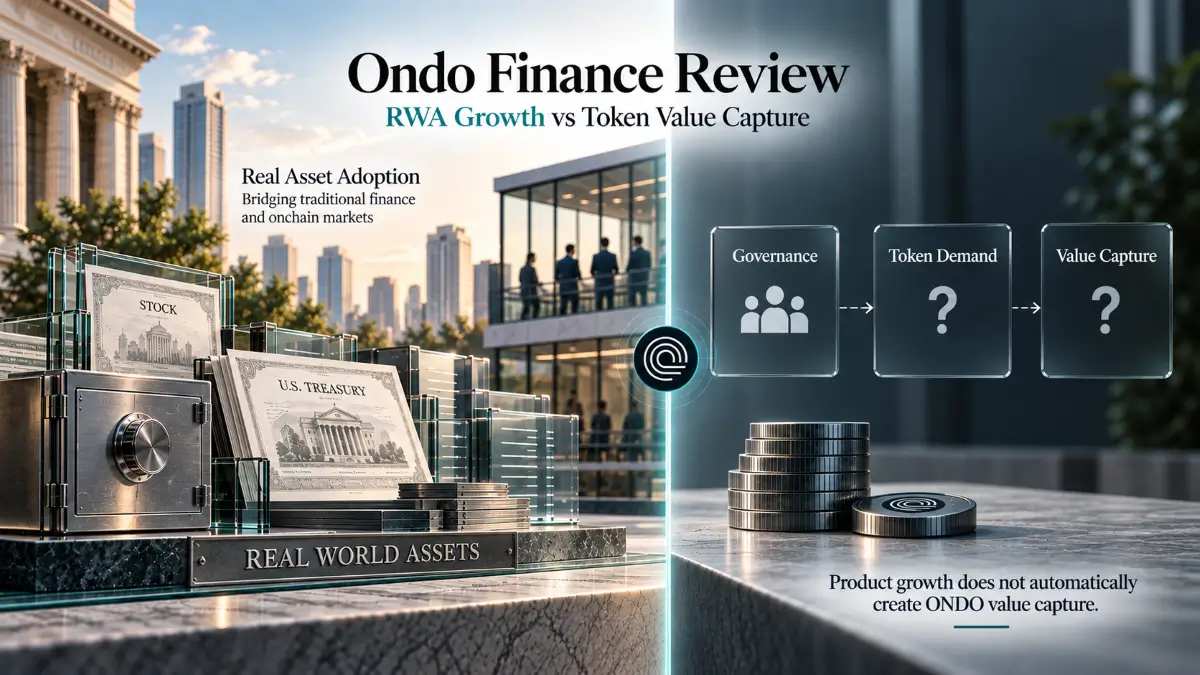
Listen brother, i remember looking into the tokenization narrative back when it started gaining real traction in mid 2022. Fast forward to May 2026, and i was scrolling through their platform data, realizing their Global Markets just crossed one billion dollars in locked value. I spent hours digging through their smart contracts because you know how i am, i need to see the actual money moving. Right from the start of this investigation, i want you to know the reality. As an analyst conducting this Ondo Finance Review 2026, i am here to share technical research, not financial advice. Because crypto is a dangerous jungle, you must protect your capital. Today, traditional finance is built on walled gardens, and regular people are locked out. But, Ondo fills this massive gap. Instead of keeping the yield, they pass it to you. Truly, giving people a functional path provides a deep sense of hope. Surely, they are bridging the old money world with the fast decentralized finance world. Overall, it is a clean setup. Ondo Finance Review: The Core Market Protocol To understand where the protocol stands today, we have to look back at the chaos of the past. Before 2025, real world assets were just a buzzword. Most projects were trying to tokenize real estate or gold with very little legal backing. Yet, Ondo took a different path by focusing on tokenized US Treasuries. Since they prioritized liquidity, they survived the market shakeout. In fact, their system gives you actual, regulated access to the underlying assets. After they partnered with heavyweights like BlackRock, Mastercard, and J.P. Morgan, their credibility exploded. For example, if you read our Lido DAO (LDO) Review, you will see how massive institutional integration changes a protocol. Later, they proved that this reliability is not a fluke. The team is led by Nathan Allman, who cut his teeth at Goldman Sachs digital assets. They have heavy institutional ties, and that is what matters when dealing with US securities laws. Move Language Security And Atomic Settlement Technical security is where the real battle is fought. Initially, everyone thought this would be just another Ethereum fork. Although the smart contract side looks decent, an audit does not mean it is bulletproof. By utilizing the Move programming language, similar to what we see in Aptos and Sui, Ondo provided a much higher level of security. Such as, the Move architecture virtually eliminates reentrancy attacks that were common in 2024. Besides, we saw similar structural containment protocols when evaluating institutional security layers in our Nexera NXRA Review. Every deep dive Ondo Finance Review 2026 must account for these technical shifts. Though the risks remain, the atomic actions provide peace of mind. Like a surgical connection, either the whole trade works or nothing happens. This removes the counterparty risk that usually keeps big banks awake at night. The Reality Of Global Markets And Flux Finance Now, let us talk about how the system actually operates. The launch of Ondo Global Markets changed everything for institutional stock trading. Before this, synthetic assets were a complete nightmare, always prone to oracle failures and sudden liquidations. Soon, brokers realized they could settle trades on the blockchain. Also, their decentralized lending protocol, Flux Finance, is built on battle-tested code from Compound, and audited by Code4rena. Indeed, a comprehensive Ondo Finance Review 2026 reveals that the protocol has now processed over twelve billion dollars in total volume. Next, you can analyze the live market depth on CoinMarketCap to trace daily movements. Then, they issue digital tokens representing a piece of that pie. So, you buy the token, hold it in your crypto wallet, and earn the interest. In short, it cuts out the middlemen. Hence, you are essentially being paid to hold your own money. Clearly, Ondo is that pipe, pouring safe interest into small cups for anyone walking down the street. The Revised RWA Competitor Clash Metric Ondo Finance (ONDO) BlackRock (BUIDL) MakerDAO (MKR) Primary Focus Tokenized US Treasuries Institutional Fund Liquidity Decentralized Stablecoin (DAI) Target Market Retail & Institutional Strictly Institutional Decentralized Crypto Users Yield Product USDY (Daily Yield) Monthly Dividends DSR (Dai Savings Rate) Blockchain Native Yes (Ethereum, Sui, Aptos) Yes (Ethereum) Yes (Ethereum Ecosystem) Tokenomics: The Brutal Reality Check Here is where i need you to pay close attention. The token itself does not give you direct ownership of those treasuries. Rather, it is strictly for governance over the decentralized autonomous organization. Currently, we are looking at a circulating supply of about 4.86 billion tokens, and the total supply is a massive 10 billion. Thus, over half the supply is waiting to hit the market. That is a lot of hidden weight, brother. Even so, the protocol introduced a sophisticated fee-sharing model that funneled revenue into a buyback mechanism. Every time a cross border settlement happens, a tiny fraction is permanently removed. Still, the inflation risk from future unlocks is real. If you want to understand how yield models survive stress, examine our Morpho (MORPHO) Review for broader market comparison. Namely, yield generation is an expectation. Furthermore, this specific Ondo Finance Review 2026 warns that regulatory compliance is a double-edged sword. There is also a significant dependency on third-party custodians, meaning centralization risks remain since core products rely on traditional banks. Ondo Finance Review: The 2027 Forecast And Final Verdict Looking toward 2027, the trajectory for the protocol is completely clear. They want to become the base layer for all tokenized debt. The Franklin Templeton partnership is a massive validation of the protocol infrastructure. To sum up, i have to be honest with you. Holding the governance token is a massive bet on the platform expanding so fast that the buying pressure eats up the remaining 5 billion tokens yet to unlock. If you are looking for a quick flip, this is highly risky. As we conclude this Ondo Finance Review 2026, keep your eyes on the unlock schedules. But, if you believe tokenization is the financial standard of the next decade, this … Read more