This Optimism L2 network review breaks down whether the underlying blockchain actually builds real institutional adoption or just recycles retail trading hype. Crypto scaling projects often pitch themselves as the ultimate solution to high network fees. Optimism operates as an Ethereum Layer-2 scaling network, attempting to process transactions faster and cheaper off-chain while relying on the Ethereum mainnet for security. Looking beyond the OP price charts, this analysis explores the project’s core technology, expanding enterprise ecosystem, tokenomics, security signals, and the main risks you should understand.
My Research Method for This Optimism L2 Network Review
I reviewed this project by analyzing its official documentation, token utility, and the underlying supply mechanics of the OP token. My research included checking the OP Stack open-source repository, official announcements from the Optimism Collective, and market data from verified exchanges. I evaluated security claims surrounding its rollup architecture and compared Optimism to competing Layer-2 blockchains. I treated all market figures as time-sensitive and checked them strictly on the listed data date.
What the Optimism Layer-2 Network Actually Does
Optimism is a Layer-2 network operating on top of the Ethereum mainnet. Its primary function is to divert transaction traffic away from Ethereum, processing those actions off-chain to reduce network congestion and drastically lower user fees.
The developers achieve this using a technology called an ‘optimistic rollup’. The system assumes that transactions processed on Layer-2 are valid by default. To save digital space and computational power, the network compresses, or ‘rolls up’, only the most essential transaction data—such as the sender, recipient, and amount, and sends it back to the Ethereum mainnet for permanent recording.
The OP Stack and Enterprise Adoption
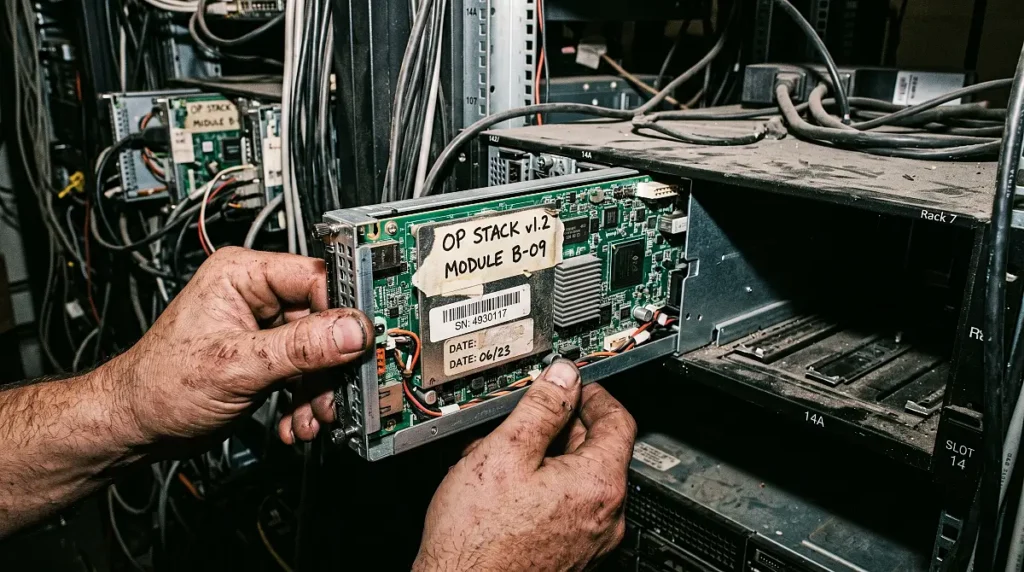
Optimism is no longer just a single standalone blockchain. It is evolving into a web of interconnected networks known as the ‘Superchain’. This entire vision relies on the OP Stack, Optimism’s open-source, modular, MIT-licensed development framework.
Instead of building competing infrastructure from scratch, massive corporate entities and cryptocurrency projects are using the OP Stack to deploy their own custom Layer-2 blockchains. This is one of the clearest indicators of the network’s actual utility. Current platforms operating on this framework include:
- Base: The Layer-2 network launched by Coinbase.
- Ink: A decentralized finance chain built by the Kraken exchange.
- Unichain: A network built by Uniswap Labs.
- Vision: A chain designed for regulated European finance by Bitpanda.
- Soneium: A blockchain initiative launched by Sony.
A crucial economic driver of this model is that Superchain participants share 15% of their sequencer revenue back with the Optimism Collective, creating a unified and sustainable revenue stream for the broader ecosystem.
Token Utility: What Does OP Actually Do?
Many retail users assume they need the native token of a network to pay for transactions. On Optimism, this is not the case—users still pay transaction gas fees in Ethereum (ETH).
The OP token serves strictly as a governance asset. The project operates under the Optimism Collective, which governs through two distinct bodies:
- The Token House: OP token holders vote on technical upgrades, project incentives, and protocol parameters.
- The Citizens’ House: This body focuses on Retroactive Public Goods Funding (RetroPGF), a system that distributes OP tokens to developers and projects that have already provided verifiable value to the ecosystem.
This structure isolates OP as an economic and voting tool rather than a strictly operational asset required to use the network.
Tokenomics, Supply, and Inflation
Optimism’s supply model is clearly defined, but its ongoing unlocks create a long-term inflation dynamic. Readers checking this should also review our general guide to crypto tokenomics to understand how inflation impacts governance tokens.
| Tokenomics Factor | Details | Why It Matters |
|---|---|---|
| Total / Max Supply | 4,294,967,296 OP | The hard cap ensures a predictable maximum limit, though an ongoing 2% annual inflation rate applies. |
| Circulating Supply | ~2.15 Billion OP | Roughly 50% of the total supply is actively circulating in the market as of the data check date. |
| Ecosystem Fund | 25% | Supports governance (5.4%), partners (5.4%), and seed programs (5.4%). |
| RetroPGF Allocation | 20% | Used to retroactively fund public goods and reward ecosystem developers. |
| User Airdrops | 19% | Distributes tokens directly to network users. Several airdrops have already occurred. |
| Core Contributors | 19% | Allocated to the founding team and core developers. |
| Investors | 17% | Tokens reserved for early financial backers of the project. |
The tokenomics are easier to evaluate because the project cleanly separates supply allocation among airdrops, retroactive funding, and investor shares. The primary research concern is whether the ongoing distribution of the remaining 50% locked supply will outpace the real market demand for a governance token.
Security Models and the 7-Day Withdrawal Friction
Because Optimism uses optimistic rollups, it relies heavily on a ‘proof of fault’ (or fraud proof) security model.
When a transaction occurs on Layer-2, it is assumed valid and published to Ethereum. However, the network enforces a 7-day challenge period. During this week-long window, any network participant can flag a suspicious transaction and submit a proof of fault. If the transaction is proven fraudulent, the sequencer faces a financial penalty, and the user who caught the error receives a reward.
While this creates a strong economic incentive for honest behavior, it introduces a massive friction point for everyday users: withdrawing native funds back to the Ethereum mainnet requires waiting 7 days for the challenge period to clear. Third-party liquidity bridges exist to bypass this wait, but using them requires understanding smart contract bridge risks since you must trust entirely separate smart contracts.
Historical Market Context
On June 26, 2026, market data sources listed OP trading near $0.10, with a circulating market capitalization of approximately $215 million. The token previously traded in the $1.50 to $4.00 range and reached an all-time high of $4.85 in March 2024. However, continuous token unlocks and severe market pressure have driven heavy volatility over its multi-year history, drastically reducing its price. Past performance does not guarantee future results, and readers should verify current market data before relying on any number.
Main Strengths
- Real Institutional Adoption: Optimism successfully provides infrastructure to massive corporate entities like Sony, Kraken, Coinbase, and Uniswap through the OP Stack, proving utility beyond retail hype.
- The Superchain Revenue Model: The 15% sequencer revenue sharing agreement creates a sustainable flow of capital back to the Optimism Collective.
- Ethereum Security: By operating as a Layer-2 rollup, Optimism avoids the risks of bootstrapping a completely new validator set, relying instead on the established, battle-tested security of the Ethereum mainnet.
Main Risks and Red Flags
- The ZK-Rollup Threat: Zero-Knowledge (ZK) rollups represent a massive competitive threat. While optimistic rollups require a 7-day challenge period to finalize withdrawals, ZK-rollups use cryptographic math to finalize transactions almost instantly. If ZK technology becomes easier to deploy, Optimism could lose its market edge.
- Future Token Unlocks: With nearly half of the OP token supply still locked or reserved for future distribution, the market faces predictable, ongoing inflation pressure.
- Intense Category Competition: Optimism operates in a crowded sector. Competitors like Arbitrum historically dwarf Optimism in total value locked (TVL) on their native networks.

How Optimism Compares to Competitors
Compared with similar projects, Optimism has secured clearer framework adoption via the OP Stack, but faces stiff competition in total network liquidity.
| Metric | Optimism (OP) | Arbitrum (ARB) | Polygon (MATIC/POL) |
|---|---|---|---|
| Layer-2 Technology | Optimistic Rollup | Optimistic Rollup | Sidechain / zkEVM |
| Token Utility | Governance / Funding | Governance | Gas Fees / Governance |
| Development Framework | OP Stack (“Superchain”) | Arbitrum Orbit | Polygon CDK |
| Withdrawal Time to L1 | 7 Days | 7 Days | Minutes to Hours |
Readers should verify the current TVL metrics of these networks before relying on ecosystem claims, as liquidity shifts quickly between Layer-2 chains.
Common Questions About Optimism
What is the OP token used for? The OP token is a governance tool used to vote on protocol upgrades, manage the Optimism Collective’s treasury, and distribute retroactive funding. It is not used to pay for transaction gas fees.
What exactly is the OP Stack? The OP Stack is an open-source, modular software framework created by Optimism. It allows developers, companies, and exchanges to easily build and deploy their own Layer-2 blockchains that plug directly into the broader ‘Superchain’ ecosystem.
Why do Optimism withdrawals take 7 days? Optimism uses optimistic rollup technology, which assumes all transactions are valid to speed up network processing. The 7-day delay acts as a security buffer, allowing anyone to mathematically challenge potentially fraudulent transactions before they permanently settle on Ethereum.
Does this review give investment advice? No. This review does not provide buy, sell, or hold advice. Readers should study the project’s utility, tokenomics, security, liquidity, and risks before making their own financial decisions.
My Final Takeaway
To conclude this Optimism L2 network review, the project becomes much easier to evaluate when you separate the OP token from the OP Stack technology. The underlying infrastructure is highly successful: the OP Stack has become a foundational layer for major financial institutions moving on-chain, and the ‘Superchain’ vision connects these networks under a shared economic model.
However, the native token itself remains strictly a governance tool facing long-term inflationary unlocks, and the optimistic rollup architecture still demands a cumbersome 7-day withdrawal period. The most vital research step for readers moving forward is watching whether Zero-Knowledge (ZK) rollups steal market share with faster withdrawals, or if the sheer momentum of enterprise adoption makes the OP Stack the permanent standard for Ethereum scaling.

Founder & Managing Editor of CryptosMedia. Zahid Hussain leads evidence-based crypto research covering tokenomics, security, governance, adoption, and risk.
CryptosMedia separates verified facts from interpretation, avoids buy/sell recommendations, and updates reviews when major evidence changes.
1 thought on “Optimism L2 Network Review: OP Risks & Utility”