
Rivalz has changed substantially from its early identity as an AI data and DePIN project. Current documentation presents a broader system built around intelligent finance, AI agents, decentralized data, oracle infrastructure, validator coordination, and the RIZ token.
That evolution makes Rivalz more interesting, but also harder to analyze. Several products now sit inside the same economic system. MOZAI manages DeFi strategies through agents. ADCS provides data and AI connectivity. OCY supplies decentralized data infrastructure. zNodes support verification. RIZ connects those components through payments, staking, incentives, rewards, and governance. Rivalz describes this broader design in its current network documentation.
Product development alone does not settle the investment case. Rivalz still needs to prove that real users generate enough economic activity to support RIZ demand after token emissions, incentives, vesting, and node rewards are considered.
That distinction drives this Rivalz Network Review. Rivalz now has live infrastructure and a clearer economic design than its earlier testnet phase suggested. RIZ also has several stated utilities and a proposed route from MOZAI revenue to token buybacks. Stronger product design, however, does not automatically mean strong token economics.
This article is for research and education only. It does not provide financial advice or a buy or sell recommendation. Rivalz combines AI systems, smart wallets, DeFi protocols, oracle infrastructure, token incentives, and distributed validators, so users face several technical and economic dependencies at the same time.
Rivalz Has Moved Beyond Its Original AI Data Story
Early Rivalz material focused heavily on AI data provenance, decentralized storage, rClients, zNodes, and a RollApp architecture linked to Dymension. Current positioning looks different.
Rivalz now describes itself as infrastructure connecting AI agents, decentralized finance, and markets. Its core stack centers on MOZAI, ADCS, OCY, zNodes, Rivalz Chain, and RIZ. This shift matters because the project no longer depends on one narrow data-storage thesis.
Older architecture should therefore not be presented as if nothing changed. Early material described Rivalz as a Dymension-based DePIN RollApp. Current documentation puts much more emphasis on Rivalz Chain, agent execution, DeFi strategies, and multi-chain connectivity. That evolution is relevant to readers because technical identities in crypto can change faster than old review pages.
A similar distinction appears in our Dymension review of modular blockchain evolution. Early infrastructure choices may remain part of project history without accurately describing the current product.
How the Current Rivalz Stack Fits Together
MOZAI sits closest to the end user. It gives users non-custodial smart wallets where agents can manage approved DeFi strategies.
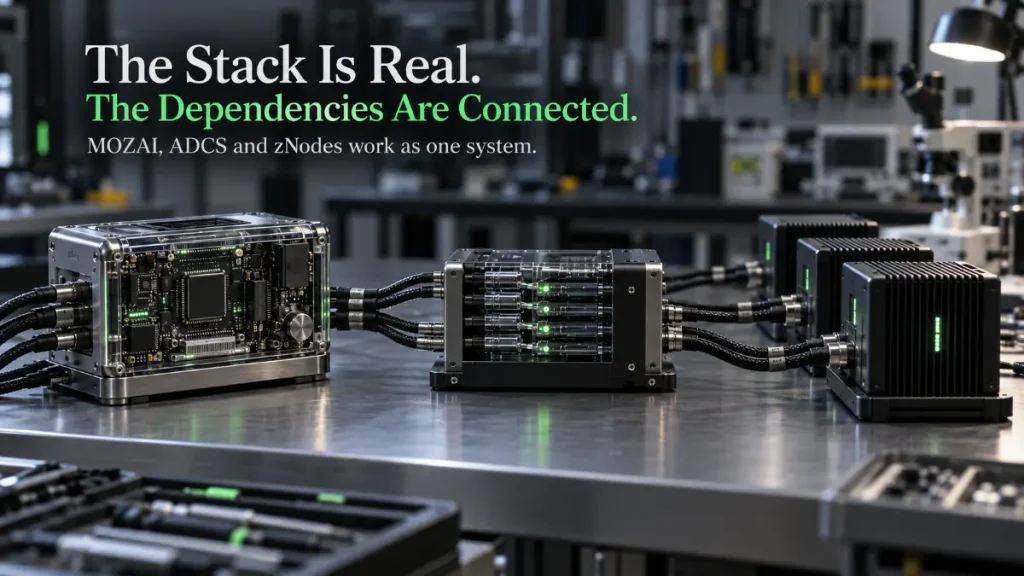
ADCS supplies data, AI inference, risk information, and connectivity between off-chain intelligence and on-chain applications. Rivalz says its oracle system allows applications to request information and AI outputs while using network infrastructure to validate those interactions. Readers can inspect the ADCS architecture directly.
OCY handles AI-oriented data infrastructure. zNodes add validation and verification. RIZ provides the economic layer across several of these functions.
Taken together, Rivalz is better understood as an AI-finance infrastructure stack than as a single AI token.
MOZAI Is Now the Most Important Product to Watch
MOZAI gives Rivalz a clearer user-facing product than the project had during its early testnet phase.
Rivalz describes MOZAI as a non-custodial system in which each strategy combines an off-chain agent with an on-chain smart wallet. Users supply capital to wallets they control, while agents propose actions within predefined rules. Smart contracts limit which assets, protocols, and actions each strategy can use.
That architecture matters because the agent does not need unrestricted control over a user’s wallet. Policy constraints can reject actions that fall outside the allowed strategy. Rivalz also says users can withdraw independently of the off-chain agent service while the underlying chain and protocols remain functional. Full technical details appear in the MOZAI documentation.
Rivalz reported in June 2026 that MOZAI had expanded beyond its original Base stablecoin strategy. At that point, it listed nine active agents across seven networks, including Base, Avalanche, HyperEVM, Polygon, Plume, BNB Smart Chain, and Optimism. These figures come from Rivalz itself, so they demonstrate claimed product expansion rather than independently verified customer demand.
Non-Custodial Does Not Mean Low Risk
Keeping custody with the user removes one important failure mode, but it does not remove DeFi risk.
MOZAI still depends on smart-wallet code, agent logic, data quality, oracle responses, supported lending or liquidity protocols, execution infrastructure, and the chains where strategies operate. Users can also face losses inside an underlying protocol even when Rivalz itself functions correctly.
Yield needs similar care. Rivalz says MOZAI’s base yield comes from underlying DeFi strategies using venues such as Aave, Morpho, and Fluid. Extra APY incentives can come from wRIZ rewards. Base DeFi yield and RIZ-funded incentives are economically different and should not be presented as one source of sustainable revenue.

This separation is important across crypto infrastructure. As discussed in our analysis of AI infrastructure economics, product activity only strengthens a token thesis when the economic flow reaches the token in a durable way.
ADCS and zNodes Form a Critical Trust Layer
Agentic finance needs more than an AI model making predictions. Agents also need reliable data and controlled execution.
ADCS attempts to solve part of that problem. Rivalz describes it as an AI oracle and connectivity layer that can deliver market data, AI inference, risk assessments, and other information to agents and decentralized applications.
Its published design includes coordinator contracts, consumer contracts, oracle routing, and external data providers. Documentation also describes access controls, request validation, reentrancy protection, and cryptographic verification mechanisms.
zNodes add another verification layer. Rivalz says these licensed validators verify data integrity, process network requests, support network state validation, and help secure agent-related infrastructure. That model creates a direct role for node operators rather than treating decentralization as a branding term.
Those responsibilities make zNodes part of Rivalz’s trust model rather than a purely economic reward layer.
Oracle design still creates dependencies. Data sources can fail, models can make poor decisions, validators can behave incorrectly, smart contracts can contain bugs, and downstream DeFi protocols can introduce their own risks.
That is why oracle reliability remains part of the wider execution trust model. An agent can only make good decisions when the systems supplying and validating its inputs continue to work.
Rivalz Adoption Evidence Needs Careful Interpretation
Rivalz has meaningful activity signals, but different metrics prove different things.
Its official website reports more than 50,000 agents launched and more than 10 blockchains with ADCS integrations. Earlier testnet material reported 1.8 million participants before sybil and eligibility filtering reduced the number eligible for the RIZ airdrop to about 1.2 million.
Those numbers should not be combined into a claim about paying customers.
Testnet participation can show distribution and community reach. Agent launches can indicate product activity. Chain integrations can show infrastructure availability. None of those metrics alone proves recurring fee revenue, profitable demand, or sustained RIZ consumption.
MOZAI gives Rivalz a better opportunity to demonstrate economic adoption because deposits, strategy activity, protocol revenue, and buybacks can eventually create measurable financial evidence. Readers should watch those figures more closely than headline testnet participation.
| Evidence | Current Position | Why It Matters |
|---|---|---|
| MOZAI | Live non-custodial agent infrastructure | Gives Rivalz a user-facing DeFi product |
| ADCS | Live AI oracle and connectivity layer | Connects agents with data and on-chain systems |
| zNodes | Licensed network validation infrastructure | Adds a distributed verification role |
| Agent activity | Rivalz reports more than 50,000 agents launched | Shows project-reported activity, not automatically paid demand |
| Multi-chain expansion | MOZAI and ADCS operate across multiple networks | Broadens addressable usage and dependencies |
| Testnet participation | Large historical participation and airdrop eligibility | Shows community reach, not recurring revenue |
| Main evidence gap | Limited independent economic reporting | Makes sustainable demand harder to measure |
Security Evidence Exists, But Coverage Matters
Rivalz does have public audit evidence, but its scope is narrow.
CertiK published an audit covering the RIZ token contract in October 2024. Its public record shows three acknowledged findings, including two classified as major, with the reviewed file identified as Riz.sol. Readers can inspect the Rivalz CertiK audit record.
That audit should not be stretched beyond its scope.
A review of the RIZ token contract does not prove that MOZAI smart wallets, ADCS oracle infrastructure, Rivalz Chain, third-party DeFi strategies, or every later contract version received the same review. Security analysis needs to follow the current architecture rather than treating one audit badge as blanket protection.
MOZAI’s non-custodial design provides another useful control. Agents do not need unrestricted private keys, and smart-account policies limit their permitted actions. High-impact reallocations can also depend on network attestations according to project documentation.

More moving parts still mean more failure boundaries. Agent logic, oracles, contracts, validators, integrated protocols, bridges, and individual execution chains can all matter to the final outcome.
RIZ Has Broader Utility Than Simple Governance
RIZ plays several roles across Rivalz.
Project documentation assigns RIZ to node staking and rewards, storage and data payments, ADCS oracle usage, AI application transactions, governance, ecosystem incentives, and MOZAI-related mechanisms. Users can also stake wrapped RIZ to qualify for additional MOZAI reward boosts.
Those functions create more potential demand channels than a governance-only token. Rivalz explains them in its RIZ utility documentation.
Utility still needs measurement.
A token can have ten documented uses and weak economic demand if users rarely pay for those services. Conversely, one heavily used service can create stronger demand than a long list of lightly used features.
RIZ therefore needs evidence showing how much token usage comes from genuine service consumption compared with staking incentives, rewards, or speculative activity.
Node economics deserve particular attention. Operators earn RIZ for infrastructure participation, while some network functions also require RIZ. This creates both demand and supply. Looking only at staking demand would miss the emissions paid back to network participants.
A similar tension appears in many DePIN systems. Our peaq review examines infrastructure reward economics, where participation incentives can also increase token supply pressure.
RIZ Tokenomics Still Create a Difficult Supply Test
RIZ has a maximum supply of 5 billion tokens.
Independent tokenomics tracking groups the largest original allocation under early rounds at 30% of supply. Other major pools include zNode-related allocations, ecosystem incentives, liquidity, treasury, team, advisors, and the community airdrop. Exact categorization can vary between trackers because node pools changed through hold and burn mechanics.
Readers can inspect the independent RIZ vesting breakdown rather than treating one static screenshot as permanent truth.
Early-round supply deserves attention because vesting continues after TGE rather than placing all tokens into circulation immediately. Team and advisor allocations also use longer vesting schedules.
zNode supply works differently. Rivalz allocated substantial RIZ to node participants and distributes part of that pool through emissions tied to active infrastructure. Project documentation confirms that node holders receive post-TGE emissions over an extended schedule.
Released Supply Is Not the Same as Circulating Supply
This distinction is essential.
Vesting trackers may classify tokens as released once contractual restrictions expire. A market tracker may use a narrower circulating-supply methodology. Treasury balances, ecosystem reserves, unlocked wallets, and tokens available for distribution can therefore produce different figures.
An unlock does not prove a sale. A wallet transfer does not prove exchange activity. Released supply also does not prove that all tokens entered liquid markets.
RIZ analysis should therefore focus on the direction of supply pressure rather than pretending one tracker provides perfect accounting.
| Tokenomics Item | Current Position | Why It Matters |
|---|---|---|
| Token | RIZ | Native economic token of Rivalz |
| Maximum supply | 5,000,000,000 RIZ | Defines the main supply ceiling |
| Early rounds | 30% in independent tokenomics tracking | Creates a large investor-linked supply pool |
| zNode allocations | Significant allocation with emissions over time | Supports infrastructure but adds token distribution |
| Airdrop | 7% of total supply | Distributed tokens to community and partner groups |
| Team | 7% | Long vesting reduces immediate release but still matters |
| Advisors | 5% | Adds another insider-linked allocation |
| RIZ utility | Fees, data, oracle use, staking, rewards, governance | Creates several possible demand channels |
| MOZAI link | wRIZ incentives and planned revenue-funded buybacks | Connects product activity with token economics |
| Main token risk | Demand may not absorb emissions and unlocks | Product growth must become sustained economic demand |
MOZAI Creates a Value-Capture Route, But It Is Conditional
One mechanism deserves particular attention in Rivalz’s current token economics.
Project documentation states that 30% of MOZAI protocol revenue goes toward a RIZ buyback program. MOZAI also gives users additional reward boosts when they stake wRIZ. Together, these mechanisms create a clearer link between product usage and the token than simple governance utility.
That does not mean every dollar deposited into MOZAI creates equivalent RIZ demand.
Deposited capital belongs to users. Base yield comes from underlying DeFi strategies. Protocol revenue depends on whatever fees Rivalz actually earns. Only a stated portion of that revenue enters the buyback mechanism.
A useful value-capture chain therefore looks like this:
MOZAI usage → fee-generating activity → protocol revenue → eligible buyback allocation → RIZ purchases
Each arrow needs evidence.

Higher TVL can help the model, but TVL alone is not revenue. More agents can increase product reach without necessarily generating meaningful fees. Buyback rules can create demand only when the product produces enough eligible revenue to fund purchases.
RIZ incentives complicate the picture further. wRIZ reward boosts can encourage staking, but rewards paid in tokens also represent distribution. Long-term economics improve only when organic demand grows faster than the incentives needed to attract that demand.
This is the central Rivalz token question.
Rivalz Must Prove More Than Product Expansion
Rivalz no longer looks like a project waiting for its first usable application. MOZAI, ADCS, node infrastructure, and the broader ecosystem give it several working components.
What remains unclear is the scale and quality of economic demand.
Project-reported agent counts are useful but insufficient. Future reporting would become much more valuable if Rivalz consistently disclosed MOZAI TVL, fee revenue, buyback execution, ADCS request volume, RIZ paid for oracle usage, active node counts, reward emissions, and retention across agent strategies.
Independent verification also matters. On-chain dashboards, transparent buyback wallets, protocol revenue accounting, and current audit coverage would make it easier to separate infrastructure activity from marketing metrics.
Security needs the same improvement. Rivalz has a historical RIZ contract audit and documented technical controls. Current users, however, interact with a broader system than one token contract. New MOZAI strategies and multi-chain deployments increase the surface that needs review.
Supply pressure will remain important while scheduled distribution continues. Rising utility can offset that pressure, but documentation alone cannot prove the balance.
What Would Strengthen the RIZ Case?
Three forms of evidence would materially change the analysis.
First, Rivalz needs durable paid activity. ADCS requests, MOZAI fees, storage payments, and other services should generate observable economic flows rather than only usage counts.
Second, value capture needs transparent execution. If protocol revenue funds RIZ buybacks, readers should be able to track how much revenue qualifies, how often purchases occur, and where acquired tokens go.
Third, incentives need to become less important relative to organic demand. zNode emissions and wRIZ boosts can bootstrap participation, but mature token economics require users to want RIZ because the network’s services have value, not only because rewards distribute more RIZ.
None of these requirements assumes Rivalz will fail. They define what evidence would separate an expanding product ecosystem from a durable token economy.
Rivalz Network Review Verdict: Better Product Case, Unfinished Token Proof
Rivalz is more substantial than its early AI DePIN story suggests.
MOZAI gives the project a live financial product. ADCS provides a concrete oracle and connectivity layer. zNodes contribute verification infrastructure. RIZ has documented roles across staking, payments, data, AI services, incentives, and governance.
Security evidence also needs careful scope control. A CertiK audit exists for the RIZ token contract, while current MOZAI and network architecture create additional security boundaries that require separate assessment.
Tokenomics remain the harder part of the thesis. Five billion maximum supply, a large early-round allocation, node emissions, and continuing vesting create a meaningful supply challenge. Calling those tokens guaranteed selling pressure would go too far, but ignoring future distribution would be equally weak analysis.
MOZAI’s revenue-funded buyback design gives RIZ a potentially stronger value-capture route. Success still depends on real protocol revenue, transparent buyback execution, sustained product usage, and demand that can compete with token distribution.
Rivalz has moved from an early infrastructure promise toward a functioning AI-finance stack. RIZ now has a clearer economic role within the stack. Evidence of durable economic demand still needs to catch up with the breadth of the technology.
Frequently Asked Questions
Rivalz is an AI and decentralized-finance infrastructure ecosystem built around agent execution, AI oracle connectivity, decentralized data, network validation, and the RIZ token.
MOZAI is Rivalz’s non-custodial agent-based DeFi system. Users fund smart wallets they control, while agents manage approved strategies within on-chain rules.
ADCS is Rivalz’s AI oracle and connectivity layer. It connects agents and decentralized applications with external data, AI inference, risk information, and other off-chain inputs.
RIZ supports network incentives, node economics, data and oracle payments, ecosystem transactions, staking, MOZAI-related rewards, and governance.
CertiK published an audit of the RIZ token contract in 2024. That audit should not be interpreted as proof that every later Rivalz product, MOZAI strategy, oracle component, or integration has identical audit coverage.
Rivalz says 30% of MOZAI protocol revenue goes toward RIZ buybacks, while wRIZ staking can unlock additional ecosystem rewards. That creates a potential value-capture route, but its importance depends on actual revenue and buyback execution.
No. Maximum supply, unlocked supply, distributed supply, and circulating supply describe different things. Vesting schedules and node emissions release tokens over time, while market trackers can apply different circulation methodologies.
The key question is whether real demand from MOZAI, ADCS, network services, and staking can become strong enough to absorb continuing distribution and make RIZ utility economically meaningful rather than mainly incentive-driven.

Founder & Managing Editor of CryptosMedia. Zahid Hussain leads evidence-based crypto research covering tokenomics, security, governance, adoption, and risk.
CryptosMedia separates verified facts from interpretation, avoids buy/sell recommendations, and updates reviews when major evidence changes.
1 thought on “Rivalz Network Review: Can MOZAI Create Durable RIZ Demand?”