
This Walrus Review starts with an advantage many infrastructure tokens never reach. Walrus already runs a live decentralized storage network, and Sui reported more than 467 TB of unencoded data stored during its first year on Mainnet. The same review named more than 200 projects building on the protocol, including large data deployments from Team Liquid and Allium.
WAL also has a direct role inside the product. Users pay Walrus storage and write fees in WAL, while SUI covers the blockchain gas needed for registration, certification, and storage extensions. Walrus currently prices storage at $0.023 per GB per month, then adjusts the number of WAL required as WAL’s market price changes.
That creates genuine utility, but utility does not automatically create lasting token value. Storage payments move into a fund that later rewards nodes and stakers. Mainnet can subsidize part of the storage cost, scheduled token releases continue to expand circulating supply, and only part of network rewards leaves circulation through the protocol burn.
The central question is therefore clear: does growing storage demand create enough recurring WAL demand to outweigh fee recirculation, subsidies, rewards, and continuing token distribution?
This article is for research and education only and does not provide financial, investment, tax, or legal advice.
What Walrus Actually Does
Walrus is a decentralized storage network built around large binary files, or blobs. Independent storage nodes hold the data, while Sui provides the coordination layer for payments, staking, governance, blob registration, and other protocol state. Walrus Mainnet became operational in March 2025 with more than 100 storage nodes.
Instead of keeping a complete copy of every file on every node, Walrus uses an erasure-coding system called Red Stuff. The network splits data into coded pieces and distributes those pieces across storage nodes. This design reduces the amount of replication needed while preserving recoverability under the protocol’s fault assumptions.
Mainnet currently uses 1,000 shards and two-week epochs. Users can buy storage across multiple epochs, while the network reconfigures storage responsibilities as committees change.
Walrus therefore combines two different systems. Storage nodes supply the physical data capacity, while Sui handles important coordination and settlement functions. That distinction matters because storing data on Walrus does not mean placing every byte directly on the Sui blockchain.
Sui Coordinates Storage Without Holding Every Blob
A typical storage operation uses WAL and SUI for different jobs. WAL pays for the storage resource and the write fee. SUI pays gas for onchain steps such as registering a blob, posting its availability certificate, and extending storage.
Walrus clients first reserve enough storage, assign a blob ID, send coded data to storage nodes, collect confirmation, and then certify availability on Sui. Once the protocol reaches the point of availability, the network commits to keeping the blob retrievable for the purchased period.
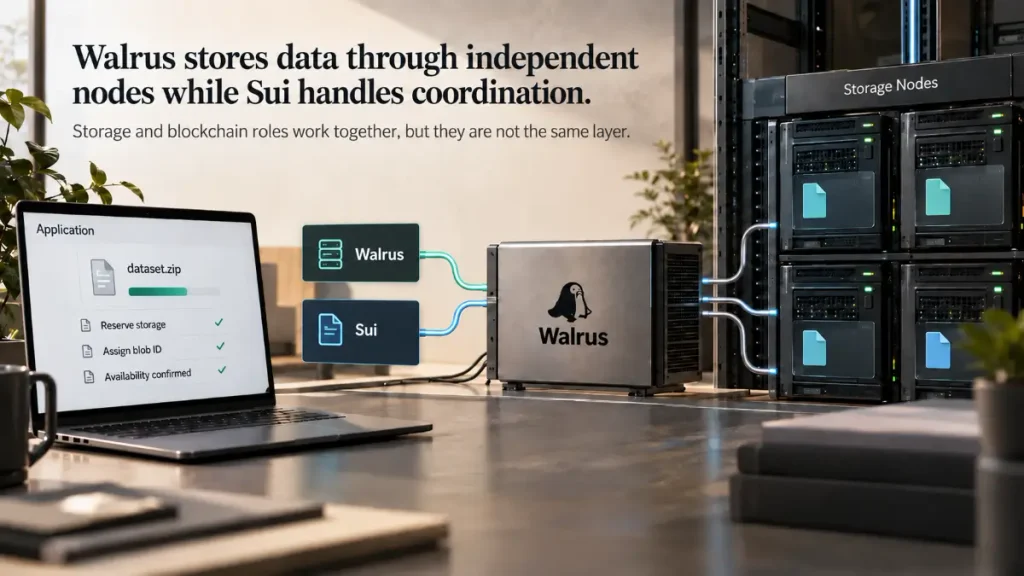
This architecture gives WAL a closer connection to product use than tokens whose networks can operate without them. Still, product necessity and investment value remain different questions.
The same distinction matters across decentralized infrastructure economics. Useful infrastructure can attract real demand without guaranteeing that every unit of demand creates durable value for the native asset.
Walrus Has Measurable Storage Usage
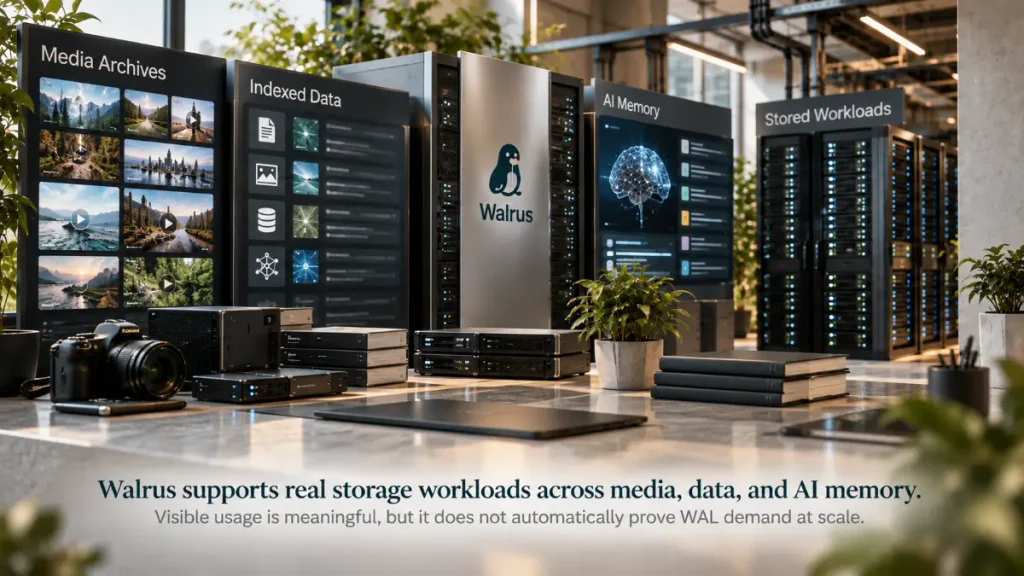
The strongest part of the Walrus thesis is no longer theoretical capacity. Sui reported 467 TB of unencoded data stored on Walrus by the network’s first Mainnet anniversary in March 2026. The same report said more than 200 projects were building with the protocol.
Named deployments add useful context. Team Liquid moved about 250 TB of match footage, photographs, behind-the-scenes media, and historical content to Walrus. Allium added about 65 TB of indexed blockchain data covering multiple networks.
These examples matter because node count alone does not prove demand. A storage network can maintain large capacity while customers use very little of it. Actual stored data gives stronger evidence that applications are consuming the service.
Yet raw terabytes still need careful interpretation. A storage total does not tell us who paid the bill, how long the data will remain stored, how much a subsidy covered, whether the customer will renew, or how much WAL entered the system from that activity.
Encoded Capacity Is Larger Than Original File Size
Walrus charges for encoded data rather than only the original file size. Official documentation says the encoded size is about 4.5 times the original blob plus 64 MB of fixed metadata per blob. Small files can therefore consume proportionally more paid capacity unless developers batch them efficiently.
This distinction prevents a common analytical mistake. A report that says 100 TB of original data does not mean the network billed exactly 100 TB at its posted storage rate.
Walrus introduced Quilt to reduce the overhead created by large numbers of small files. Sui said Quilt had already saved ecosystem partners more than 3 million WAL by the network’s first anniversary.
That saving improves product efficiency, but it also illustrates why stored bytes and token demand do not move in a simple straight line. Better compression and batching can let usage grow without requiring WAL spending to rise at the same rate.
AI Expands the Storage Opportunity
Walrus has increasingly positioned itself as data infrastructure for AI agents and other persistent applications. In March 2026, the ecosystem introduced MemWal, now documented as Walrus Memory, to give AI agents persistent memory that can survive across sessions and applications.
The technical use case fits Walrus. Agents can generate conversation history, tool outputs, application state, embeddings, files, and other context that needs durable storage. Walrus can hold that underlying data while other components handle indexing and retrieval.
Relayers Can Pay WAL for AI Storage
The current managed relayer gives developers a production Mainnet endpoint without requiring them to operate the full stack themselves. The Walrus Foundation-hosted relayer pays underlying storage costs from its server wallet, while developers can self-host if they want greater control over funding and trust.
That detail matters for token analysis. An AI agent may never hold WAL directly, yet its storage still creates an underlying WAL expense if the relayer pays Walrus for the write.
However, the public documentation does not provide audited figures for paying Walrus Memory users, recurring AI storage revenue, or total WAL spent by agents. AI therefore expands the possible demand surface without proving its present economic scale.
A similar distinction matters across verifiable data infrastructure. Technical relevance to AI does not automatically prove commercial adoption.
| Evidence | Current Position | Why It Matters |
|---|---|---|
| Mainnet | Live since March 2025 | Confirms production operation |
| Stored data | 467 TB unencoded reported in March 2026 | Shows measurable network usage |
| Projects building | 200+ reported at first anniversary | Indicates ecosystem breadth |
| Team Liquid | About 250 TB migrated | Shows one large content deployment |
| Allium | About 65 TB indexed data | Adds structured-data demand |
| Storage price | $0.023 per GB per month | Creates predictable dollar pricing |
| WAL payment | WAL pays storage and write fees | Gives WAL direct product utility |
| Walrus Memory | Mainnet managed relayer available | Creates an AI-agent storage path |
WAL Has Direct Utility, but Pricing Changes the Demand Math
Walrus prices storage in US dollars and collects the payment in WAL. At the current documented rate of $0.023 per GB per month, the protocol changes the amount of WAL required when WAL’s market price moves. Storage nodes track WAL prices from several sources and submit onchain price votes to keep customer costs aligned with the dollar target.
That structure protects customers from having their dollar storage bill move directly with WAL. It also means storage growth does not create a fixed quantity of token demand.
Suppose a workload needs the same encoded storage for the same duration. If WAL doubles in dollar price, the customer needs fewer WAL to satisfy the same dollar-denominated storage charge. If WAL falls, the customer needs more WAL.
Storage usage therefore creates economic demand routed through WAL, but the number of tokens required per unit of storage changes with price.
This is still stronger utility than a purely optional governance token. The qualification is that rising storage demand does not mechanically imply an equal percentage increase in WAL units purchased.
Storage Fees Flow Back to Nodes and Stakers
Walrus sends storage payments into a storage fund. The fund holds WAL for the epochs covered by the storage contract and releases rewards to storage nodes based on their measured performance. Delegators who stake with those nodes receive part of the node’s storage-fee rewards.
This creates a real economic loop. Customers fund storage, nodes provide the service, and stakers help secure the network.
It does not mean every WAL holder receives protocol revenue. Nodes and stakers earn rewards because they participate in storage and security. Those WAL can remain staked, move elsewhere in the ecosystem, or return to the market.
That distinction matters when discussing value capture. A payment can create genuine demand at the point of purchase while later re-entering circulation through service-provider rewards.

Walrus Burns Part of Epoch Rewards
Walrus includes a protocol-level burn, but the mechanism needs precise wording. Official documentation states that the protocol burns 3% of each epoch’s total rewards before distributing the remaining rewards to storage nodes and stakers.
Walrus can also burn a misbehaving node operator’s accumulated commission after the committee approves and executes a slashing action. Delegated principal does not face the same slashing mechanism under the current design.
The protocol does not burn every WAL that a customer spends on storage. Storage payments enter the fund first. Deleting a blob also does not burn or refund the WAL payment.
This distinction prevents the burn mechanism from looking stronger than it is. Walrus has a real destruction mechanism, but analysts need to compare it with rewards and token releases before describing the asset as net deflationary.
Subsidies Complicate the Organic Demand Signal
Walrus also supports an onchain storage subsidy. Official documentation says a configured subsidy can offset part of the WAL cost of a store. The subsidy changes how much WAL the storage operation consumes from its payer, although the user or sponsor still handles the required SUI gas.
Subsidized storage still represents real network activity. Nodes store the data and the protocol performs the work.
The economic evidence is different from fully customer-funded demand. If the network subsidizes part of the storage cost, public terabyte totals cannot tell us how much WAL customers would willingly spend without that assistance.
Sponsored uploads introduce another layer. A developer, relayer, or service can pay the user’s WAL and SUI costs. In that case real WAL spending still occurs, but the end user does not necessarily create direct open-market demand personally.
A stronger economic dashboard would separate customer-funded fees, protocol subsidy, third-party sponsorship, renewals, write fees, storage-fund distributions, and WAL burned.
WAL Tokenomics Keep Future Supply Relevant
WAL has a 5 billion maximum supply. The launch structure began with 1.25 billion WAL counted as circulating supply. A disclosure published around Mainnet launch lists five major allocation groups: 43% Community Reserve, 30% Core Contributors, 10% Walrus User Drop, 10% Subsidies, and 7% Investors.
CoinGecko reported about 2.564 billion WAL circulating on September 18, 2026. That equals roughly 51.3% of maximum supply. Its market capitalization was about $70.8 million, with roughly $2.7 million in 24-hour volume on the same date.
Those numbers show that WAL has already moved well beyond its initial circulating float. They also show that a substantial share of maximum supply remains outside current circulation.
The original release structure extends across several years. Kraken’s disclosure says the Community Reserve releases linearly through March 2033, the Mysten Labs portion of Core Contributors through March 2030, subsidies over 50 months, while early contributors used a four-year schedule with a one-year cliff.
An unlock or scheduled release does not prove a sale. Recipients may stake, hold, spend, delegate, or sell the tokens. The economic issue is that additional transferable supply can compete with organic demand regardless of what recipients eventually choose to do.
| Tokenomics Item | Current Position | Why It Matters |
|---|---|---|
| Maximum supply | 5B WAL | Defines the published supply ceiling |
| Initial circulation | 1.25B WAL | Shows launch float |
| Circulating supply | 2.564B WAL on Sep. 18, 2026 | Roughly 51.3% of maximum supply |
| Community Reserve | 43% | Largest original allocation |
| Core Contributors | 30% | Creates long-running contributor supply |
| Walrus User Drop | 10% | Supports direct community distribution |
| Subsidies | 10% | Funds early network economics |
| Investors | 7% | Adds another scheduled supply source |
| Storage utility | WAL pays storage and write fees | Connects product use with WAL spending |
| Staking | WAL delegates to storage nodes | Influences committee weight |
| Reward burn | 3% of epoch rewards | Creates a supply-removal mechanism |
| Main economic test | Paid demand versus recirculation and releases | Determines whether usage creates durable pressure |
Supply Releases Matter More Than the Headline Allocation
The percentage allocation alone does not reveal current dilution pressure. Timing matters more.
Circulating supply has already risen from 1.25 billion at launch to about 2.564 billion by September 2026. That increase does not prove recipients sold their tokens, but it does show that the market has absorbed a much larger transferable supply than it faced at launch.
Future WAL analysis should therefore compare storage-fee demand and staking demand with new circulation rather than focusing only on the 5 billion cap.
Staking Gives WAL a Security Function
Walrus uses delegated proof of stake. WAL holders can delegate tokens to storage nodes, and the protocol assigns shards each epoch roughly in proportion to delegated stake. Stakers then receive a share of storage fees earned by their selected node.
That gives WAL more than a payment function. Stake influences which operators carry storage responsibilities and therefore participates directly in network security.
Staking can also reduce liquid supply while tokens remain delegated. Still, staking itself does not prove value capture because rewards create another token flow back to participants.
The current slashing mechanism targets node operators rather than ordinary delegators. Committee members can vote against a misbehaving node, and execution burns the operator’s accumulated commission after the proposal reaches quorum.
Walrus Mainnet uses 1,000 shards, and the current slashing process requires at least 667 shards of voting weight to reach quorum.
Governance Is Node-Centered and Stake-Weighted
Walrus governance does not operate as a simple wallet referendum where every holder directly votes on every protocol change. Nodes vote on certain system parameters, and their voting power reflects WAL stake, including delegated stake.
The whitepaper separates parameter governance from protocol upgrades. Storage nodes can vote on economic penalties and related operating settings, while protocol changes require enough storage nodes to accept the new version during reconfiguration.
This gives token holders indirect influence through delegation, but storage operators exercise much of the operational governance.
That distinction matters for risk analysis. Saying WAL provides governance utility is accurate. Saying every holder directly controls protocol changes would overstate the mechanism.
Security Evidence Has a Defined Scope
Walrus has a documented external security assessment. Sui’s security directory lists an OtterSec Walrus Smart Contract Security Assessment dated March 3, 2025. Sui describes the review as covering Walrus smart contracts involved in storage, payments, and governance metadata.
This is meaningful evidence, but the scope should remain explicit. The assessment does not justify saying every component of the current Walrus platform has received equivalent third-party audit coverage.

Walrus also publishes its code openly. The repository includes contracts, storage-node software, client components, simulation testing, stress testing, and other supporting infrastructure.
Its GitHub security policy directs vulnerability reports through a HackenProof bug bounty program. A bug bounty, open-source repository, simulation test, and security assessment all contribute different kinds of evidence. None of them proves that the system cannot contain vulnerabilities.
Storage Security Includes Client Responsibilities
Walrus’s security model also depends on how applications use the network. Official onboarding guidance says publishers and aggregators should not receive blind trust. Clients should verify blob IDs and onchain availability state when integrity matters.
Base Walrus storage does not automatically provide confidentiality. Anyone who obtains a blob ID may retrieve public blob data, so applications handling sensitive information need encryption and appropriate key management.
Seal and other access-control tools can add privacy layers, but those protections belong to the application architecture rather than every Walrus blob by default.
This distinction becomes especially important for AI memories, financial records, proprietary datasets, and enterprise archives. Data availability, integrity, and confidentiality solve different problems.
Revolut Expands WAL Access, Not Storage Usage
Walrus Foundation reported in its August 2026 ecosystem update that WAL became available through Revolut. The same update framed the addition as expanded global token access rather than evidence of storage adoption.
That distinction should stay intact. Easier access can improve distribution and liquidity, but an exchange or fintech listing does not prove that the platform’s users consume Walrus storage.
The claim also comes from Walrus Foundation rather than a directly indexed Revolut asset announcement in the evidence reviewed here. The safest wording is therefore Foundation-reported Revolut availability.
Market access can support the token’s usability while leaving the underlying storage economics unchanged.
What Walrus Still Needs to Prove
Walrus no longer needs to prove that its network can store meaningful amounts of real data. Mainnet operation, hundreds of terabytes of reported usage, Team Liquid’s large archive, Allium’s indexed datasets, and more than 200 projects building on the system provide substantial evidence of product adoption.
The bigger gap is economic transparency. Public materials do not provide one clean dashboard that separates organic customer WAL payments from protocol subsidies, sponsored transactions, renewals, write fees, storage-fund distributions, and reward burns.
Better Disclosure Would Clarify WAL Economics
Those metrics would make WAL’s economics much easier to judge. Analysts could then compare customer-funded demand with WAL entering circulation and WAL leaving supply through burns.
The AI case needs the same discipline. Walrus Memory creates a plausible demand channel for persistent agent data, but production tooling alone does not prove large recurring paid usage.
Supply also remains relevant. Around half of the maximum WAL supply circulates, while multi-year allocations continue to release according to their schedules. Real product demand does not need to eliminate dilution to matter, but investors should compare both sides of the economic flow.
Walrus Review Verdict
Walrus has a stronger product-to-token connection than many infrastructure projects. Customers need WAL for storage and write fees, delegated WAL affects storage-node responsibility, and stake-weighted governance participates in network operations.
The product side also has credible evidence. Mainnet has operated since March 2025, Sui reported 467 TB of unencoded data after the first year, and named deployments include large media and blockchain datasets.
Product Adoption and Token Value Are Different Questions
The economic connection requires more caution. Walrus prices storage in dollars, so a higher WAL market price reduces the number of WAL required for the same service. Storage fees largely move back to nodes and stakers, while subsidies can reduce the amount that customers fund directly.
The protocol’s 3% epoch-reward burn creates a genuine counterflow, but scheduled token releases continue in the opposite direction. Neither staking nor burning should receive more weight than the underlying customer demand can support.
Walrus therefore has strong evidence that storage demand creates WAL usage. The evidence is less complete on whether that usage creates durable WAL value after fee recirculation, subsidies, rewards, and continuing supply releases are included.
The most useful next proof would be consistent disclosure of customer-funded storage fees, subsidy usage, renewal rates, storage-fund distributions, and WAL burned. Those figures would turn a credible product-demand story into a much clearer token-economics story.
Frequently Asked Questions
Walrus is a decentralized blob-storage network that uses independent storage nodes to hold data and Sui to coordinate payments, staking, governance, and other protocol state. Mainnet has operated since March 2025.
WAL pays storage and write fees, supports delegated staking with storage nodes, and participates in stake-weighted governance. SUI covers the blockchain gas associated with Walrus’s onchain transactions.
No. More paid storage creates WAL spending, but dollar-based pricing changes the number of WAL required, fees later flow to nodes and stakers, subsidies can offset part of the cost, and additional tokens continue to enter circulation.
Yes. Current documentation says Walrus burns 3% of each epoch’s total rewards before distributing the rest to nodes and stakers. Slashing can also burn a storage-node operator’s accumulated commission.
No. Storage payments enter the storage fund and later support node and staking rewards. Deleting a blob does not burn or refund the WAL used to purchase storage.
CoinGecko reported about 2.564 billion WAL circulating on September 18, 2026, compared with a maximum supply of 5 billion WAL. That represented roughly 51.3% of maximum supply at that date.
OtterSec reviewed Walrus smart contracts before Mainnet. Sui’s security directory dates the assessment to March 3, 2025 and describes the scope as smart contracts for storage, payments, and governance metadata. That scope should not be expanded into a claim that every Walrus component received the same audit coverage.
Not automatically. Walrus provides public blob storage, so applications that need confidentiality should add encryption and proper access control rather than relying on blob-ID secrecy.
No. Walrus Foundation reported that WAL became available through Revolut in August 2026. That broadens token access but does not show that Revolut users consume Walrus storage.
The main question is whether recurring customer-funded storage demand can grow enough to outweigh fee recirculation, subsidies, rewards, and new WAL entering circulation.

Founder & Managing Editor of CryptosMedia. Zahid Hussain leads evidence-based crypto research covering tokenomics, security, governance, adoption, and risk.
CryptosMedia separates verified facts from interpretation, avoids buy/sell recommendations, and updates reviews when major evidence changes.