
This review is for educational purposes only and is not financial advice. LIT, perpetual trading, staking, token unlocks, and crypto markets involve risk. Always verify current data before making financial decisions.
Lighter is a trading-focused ZK rollup built to make onchain perpetual trading faster while keeping key exchange operations verifiable. Its system uses custom ZK infrastructure and Ethereum-based proofs for functions such as order matching and liquidations. Lighter’s official website presents the project as exchange infrastructure rather than a simple trading interface.
The harder question is LIT. Strong trading volume does not automatically create token demand, especially when some activity can be zero-fee or incentive-driven. This review tests whether paid account use, staking, fee credits, buybacks, and tokenomics can turn Lighter’s trading activity into durable demand for LIT after incentives, unlocks, and operating risks are considered.
Live market data changes quickly. Use this box as current context only, not as the full basis for the LIT thesis.
Quick Verdict
Lighter has a real product, a clear technical angle and measurable perpetual trading activity. Its Standard account structure can help attract retail flow, while Premium account mechanics create a stronger link between trading needs, staked LIT and fee discounts.
The strongest token case is not simply that Lighter processes volume. A stronger case would show enough activity becoming fee-producing activity, that fee revenue supports meaningful buybacks, and that advanced traders have a lasting reason to stake, hold or use LIT through platform mechanics.
The main risk is that volume alone can overstate token demand. Standard users can trade with zero maker and taker fees, so a large share of headline volume may not create direct fee revenue. Paid activity, Premium account adoption, staking behavior, fee-credit use, buyback durability, unlock pressure and Lighter’s rollup security maturity matter more for LIT demand.
Key Takeaways
Lighter is a trading-focused ZK rollup, not a general-purpose Layer 2. Its core product focuses on fast, verifiable exchange activity.
Product success and token demand are separate questions. Lighter can grow as an exchange while LIT still needs a clear route from real usage to recurring token demand.
Standard accounts help Lighter compete for users because the account model supports zero-fee trading for retail-style activity. Premium accounts create a stronger token link because staked LIT can affect trading conditions.
LIT utility is broader than a simple governance label. The current model connects the token to staking, LLP access, staking rewards and protocol buybacks.
Perpetual volume is useful product evidence, but it does not automatically prove token demand. The key question is how much activity becomes fee revenue, buybacks, staking demand or another token-linked value path.
Tokenomics still matter. If only part of total supply is circulating, future unlocks and allocation flows must be compared against buybacks and organic demand.
The long-term LIT question is not whether Lighter can generate attention. It is whether fee-producing users, token utility and buybacks remain strong enough after incentives, unlocks and market conditions change.
Lighter at a Glance
This table gives a quick research overview of what Lighter is, how LIT connects to the system, and where the main token question begins.
| Field | Current Position | Why It Matters |
|---|---|---|
| Project | Lighter | Identifies the exchange infrastructure being reviewed |
| Token | LIT | The asset whose demand and value-capture route is being examined |
| Category | Perp DEX ZK rollup | Shows that the project combines trading venue economics with rollup architecture |
| Core product | Verifiable order-book trading with matching and liquidations | The technical edge depends on execution speed plus verifiability |
| Standard account model | Designed for retail and latency-insensitive traders | Helps explain how Lighter can attract activity without every trade creating direct fee revenue |
| Premium account model | Lower latency Higher-intensity trading | Creates a more direct LIT utility route for advanced traders |
| Main activity signal | Volume Open interest Account usage | Useful product evidence, but not the same as durable token demand |
| Token demand question | Whether trading activity consistently reaches LIT through fees, staking, fee credits or buybacks | Demand test Keeps the review focused on value capture rather than headline volume |
| Main risk | Activity may grow faster than proven LIT value capture | Value-capture risk The token case remains weaker if usage does not become recurring economic demand |
Research takeaway: Lighter has real exchange utility, but the token case still depends on whether that activity becomes recurring demand for LIT.
What Lighter Actually Does
Lighter is not a generic blockchain trying to host every kind of application. Its design centers on trading, especially order-book markets and perpetual futures. That matters because perpetual exchanges have different requirements from ordinary DeFi applications.
Traders need fast order placement, low latency, reliable liquidations, deep liquidity, accurate pricing and confidence that the matching engine follows the rules it claims to follow. A slow or expensive chain can make that experience difficult.
Lighter’s technical pitch is that exchange operations can be executed with high performance while still producing verifiable state transitions. In plain English, the project is trying to offer a trading experience closer to high-performance exchanges while keeping more of the execution logic publicly verifiable.
Readers should not judge Lighter only as an app. It is closer to exchange infrastructure. The token question then becomes sharper: if the infrastructure succeeds, how much of that success actually reaches LIT?
Product Success Is Not the Same as LIT Demand
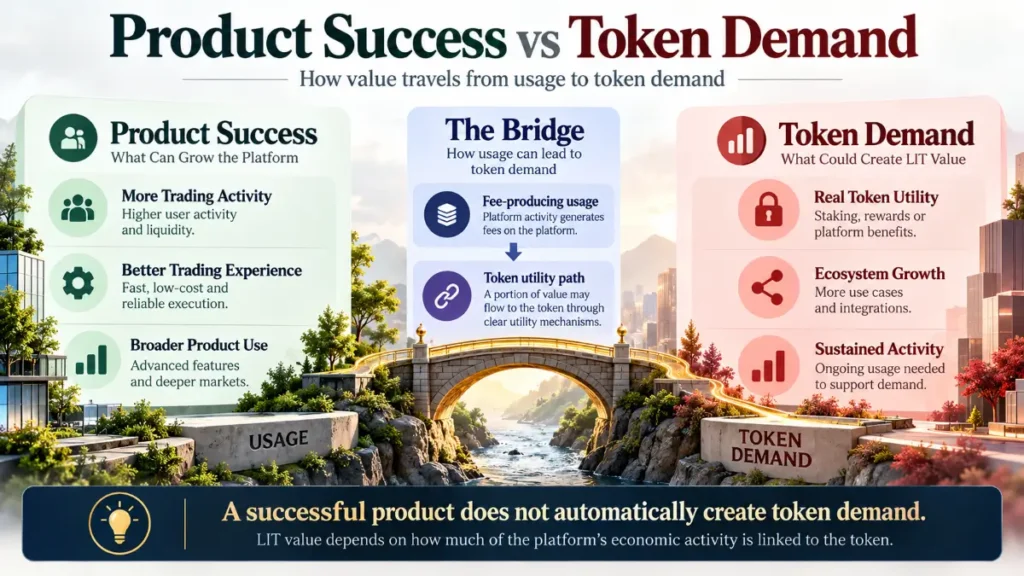
A perpetual exchange can grow for many reasons. It can offer lower fees, faster execution, better markets, trading incentives, referral campaigns, points programs, deeper liquidity or an easier interface. Some of those drivers create revenue. Others create activity without much direct token value capture.
This distinction is central to LIT. Lighter’s current account documentation shows that Standard accounts are suitable for retail and latency-insensitive traders, with 0% maker and 0% taker fees. Premium accounts are different. Lighter describes them as suitable for high-frequency trading and lower latency, with maker and taker fees that decline across higher staked-LIT tiers. Lighter’s account-type documentation also states that fee credits count as staked LIT for the parameters shown in its Premium account table.
That creates a split economic model. Zero-fee trading can help Lighter attract users and volume, but the direct token link is stronger where users pay fees, buy fee credits, stake LIT or use account features that require token commitment. If most activity remains in zero-fee Standard accounts, headline volume will matter less for LIT than the share of activity that becomes fee-producing usage.
The right question is not simply how much volume Lighter processes. The better question is how much of that volume creates recurring economic activity that reaches LIT.
This is also why perp DEX reviews need a careful value-capture lens. A project such as Hyperliquid can have strong market activity, but activity still needs to be separated from token-holder value. That same distinction appears throughout CryptosMedia’s Hyperliquid review, and it is directly relevant to how Lighter should be evaluated.
How Lighter’s Account System Connects to LIT
The account system is one of the most important parts of the LIT thesis. Standard accounts make the platform attractive to ordinary traders because they can trade without ordinary maker or taker fees. That helps explain how Lighter can compete for volume, but it also limits direct fee revenue from that account type.
Premium accounts create a clearer economic link. A trader who needs lower latency, larger rate limits or better fee terms may have a reason to interact with the LIT-linked account structure. That does not mean every user needs LIT, but it gives the token a defined role inside the trading system.
Fee credits add another route, but they should still be read carefully. If fee credits count toward staking-related parameters, they can help users access better account economics without committing the full staking amount. That is useful utility, but its strength depends on how many traders actually need those benefits over time.
This is the key difference between real utility and broad token branding. LIT is not only a name attached to an exchange. It has platform functions. The open question is whether those functions are used by enough economically meaningful participants to support lasting demand.
Volume Is Useful Evidence, but Not Enough
Lighter’s trading activity is the obvious reason the token attracts attention. DefiLlama tracks Lighter Perps fees, revenue, holders revenue, open interest and perpetual volume. That makes it easier to separate product activity from token-relevant economics. DefiLlama’s Lighter Perps page also describes holders revenue as LIT token buybacks from treasury.
Volume is meaningful product evidence. It shows that traders use the platform, open positions and route orders through the matching engine. A perpetual DEX with no meaningful volume would have a weaker case regardless of its technology.
Still, volume is not revenue. Perpetual notional volume measures the dollar value of trades, including leverage. It does not tell readers how much users paid in fees, how much of that fee flow becomes protocol revenue, how much reaches LIT buybacks, or how much activity came from incentives, market-maker programs or zero-fee flow.
Read Lighter volume as product evidence. To test LIT demand, connect that volume to paid activity, buybacks, staking behavior, fee-credit use, unlock schedules and whether token recipients retain or sell LIT.
A similar issue appears in other exchange-token models. Buybacks, burns and fee-linked demand can be meaningful, but they must be measured against rewards, emissions, unlocks and user behavior. That is why CryptosMedia’s Aster review separates exchange activity from net token demand rather than treating volume as the whole story.
Live Activity vs Token Demand
The table below separates visible platform activity from actual token-demand evidence.
| Activity | What It Demonstrates | What It Does Not Prove |
|---|---|---|
| Trading volume | Traders are using Lighter markets | That all volume creates fee revenue |
| Standard account activity | Lighter can attract cost-sensitive users | That each trade directly creates LIT demand |
| Premium account use | Some users may pay for lower latency and higher limits | That most volume comes from paid users |
| LIT staking | Users may commit LIT for platform benefits | That staking demand is permanent |
| Fee-credit use | Traders may use token-linked credits for better account terms | That credit demand will remain strong without incentives |
| LIT buybacks | Fees can create market purchases of LIT | That buybacks exceed unlocks or recipient selling |
| Open interest and TVL | Capital is active in the system | That token holders capture that capital’s value |
| Incentive-driven activity | Growth campaigns can attract users | That usage is fully organic or durable |
Research takeaway: Strong trading activity can support the product, but it does not automatically create durable LIT demand.
This distinction matters because strong trading activity can support the product without automatically creating durable LIT demand.
The LIT Token Demand Path
The cleanest version of the LIT thesis follows this chain:
real traders use Lighter
→ some traders pay fees or use paid account features
→ the protocol generates revenue
→ part of that value supports buybacks or token-holder economics
→ advanced users may stake LIT or use fee credits
→ recurring trading activity supports recurring token demand
This chain shows where LIT’s token thesis can strengthen or break. Trading activity matters most when enough of it becomes paid usage, protocol revenue, buybacks, or lasting token commitment rather than remaining zero-fee or incentive-driven volume.
LIT Mechanism / Value Path
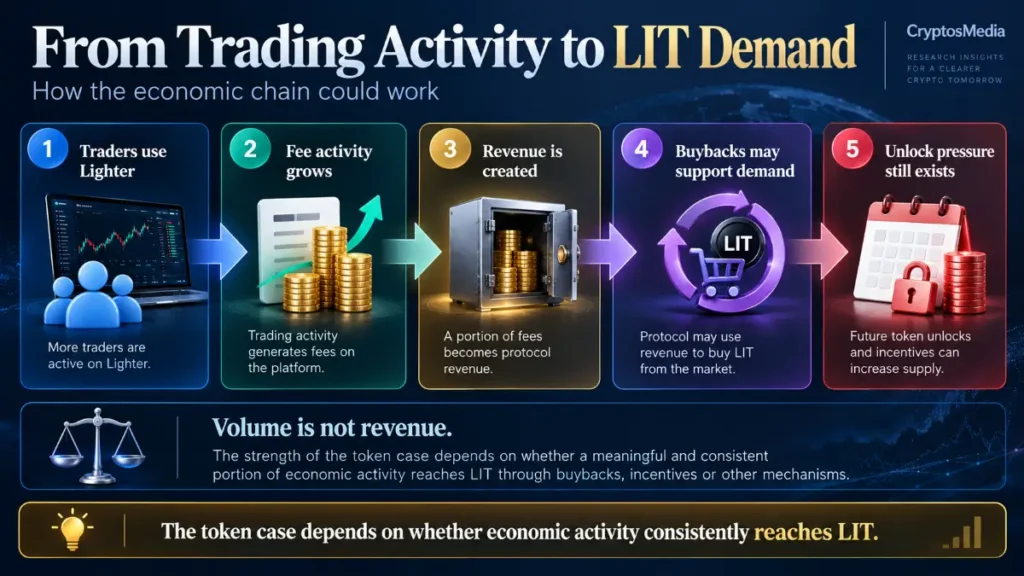
Every link in that chain matters. The chain weakens when trading grows but most volume pays no fees. Fee growth also matters only if buybacks become large and consistent enough to support token demand. Even when buybacks occur, large unlocks or recipient selling can still offset part of that demand. Staking demand can also fade if it depends mainly on incentives rather than durable trading utility.
This is where Lighter becomes more interesting than a simple volume story. It has activity, account tiers, fee-linked mechanics and buybacks. But the long-term token case still depends on scale, durability and net flows.
A buyback mechanism matters more when fee revenue is recurring, transparent and large enough to compete with unlock pressure and selling from token recipients. If buybacks are small compared with future supply flows, the token case weakens even if the product remains active.
LIT Utility and Fee Credits
LIT’s utility is not limited to a vague governance idea. Lighter’s own utility page describes LIT as the native infrastructure token supporting access, incentives and alignment across the ecosystem. It identifies staking, LLP access, staking APR and buybacks as active parts of the current model. Lighter’s LIT utility documentation states that the Lighter Liquidity Pool is accessible to LIT stakers, and that every 1 LIT staked may allow up to 10 USDC to be deposited into the LLP.
This gives LIT several possible demand routes. A user may stake LIT for platform benefits. A participant may want LLP access. A trader may care about fee tiers. A token holder may watch buybacks as a link between protocol activity and token demand.
Those are real mechanisms, but they still need economic discipline. Staking is not automatically value capture. A fixed staking reward is not automatically real yield. LLP access is not automatically permanent token demand. Each mechanism depends on user behavior, reward sustainability, demand for the underlying product and the balance between token inflows and token outflows.
This is the broader rule for every CryptosMedia token review: token utility is only the start. The stronger question is whether the utility creates durable demand after rewards, unlocks, incentives and market conditions are included. This is also why staking-heavy models should be reviewed carefully. CryptosMedia’s Lido DAO review follows the same principle by separating staking activity from direct token-holder value capture.
Tokenomics and Unlock Pressure
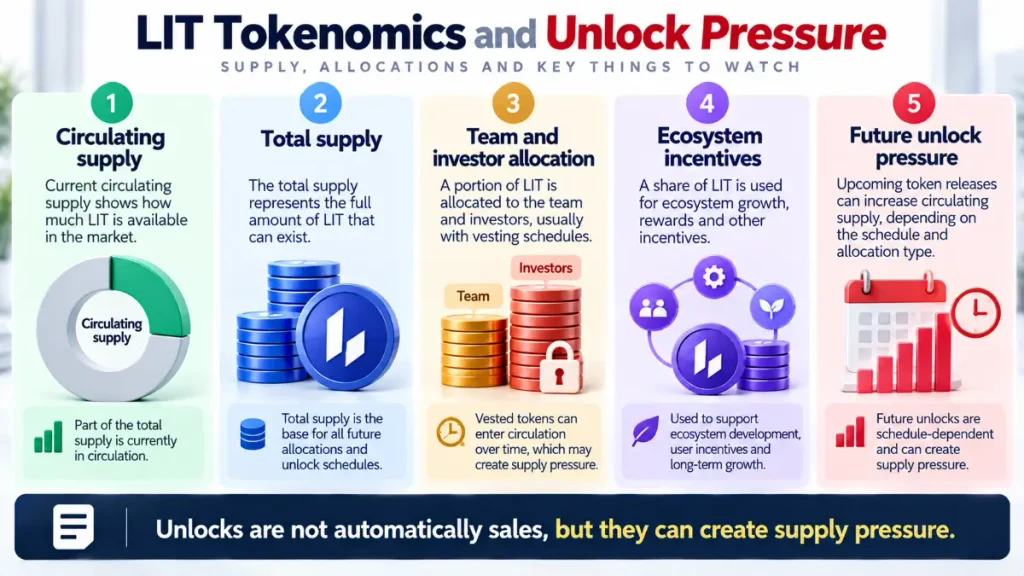
LIT’s tokenomics need careful reading because the project combines a large ecosystem allocation with a large team-investor allocation. As checked on 30 September 2026, Tokenomist reports 250 million LIT circulating against a nominal total supply of 1 billion LIT. Reported token burns can reduce the effective outstanding supply, so circulating, nominal total, and post-burn supply should be read separately. Its allocation breakdown listed Ecosystem at 25%, Airdrop at 25%, Team at 26% and Investor at 24%. Tokenomist’s Lighter tokenomics page also described a vesting schedule extending into 2029.
That structure creates a clear trade-off. The airdrop rewards early users and can spread token ownership. The ecosystem allocation can support future growth, incentives and partnerships. But team and investor allocations remain major future supply considerations. A lock or vesting schedule can reduce sudden early pressure, but it does not remove future supply from the equation.
The important point is not that unlocks equal selling. They do not. The point is that unlocks increase the amount of supply that can move. Buybacks, staking demand and organic user demand must be strong enough to absorb those flows over time.
The table below turns those supply details into the main token-demand questions readers should track.
| Tokenomics Item | Current Position | Why It Matters |
|---|---|---|
| Total supply | 1 billion LIT nominal supply before accounting for reported burns | Defines the nominal supply base; effective outstanding supply can be lower after burns |
| Circulating supply | 250 million LIT checked on 30 September 2026 | Shows that only part of the nominal supply is circulating |
| Airdrop allocation | 25% | Rewards early users but may create recipient selling |
| Ecosystem allocation | 25% | Can support growth, incentives and partnerships |
| Team allocation | 26% | Creates alignment if vested responsibly, but also future unlock pressure |
| Investor allocation | 24% | Adds potential supply pressure after lock and vesting periods |
| Staking utility | LIT staking supports platform benefits and LLP access | Gives users a reason to commit LIT |
| Buybacks | Fee-funded buybacks described by Lighter documentation and DefiLlama | Provides a measurable value-capture route |
| Main transparency gap | Future activity, unlock impact and recipient behavior can change | Monitor over time Explains why live monitoring remains necessary |
Research takeaway: Unlocks do not guarantee selling, but future supply must be compared with buybacks, staking demand and organic user demand.
Buybacks Help, but They Do Not End the Analysis
Buybacks are one of the strongest parts of the LIT case because they provide a clearer route from protocol economics to token demand. If trading fees support market purchases of LIT, then the platform has a measurable way to connect usage with token demand.
That is useful, but readers should not overstate it. A buyback is a purchase of tokens from the market. It can support demand, but it does not automatically guarantee long-term price performance or prove that token economics are stronger than future selling pressure.
Readers should not judge Lighter only by whether buybacks exist. They should ask whether fee-funded buybacks remain material relative to supply flows. If buybacks become large, regular and transparent, the token case improves. If buybacks are small compared with future unlocks or mostly depend on temporary growth, the case becomes weaker.
The cleanest long-term evidence would be a consistent relationship between fee-producing volume, protocol revenue, token buybacks, staked LIT and changes in circulating supply. Without that full picture, buybacks remain positive but not conclusive.
Security and Governance Risks
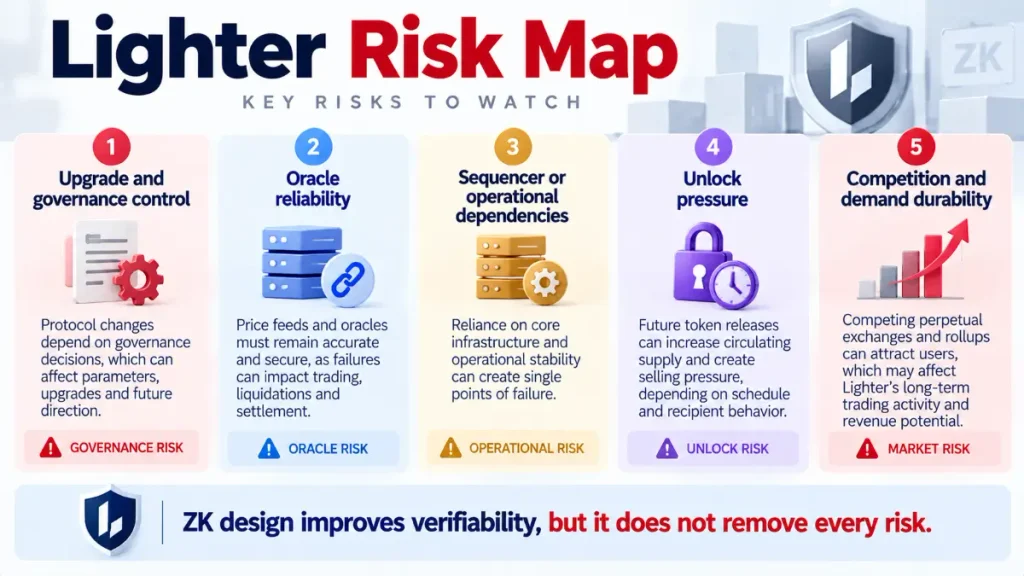
Lighter’s technical design is one of its strengths, but it also requires precise risk analysis. A ZK rollup can improve verifiability, yet users still depend on contracts, upgrade controls, sequencer behavior, oracle inputs, data availability and operational reliability.
L2BEAT classifies Lighter as a Stage 0 Appchain ZK Rollup and states that stages do not directly reflect project security. L2BEAT’s Lighter page also identifies Lighter’s purpose as exchange infrastructure and provides details on state validation, forced transactions and escape-hatch mechanics.
This distinction matters. Readers should not treat a Stage 0 label as a simple safety score, but the label does show that maturity and decentralization assumptions need attention. Lighter may offer verifiable matching and ZK-based state validation while still having upgrade, oracle, sequencer and operational dependencies.
L2BEAT currently reports that regular Lighter upgrades use a 21-day delay, while the Security Council can reduce that delay to zero during an emergency. This means governance and upgrade authority remain part of Lighter’s trust model even alongside ZK-based verification.
A careful review should not turn ZK proofs into a broad promise that every part of the system is trustless. ZK proofs can verify defined computations. They do not eliminate every governance, oracle or operational risk around a live exchange.
Oracle reliability also matters because perpetual markets depend on accurate reference prices, liquidation calculations and market integrity. CryptosMedia’s Pyth Network review is useful background for understanding why data providers and oracle assumptions are central to leveraged trading infrastructure.
Case For LIT
The strongest case for LIT starts with product-market evidence. Lighter is live, active and operating in a category where user demand already exists. Traders already use perpetual futures. Lighter does not need to invent the behavior. It needs to win share by offering better execution, lower costs and stronger verification.
Another positive is token utility. LIT connects to staking, account benefits, fee credits, LLP access, staking rewards and buybacks. That gives the token more visible platform relevance than tokens whose main role is only broad governance or branding.
Buybacks add a third point. Fee-funded purchases can create a measurable path from protocol activity to market demand for LIT. If Lighter’s paid activity grows, this route could become more important.
Finally, positioning matters. Perp DEXs remain one of the most active sectors in crypto. A platform that can combine speed, liquidity, low costs and verifiable execution has a plausible reason to remain relevant if onchain perps continue competing with centralized venues.
Case Against LIT
The strongest case against LIT is that volume can mislead readers. Standard accounts can produce activity without ordinary trading fees. If a large share of activity comes through zero-fee accounts, incentives or low-revenue flow, volume will overstate economic value.
Future supply is another concern. Tokenomist reported 250 million LIT circulating against 1 billion total supply, as checked on 30 September 2026. That makes future supply movement important. Unlocks are not automatically sales, but they increase the amount of supply that can become liquid. Buybacks and staking demand must be strong enough to absorb those flows.
Infrastructure maturity also matters. Lighter’s ZK design is important, but exchange users still need to monitor upgrade control, sequencer behavior, oracle reliability, forced-transaction paths and exit assumptions. Those are not unusual for newer high-performance systems, but they must be part of the risk discussion.
Competition adds one more risk. Lighter competes in a market where fees, incentives, liquidity and execution quality can change quickly. Lighter’s token case needs durability beyond temporary rewards, points or fee advantages.
What Would Strengthen the LIT Thesis?
The LIT thesis would become stronger if Lighter keeps growing fee-producing activity, not only total volume. A useful signal would be a rising share of Premium account use, sustained protocol revenue, transparent buybacks and clear reporting that separates zero-fee volume from paid activity.
Another strengthening factor would be clearer long-term token-holder economics. If buybacks, fee credits, staking rewards, LLP access and governance rights become easier to track, readers can judge whether LIT captures value directly, indirectly or only under certain conditions.
Security maturity would also matter. Progress toward reduced upgrade risk, stronger decentralization, clearer operator structure, stronger oracle transparency and more robust exit guarantees would improve confidence in the infrastructure that supports the exchange.
Finally, LIT would benefit from organic retention after incentives. If traders continue using Lighter because execution, liquidity, markets and cost are genuinely better, the token case becomes less dependent on subsidized growth.
What Would Weaken the LIT Thesis?
The thesis would weaken if reported volume stays high while fees, revenue or buybacks fail to grow. That would suggest that activity is not translating into token-relevant economics.
It would also weaken if future unlocks create persistent selling pressure that buybacks and staking demand cannot absorb. Unlocks are not automatically sales, but they increase the amount of supply that can move.
A security, oracle or downtime incident would also damage confidence. Perpetual exchanges depend heavily on reliable pricing, liquidation integrity, market data, withdrawal confidence and operational continuity. A serious failure in any of those areas could affect both product use and token perception.
The thesis would also weaken if LIT utility remains mostly optional. If Standard users remain the dominant activity base and Premium staking demand stays limited, LIT may depend more on buybacks and market sentiment than on direct user necessity.
Final Assessment
Lighter is a serious perpetual exchange project with a clearer technical identity than many trading tokens. Its ZK rollup design, Ethereum settlement layer, verifiable matching claims, zero-fee Standard account model and Premium account structure give it a distinctive place in the onchain trading market. The product deserves attention because it addresses a real problem: traders want speed and low costs, while DeFi users also want stronger verification and self-custody protections.
LIT is a more difficult question. The token has meaningful links to the platform through staking, fee-linked account benefits, fee credits, LLP access, rewards and buybacks. Those links are stronger than a vague promise that exchange growth may help the token someday.
Still, readers should not evaluate LIT by trading volume alone. The correct question is whether Lighter’s paid activity, protocol revenue, buybacks and stake-linked demand can remain strong after incentives, zero-fee flow and future unlocks are included. If that chain strengthens, LIT has a credible value-capture route. If the chain breaks at revenue, buybacks, staking demand or supply pressure, then product success may not fully translate into durable token demand.
For now, the balanced view is this: Lighter looks like a real exchange infrastructure project with measurable activity, but LIT’s long-term case depends on the quality of that activity and the durability of its economic link to the token.
Key Questions About Lighter, LIT, and Token Demand
What is Lighter?
Lighter is a decentralized exchange infrastructure project focused on high-performance trading. Its system uses custom ZK infrastructure and Ethereum-based verification to support exchange operations such as matching and liquidations.
What is LIT used for?
LIT is the Lighter Infrastructure Token. Current documentation connects it to staking, platform benefits, LLP access, staking rewards, fee credits, and protocol buybacks.
Does Lighter’s trading volume automatically create LIT demand?
No. Trading volume shows product activity, but it does not automatically prove token demand. The stronger question is how much activity generates fees, buybacks, staking demand, or other token-linked value.
Why do Standard accounts matter for the LIT thesis?
Standard accounts help Lighter attract traders because they support zero-fee trading. That can strengthen product adoption, but Standard-account activity should not be treated as direct fee revenue by itself.
Why do Premium accounts matter more for value capture?
Premium accounts matter because paid account activity can create a clearer route from trading usage to protocol revenue. The stronger LIT thesis depends on whether paid activity becomes large and recurring enough to support token-linked mechanisms.
Does Lighter buy back LIT?
Yes. Lighter documentation and DefiLlama describe a fee-funded buyback route. The important question is whether those buybacks remain large and durable enough compared with unlocks, incentives, and possible selling pressure.
Do LIT buybacks automatically create net token demand?
No. Buybacks can support demand, but they should be compared with token unlocks, reward distribution, staking flows, and holder behavior. Buybacks are one part of the economic picture rather than automatic proof of net demand.
What is the main tokenomics risk for LIT?
The main tokenomics risk is future supply pressure. Tokenomist reported 250 million circulating LIT against 1 billion total supply as checked on 30 September 2026, so future unlocks and recipient behavior need to be compared with buybacks and staking demand.
Does staking automatically create value capture for LIT?
No. Staking can create utility, working-balance demand, and access benefits, but staking rewards and eventual withdrawals also affect supply. The stronger test is whether users need to hold or stake LIT for productive reasons beyond receiving incentives.
What evidence matters most for the LIT demand thesis?
The most useful evidence is paid activity, protocol revenue, reported buybacks, Premium account adoption, fee-credit use, staked LIT demand, and upcoming unlocks. Perpetual volume matters, but it becomes more useful when read alongside revenue and token-flow data.
This article is independently prepared from publicly available information and cited research sources. CryptosMedia does not provide buy, sell, or hold recommendations.

Founder & Managing Editor of CryptosMedia. Zahid Hussain leads evidence-based crypto research covering tokenomics, security, governance, adoption, and risk.
CryptosMedia separates verified facts from interpretation, avoids buy/sell recommendations, and updates reviews when major evidence changes.