
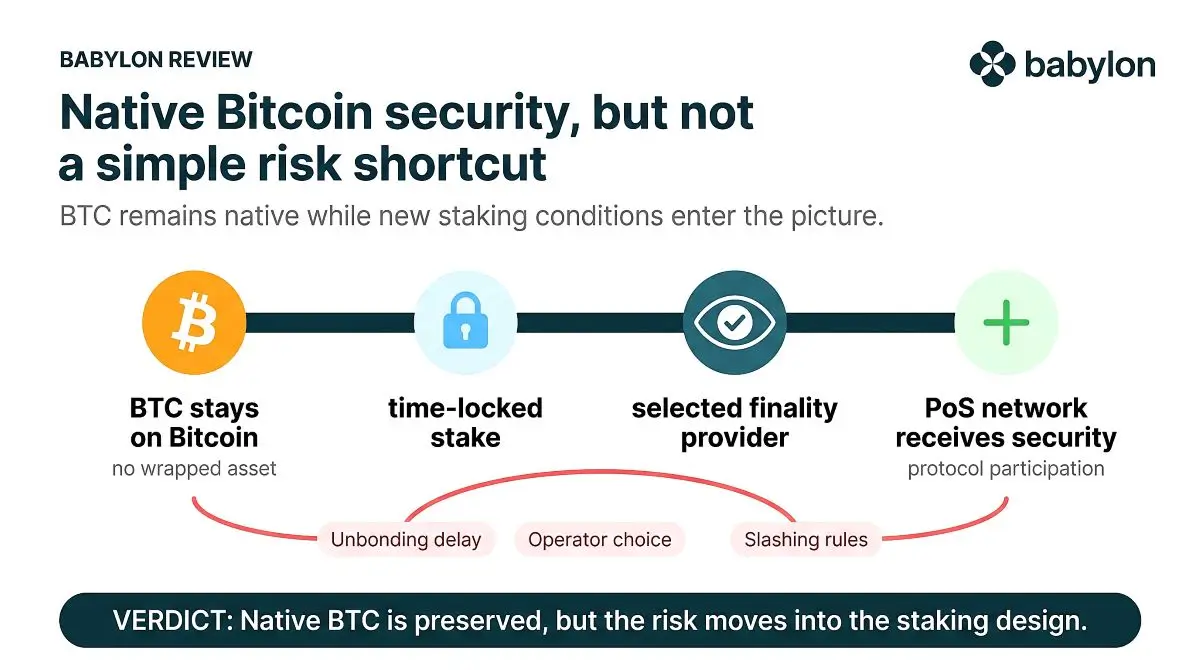
Bitcoin can remain on its native chain while helping secure another network, but that does not make the arrangement simple. This Babylon Review examines how Babylon uses native BTC, what BABY controls, and where the security and tokenomics trade-offs sit.
Babylon solves a real infrastructure problem. Bitcoin has deep economic weight, while younger proof-of-stake networks often need stronger security than their own native tokens can provide. Babylon’s model lets a BTC holder lock Bitcoin through a defined Bitcoin transaction, delegate security power to a finality provider, and contribute to the security of Babylon Genesis.
The attraction is clear. BTC does not need to become a wrapped token, move through a bridge, or sit with a centralized lender. The cost is complexity. A user must understand the finality provider, the Bitcoin script, the covenant-signing process, Babylon Genesis parameters and the conditions under which a stake can leave the system.
What Babylon Actually Does
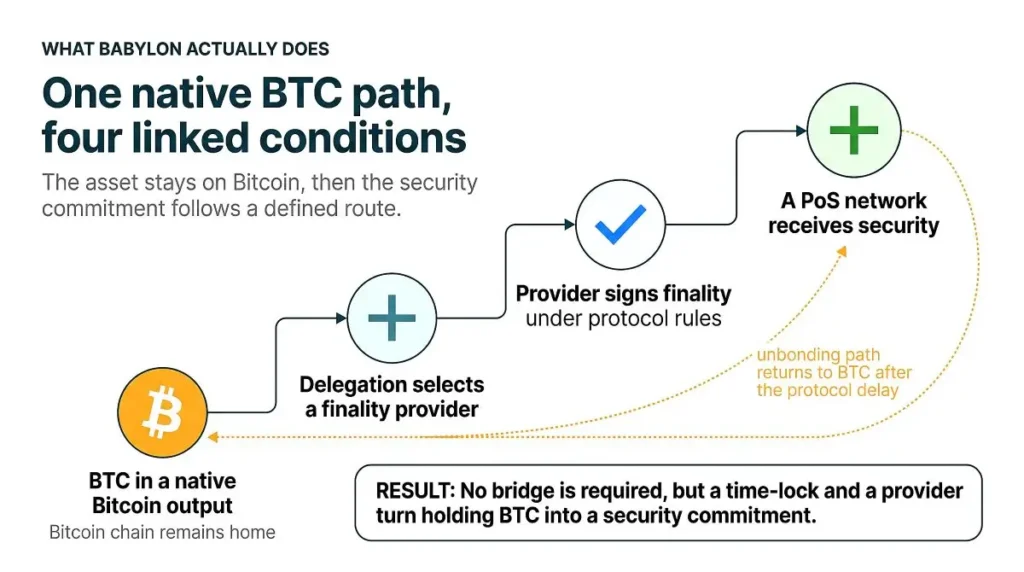
Babylon is shared-security infrastructure, not a conventional Bitcoin savings product. Its Bitcoin staking protocol turns a native BTC position into economic security for Babylon Genesis and, over time, potentially other Bitcoin Supercharged Networks.
A staker chooses a finality provider. That operator participates in Babylon’s finality process, while the BTC stake supplies delegated voting power. Babylon Genesis, a Cosmos SDK chain, acts as the coordination layer. It records relevant staking information, manages protocol logic and connects the Bitcoin-side stake to the proof-of-stake security process.
Babylon’s design relies on Bitcoin Taproot scripts. Each valid stake can include a timelock path, an unbonding path and a slashing path. Those paths matter because they define what the staker can recover, when recovery can occur and what happens after a provable security violation.
The protocol does not promise that BTC becomes productive without conditions. It offers a different risk model from wrapped Bitcoin, centralized lending or exchange-based yield products. The holder keeps Bitcoin native, but accepts cryptographic and operational rules that ordinary wallet ownership does not require.
Babylon Review: Native BTC Does Not Mean Simple Risk
Self-custody is Babylon’s strongest claim, but it needs precise language. The staker controls the Bitcoin key and the BTC does not become a synthetic or bridged asset. That removes some familiar risks, including a wrapped-token issuer failing or a centralized lender freezing withdrawals.
It does not remove every dependency. A BTC stake names a finality provider and depends on Babylon’s current parameters. The unbonding process also involves the covenant-emulator system and Bitcoin confirmation rules. These parts have different jobs, but together they make the system work.
A covenant committee is not a normal custodian with unilateral withdrawal power over user BTC. Its signatures help enforce the protocol’s defined spending rules. Still, the user experience depends on more actors and more software than holding BTC in a standard self-custody wallet.
Babylon’s own technical documentation says a stake currently selects one finality provider. Multiple-provider delegation is not presently supported in the staking flow. That concentrates a staker’s operational choice: the selected provider’s key management and finality behavior matter directly.
For readers comparing models, Bitcoin’s institutional adoption explains why Bitcoin holders increasingly look for ways to use BTC without surrendering core custody. Babylon addresses that demand, but it should be assessed as security infrastructure, not as a friction-free yield feature.
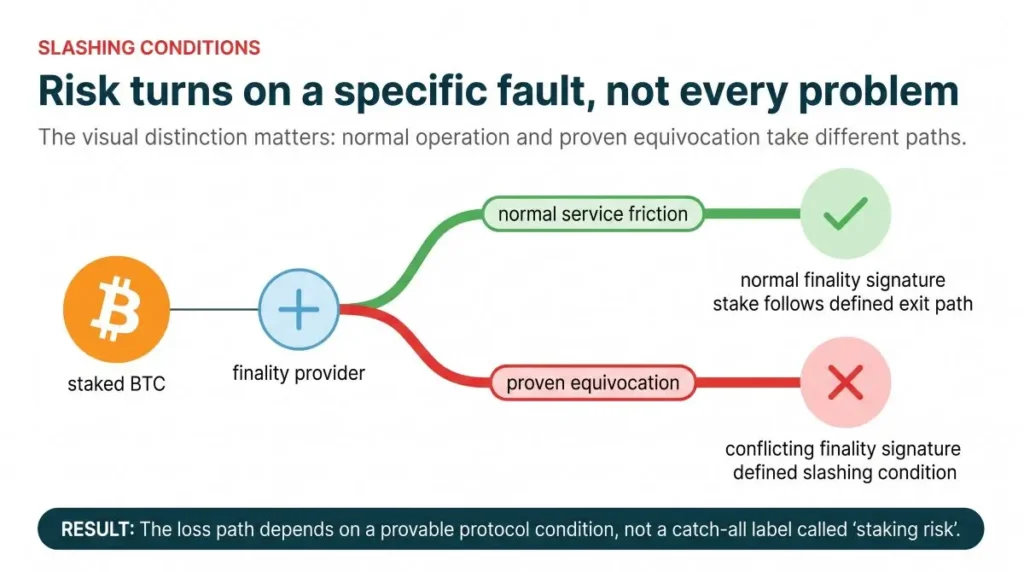
Slashing Is Specific, Not a Catch-All Penalty
The earlier draft wrongly suggested that any chain hack could automatically burn a staker’s BTC. Babylon’s slashing condition is narrower.
In the Bitcoin staking design, a finality provider can trigger slashing when it double-signs, meaning it signs conflicting finality votes for the same security event. The slashing transaction can send the defined penalty portion of the BTC stake to a burn address, while the remainder follows a refund and timelock path.
This distinction matters for accuracy. A market crash, a normal software outage or a generic exploit headline does not automatically mean a BTC staker loses coins. The relevant question is whether the protocol’s provable slashing condition is met.
The risk remains material. A user who delegates BTC is not only trusting their own wallet security. They are accepting the possibility that a finality provider’s severe, provable misconduct can produce a Bitcoin-side penalty. The protocol is built to make that penalty enforceable, which is the reason its shared-security model has weight.
A responsible review should therefore avoid two extremes. It is wrong to call Babylon custodial in the ordinary sense. It is also wrong to describe native BTC staking as risk-free simply because a bridge or lender is absent.
Babylon Genesis Has Delivered a Live Coordination Layer
Babylon Genesis mainnet launched in April 2025. That moved Babylon beyond a research-only proposition and created a live Layer 1 responsible for coordinating its Bitcoin staking design, validators, governance and connected security processes.
Live operation is meaningful evidence. It shows that the protocol has moved from papers and test environments into a working network. Yet the current scope remains more important than the long-term vision.
Babylon Genesis is the first Bitcoin Supercharged Network. It should not be treated as proof that every future network will adopt Babylon’s model, or that all proposed integrations already produce mature demand for native BTC security. A chain can be live while adoption, decentralization and token-value capture are still developing.
The architecture also has a practical consequence. Babylon combines Bitcoin’s slower settlement environment with a Cosmos-based coordination chain and off-chain operator tooling. That can create useful security properties, but it creates more boundaries to monitor: Bitcoin transactions, Babylon Genesis state, finality-provider software, covenant-emulator behavior and governance decisions.
EigenCloud’s shared-security model offers a useful comparison because both projects ask users to assess security beyond a single chain. Their assets, trust assumptions and mechanisms differ, but the core lesson is the same: shared security is strongest when its live scope and control points are easy to verify.
BABY Has Utility, but Governance and Supply Matter
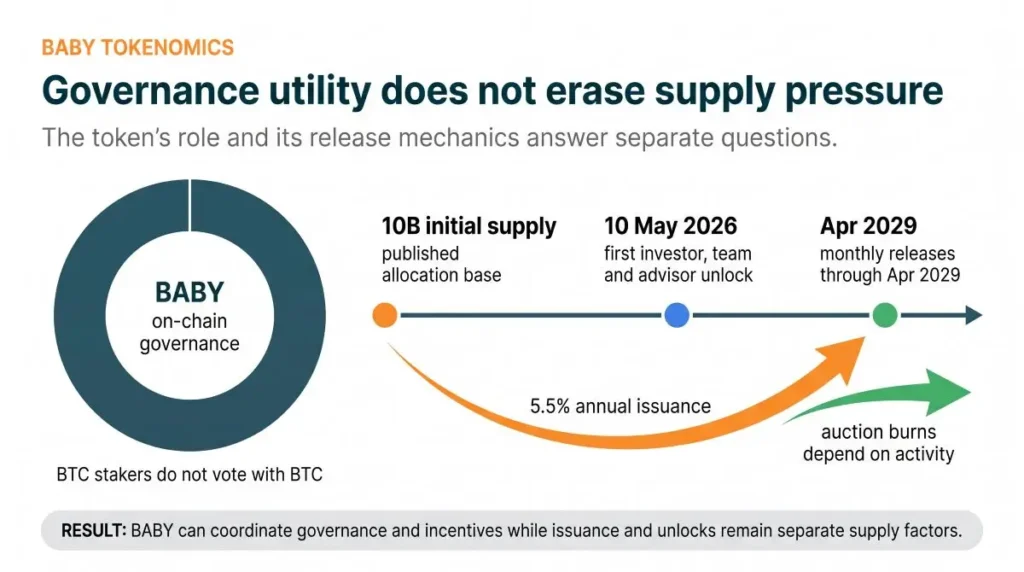
BABY is Babylon Genesis’s native token. It pays transaction fees, supports staking and gives holders governance power over the chain. BTC stakers supply economic security, but BABY holders and their delegated validators participate in governance.
That separation matters. Bitcoin staking and BABY governance are connected in the same network, but they are not the same right. A BTC staker should not assume that contributing security creates the same policy influence as holding or staking BABY.
Babylon’s current tokenomics documentation lists a total initial supply of 10 billion BABY and a 5.5% annual inflation rate, reduced from the earlier 8% rate. Both BTC and BABY stakers can receive BABY rewards under the dual-staking model.
The rate is a more useful figure than a vague promise of rewards. Inflation can support validator and staker incentives, but it also adds supply. Whether network activity, fee demand and future burn mechanisms offset that effect depends on real usage and governance decisions, not on the existence of a token utility list.
Vesting Is Now a Live Supply Question
The BABY distribution is not only about the original airdrop. It includes community incentives, ecosystem building, research and operations, early investors, team members and advisors.
Babylon’s published schedule states that early-investor, team and advisor unlocks began on 10 May 2026 and continue through monthly releases until April 2029. The published allocation places 30.5% with early private investors, 15% with the team and 3.5% with advisors.
That does not prove that every unlock produces selling pressure. It does mean circulating-supply analysis cannot stop at the initial supply or airdrop narrative. Unlocks, inflation, foundation-controlled community incentives and future burns must be examined together.
| Supply factor | Verified position | Practical meaning |
|---|---|---|
| Initial supply | 10 billion BABY | Supply analysis starts from a large fixed initial base |
| Current inflation | 5.5% per year | Rewards add issuance over time |
| Community incentives | 15%, fully unlocked | Foundation-managed distribution can affect supply availability |
| Investor allocation | 30.5%, monthly unlocks through April 2029 | Unlock schedule remains relevant after May 2026 |
| Team and advisor allocations | 18.5% combined | Vesting continues through the same broad period |
| Reward-auction burns | Protocol design feature | Effect depends on real activity and governance execution |
Babylon has described a mechanism in which some Bitcoin Supercharged Network rewards can be auctioned for BABY and the winning BABY bid can be burned. That is a possible offset, not a reason to assume net deflation. It must be judged against actual auction activity and current issuance.
Security Audits Need Scope, Not Slogans
Babylon has a meaningful published security record. Its audit documentation lists phase-one Bitcoin staking audits, initial Babylon Genesis reviews by Coinspect, Zellic and Sherlock, later Genesis V2 reviews by Oak Security and Informal Systems, and V4 reviews by Coinspect and Halborn. Halborn is also listed for the frontend staking application. Babylon’s official audit record should be checked before relying on any claim about a particular code version.
This is a positive signal, but it is not a blanket safety certificate. An audit covers a specified code scope at a point in time. It cannot guarantee that every later upgrade, validator operation, wallet connection or external integration is free from risk.
The most useful security question is therefore not ‘Has Babylon been audited?’ It is ‘Which component, which version and which risk was reviewed?’ That distinction protects readers from treating a firm name as proof that a whole ecosystem has no remaining attack surface.
Readers who want to see why audit scope matters can compare this approach with our Decred technical audit. Good technical review work separates verified code coverage from wider governance, operational and market risks.
Babylon Versus Wrapped BTC and Lending
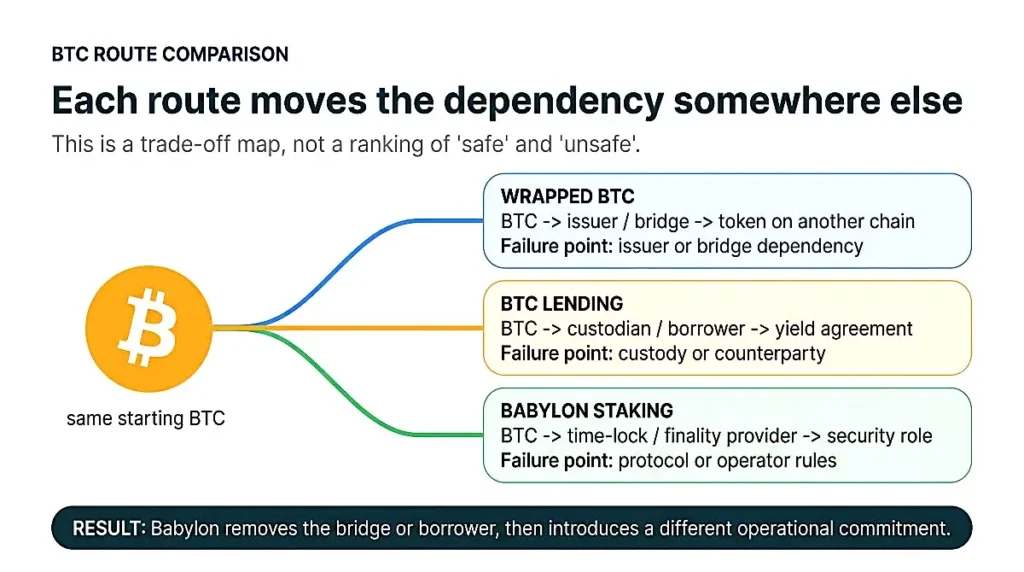
Babylon is not competing with only one product. It sits between several ways Bitcoin holders try to use BTC.
Wrapped BTC can provide fast access to DeFi applications, but the holder accepts issuer, custody, bridge or smart-contract assumptions. Centralized lending can be simpler to use, but it introduces company solvency and withdrawal risk. Native BTC staking keeps Bitcoin on its own chain, but introduces finality-provider selection, slashing rules and protocol-level dependencies.
Wrapped Bitcoin products show why the asset’s location matters. Babylon reduces reliance on a wrapped representation, but it replaces that model with Bitcoin-script enforcement and Babylon-specific security assumptions.
No option should be judged by marketing language alone. The right comparison is the source of failure:
- Wrapped BTC can fail through backing, custody, bridge or contract assumptions.
- Centralized lending can fail through counterparty insolvency or withdrawal controls.
- Babylon staking can fail through protocol defects, operator misconduct, governance changes or misunderstood script conditions.
This does not make one option universally better. It makes the trade-off visible.
What Would Strengthen Babylon’s Evidence
Babylon’s strongest next step is not a louder airdrop narrative. It is more transparent proof around live security and token economics.
Readers should be able to assess finality-provider concentration, active BTC stake distribution, meaningful use by connected networks, current parameters, governance outcomes and the relationship between issuance and any burn activity. Each of those factors changes the real risk and value-capture picture.
The project has already done important work: a live Genesis chain, native BTC staking mechanics, public documentation and named audit reports. The remaining challenge is showing that the model can expand without becoming opaque or overly dependent on a small set of operators and governance participants.
Verdict: Serious Bitcoin Security Infrastructure, Real Trade-Offs
Babylon has a credible technical purpose. It gives native BTC a role in proof-of-stake security without requiring a wrapped token, bridge transfer or centralized lender. Its live Genesis chain, defined Bitcoin-script paths and published security work give the project more substance than a speculative BTCFi narrative.
The risk model is demanding. A BTC holder must understand the selected finality provider, slashing condition, unbonding path, governance structure and BABY supply schedule. BABY has genuine roles in fees, staking and governance, but inflation and scheduled unlocks mean utility should not be confused with automatic token-value capture.
Babylon is strongest when assessed as infrastructure with visible assumptions. It becomes weaker when described as effortless Bitcoin yield. The protocol deserves attention for what it has built, while its security decentralization, live adoption and supply dynamics continue to require evidence-led scrutiny.
Frequently Asked Questions About Babylon
No. Babylon’s Bitcoin staking design keeps BTC native on Bitcoin through protocol-specific transactions and scripts. It does not mint a wrapped BTC token for the staking process.
A finality provider does not have a normal withdrawal right over staked BTC. However, provable double-signing can activate the protocol’s slashing path, which is why provider selection is a material decision.
BABY is used for Babylon Genesis transaction fees, staking and governance. BABY holders participate in governance, while BTC stakers contribute to the network’s security model.
No. Babylon’s current official tokenomics documentation lists a 5.5% annual inflation rate, reduced from 8%. Parameters can change through governance, so this should be rechecked before publication.
Unlocks can increase available supply over time. Babylon’s published schedule shows monthly investor, team and advisor unlocks continuing through April 2029.

Founder & Managing Editor of CryptosMedia. Zahid Hussain leads evidence-based crypto research covering tokenomics, security, governance, adoption, and risk.
CryptosMedia separates verified facts from interpretation, avoids buy/sell recommendations, and updates reviews when major evidence changes.
3 thoughts on “Babylon Review: BTC Staking, BABY and Security Risks”