Maker MKR Truth: Dark Reality Behind Sky Transition

Maker MKR Truth Cryptosmedia engraved on a heavy iron gear inside a disassembled pocket watch.

Maker MKR holds dark secrets behind its shiny decentralized financial system. Crypto projects often present beautiful faces, but diving below surface level reveals complex webs of governance transitions, peg stability mechanisms, and structural overhauls. Over past year, Maker ecosystem has been undergoing its biggest transformation – huge rebranding called ‘Sky’. Under this shift, legacy tokens MKR and DAI face replacement with new tokens SKY and USDS. Anyone looking for information right now must understand this complex transition and token conversion process. I will explain new Sky transition’s technical mechanics using simple words. We will evaluate real Maker utility, analyze Maker tokenomics deeply, highlight security and centralization risks every regular holder should know. Most important research question stands: does this rebrand scale DeFi properly, or does it compromise censorship-resistant principles on which founders built Maker? My Research Method: How I Evaluated This Project To prepare this report, I deeply analyzed first-party project documentation, historical market data, smart contract parameters, Maker audit reports, public governance forum debates. I monitored core smart contracts on Ethereum, checked CertiK security ratings, analyzed latest financial reports from Sky Frontier Foundation. Crypto market data changes very quickly. Therefore, I verified all market metrics here using live data from July 14, 2026. I used rates and liquidity metrics from CoinMarketCap, Binance, MetaMask, Independent Reserve to ensure absolute accuracy. Truth About Rebranding: Journey From Maker MKR To Sky Maker Protocol Mechanics Danish entrepreneur Rune Christensen conceived Maker Protocol during 2015. It launched fully during late 2017, becoming one foundational pillar for DeFi space. Fundamentally, this system operates as decentralized credit platform. Users lock volatile crypto collateral (like Ether) inside smart contracts called Vaults. Against locked collateral, system allows them to mint DAI. DAI is decentralized stablecoin holding soft-peg with US dollar. Because crypto prices remain highly volatile, overcollateralization runs everything here. Meaning, if you want to borrow $100 worth of DAI, you must lock collateral holding much higher value. If collateral value drops below critical threshold, protocol automatically liquidates that Vault. It sells collateral through on-chain auctions to recover outstanding DAI debt. Sky Transition: MKR And DAI Swap Process During late 2024 and 2025, Maker governance decided to change brand name to ‘Sky’ under ‘Endgame’ plan. They introduced two new upgraded tokens alongside this transition: This transition caused immense confusion and restlessness among community members. On Reddit and other social platforms, regular users expressed anger regarding automatic conversions happening on centralized exchanges. Wallets stopped showing new balances. People worried about impacts on legacy Vaults. Although collateralized debt engines operate normally, new governance structure now divides into networks of independent ‘SubDAOs’ (called Sky Stars). Token Utility: Roles Inside Maker MKR Ecosystem Governance Votes And System Parameter Control MKR and SKY tokens function like internal voting shares. Holding these tokens gives no passive dividends. Instead, holders control crucial system parameters. Holders vote on these critical decisions: Solvency Recapitalization: How Holder Capital Faces Risk Many new users remain unaware regarding one fundamental risk. Governance tokens bring financial liability along with power. If collateral values crash rapidly and liquidation auctions fail to cover outstanding DAI or USDS debt, system automatically mints new MKR or SKY tokens. It dumps them on open market. This recapitalization backstop means if governance accepts bad collateral or sets incorrect parameters, heavy financial loss falls onto regular holders through massive token dilution. Maker Tokenomics: Supply, Buybacks, Reserves Analyzing Maker supply dynamics and solvency buffers is essential inside this new system. Buyback mechanism uses surplus protocol revenues to buy and burn new tokens from open market whenever financial health permits. Maker MKR Tokenomics Summary Table I verified new core metrics inside this table: Tokenomics Factor Live Verified Details (July 14, 2026) Market Implications Legacy Token Price $1,465.33 (Binance) / $1,410.51 (MetaMask) Price spreads exist between exchanges and wallets. Max Supply Floor 1,000,000 MKR A hard ceiling exists, though recapitalization mechanisms may still introduce additional minting if required. Total Supply 870,827.47 MKR The total supply has declined over time through token burns and buybacks. Circulating Supply 847,225.42 MKR (Self-Reported) Approximately 84.72% of the maximum supply is available for public trading. Fully Diluted Valuation ~$1.46 Billion Represents the potential valuation if the maximum supply were valued at the current market price. Total Value Locked (TVL) ~$5.87 Billion Reflects the total collateral value locked within the protocol’s smart contracts. Reality Of Reserves And Solvency Metrics Financial safety depends heavily on reserves. I verified these buffer figures from latest documents: Governance Centralization And Censorship Red Flags Centralization Problem: 5 Wallets Control 98% Voting Power Despite claiming decentralization, Maker governance centralization remains massive problem. During crucial rebranding votes, data revealed only five large token holder addresses controlled 98% voting power. This means regular retail holder votes hold zero actual value. Few whales and institutional players control entire monetary policy and smart contract upgrades. Censorship Risks: DAI Delisting And USDS Freeze Feature Biggest Maker risks emerge from regulations and stablecoin freeze designs: Ecosystem Activity: Real-World Assets And Revenue Updates Institutional Capital Deployment Details Maker no longer relies solely on crypto collateral. It leads industry in integrating traditional financial markets: Record Protocol Revenues And Financial Health These diversification strategies made system revenue model highly organic: Head-To-Head DeFi Competitors Comparison I analyzed three major DeFi protocols side-by-side to help readers find correct direction: Metric / Feature Maker (Sky Ecosystem) Aave Protocol Curve crvUSD Primary Category Collateralized Stablecoin & Debt Money Market & Lending Automated Market Maker & Stablecoin Stablecoin Product USDS (New) / DAI (Legacy) GHO crvUSD Peg Backing Model Overcollateralized Debt & RWAs Multi-Asset Lending Pools AMM Liquidity Pools Yield Source RWA Yields, Stability Fees Variable Borrow Rates Swap Fees, Pool Incentives Censorship Resistance Low to Medium (USDS Is Freezable) High (Decentralized Pools) High (Censorship Resistant) System Audit Score 4.5/5.0 (CertiK) High (Multi-Audited) High (Audited Contracts) Biggest Structural Risk Governance Whales, Regulatory Limits Pool Utilization Rates, Bad Debt Liquidity Lockups, Contract Bugs What Makes Our Evaluated Project Different? Biggest advantage comes from massive real-world revenue models and deep capital integrations. These separate it from simple borrow-and-lend … Read more

Aave V4 Upgrade: The Hidden Smart Contract Risks Exposed

A close look at the technical lending environment and liquidity pools behind the Aave V4 upgrade.

The Aave V4 upgrade is changing how decentralized finance (DeFi) lending works, but it brings hidden dangers. DeFi platforms often show a perfect picture to the public with high profits and automated code. Behind the dashboard graphics lies a complex system of crypto smart contracts, liquidity pools, and economic incentives that need critical analysis. This article looks past the marketing to examine the core mechanics. We will look at the new architecture, recent exploits, the changes in Aavenomics 3.0, and the actual utility of the AAVE token. How I Audited This DeFi Project I evaluated the official documentation, historical whitepapers, smart contract reports, and live market data. To keep facts accurate, I treated all market cap, volume, and supply figures as time-sensitive based on July 9, 2026. I checked the mechanics of liquidity pools, the scope of safety reserves, and cross-referenced public auditing history with documented security incidents. I do not do simulated code deployments; my analysis relies strictly on verified on-chain events and official developer disclosures. The Evolution of DeFi Liquidity Pools Aave is a non-custodial liquidity protocol on multiple blockchains, mostly on Ethereum. It allows borrowing and lending without central middlemen, as smart contracts automatically manage all asset transfers. Shifting from ETHLend to a Unified Model Stani Kulechov originally launched the project in November 2017 as ETHLend. It started as a peer-to-peer lending system where the platform directly matched individual borrowers and lenders. This model was highly inefficient, suffering from low liquidity and long wait times. Kulechov’s team rebranded the project to Aave in early 2020. Under this new setup, the protocol dropped peer-to-peer matching for pooled liquidity. How Borrowing and Lending Works Natively Instead of waiting for a counterparty, lenders deposit assets into unified smart contracts called lending pools. Uncollateralized Liquidity via Flash Loans Aave’s secondary borrowing mechanic is the flash loan, which does not require collateral. A user can borrow any amount of available liquidity from a pool, provided they return the principal plus a 0.09% fee within the exact same blockchain transaction block. If the borrower fails to return the funds and fee within that single block, the system automatically reverses the entire transaction. While flash loans help with complex strategies like arbitrage, executing them safely requires advanced programming skills. AAVE Token Supply, Utility, and Market Value The AAVE token is an ERC-20 asset that serves as the administrative and security core of the protocol. The development team introduced it via a 100:1 migration from the original LEND token. On July 9, 2026, market data listed the Aave token price near $88.34 with a 24-hour trading volume of $239,107,333. The protocol maintains a verified circulating supply of 15,414,022.35 AAVE out of a hard-capped maximum supply of 16,000,000 AAVE. This capped supply makes the token non-inflationary. Tokenomics Factor Details Why It Matters Max Supply Capped at 16,000,000 AAVE Prevents long-term dilution from arbitrary minting. Circulating Supply 15,414,022.35 AAVE Minimizes the risk of massive unexpected supply unlocks. Safety Module Staking Backstop Reserve Funded by Stakers The protocol can liquidate staked AAVE to cover shortfalls. Value Recapture Burn Mechanisms and Automated Buybacks Links token demand directly to protocol usage. Core Utility Roles Exploring the Hub-and-Spoke Architecture The Aave V4 upgrade replaces the single-pool design with a Hub-and-Spoke model. The Liquidity Hub acts as the central ledger, while individual Spokes act as specialized lending markets. This structure allows Aave to isolate risk parameters for distinct asset classes. Inside the Global Dollar Hub A primary component of the Aave V4 upgrade is the Global Dollar Hub, designed to aggregate stablecoin liquidity on Ethereum. This hub integrates stablecoins like GHO and USDG to facilitate lower-fee transactions and improve capital routing. GHO currently utilizes the Aave Savings Rate of 4.25% APY via Savings GHO to drive adoption. Targeting the Traditional Securities Market The Aave V4 upgrade explicitly bridges traditional Wall Street mechanisms with decentralized finance. The protocol integrates tokenized real-world assets and tokenized stocks on Aave Horizon. Through integrations like mGLOBAL, institutional users can deposit tokenized private credit or treasury bills as collateral to borrow stablecoins. Security Audits and Real Vulnerabilities Aave possesses one of the more seasoned security profiles in DeFi, backed by an annual SOC 2 Type 2 security audit and formal verification by Certora. No protocol is entirely risk-free. Aave has suffered substantial stress events that users must evaluate. The Legacy V3 Bridge Exploit In mid-2026, a critical bridge vulnerability caused a massive panic, leading to an $8.45 billion emergency withdrawal. While the protocol survived this liquidity shock, the event highlighted the systemic risks present in cross-chain bridge dependencies. The KelpDAO Bad Debt Incident On June 17, 2026, an exploit involving KelpDAO generated $230 million in bad debt directly on Aave’s balance sheet. This crisis forced the protocol to overhaul its asset listing standards and lead a $320 million ETH recovery effort to cover the shortfall and protect depositors. These incidents demonstrate that even a formally verified protocol remains vulnerable to external integrations. Governance Dynamics and Centralization Risks The Aave Decentralized Autonomous Organization theoretically governs the protocol as holders vote on proposals. However, the reality of its governance reveals central points of failure. Comparing Aave V4 with Competitors To evaluate Aave’s market position, it is useful to compare its core variables against other prominent lending protocols like Maker and Compound. Metric Aave Maker (Sky) Compound Primary Category Multichain Pooled Lending Stablecoin Debt Ingestion Ethereum Pooled Lending Total Value Locked $12.94 Billion Varies Lower than Aave Token Capping Hard Cap of 16M AAVE Variable Hard Capped Primary Token Utility Governance, Safety Module Governance, Burn Mechanism Governance Only Major Deficit Risk Third-Party Smart Contract Exploits Undercollateralized Peg Failures Liquidity Utilization Locks DeFi Investor Checklist: What to Verify Independently Before depositing assets or holding AAVE, I recommend verifying the following on-chain metrics: Deciding If Aave’s Ecosystem Aligns with Your Focus This Guide Is Most Useful If You Are: Extra-Careful Readers Should Slow Down If You Are: Common Questions About the Aave Protocol Is the AAVE token inflationary? No. The AAVE token … Read more

Morpho (MORPHO) Review: The Modular Reality Of DeFi Lending

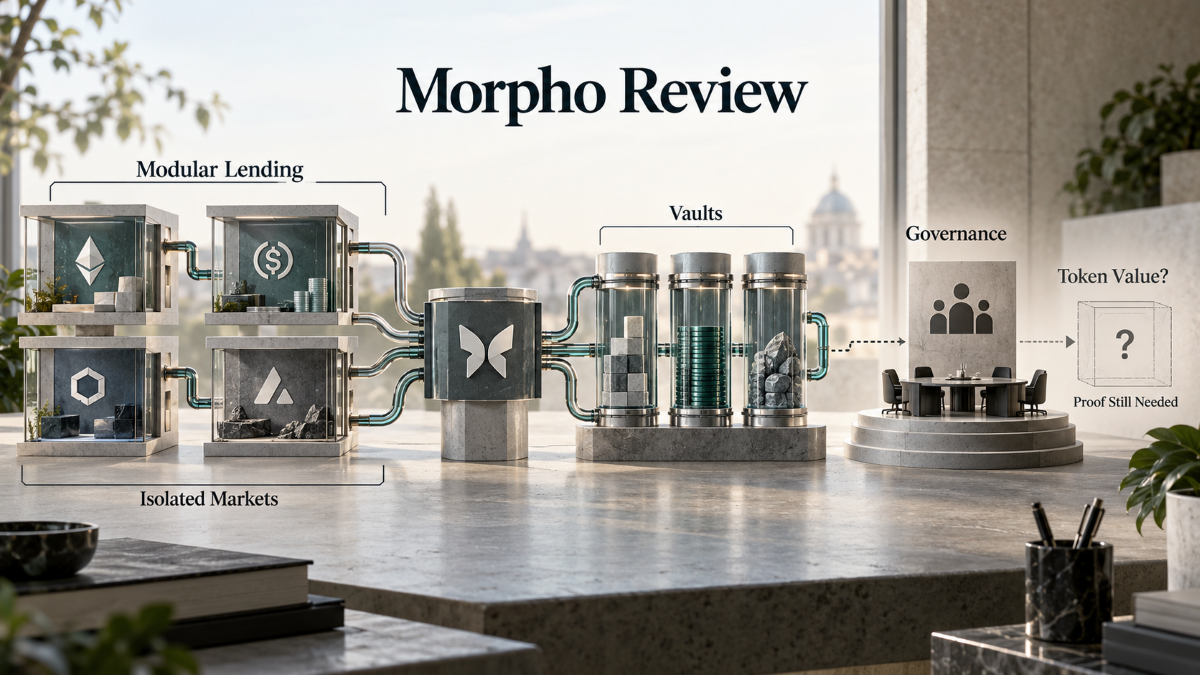
Morpho CRYPTO review showing technical lending data charts on Cryptosmedia website

Lending models often fall apart like glass houses during a market storm. I sat with my coffee on May 13 2026 and looked at the charts after the Kelp DAO exploit. I spent hours going through the raw data because i wanted to find out which protocols survived. You know how it feels when the market bleeds, brother. It is a time of panic and lost hopes. But then i saw something that changed my perspective. Morpho only lost 1 million while others lost everything. I looked closer at their isolated vaults to understand why they stayed standing. This Morpho review tells the technical truth of that survival and what it means for your money today. The Morpho (MORPHO) Review YMYL Safety Check This is not financial advice. You are the only person responsible for your money, and i am here to give you the data to protect it. Paul Frambot and Merlin Egalite lead the project team. They raised 69 million from big names like a16z Crypto and Coinbase Ventures. A public team helps build trust, and it reminds me of the transparency i saw in my Peaq Network review earlier. They have 25 audits, but audits do not protect you from every danger. A white hat operator stopped a 2.6 million frontend exploit in April 2025. The security score on Token Sniffer shows a very low 30 out of 100. This is the reality we must face today. The Problem With Shared Risk The main issue in finance today is that everything connects in a bad way. If one asset fails, the whole system can go down with it. This was the exact story during the Kelp DAO hack. Morpho fixes this by keeping the risk in its own box. If something goes wrong in one vault, the damage does not spread to other users. We need this kind of flexibility in our technical plumbing. I mentioned a similar need for solid foundations in my Grass crypto review recently. Now big money looks at this as a way to stay safe in the long run. How The Vault Architecture Works Think of old lending like a big public pool. If one person ruins the water, everyone has to leave. Morpho is different because it works like a gym with thousands of private pools. They call these Morpho Vaults. If one pool gets dirty, every other pool stays clean and safe. People set their own rules in these small pools and they do not affect anyone else. This design gives a sense of safety to big players who fear a total collapse. They want a path that stays functional and real. Morpho vs Aave: The Competitive Matrix Core Metric Morpho (MORPHO) Reality Aave (AAVE) Reality Risk Architecture Isolated private vaults Shared public pools Capital Efficiency High via peer to peer matching Standard pool rates Smart Contract Control Proxy active (Devs hold power) Highly decentralized Network Momentum Taking over Base network Rules Ethereum mainnet Interest Rate Model Market driven in upcoming V2 Governance controlled The Strong Points The most solid fact in this Morpho review is the direct support from big institutions. Coinbase uses Morpho as the engine for their new lending features. The buy plan from Apollo Global marks one of the biggest moves we have seen lately. They also develop a new version for 2026 that will use market rates to bring in more money. This reminds me of the hardware growth i tracked in my Aethir crypto review work. If you want a path that stays built for the long term, this technology shows a real way forward. Tokenomics Data And Reality Numbers are the only thing that do not lie to us. The current supply moving in the market is 489,269,139.16 MORPHO. The total supply reaches 1,000,000,000 MORPHO. This means the team will release more tokens soon, and that can change the price. Right now the value sits around 1.14 billion if we count all tokens. One good thing is that the top 10 people only hold 18 percent of the supply. Also, Apollo Global plans to buy 90 million tokens over the next 48 months. This long timeline shows they have real hope for the future. You can check the rest of the data on the official Morpho documentation site. The Real Dangers I will not hide the truth from you, brother. Final Expert Verdict For This Morpho Review Morpho is not just another lending protocol playing with fire. Their isolated vault system is a true mechanical upgrade for the market. I watched them survive the Kelp DAO collapse while older systems broke down completely. That kind of resilience is exactly what heavy institutional money demands right now. But the proxy contract issue is a massive wall in front of true decentralization. The developers still hold the master keys to the plumbing, and the upcoming token unlocks will heavily test the market’s patience. If you are building a long term infrastructure portfolio, their tech is clearly leading the race today. Just remember that no system is truly safe until the creators walk away and give up control. Make your moves based on math because i want you to survive the next cycle, brother. Keep this Morpho review bookmarked for the next unlock phase. Zahid Hussaincryptosmedia.com