

Evidence from Hyperliquid’s architecture, usage, token economics and incident record supports a clear conclusion: the network is a functioning crypto market rather than a project sustained only by promises. Findings in this Hyperliquid Review also show that it operates a fast, non-custodial trading venue on its own blockchain, records activity onchain and generates material fee revenue.
HYPE also has clearer links to network activity than many governance tokens. It supports staking, network fees and several platform functions. Protocol revenue also feeds an automated token-purchase and burn mechanism.
However, the evidence does not support calling the system fully trustless or the token low-risk. A relatively small validator set secures a complex derivatives engine. The JELLY intervention showed that validators can coordinate decisions with major financial consequences. Large token allocations also remain outside circulating supply.
My verdict is cautiously positive. Hyperliquid has delivered real usage and strong product execution. However, its speed partly depends on concentrated coordination. That combination makes the network credible and commercially significant while leaving serious questions about decentralization, emergency control and future dilution.
What Hyperliquid Actually Is
Hyperliquid is a Layer-1 blockchain built around perpetual futures, spot markets and related financial applications. Its network state has two main components: HyperCore and HyperEVM.
HyperCore runs the native order books, margin system, liquidations, staking and spot assets. This places important trading functions directly within the network rather than inside a separate application contract.
HyperEVM provides an Ethereum-compatible environment for smart contracts. Developers can use familiar Solidity tools while connecting applications to the same broader financial ecosystem.
Both environments inherit consensus from HyperBFT, the network’s delegated proof-of-stake system. The project’s official technical overview reports capacity of roughly 200,000 orders per second and a block time of about 0.07 seconds.
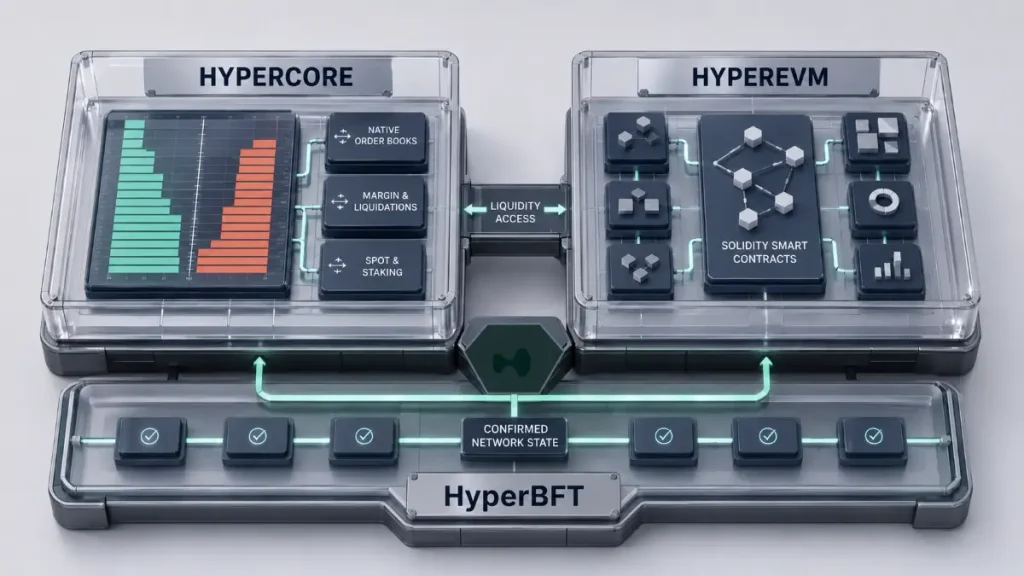
These are project-reported system capabilities. They should not be presented as guaranteed performance for every trader during congestion, extreme volatility or infrastructure failure.
This design differs from an exchange deployed entirely through smart contracts on Ethereum or an existing rollup. Trading logic sits closer to consensus, which can reduce execution overhead. It also gives validators greater responsibility for the operation of the financial system.
Non-Custodial Does Not Mean Risk-Free
Users do not deposit their assets with a conventional centralized-exchange operator. Orders, trades, funding and liquidations are recorded onchain. Users also retain wallet-based control over withdrawals.
This removes some custody and balance-sheet risks associated with opaque exchanges. It does not remove technical, market or governance risk.
Traders still depend on the chain, validator consensus, oracle inputs, market parameters, bridge infrastructure and liquidation rules. They also depend on the security of their wallets and the interfaces used to access the network.
Leverage adds another layer of danger. A relatively small price movement can trigger a forced liquidation when a position carries heavy leverage. Fast execution cannot protect a trader from an unsuitable position size.
Collateral dependence matters as well. USDC supports much of the trading and settlement activity. Readers can examine its reserve, issuer and contract risks in our Circle stablecoin review.
A non-custodial design changes the risk map. It does not eliminate the map.
Where the Product Has Earned Credibility
The strongest case for the network is not a future roadmap. It is an operating market with visible activity.
The platform supports perpetual and spot trading across crypto assets and several real-world reference markets. Developers can deploy contracts on HyperEVM. Builders can also connect applications to existing liquidity through supported integration routes.
Usage is substantial. DefiLlama data viewed on 25 August 2026 showed approximately $210.2 billion in 30-day perpetual volume. It also recorded about $59.21 million in 30-day fees and $6.66 billion in combined value locked.
These figures are volatile and depend on the provider’s methodology. Their scale still shows that the network is active and processing meaningful financial activity.
The development model is also unusual. Hyperliquid Labs says it was self-funded and did not take outside investment. The HYPE genesis distribution did not include a conventional allocation for private investors, centralized exchanges or market makers.
That decision reduced one familiar source of early selling pressure. It did not remove insider concentration entirely. Core contributors still received a substantial allocation that vests over time.
The distinction matters. A project can avoid venture-capital funding while still carrying contributor unlocks, foundation-controlled allocations and future emissions.
Revenue Creates a Real Token Link
HYPE is not limited to voting. It secures the chain through staking and pays gas on HyperEVM. Staked HYPE can qualify traders for fee discounts. The token also supports some asset-deployment functions.
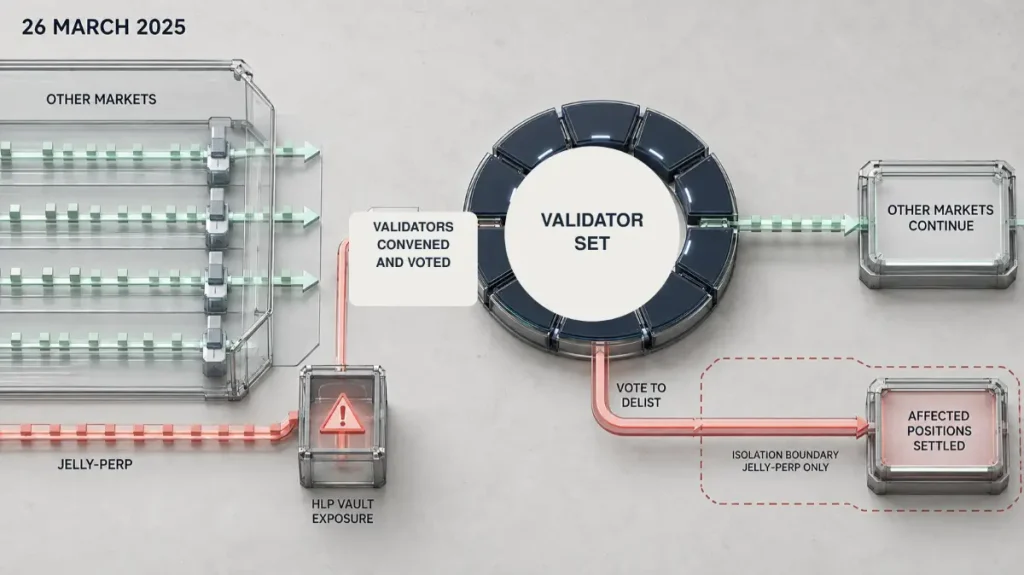
The project currently states that 99% of protocol revenue is directed to the Assistance Fund. That mechanism automatically uses available revenue to purchase HYPE. Tokens reaching the fund are burned under the current protocol rules.
This creates a measurable connection between network activity and the token. It is stronger than a model in which fees reach only a company treasury while the token has no economic role.
However, several limits remain.
Trading volume is not the same as protocol revenue. Gross fees are not the same as the final amount available for token purchases. Revenue can also decline when trading activity falls.
The mechanism remains governed by protocol rules. Those rules may change through future network decisions. Investors should therefore treat the current burn route as an operating mechanism, not a permanent guarantee.
Buy-and-burn activity may offset part of future issuance. It cannot guarantee price appreciation. Market value still depends on demand, circulating supply, staking participation, trading conditions and the value assigned to future network activity.
HYPE Tokenomics: Strong Launch, Long Overhang
HYPE launched with a maximum supply ceiling of one billion tokens. Its genesis distribution gave 31% to eligible users. Another 38.888% was reserved for future emissions and community rewards.
Core contributors received 23.8%. The remaining allocation went mainly to the Hyper Foundation, community grants and HIP-2 liquidity.
| Tokenomics item | Verified position | Why it matters |
|---|---|---|
| Maximum supply | 1,000,000,000 HYPE | Establishes the stated supply ceiling under current protocol rules. |
| Total supply | About 955.31 million on 25 August 2026 | Sits below the original maximum following burns and supply adjustments. |
| Circulating estimate | About 222.45 million on 25 August 2026 | Shows that a large portion of the total supply was not classified as circulating. |
| Genesis distribution | 31.0% | Gave eligible users a large share of the initial distribution. |
| Future emissions and community rewards | 38.888% | Represents the largest allocation and an important long-term dilution variable. |
| Core contributors | 23.8% | Creates recurring vesting pressure and a potential source of concentration. |
| Foundation, grants and HIP-2 | 6.312% combined | Supports development and liquidity but remains governed allocation. |
| Current value-capture route | Staking, gas, fee discounts, deployment demand and Assistance Fund burns | Allows network activity to reach HYPE while competing with unlocks and changing demand. |
Why the Supply Overhang Still Matters
The main economic question is not simply whether supply has a maximum. The more important issue is how quickly non-circulating allocations enter the market.
Core-contributor tokens were subject to an initial lock, followed by vesting over several years. Future community emissions do not follow one simple monthly calendar. Provider classifications may also differ when calculating circulating supply.
For that reason, one monthly unlock cannot describe the entire supply position. A small release in one period does not remove the remaining allocation.
Readers should examine circulating supply, contributor wallets, future emissions and Assistance Fund burns together. Governance changes may also alter how these mechanisms operate.
The strongest token case would require network-linked demand to absorb new supply over time. High activity helps that argument. It does not settle it.
Validator Concentration Is the Central Trade-Off
As checked on 25 August 2026, HyperBFT selected 27 active validators through delegated stake. More than two-thirds of stake must approve a block.
A seven-day unstaking queue applies when assets move from the staking account back to the spot account. This delay makes it harder to assemble and rapidly withdraw stake around a consensus attack.
The queue does not stop traders from withdrawing ordinary trading balances. It should not be described as protection against general capital flight. Its purpose relates specifically to staking and consensus security.
Twenty-seven active validators represent a relatively small operating set compared with mature general-purpose networks. Validator count alone also does not measure decentralization.
Stake distribution is equally important. If a few validators or related entities control a large share of delegated stake, the practical decision-making base may be narrower than the headline count suggests.
A small group can coordinate quickly during technical or market stress. That speed may protect system continuity. It can also reduce credible neutrality when the same group can influence listings, emergency responses and consensus outcomes.
This speed-versus-control tension resembles concerns examined in our BNB network review. The two networks use different architectures, but both show why performance and decentralization must be tested separately.
What the JELLY Intervention Revealed
On 26 March 2025, suspicious trading in the illiquid JELLY perpetual market created dangerous exposure for the Hyperliquidity Provider vault.
Hyperliquid stated that the validator set convened and voted to delist JELLY perpetuals. Affected positions were then settled through an emergency response. The Foundation said users other than flagged addresses would be made whole following the intervention.
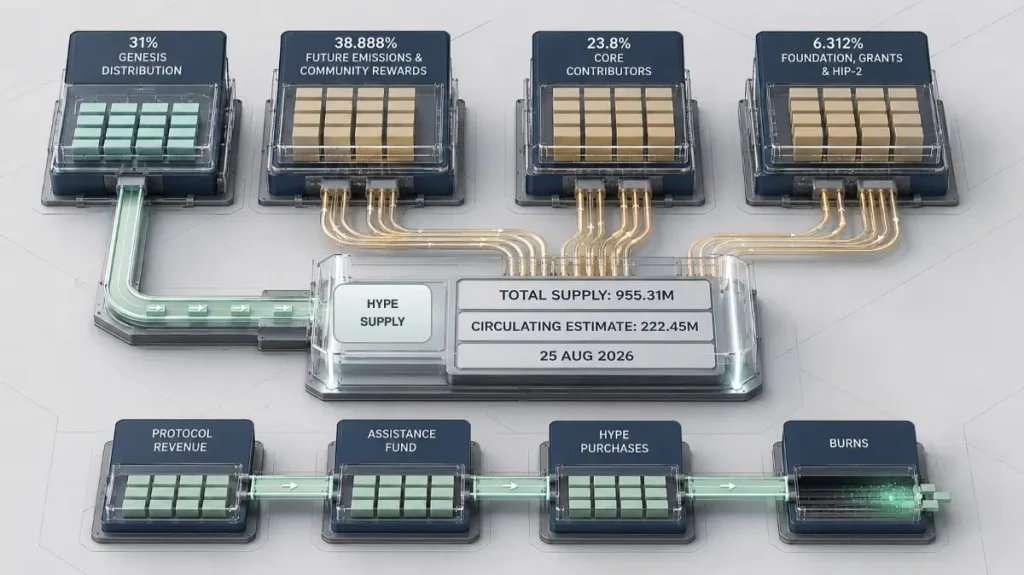
The response demonstrated that validators could coordinate quickly during a market emergency. It also showed that they could make a market-level decision with significant financial consequences.
Those two conclusions should be considered together.
The event is not evidence that the project is fraudulent. It is also not evidence of complete decentralization. It is evidence of the authority held by validators within the operating model.
Some users may value the ability to respond quickly to abnormal market activity. Others may view intervention as a departure from strict, automatic execution. The incident makes that governance trade-off visible.
Security Evidence Has Clear Boundaries
The official audit record includes a Zellic review of the legacy bridge contract. That provides useful evidence for the code and conditions covered by that review.
It does not prove that every part of HyperCore, HyperEVM, validator software, market parameters, liquidation logic, oracle infrastructure and front-end deployment received the same examination.
Audit scope matters more than an audit badge. A review can reduce uncertainty around specific components without guaranteeing the security of the complete production system.
Third-party security scores should be treated with the same caution. Such scores may combine audits, monitoring, bug bounties and other signals. They cannot prove that a network is safe from every future attack.
The Foundation also supports a bug bounty. That can improve vulnerability discovery and responsible reporting. It cannot eliminate implementation, oracle, bridge, liquidation or governance risk.
Readers should therefore ask three separate questions:
- Which component was reviewed?
- Which code version was included?
- Does the reviewed version match the system currently in production?
Hyperliquid Versus Other Perpetual DEX Models
Hyperliquid is best compared with other onchain derivatives systems. Prediction markets and unrelated Layer-1 tokens do not provide a useful direct comparison.
The central question is how each venue combines execution, consensus and liquidity.
| Feature | Hyperliquid | dYdX Chain | GMX |
|---|---|---|---|
| Primary design | Native onchain order books plus HyperEVM | Cosmos app-chain with validator-maintained order books | Oracle-priced perpetual markets backed by liquidity pools |
| Execution environment | Dedicated HyperCore state secured by HyperBFT | Dedicated proof-of-stake chain using CometBFT | Smart contracts across supported networks |
| Liquidity source | Order-book market makers and HLP strategies | Order-book market makers | GM and GLV liquidity providers |
| Native-token role | Staking, governance, gas, discounts, deployments and burn route | Staking, governance and chain functions | Governance and protocol incentives |
| Main strength | Integrated high-throughput trading with substantial usage | Open-source app-chain model with distributed order-book operation | Multi-chain access without relying on a traditional order book |
| Main limitation | Small active validator set and concentrated emergency authority | Short-term order data includes offchain propagation dependencies | Oracle and pool exposure can shift risk toward liquidity providers |
The comparison does not produce one automatic winner.
Hyperliquid prioritizes tightly integrated execution and speed. dYdX uses a separate app-chain model. GMX relies more heavily on oracle-priced markets and liquidity pools.
Each design moves risk to a different place. Order books depend on market makers and execution infrastructure. Pool-based markets expose liquidity providers to inventory and trader-profit risk. App-chains depend on their validator and networking models.
Another direct competitor is examined in our Aster review. Readers interested in a different derivatives design can also compare the architecture and token risks in our Synthetix review.
No model removes the need to understand collateral, liquidation, liquidity and governance.
Who Built Hyperliquid?
Hyperliquid Labs is led by co-founder Jeff Yan and the pseudonymous co-founder known as iliensinc. Official project material describes them as Harvard classmates.
The project says it was developed without conventional outside investment. That supports its claim of avoiding direct venture-capital influence during the initial distribution.
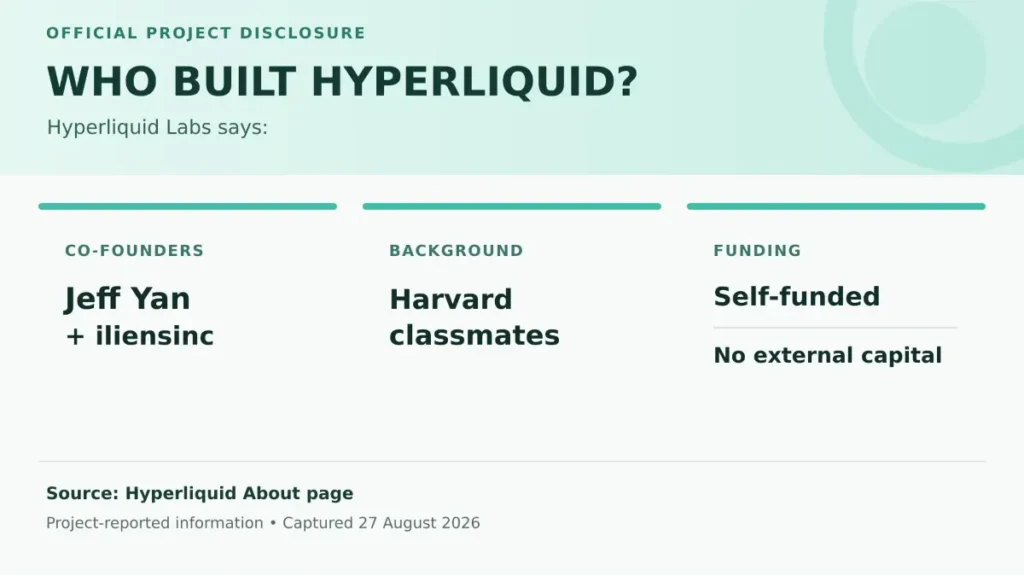
Pseudonymity still matters when a system manages high-value financial infrastructure. Users may reasonably expect clear operational disclosures, governance procedures and accountability during emergencies.
The correct conclusion is not that pseudonymity proves dishonesty. It is that limited public identity creates an additional transparency consideration.
Hyperliquid Review: Final Verdict
This Hyperliquid Review finds one of the stronger examples of a crypto product building genuine usage before relying on a broad future narrative.
Its order books operate at meaningful scale. The network processes substantial financial activity. Developers can access its liquidity and deploy applications through HyperEVM. HYPE also has several functional and economic roles.
The unresolved issue is how much trust remains concentrated within the system.
Twenty-seven active validators secure a complex trading stack. The JELLY response demonstrated both the benefit and cost of rapid coordination. The audit evidence remains narrower than the full production environment.
Token supply creates another pressure point. Contributor vesting and future community emissions can expand circulating supply. Revenue-funded purchases and burns work in the opposite direction.
Neither side should be considered alone.
My final position is cautiously constructive. The network is rising on real product evidence, but decentralization remains incomplete and the token case is not risk-free.
Usage, technical speed and revenue-linked burns deserve credit. Validator concentration, liquidation design, audit scope and future dilution deserve equal weight.
Frequently Asked Questions About Hyperliquid
No. Trading and settlement occur on the Hyperliquid blockchain, and users retain wallet-based control over their assets. However, the relatively small active validator set means decentralization and emergency governance remain material concerns.
HYPE supports staking, governance, HyperEVM gas, trading-fee discounts and certain asset-deployment functions. Under current rules, protocol revenue also supports automated HYPE purchases and burns through the Assistance Fund.
The project reports capacity of roughly 200,000 orders per second and a block time of approximately 0.07 seconds. This should be described as a project-reported system capability, not guaranteed performance for every user.
The main economic risk is the gap between circulating and maximum supply. Contributor vesting and future community emissions can add supply even while network revenue funds token purchases and burns.
No public audit should be interpreted that broadly. The official record includes a Zellic review of the legacy bridge contract. That scope does not certify every live component, market parameter or later deployment.

Founder & Managing Editor of CryptosMedia. Zahid Hussain leads evidence-based crypto research covering tokenomics, security, governance, adoption, and risk.
CryptosMedia separates verified facts from interpretation, avoids buy/sell recommendations, and updates reviews when major evidence changes.
6 thoughts on “Hyperliquid Review: Fast Markets, Concentrated Risk”