

Hivemapper has moved beyond the stage where its main challenge was proving that a decentralized network could collect useful street-level data. Contributors operate purpose-built cameras on real vehicles, customers use network data, and the project has expanded its model toward developer-requested sensor and edge-compute workloads.
That progress makes the economic question more important, not less.
HONEY sits directly inside the network economy. Customers who consume network products use Map Credits, and creating those credits requires HONEY burns. Contributors receive HONEY for useful work. The protocol therefore has a clearer connection between product activity and its native token than many crypto projects.
Yet direct utility does not guarantee durable value capture.
Hivemapper continues to issue contributor rewards while customer consumption removes part of the HONEY used for network access. Its 2026 architecture also broadens the product from mapping toward a marketplace of sensors and compute, but public disclosure does not yet make the commercial scale of every new workload easy to measure.
This Hivemapper Review therefore focuses on one central question: can recurring customer demand create enough permanent HONEY burn pressure to remain economically meaningful after contributor rewards and other token distribution are included?
This article is for research and education only and does not provide financial, investment, tax, or legal advice.
Hivemapper Is No Longer Just a Crowdsourced Map
Hivemapper began with a straightforward DePIN model. Drivers install compatible cameras, collect street-level imagery during normal travel, and contribute useful observations to a shared network.
The physical infrastructure matters because contributors do not simply provide blockchain transactions. They operate real devices, travel real roads, and generate geographic data that mapping applications can use.
That original model still operates, but the network has changed materially.
Hivemapper updated its network terms on May 5, 2026 to describe the network as a marketplace of sensors and compute. Contributor devices can now fulfill developer Work Orders that request specific data or computational workloads. Hivemapper operates the protocol, validates fulfillment, and distributes rewards, while Work Order outputs can travel directly from contributor devices to the commissioning developer.
This shift expands the economic opportunity beyond selling existing map imagery. A developer can potentially request geographic observations or run supported workloads where the physical network already has coverage.
The same economic principle appears across decentralized compute markets. Infrastructure supply matters, but sustainable economics depend on whether customers repeatedly pay to use that supply.
Work Orders Make Customer Intent More Direct
Traditional map production collects data first and looks for buyers later. Work Orders can reverse part of that sequence.
A developer can specify a workload and geographic requirement, then participating devices can perform the requested work. The current terms state that developers pay for network access using Map Credits acquired through HONEY burns.
That model matters because developer-requested work can provide stronger evidence of demand than collecting additional data simply because contributor rewards encourage it.
Still, a mechanism is not the same as commercial scale.
Public materials explain how Work Orders function, but they do not provide one complete audited dashboard showing total Work Order spending, repeat paying developers, HONEY burned through those workloads, and contributor compensation linked specifically to customer-funded Work Orders.
Hivemapper has therefore improved the path from customer intent to network work. The next test is measuring how large and repeatable that path becomes.
The Bee Expands the Physical Network Into Edge Compute
Hardware remains a critical part of Hivemapper because software cannot observe changing roads without access to physical-world sensors.
The current device lineup centers on Bee hardware. Official device documentation lists LTE plus Wi-Fi and Wi-Fi-only Bee models, while the earlier Hivemapper Dashcam and Dashcam S models have been discontinued.
Bee also provides more than basic image capture. Hivemapper’s public development work includes sensor processing and plugins for real-time mapping and edge AI. That creates the technical foundation for devices to do more processing close to where data originates rather than sending every task to centralized infrastructure.
Edge capability does not automatically create paid demand, but it expands what the network can sell.

A mapping camera may serve one primary data market. A programmable sensor and compute device can potentially support map updates, object detection, geographic observations, fleet intelligence, model outputs, and other workloads that depend on location.
A similar distinction matters in distributed GPU infrastructure. Technical capacity creates opportunity, while repeat customer-funded execution determines whether that opportunity becomes durable economic activity.
There Is Evidence of Real Commercial Use
Hivemapper has more than supply-side participation. Commercial organizations use products built around its mapping and physical data ecosystem.
Bee Maps, the commercial business associated with Hivemapper Inc., currently lists organizations including HERE Technologies, Lyft, Mapbox, Volkswagen, and others among customers or trusted users of its products on its company overview. It also describes use cases across mapmaking, fleet operations, autonomous vehicle development, and AI training.
Those relationships provide useful evidence that physical data from this ecosystem can solve real commercial problems.
They need careful interpretation.
A Bee Maps customer relationship does not automatically reveal how many Map Credits the customer consumes, how much HONEY the underlying activity burns, or what share of Bee Maps revenue ultimately reaches the decentralized network.
Commercial adoption and token value capture remain separate questions.
That distinction is especially important because Bee Maps can build software, fleet products, APIs, and other services around physical data. Revenue at the company level would not automatically equal revenue for HONEY holders even when the underlying network contributes valuable data.
Real Infrastructure Still Does Not Equal Paying Demand
Contributor activity proves that the network can collect physical data.
It does not prove that customers pay for every kilometer, image, observation, or computational result that contributors generate.
Hivemapper’s reward design tries to improve this relationship by directing contributors toward coverage, freshness, quality, and useful geographic areas instead of rewarding raw collection without limits.
Even so, analysts should separate three measurements:
customer demand, contributor activity, and HONEY issuance.
Each can grow while the others move differently.
| Evidence | Current Position | Why It Matters |
|---|---|---|
| Physical network | Contributors operate real road-facing devices | Confirms real-world infrastructure |
| Bee hardware | Current LTE and Wi-Fi models support the network | Provides modern sensor infrastructure |
| Commercial ecosystem | Bee Maps lists major mapping and mobility customers | Supports evidence of real business use |
| Map Credits | Customers use them for network consumption | Connects product demand with HONEY |
| Work Orders | Developers can commission sensor and compute work | Expands the demand surface |
| Direct data flow | Work Order outputs can move from devices to developers | Supports a marketplace model |
| Main evidence gap | No unified public breakdown of Work Order economics | Limits measurement of new demand scale |
The network has passed the basic product-existence test. The harder issue is determining how efficiently commercial activity translates into sustained HONEY demand.
HONEY Has a Direct Network Function
HONEY operates on Solana and coordinates economic incentives between contributors and network consumers.
The official HONEY documentation says contributors can receive HONEY for useful network work, while enterprises and developers consume network data through an economy that requires HONEY. The same documentation publishes relevant Solana program addresses and establishes a maximum supply of 10 billion HONEY.
That gives HONEY a real product role.
This does not mean every useful action creates equal token demand.
Contributors represent the supply side of the marketplace. Customers represent the demand side. HONEY links those groups, but the network can still distribute more tokens to contributors than customer activity permanently removes during a particular period.
That issue appears across DePIN token economics. Real machines and real users improve the product case, but token value capture still depends on the economic route between activity and the native asset.
Map Credits Turn Customer Spending Into HONEY Demand
Map Credits provide the clearest product-to-token connection in Hivemapper.
According to the official burn-and-mint documentation, users generate Map Credits by burning HONEY. Each Map Credit carries a fixed value of $0.0075, which keeps wholesale network pricing denominated in dollars rather than allowing HONEY price volatility to directly change the customer’s unit cost.
This creates genuine HONEY demand, but the number of tokens required changes with HONEY’s market price.
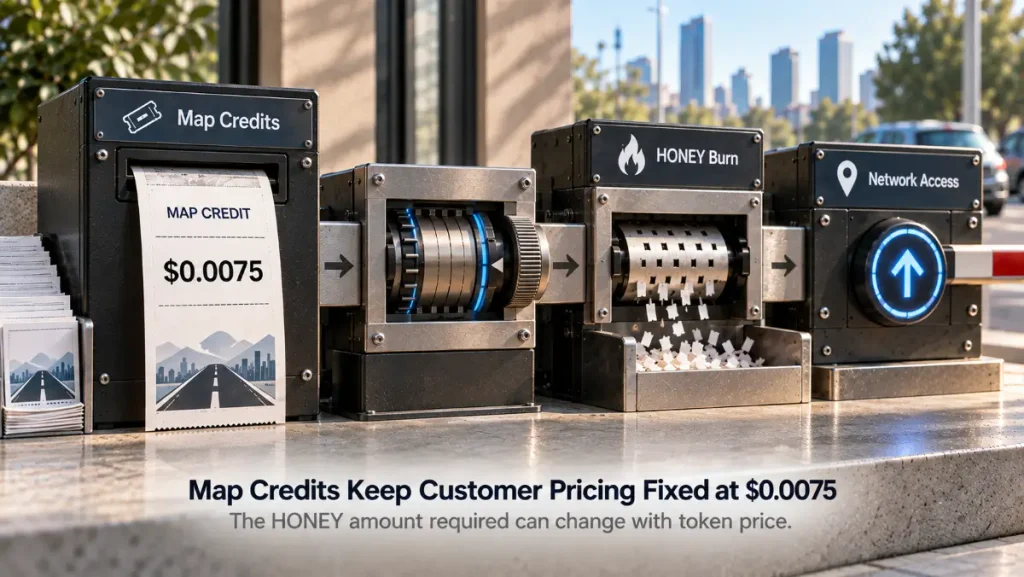
If a customer needs the same dollar value of Map Credits while HONEY trades at a higher dollar price, the system requires fewer HONEY tokens. A lower token price requires more HONEY for the same amount of dollar-denominated network consumption.
Product demand therefore creates an economic route through HONEY without creating a fixed quantity of token demand per unit of service.
That distinction also matters in decentralized data infrastructure, where real product usage can depend on a native token even though dollar-based pricing changes the number of tokens required for a fixed service cost.
Fiat Access Does Not Remove the HONEY Mechanism
Crypto-native payment is not the only possible customer path.
Hivemapper’s burn-and-mint documentation explains that some customers prefer fiat. Under the documented framework, fiat-funded paid use still creates an obligation to acquire the corresponding HONEY and burn it for Map Credits rather than treating fiat payment as a way to bypass the token economy.
That is economically important.
Payment abstraction can make a crypto product easier to use without necessarily weakening token demand when the settlement process still requires market-acquired HONEY.
The meaningful metric is therefore not whether the customer personally holds a crypto wallet. It is whether paid network consumption ultimately causes HONEY acquisition and burn activity.
The 75 Percent Burn Creates Real Value Capture
Hivemapper’s burn mechanism is stronger than a system that simply recycles every token paid by customers.
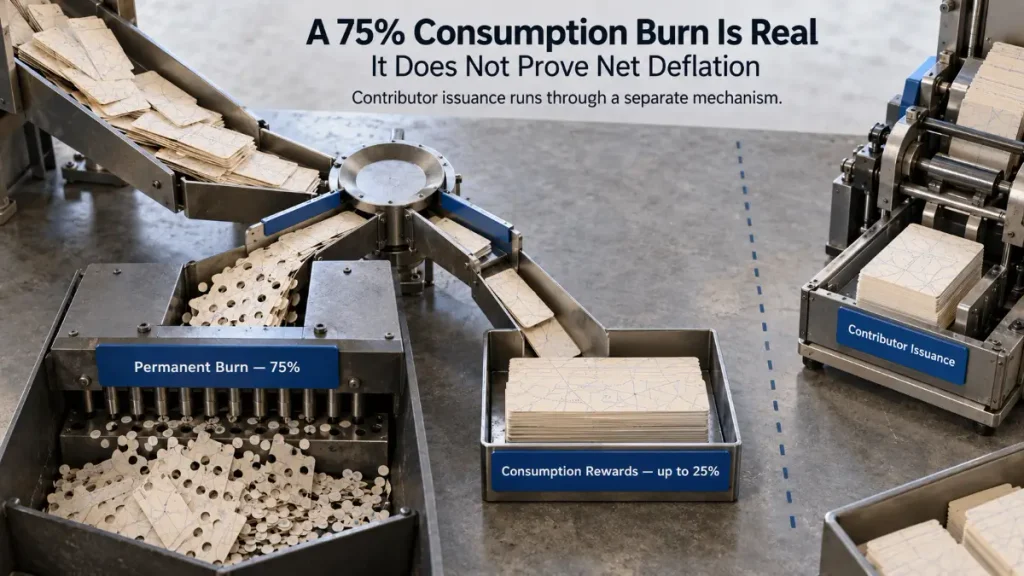
Under the current model, the protocol permanently removes 75% of HONEY associated with Map Credit consumption. It re-mints the remaining 25% as Map Consumption Rewards for contributors, subject to a weekly ceiling of 500,000 HONEY. Any qualifying amount above that ceiling remains permanently removed.
This creates a genuine net burn within each qualifying consumption transaction.
For example, if network consumption causes 1 million HONEY to enter the burn-and-mint process, the mechanism does not simply return the full 1 million to contributors. Under the current rules, only the permitted consumption-reward portion can return.
That is real value capture.
It still does not prove net deflation for the entire HONEY supply.
Hivemapper has another issuance mechanism that distributes contributor rewards as the map progresses. Analysts therefore need to compare permanent consumption burns against all relevant new issuance, not just against the 25% consumption reward.
Contributor Minting Is the Other Side of the Equation
Hivemapper originally allocated 4 billion HONEY, equal to 40% of maximum supply, to contributors.
Its Global Map Progress system determines the pace at which that contributor allocation enters circulation. Weekly rewards depend on network progress rather than a simple fixed emission schedule.
Coverage, activity, and resilience influence regional progress. This structure tries to reward useful development of the network instead of distributing a fixed number of tokens regardless of whether the map improves.
The logic is sensible, but the economic consequence remains important.
Customer consumption can permanently remove HONEY while Global Map Progress can introduce additional contributor HONEY into circulation. Both flows can occur simultaneously.
The key equation is therefore broader than burn volume alone:
customer-funded permanent burns versus new HONEY entering circulation
A project can report rising burns while total circulating supply still expands if issuance remains larger.
Reward Design Tries to Avoid Wasteful Mapping
Hivemapper also adjusts individual incentives according to factors such as coverage and freshness.
Frequently covered areas can become less attractive for additional rewards, while stale or under-covered locations regain incentive value. Official documentation describes map saturation as a dynamic mechanism that shifts rewards toward data the network considers more useful.
This improves capital efficiency at the contributor layer because the protocol does not need to reward every repeated drive equally.
It cannot solve the demand problem by itself.
More efficient rewards reduce unnecessary supply-side spending. Sustainable token economics still require customers to consume enough network products to create meaningful burn activity.
HONEY Tokenomics Need Both Supply and Demand Analysis
Hivemapper publishes a maximum HONEY supply of 10 billion.
The allocation alone does not reveal current selling pressure.
Investor and employee vesting schedules describe when tokens could become transferable. They do not prove that recipients sold those tokens. Contributor allocation also follows a separate progress-based issuance process.
Current circulating supply requires extra care.
Market trackers did not report exactly the same current figure on September 18, 2026. CoinGecko displayed roughly 6.55 billion HONEY as circulating, while CoinMarketCap reported about 6.11 billion. That disagreement makes a dated live market source more appropriate than presenting one changing number as permanent fact.
| Tokenomics Item | Current Position | Why It Matters |
|---|---|---|
| Token | HONEY on Solana | Native network economic asset |
| Maximum supply | 10B HONEY | Defines the published ceiling |
| Contributors | 40% | Funds long-term network work |
| Investors | 20% | Significant original allocation |
| Employees | 20% | Significant original team allocation |
| Hivemapper Inc. | 15% | Supports research and operations |
| Hivemapper Foundation | 5% | Supports network management |
| Map Credit price | $0.0075 | Gives customers dollar-based pricing |
| Consumption mechanism | Protocol permanently burns 75% | Creates direct supply reduction |
| Consumption rewards | Protocol can re-mint 25%, capped weekly | Returns part of consumption value to contributors |
| Contributor issuance | Global Map Progress controls the 4B pool | Adds HONEY as useful map progress occurs |
| Circulating supply | Use dated live data | Tracker methodologies currently differ |
| Main token test | Permanent burns versus new issuance | Tests durable HONEY value capture |
This structure makes HONEY more analytically interesting than a token with no measurable product connection.
It also prevents a simplistic conclusion.
A 75% consumption burn does not mean HONEY supply falls by 75% of all network rewards. The permanent burn applies to the relevant customer-consumption flow, while contributor issuance operates through separate reward mechanics.
Work Orders Could Expand the Demand Side
The 2026 Work Order architecture may become the most important development in HONEY economics.
Mapping data has a defined customer base, but a distributed sensor network with local compute can address a wider range of physical-world tasks. Developers can potentially request observations, sensor outputs, or edge computation in areas where participating devices operate.
Current network terms require developers to pay for network access with Map Credits. That creates a direct HONEY route for Work Order demand rather than introducing a completely separate economic system.
The economic potential is therefore clear.
What remains uncertain is scale.
Public reporting does not yet provide one standardized set of figures for Work Order spending, unique paying developers, repeat workloads, developer retention, HONEY burned specifically for Work Orders, and contributor income linked to those jobs.
This is the difference between a promising mechanism and a demonstrated economic engine.
Hivemapper does not need every developer to interact directly with HONEY for the mechanism to matter. It needs real customer spending to consistently reach the HONEY burn layer.
Security Extends Beyond the Token Programs
Hivemapper’s security surface has expanded as the network has evolved.
The system includes Solana programs, contributor wallets, device firmware, cameras, sensors, network connectivity, workload validation, developer code, data transport, APIs, and physical hardware.
Official HONEY documentation publishes several Solana program addresses, which improves transparency around onchain components. The Hivemapper organization also maintains public repositories for device software, sensors, mapping tools, and Bee edge-development components.
Those facts do not equal a full security audit.
The official sources reviewed for this article do not identify a current independent audit that covers the complete 2026 sensor, compute, data-delivery, device, and token architecture.
That scope limitation should remain explicit.
Open-source code helps independent inspection. Published program addresses help onchain verification. Neither proves that every component lacks vulnerabilities.

Physical Devices Add Different Failure Surfaces
A blockchain program cannot guarantee that every remote camera reports correct physical-world information.
Devices can face firmware bugs, connectivity failures, sensor faults, tampering, incorrect calibration, credential compromise, or malicious inputs. Hivemapper therefore needs verification at both the blockchain and physical-data layers.
Work Orders add another dimension because developers can send workloads toward distributed devices.
The network must consider workload isolation, developer permissions, data handling, device integrity, and validation alongside token security.
That architecture does not make the system inherently unsafe. It means security should be judged as a collection of different controls rather than one smart-contract label.
Work Orders Also Change the Privacy Model
Street-level sensor networks process information about physical locations, vehicles, roads, and potentially people who never directly joined the crypto network.
Privacy therefore matters to product quality.
The May 2026 terms state that Work Order outputs can flow directly from contributor devices to commissioning developers. They also place privacy and data-protection obligations on developers that use the network.
This structure can reduce Hivemapper’s role as a central custodian for Work Order data, but it does not remove privacy risk.
Responsibility moves across several parties. Device operators collect data, developers commission workloads, protocol rules validate fulfillment, and applicable laws can restrict how developers process or retain outputs.
A distributed data path still needs clear controls.
Governance Remains Foundation-Led
HONEY should not be described as a conventional token-voting governance asset.
The Hivemapper Network uses Map Improvement Proposals to introduce and evaluate major changes involving network structure, incentives, and token economics.
Official governance documentation describes the current process as notice-and-comment rulemaking. Community members can provide feedback, after which proposals can become final, change, or fail. The documentation says future governance may introduce stronger mechanisms that could include voting.
The Hivemapper Foundation currently carries substantial responsibility.
It manages ongoing token economics and issuance and plays a central role in network governance. Bee Maps, formerly Hivemapper Inc., continues to provide important technology and operational infrastructure.
This structure does not invalidate the decentralized contributor network.
It does mean that claims of direct HONEY-holder control would overstate current governance.
What Hivemapper Still Needs to Prove
Hivemapper no longer needs to prove that decentralized participants can collect useful physical-world mapping data.
The network has active hardware, real contributor activity, a commercial data ecosystem, an explicit Map Credit mechanism, and a direct HONEY burn path. Its 2026 architecture also creates a credible route toward broader sensor and edge-compute demand.
The unresolved issue is economic transparency.
A stronger public dashboard could separate permanent HONEY burns, consumption rewards, Global Map Progress issuance, Work Order demand, map-data demand, repeat paying developers, contributor payouts, and Foundation-funded incentives.
Those metrics would make the central HONEY question much easier to answer.
The most important number is not total kilometers collected.
It is also not one large customer logo or one week of HONEY burns.
The strongest proof would be sustained customer-funded consumption that continues to grow relative to the amount of new HONEY entering circulation.
Hivemapper Review Verdict
Hivemapper has built something materially harder than a token narrative.
It operates a physical contributor network, produces usable geographic data, supports commercial products, and now offers a framework for developer-commissioned sensor and edge-compute workloads.
HONEY also has genuine product utility.
Customers use Map Credits for protocol-level network consumption, and the system requires HONEY to create those credits. Current burn-and-mint rules permanently remove 75% of qualifying consumption HONEY while returning only a limited portion through Map Consumption Rewards.
That gives HONEY measurable value capture.
Global Map Progress continues to introduce contributor rewards from the 4 billion HONEY allocation. Other token distributions also affect circulating supply. A permanent burn can therefore be meaningful without making the entire token economy net deflationary.
Work Orders could strengthen the demand side because they expand what developers can purchase from the physical network. The present public evidence is much clearer on how that mechanism works than on its current commercial scale.
Hivemapper has credible physical infrastructure, real commercial use, and a direct HONEY consumption mechanism. The remaining economic test is whether recurring customer-funded burns can grow enough to remain stronger than contributor issuance and other token distribution over time.
That question matters more than token price movements or headline mapping totals.
Frequently Asked Questions
Hivemapper is a decentralized physical infrastructure network built around vehicle-mounted sensors, street-level mapping, and developer-requested sensor or edge-compute workloads. Contributors perform useful network work and can receive HONEY rewards.
HONEY is the Solana-based economic token of the Hivemapper Network. Contributors can receive HONEY for eligible work, while customers use Map Credits created through HONEY burns to consume network products.
Yes. Current burn-and-mint rules permanently remove 75% of HONEY used in qualifying Map Credit consumption. The protocol can re-mint the remaining 25% as Map Consumption Rewards, subject to a 500,000 HONEY weekly cap.
Not automatically. Hivemapper also issues contributor rewards through Global Map Progress. Analysts need to compare permanent burns with new issuance and other token distribution before describing total supply dynamics as deflationary.
Official documentation sets HONEY’s maximum supply at 10 billion tokens. The original allocation assigned 40% to contributors, 20% to investors, 20% to employees, 15% to Hivemapper Inc., and 5% to the Hivemapper Foundation.
Map Credits are non-transferable units used for protocol-level network consumption. Their current documented value is $0.0075 each, and the system requires HONEY burns to create them.
Work Orders allow developers to commission specific sensor or computational workloads from devices on the Hivemapper Network. The 2026 network terms describe this model as part of Hivemapper’s shift toward a marketplace of sensors and compute.

Founder & Managing Editor of CryptosMedia. Zahid Hussain leads evidence-based crypto research covering tokenomics, security, governance, adoption, and risk.
CryptosMedia separates verified facts from interpretation, avoids buy/sell recommendations, and updates reviews when major evidence changes.
1 thought on “Hivemapper Review: Can Map Demand Sustain HONEY Economics?”