
Crypto projects often look simple from the outside, but this GEODNET DePIN review asks the harder question. Specifically, does the token actually do something useful in the real world? GEODNET claims to solve a physical problem by building a decentralized location layer for robotics and autonomous vehicles. Therefore, by crowdsourcing roof-mounted space weather miners, the project aims to provide centimeter-level accuracy that standard GPS cannot achieve. We will look at its RTK (Real-Time Kinematic) utility, tokenomics, ecosystem growth, security signals, and main risks to separate verifiable data from the DePIN hype.
How I Checked The GEODNET DePIN Data
I reviewed this project by checking its official whitepaper, official documentation, live network console, CoinMarketCap data, and automated smart contract security scans from Token Sniffer. Since market figures are time-sensitive, i checked them only on the listed data date. However, if i found gaps in the transparency regarding smart contract permissions, i noted them as areas requiring your own verification.
What The GEODNET Network Actually Does
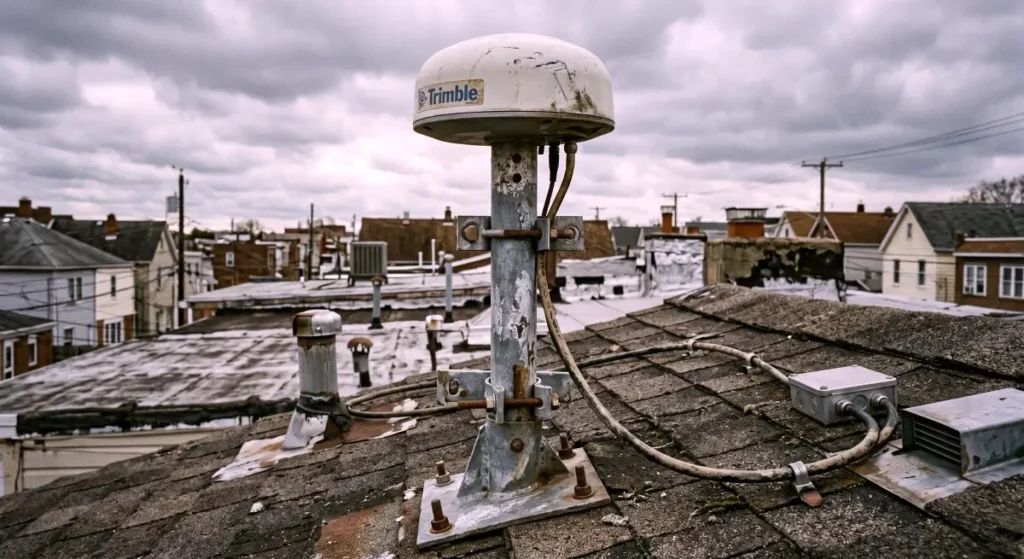
Standard GPS is often off by several meters, which is a massive problem for autonomous tractors, drones, and precision construction. Indeed, traditional companies spend millions building RTK infrastructure to fix this error margin.
GEODNET takes a decentralized approach. Specifically, users buy and mount approved GNSS (Global Navigation Satellite System) receiver antennas on their roofs. These “miners” collect space weather data and send it to the network. Meanwhile, in exchange, the operators earn GEOD tokens. The network then sells the aggregated data as a service to industries that need absolute precision. Therefore, it effectively creates a community-owned alternative to centralized CORS (Continuously Operating Reference Station) networks.
GEODNET DePIN Utility: What Is GEOD Used For?
A project’s hardware can be impressive, yet the token must have a clear role inside the ecosystem. Because of this, the available sources show that the GEOD token has three primary functions:
- Miner rewards: Users who install base stations and pass “Proof of Location” and “Proof of Accuracy” checks receive GEOD daily.
- Service payments: Enterprise users and robotics companies use GEOD to pay for GEODNET data streams and RTK services.
- Governance: Token holders can vote on GeoDAO proposals to determine network resource allocation.
The most notable utility mechanism is the network’s deflationary design. Still, according to the project’s dashboard, the protocol uses 80% of GEODNET’s data revenue to buy back and burn GEOD tokens, permanently reducing the supply as network usage grows.
GEODNET Tokenomics And Supply Structure
Tokenomics are easier to evaluate when you know exactly how many tokens exist and how many are left to enter the market. Therefore, i checked GEOD’s supply numbers on CoinMarketCap.
| Tokenomics Factor | Details | Why It Matters |
|---|---|---|
| Total supply | 976.56M GEOD | The total amount currently minted. |
| Max supply | 1 Billion GEOD | Hard cap on the maximum tokens that should ever exist. |
| Circulating supply | 438.77M GEOD (43.8%) | Less than half the supply is currently circulating. |
| Burn mechanism | 80% of data revenue | Creates a direct link between real-world network usage and token scarcity. |
| Market cap | ~$68.2M | Evaluates current market footprint (Checked May 26, 2026). |
Because less than 45% of the token supply is circulating, the project has a significant amount of future unlock and emission pressure. These emissions are necessary to reward miners and expand the network globally. However, future supply increases must be matched by real enterprise demand to absorb the inflation.
Ecosystem And Adoption Signals
Many crypto projects struggle to prove real-world adoption, yet the network has measurable hardware deployment. As of my data check, the network console reports over 21,400 active miners across 160 countries. More importantly, the project dashboard claims a Current Annual Recurring Revenue (ARR) of $10.25M. Since this separates GEODNET from many purely speculative tokens, it indicates actual enterprise customers paying for the RTK data.
GEODNET Token Security, Audits, And Smart Contract Risks
This is the most critical part of our review where readers need to pay close attention. I checked automated security scans for the GEOD token on the Solana network via Token Sniffer. While CoinMarketCap notes a CertiK rating of 4.5, the Token Sniffer audit report gave the contract a 0/100 safety score. Specifically, this automated score highlights several critical red flags:
- Mint authorization is enabled: The smart contract allows the mint authority to create new tokens. Indeed, this is a severe centralization risk, because the controller could theoretically inflate the supply beyond the stated 1 Billion max cap and dump tokens on the market.
- Holder concentration: Token Sniffer detected that a single wallet contains a substantial amount of the circulating supply. Specifically, the top 10 holders possess over 57% of the circulating token supply.
- Trading groups: The scan detected 6 distinct trading groups. Therefore, this may indicate coordinated trading or insider distribution.
I treat the enabled mint authorization as a major transparency gap. Until the project renounces the mint contract or places it under a highly secure, verified multisig timelock, this remains a significant research risk.
Governance And Centralization
The GeoDAO Foundation governs the network. While the word ‘DAO’ implies decentralization, the project’s own whitepaper admits that during its initial rollout phases, the software stack and service provider nodes were centralized and run by the Foundation. However, the project states it plans to transition operations to a fully decentralized validator node system using Proof of Stake (POS). Still, readers should verify how far along the project is in this decentralization roadmap before assuming the network is fully trustless.
Historical Market Context
I checked the historical price action to understand the token’s volatility. Specifically, on January 25, 2025, GEOD reached an all-time high of $0.3746. Prior to that, its all-time low was $0.0089 in February 2023. Meanwhile, at the time of this review, the token trades near $0.155. Past performance does not guarantee future results, yet this shows the asset carries standard cryptocurrency volatility.
Where The GEODNET DePIN Network Stands Out
The project’s clearest strength is its proven physical footprint. Since operating a network of over 21,000 active hardware nodes globally requires heavy logistical execution, it stands out. Indeed, linking 80% of actual fiat data revenue to a token buy-back and burn mechanism provides a highly transparent utility model. Therefore, it relies on enterprise adoption rather than just retail trading volume.
Main Risks And Red Flags
- Smart contract mint authority: The ability for the contract authority to mint new tokens is the most glaring risk.
- Supply dilution: Since less than 45% of the total supply is circulating, the market must absorb over 500 million future GEOD tokens.
- Hardware reliance: The network relies on individuals maintaining physical antennas with stable internet. However, if token rewards drop in value, node operators may unplug their hardware, therefore degrading the network’s data quality.
Competitor Comparison Context
| Metric | GEODNET | Traditional CORS Networks | Helium (LoRaWAN) |
|---|---|---|---|
| Main use case | Global RTK/GNSS precision | Regional survey accuracy | IoT wireless data |
| Infrastructure | Decentralized user nodes | Centralized government/corporate | Decentralized user nodes |
| Token utility | Rewards, data payments, burn | N/A (Fiat) | Rewards, data credits |
As shown in this overview, the network has scaled much faster across borders compared to traditional CORS networks. Specifically, this is due to token incentivization. However, traditional networks do not carry the smart contract risks or token volatility associated with Web3 infrastructure.
What Readers Should Verify
If this analysis has encouraged you to research further, i highly recommend checking these specific areas:
- Contract permissions: Verify on a blockchain explorer if the mint authority has been renounced or locked.
- Network console: Check the live dashboard to see if the active node count and ARR are still growing or if they have stalled.
- Circulating supply: Monitor how fast new tokens are entering the market compared to the burn rate.
This Review Is Most Useful If…
You are researching the DePIN sector and want to understand how blockchain can incentivize physical hardware networks. Indeed, it is also helpful for readers trying to separate a project’s physical tech achievements from its on-chain token contract risks.
Read This Closely If You’re Checking Market Hype
A reader checking this project for the first time may see the impressive $10M+ ARR and 21,000 nodes and assume the token is entirely safe. However, the presence of an active mint function on the smart contract and high token concentration means the underlying blockchain architecture carries significant trust assumptions.
Common Questions About The GEODNET DePIN
- What is GEODNET used for? GEODNET collects space weather data from global user-hosted antennas to provide centimeter-level GPS correction (RTK) for drones, tractors, and autonomous vehicles.
- Is GEODNET fully decentralized? The hardware network is distributed. However, the project’s governance and software stack initially launched in a highly centralized manner under the GeoDAO Foundation, with ongoing plans to transition to decentralized validators.
- Does GEODNET have a fixed supply? The stated maximum supply is 1 Billion GEOD. Still, automated audits flag that the contract’s mint authority is currently enabled, meaning this cap requires trust in the administrative keys.
- How do the token burns work? The project uses 80% of the revenue generated from selling RTK data to buy back and burn GEOD tokens from the open market.
- Does this review give investment advice? No. This review does not provide buy, sell, or hold advice. Therefore, readers should study the project’s utility, tokenomics, smart contract risks, and liquidity before making their own financial decisions.
My Final Takeaway On GEODNET DePIN
GEODNET is one of the clearer examples of DePIN execution. Specifically, it solves a verifiable problem of inaccurate GPS by financially incentivizing people to host hardware, and it has successfully generated millions in data revenue. Since the economic loop of using revenue to burn tokens makes sense on paper, it looks promising. However, the smart contract red flags, particularly the enabled mint function and heavy wallet concentration, create a sharp contrast. Indeed, it is a contrast between the project’s strong physical infrastructure and its higher-risk blockchain foundation. Until those contract permissions are secured, evaluating this GEODNET DePIN requires weighing the success of the hardware network against the trust required in the token’s administrators.

Founder & Managing Editor of CryptosMedia. Zahid Hussain leads evidence-based crypto research covering tokenomics, security, governance, adoption, and risk.
CryptosMedia separates verified facts from interpretation, avoids buy/sell recommendations, and updates reviews when major evidence changes.
1 thought on “GEODNET DePIN Review: Utility And Smart Contract Risks”