
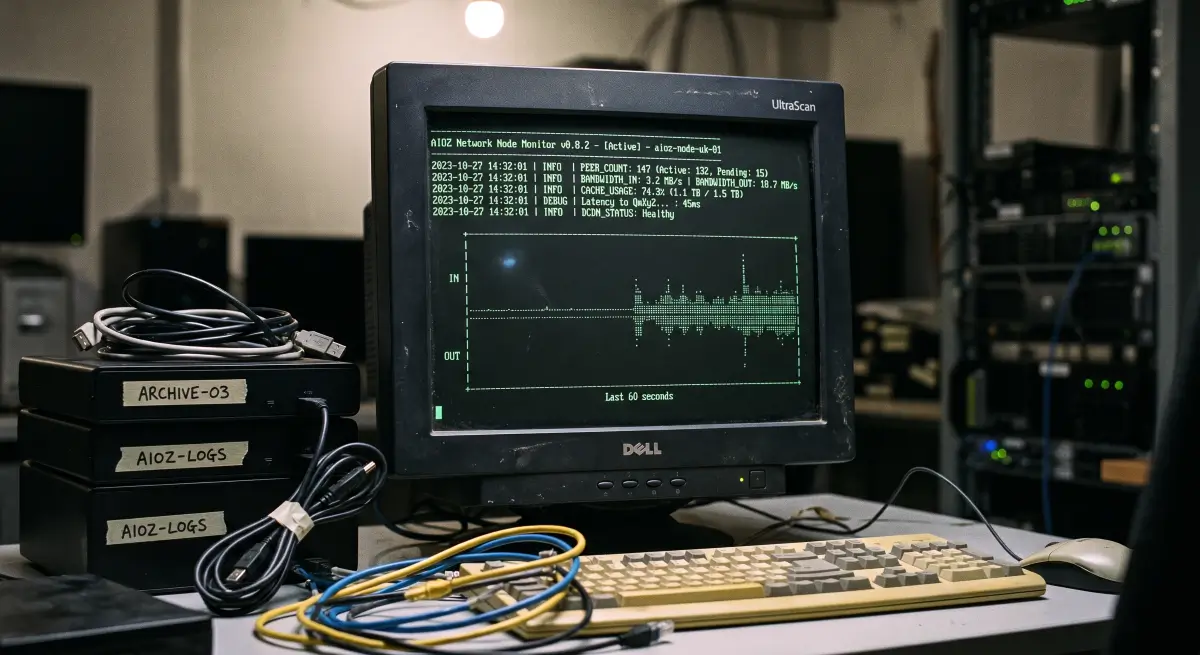
Decentralized Physical Infrastructure Networks represent a serious attempt to break the monopoly of centralized cloud providers. AIOZ Network targets this exact sector by merging artificial intelligence computation, decentralized storage, and video streaming into a single blockchain architecture. This AIOZ Network review strips away the initial market hype to audit its underlying technology, token utility, and the structural supply mechanics that dictate its long-term value.
Core Technology: What AIOZ Actually Does
Operating as a native Layer-1 blockchain, the protocol focuses on heavy online content distribution. Rather than renting server space from corporate giants like Amazon Web Services, the system relies on a global peer-to-peer network of user-operated nodes.
The architecture maintains full interoperability, connecting natively with both the Ethereum and Cosmos ecosystems. By supporting EVM and WebAssembly smart contracts, external developers can easily deploy decentralized applications directly onto the infrastructure.
The Four Operational Pillars
The project divides its technical capacity into four distinct service layers:
- AIOZ W3S (Storage): A decentralized cloud object storage framework built to compete with traditional S3 buckets.
- AIOZ W3IPFS (Pinning): A permanent file storage system primarily utilized for securing NFT metadata.
- AIOZ W3Stream: A decentralized video-routing and streaming infrastructure.
- AIOZ W3AI: A decentralized computing marketplace where users lease physical processing power to train AI models.
Token Utility and Network Fuel
A massive technical vision requires a strict economic engine. The AIOZ token acts as the required fuel for this entire physical network, stepping beyond basic governance voting.
Customers must spend the native asset to purchase network services, whether they are rendering AI nodes or hosting video content. Conversely, everyday users who operate nodes on their personal hardware earn tokens as direct compensation for sharing their unused bandwidth. This creates a closed-loop economy facilitating actual real-world hardware leasing.
Tokenomics and the Infinite Supply Structure
Evaluating the economic model requires accepting one fundamental reality: this asset operates on an inflationary structure with no hard supply cap.
| Tokenomics Factor | Live Details | Forensic Impact |
|---|---|---|
| Circulating Supply | ~1.25 billion AIOZ | Nearly all initial tokens are circulating. This reduces sudden massive unlock risks. |
| Max Supply | Infinite | The protocol continuously mints tokens. This dilutes existing holders over time. |
| Inflation Rate | 5% target by 2026 | Inflation drops 1% every December 25th. |
| Burn Mechanism | Usage-based | AIOZ burns 50% of transaction fees and 5% of node rewards. |
The math dictates the risk. Because the protocol constantly creates new tokens to reward node operators, existing holders face slow dilution. The asset maintains value only if massive enterprise clients buy and use enough network services to trigger the 50% fee burn, destroying tokens faster than the network prints them.
Governance and Treasury Centralization
While the node infrastructure spans the globe, the financial control of the project remains tightly consolidated. Founder Erman Tjiputra and the core team maintain a public presence, which establishes initial baseline trust.
However, the governance structure presents a critical research gap. There is currently no mature Decentralized Autonomous Organization managing the project treasury. By design, the protocol treasury automatically collects 50% of all network inflation. The founding team retains centralized, unilateral control over a massive, constantly growing pool of capital. For an infrastructure project championing decentralization, this financial bottleneck is a significant structural vulnerability.
Ecosystem Growth and Security Verification
Despite treasury concerns, the protocol delivers measurable growth. The network recently scaled from 60,000 active nodes to over 180,000, indicating massive retail hardware participation.
The team is actively securing traditional tech pathways, boasting public integrations with Google for Startups, NVIDIA Inception, and a direct working relationship with Alibaba Cloud in Southeast Asia.
CertiK assigns the network a 4.0 safety rating, and on-chain records show no history of catastrophic protocol exploits to date.
Main Strengths vs. Major Risks
Let us weigh the verified project strengths against its structural vulnerabilities.
Main Strengths:
- Verified Network Growth: 180,000+ active physical nodes prove the peer-to-peer network is functional, not theoretical.
- Clear Utility: Enterprise customers must actively buy the token to use the network’s computing and storage services.
- Aggressive Burn Rules: Destroying 50% of transaction fees provides a necessary mathematical counterweight to the infinite supply.
Major Risks and Red Flags:
- Infinite Dilution Risk: If enterprise demand stalls, the fee burn will fail to outpace inflation, destroying token value over time.
- Treasury Centralization: The core team holds absolute control over the treasury, which absorbs half of the network’s ongoing inflation.
- Wallet Concentration: On-chain data indicates that the top five wallets currently control roughly 20% of the entire circulating supply.

DePIN Category Comparison
To understand market positioning, you must compare the protocol to established giants in the decentralized physical infrastructure sector.
| Metric | AIOZ Network | Filecoin | Render |
|---|---|---|---|
| Category | Multi-sector DePIN | Decentralized Storage | Decentralized GPU Compute |
| Main Focus | AI, Storage, Streaming | Cold data storage | 3D rendering & AI |
| Supply Model | Infinite (Inflationary) | Capped Max Supply | Capped Max Supply |
While Filecoin and Render dominate specific niches, AIOZ attempts to build a unified ecosystem that does everything simultaneously. The burden of proof lies on the protocol to show it can capture enterprise market share across multiple fronts.
Frequently Asked Questions
Is AIOZ an ERC-20 token? It is a native Layer-1 coin. It also exists as an ERC-20 and BEP-20 token to facilitate cross-chain utility and exchange liquidity.
Does the asset have a maximum supply cap? No. It operates with an infinite maximum supply. The project manages this via a 5% inflation target by 2026, paired with an aggressive fee burn mechanism.
How do users earn tokens? Users earn tokens by running a node on their personal hardware. Existing holders can also stake their assets to secure the network and generate passive interest.
Final Verdict
This AIOZ Network review concludes that the project is one of the few crypto initiatives delivering a functioning product rather than just a whitepaper promise. Its massive node count and direct integrations with companies like Alibaba Cloud prove the underlying technology is highly competitive.
However, anyone evaluating the asset must separate the brilliant technology from the risky economics. The infinite supply model demands constant, aggressive network usage to prevent token devaluation. The infrastructure is ready, but true price stability requires traditional tech companies to fully migrate their daily data operations onto the blockchain.

Founder & Managing Editor of CryptosMedia. Zahid Hussain leads evidence-based crypto research covering tokenomics, security, governance, adoption, and risk.
CryptosMedia separates verified facts from interpretation, avoids buy/sell recommendations, and updates reviews when major evidence changes.
7 thoughts on “AIOZ Network Review: DePIN Utility & Risks”