

Grass has moved beyond the simple story of earning tokens from unused internet bandwidth. The network now reports paying customers, growing AI data revenue, millions of users, active staking, and a plan to expand from training data into Live Context Retrieval. That makes the project easier to judge as a business rather than as an airdrop story.
This Grass Review asks a narrower question. If AI companies pay Grass for data, how much of that economic value creates measurable demand for GRASS? The answer is not as simple as revenue growth. Grass paid Stage 2 participant rewards in USDC, current token circulation is much higher than many older trackers still show, and the network documentation still describes important parts of validation and slashing as centralized or manual.
The strongest case for Grass is now commercial demand. The weakest part is public proof of how that demand reaches the token.
Grass Is Selling Data, Not Just Bandwidth
Grass starts with residential internet connections, but bandwidth is only the first input. A node routes requests for public web data through unused connection capacity. Routers aggregate node traffic, a validator checks web transactions, a zero-knowledge processor creates proofs, and a data ledger links collected material with provenance records.
AI companies do not simply need random web pages. They need large datasets that operators can collect, clean, structure, refresh, and trace back to their source. Grass is trying to turn a distributed pool of residential connections into that production system.
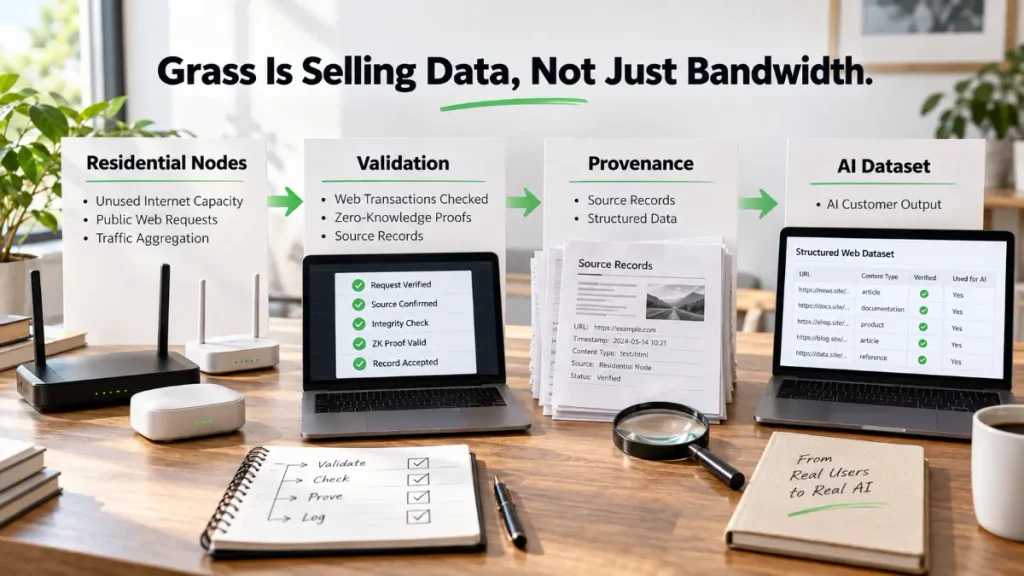
The trust problem resembles the challenge faced by programmable data verification networks. A system can prove that a data event passed through its infrastructure without proving that every source was accurate, lawful, useful, or commercially valuable. Grass still depends on customer selection, data quality controls, routing rules, and the systems that decide which nodes handle traffic.
Grass Points also reveal an important distinction. Uptime Points reward availability. Network Points depend on bandwidth that customers and the network actually use. A contributor can remain connected without generating the same economic value as a node in a location where customer demand is stronger.
Grass Review: Revenue Is Stronger Than the Old Narrative
The biggest change since the original article is that Grass now reports meaningful business revenue. In its July 2026 participant update, Grass said 2025 revenue reached $17 million. The detailed H1 2026 section lists another $17 million for the first half of 2026, while a later summary in the same update says $18 million.
That one-million-dollar inconsistency matters. The cleanest description is roughly $17 million to $18 million of project-reported H1 2026 revenue. Grass also said it was profitable, with ongoing cash expenses of around $2 million to $3 million per month, and said nearly every AI customer it served returned for more business.
What the Revenue Figures Actually Prove
The official H1 2026 network participant update provides stronger evidence than price action or user-count marketing. It shows a business claiming real sales and recurring demand. Grass has not published audited financial statements that independently verify every commercial figure, and it publicly identifies only a limited number of customers.
The same distinction matters across enterprise AI infrastructure. Revenue can validate a product without automatically validating the economics of its associated token. Grass needs to show both.
| Evidence | What It Shows | What It Does Not Prove |
|---|---|---|
| 8.5M users reported on Grass sites | Very broad distribution and onboarding reach | 8.5M users are active daily or generating paid traffic |
| About $17M to $18M H1 2026 revenue reported | Commercial demand exists according to Grass | Revenue is independently audited or fully visible onchain |
| Repeat AI customers reported | Some buyers appear willing to return | Customer concentration is low |
| Stage 2 rewards paid in USDC | Grass can compensate contributors without new GRASS emissions | More node activity automatically creates GRASS demand |
| Current circulation near 677M GRASS | Much more supply is liquid than older trackers show | Every unlocked token is actively being sold |
Stage 2 Changed the Reward Story
Grass Airdrop One distributed 100 million GRASS to early participants. Stage 2 took a different route. For participation between October 14, 2024 and June 8, 2026, Grass made Stage 2 rewards available in USDC. The Foundation said regulatory uncertainty drove that decision and said the distribution would not create new GRASS emissions or increase circulating GRASS supply.
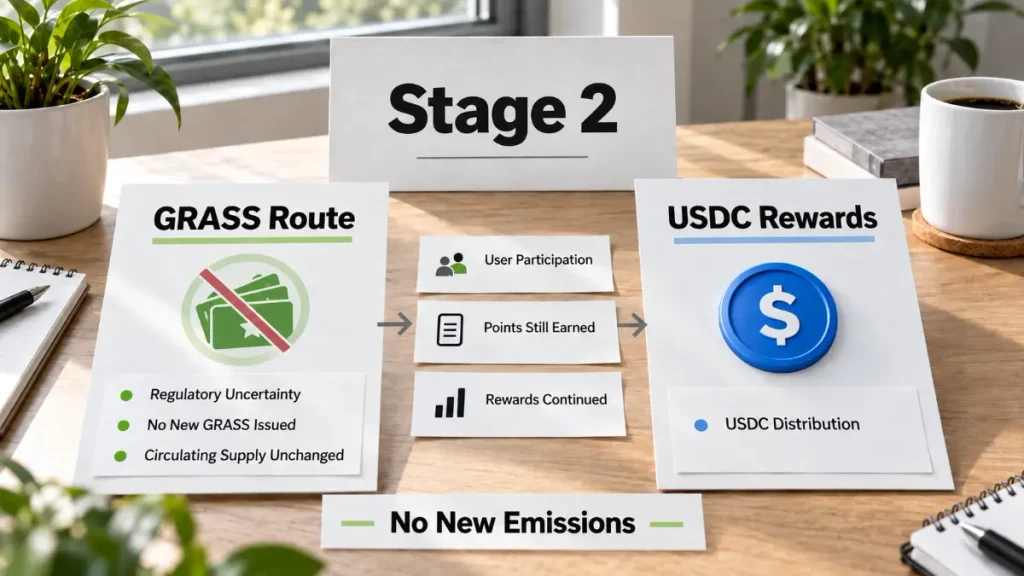
That reduces one form of dilution. It also changes the link between node participation and the native token. A user can contribute bandwidth, accumulate points, and receive a reward without receiving newly issued GRASS.
The change gives Grass a cleaner test. Growth in the contributor base no longer proves GRASS buying pressure by itself. The token thesis must rely more heavily on staking, network settlement, and the documented conversion of customer revenue into GRASS.
GRASS Has Utility, but the Conversion Route Needs Proof
GRASS has several documented functions. Holders can delegate tokens to routers. Grass also plans to use the token for governance, web-scraping transactions, dataset purchases, and Live Context Retrieval usage.
The most important claim is the revenue route. The official GRASS documentation says purchasers may pay in USD, USDC, or other supported tokens. It also says the network will convert revenue into GRASS and use those tokens to compensate stakeholders that provide network resources.
That mechanism could create genuine value capture. Customer payments can enter the business in fiat or stablecoins, conversion can create GRASS demand, and GRASS can then move toward routers and other network participants.
The missing part is measurement. Current public material does not give readers a simple dashboard showing customer revenue, the amount converted into GRASS, conversion dates, tokens distributed to network stakeholders, treasury retention, and the amount of token demand created per dollar of service revenue.
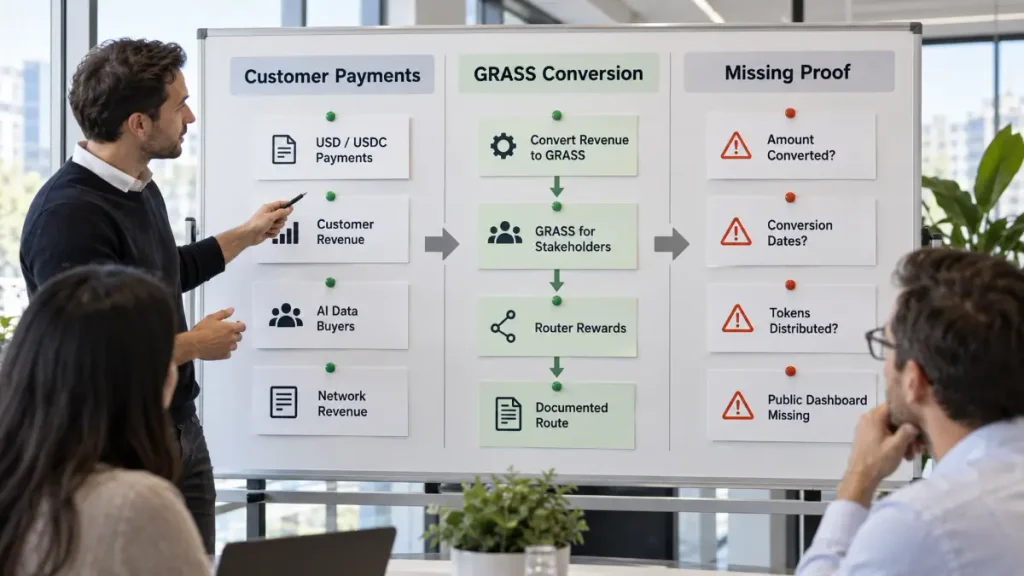
This is the same analytical boundary that matters when data infrastructure and native-token economics develop at different speeds. A successful service supports a token thesis only when the economic bridge between product demand and token demand becomes measurable.
Staking Is Real, but Security Is Still Transitional
GRASS staking is active on Solana. Holders delegate tokens to available routers, router operators retain a commission, and routers distribute the remaining eligible staking rewards to delegators. Unstaking carries a seven-day lock period.
Staking gives GRASS a direct use beyond governance. It can lock liquid supply and align router operators with token holders. The security model, however, remains less complete than a simple proof-of-stake label suggests.
Grass documentation says operators still trigger slashing manually rather than through an automatic in-protocol process. The same documentation describes a validator that began as a single centralized entity and a future plan for a committee of economically collateralized validators.
This review found no public announcement confirming that Grass has completed the full validator-committee transition. Millions of edge nodes can make bandwidth supply geographically distributed while validation, routing policy, customer access, and enforcement remain more concentrated.
That distinction also matters in decentralized infrastructure economics. Decentralization depends on who can validate, route, change rules, enforce penalties, and direct economic flows, not only on how many devices connect.
App Certification Is Not a Protocol Audit
The old version of this article treated a CertiK score as evidence of an audit. That was inaccurate. CertiK currently says it has not audited Grass, and its audit section does not list a completed Grass audit.
There is useful independent software evidence. AppEsteem lists active Grass desktop and macOS app versions as certified. That supports claims about application behavior and software compliance within the certification scope.
App certification does not audit the entire Sovereign Data Rollup. It does not prove that the validator cannot fail, that router accounting is correct, that every server-side system is secure, or that future versions will contain no vulnerabilities.
The security case therefore has several separate layers: app behavior, residential traffic routing, router operations, validator integrity, staking enforcement, Solana settlement, and the systems that process and sell collected data.
The Current Supply Picture Is Much Larger Than 243.9M
The old article treated a higher self-reported supply figure as evidence of hidden inflation. Current evidence points to a different conclusion. As of September 12, 2026, CoinGecko reports an estimated circulating supply of about 677.0 million GRASS and links that figure to Grass Foundation circulation data. Tokenomist shows almost the same amount as unlocked supply. CoinMarketCap still reports roughly 243.9 million circulating.
The gap is material, but the higher figure is no longer an isolated project claim. Foundation-linked circulation data, CoinGecko, and Tokenomist now align closely. The safer conclusion is that at least one major tracker appears to lag the current release schedule. The difference does not prove hidden inflation.
GRASS has a fixed one-billion-token supply. The original allocation gives 30% to the community, 22.8% to Foundation and ecosystem growth, 25.2% to early investors, and 22% to contributors. Community allocation includes Airdrop One, future incentives, and router rewards.
At roughly 677 million circulating, about 67.7% of maximum supply is already in circulation. Around 323 million tokens remain outside that figure. Future releases can still add supply, but the remaining dilution gap is much smaller than an old 243.9 million circulation figure would imply.
GRASS Tokenomics: Supply, Staking and Revenue Conversion
The central tokenomics question is no longer whether GRASS has any utility. The network already uses staking, and its documentation describes a revenue-conversion route. The harder question is whether recurring service demand can create enough GRASS demand to matter beside future releases and staking rewards.
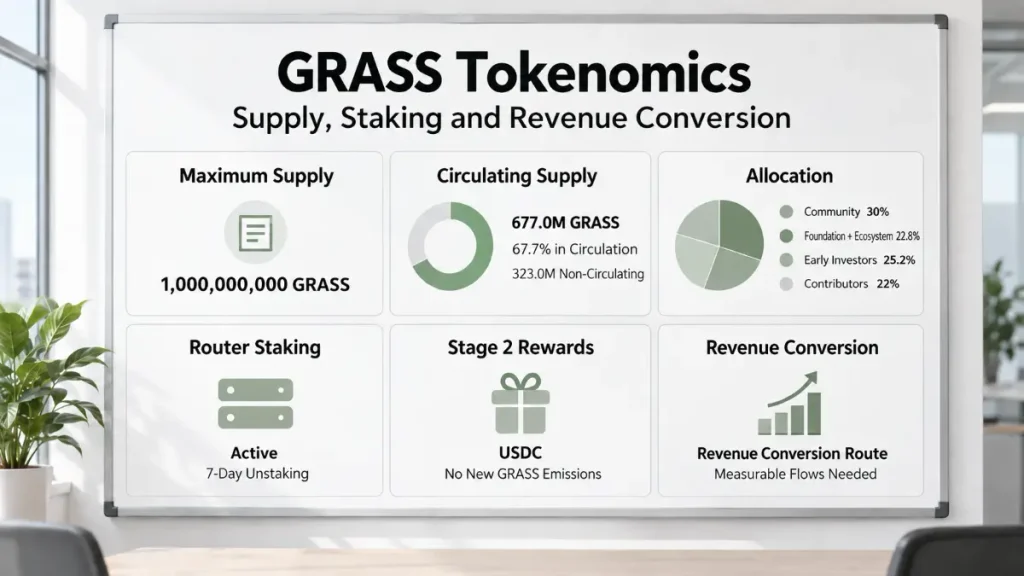
| Tokenomics Item | Current Position | Why It Matters |
|---|---|---|
| Maximum supply | 1,000,000,000 GRASS | Sets the stated supply ceiling |
| Community | 30% | Includes Airdrop One, future incentives, and router rewards |
| Foundation and ecosystem growth | 22.8% | Funds operations, growth, research, and ecosystem activity |
| Early investors | 25.2% | Creates continuing release pressure under the vesting schedule |
| Contributors | 22% | Large long-term allocation with continuing vesting |
| Circulating supply | About 677.0M on Sep 12, 2026 | Roughly 67.7% of maximum supply is already circulating |
| Remaining non-circulating amount | About 323.0M | Future releases can still add sell-side liquidity |
| Stage 2 participant rewards | USDC | Avoided new GRASS emissions for that distribution |
| Router staking | Active | Creates token locking and network participation demand |
| Unstaking period | 7 days | Reduces immediate liquidity for delegated tokens |
| Revenue conversion | Documentation says network revenue converts into GRASS | Could connect customer spending to token demand if flows become measurable |
Do Not Confuse Grass With Other GRASS Tokens
GRASS is a common ticker and name. Search results can mix unrelated projects into the same news stream. The official Grass Network token is the Solana asset with contract address Grass7B4RdKfBCjTKgSqnXkqjwiGvQyFbuSCUJr3XXjs.
Claims about a different GRASS token on another chain, including unrelated buyback or burn announcements, should not enter this token’s economics. Current Foundation material reviewed for this article does not document an official GRASS burn mechanism for the Grass Network.
Live Context Retrieval Could Strengthen the Token Case
Grass wants to expand beyond training datasets into Live Context Retrieval, or LCR. The idea is to let AI systems retrieve fresh public-web context at inference time rather than relying only on data collected for model training.
That could make the network more useful because inference demand can continue throughout the life of an AI product. It could also strengthen GRASS economics if LCR payments follow the documented conversion route into the token.
The timing should not be overstated. Grass said in July that public LCR products would begin launching during the summer. Later Grass educational material still described LCR as a capability the network was developing. Until usage data appears, LCR belongs in the future-demand case rather than in proven current revenue.
What Grass Needs to Prove Next
Grass has already cleared one hurdle that many DePIN projects never clear. It has a live consumer product, a large contributor network, and project-reported revenue from AI data customers.
The next proof is economic transparency. A public revenue-to-GRASS dashboard would show whether the token captures business growth in practice. A completed validator-committee transition would reduce dependence on the current centralized validation assumption. Automated slashing would make router security less discretionary.
Clear LCR usage metrics would also show whether the next product line is operating rather than planned. Supply reporting needs to become consistent across major trackers as well. The current gap between roughly 677 million and 243.9 million is too large for a mature market-data picture.
Those are measurable tests. None requires a price forecast.
Verdict: Real Business, Incomplete Token Proof
Grass is materially stronger than the old hype-versus-crash framing suggested. The network has millions of users, a working bandwidth product, active staking, independent app certification, and project-reported AI data revenue that grew sharply from 2025 into 2026.
Stage 2 USDC rewards also show that contributor compensation does not have to depend on fresh GRASS emissions. That same decision exposes the main token question. Network participation can grow without every reward creating GRASS demand, and enterprise customers can pay in fiat or stablecoins.
The Foundation says it will convert network revenue into GRASS, but readers still lack a clear public view of that conversion flow at the scale implied by reported business revenue. Decentralization is also unfinished because current documentation still describes centralized validator assumptions and manual slashing.
Supply pressure is no longer accurately described by the old 243.9 million circulation figure. Current Foundation-linked data points to about 677 million circulating, leaving roughly one third of maximum supply outside circulation. That reduces the size of the remaining dilution gap, but it does not remove it.
The conclusion is mixed for a different reason than before. Grass has stronger evidence of a real business than the old article gave it credit for. GRASS also has genuine staking and settlement utility. What remains unproven is whether commercial success produces enough transparent, recurring token demand to make the token economics as strong as the underlying data business.
Frequently Asked Questions
Grass is a distributed bandwidth network that uses participating internet connections to retrieve public web data for AI and enterprise customers. Its infrastructure also processes and records data-provenance information.
GRASS supports router staking and is intended for network payments and governance. Foundation documentation also says the network will convert revenue from supported payment currencies into GRASS for network stakeholders.
No. Grass made Stage 2 participant rewards available in USDC and said the distribution would not create new GRASS emissions.
As of September 12, 2026, CoinGecko reports about 677.0 million GRASS using Foundation-linked circulation data. Tokenomist shows almost the same unlocked amount, while CoinMarketCap still reports about 243.9 million. The disagreement remains material.
No completed CertiK audit is currently listed. CertiK provides monitoring information for Grass, but that monitoring does not equal a protocol audit. AppEsteem separately certifies active versions of the Grass application, which covers a different security scope.
The biggest unresolved issue is measurable value capture. Grass reports growing AI data revenue, but public evidence still needs a clearer bridge from customer payments to GRASS conversions, staking rewards, and recurring token demand.

Founder & Managing Editor of CryptosMedia. Zahid Hussain leads evidence-based crypto research covering tokenomics, security, governance, adoption, and risk.
CryptosMedia separates verified facts from interpretation, avoids buy/sell recommendations, and updates reviews when major evidence changes.
4 thoughts on “Grass Review: Can Real Revenue Reach GRASS?”