
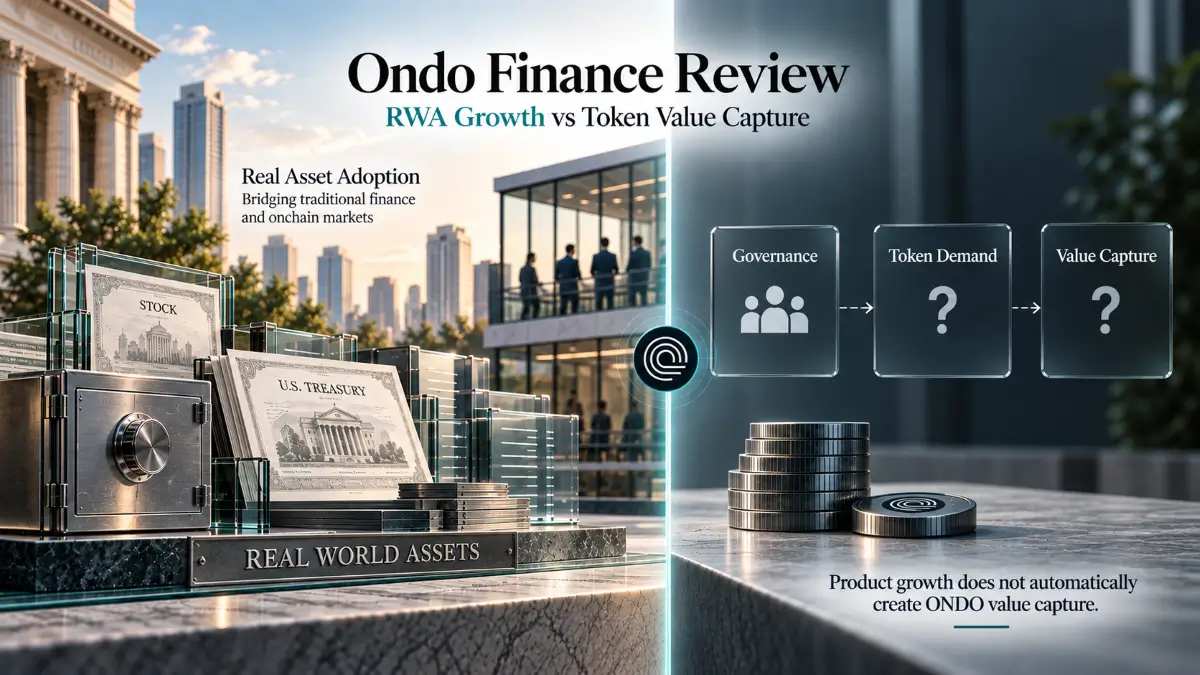
Ondo Finance has grown from a tokenized Treasury specialist into a broader real-world asset platform. Its current product stack includes tokenized stocks and ETFs, a yield-bearing dollar product, institutional Treasury exposure, and a newer execution network for financial applications. By mid-September 2026, Ondo’s product dashboard showed about $1.05 billion in Ondo Stocks TVL, more than 450 tokenized stocks and ETFs, roughly 221,200 unique holders, and about $2.21 billion in USDY TVL.
Those figures give the real-world asset side of this Ondo Finance review measurable substance. They do not answer the harder question for the ONDO token because product usage, company economics, and token demand are different things. Public ONDO documentation establishes governance rights, but it does not give token holders equity in Ondo Finance or a direct claim on revenue from Ondo Stocks, USDY, or OUSG.
That distinction defines the central thesis of this review. Ondo has proved RWA adoption more clearly than it has proved durable ONDO value capture, and the gap becomes more important while a large share of the 10 billion maximum supply remains outside circulation. This article examines product adoption, economic flows, token utility, supply, governance, security, and the evidence still needed to connect Ondo’s growing financial infrastructure with ONDO.
This article is for research and education only and does not provide financial, investment, tax, or legal advice.
Ondo Finance Is Now a Multi-Product RWA Platform
Ondo is no longer accurately described as a single tokenized Treasury protocol. Different parts of the ecosystem serve different users and rely on different legal, technical, and economic structures. Ondo Stocks brings public-security exposure onchain, USDY offers qualifying users a yield-bearing dollar asset, OUSG serves institutional Treasury investors, and Ondo Network provides an execution environment for financial applications.
Treating all four as one economic pool would obscure the most important question in this review. Product TVL can rise without creating protocol revenue, and business revenue can increase without creating ONDO demand. A useful analysis therefore needs to separate what the products do from what the token captures.
Ondo Stocks Connects Public Securities to Blockchain Markets
Ondo Stocks, previously known as Ondo Global Markets, provides eligible non-US users with tokenized economic exposure to publicly traded securities. The platform now supports more than 450 tokenized stocks and ETFs across Ethereum, BNB Chain, and Solana. Ondo’s product documentation states that these tokens track the economic performance of the underlying assets, including applicable dividends, but the tokens are not themselves the corresponding shares or ETFs.
Underlying shares, ETFs, and cash in transit sit with US-regulated financial institutions. Ondo says an independent Verification Agent reviews the backing each business day, while a Security Agent holds a first-priority security interest in the collateral for token holders. The arrangement gives Ondo Stocks an identifiable off-chain asset base, but it does not remove custody, legal, operational, or redemption dependencies.
Blockchain infrastructure therefore changes how the exposure can move without replacing the traditional financial system beneath it. Users can transfer supported tokens onchain and integrate them with compatible applications, but the securities themselves remain inside regulated financial infrastructure. That mixed architecture is central to both the value proposition and the risk model.
USDY and OUSG Serve Different Treasury Markets
USDY is a tokenized note designed for qualifying non-US users who want dollar-denominated exposure backed primarily by short-term US Treasuries. Ondo’s September data showed about $2.21 billion in USDY TVL, with approximately $2.23 billion of underlying assets and about $2.14 billion of USDY outstanding in a September 9 portfolio snapshot. Those figures should be treated as dated product data rather than permanent values because the portfolio changes over time.
USDY sits within the broader market for yield-bearing dollar products, where backing, redemption terms, collateral quality, and the source of yield matter more than headline APY. Yield generated inside USDY belongs to the USDY product structure. It does not automatically become yield or revenue for ONDO holders.
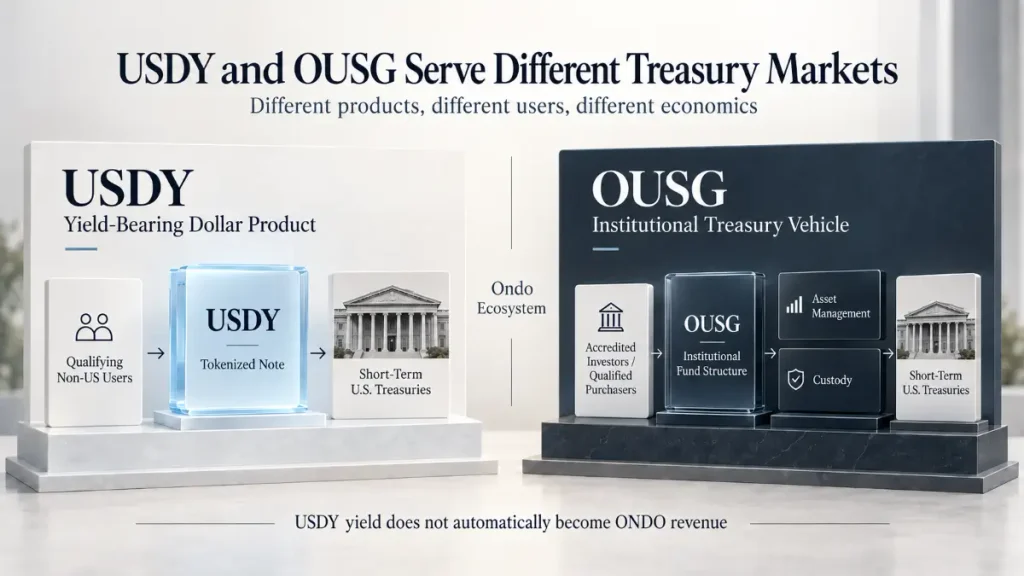
OUSG targets a different audience. It is available to eligible accredited investors and qualified purchasers and provides exposure to short-term Treasury and money-market assets through a private fund structure. A September 10 portfolio snapshot showed roughly $338 million in TVL and a diversified portfolio that included State Street, BlackRock, Franklin Templeton, and Fidelity products alongside smaller liquidity positions.
OUSG also illustrates why TVL cannot be treated as revenue. Its management fee is capped at 0.15%, but Ondo currently states that the management fee is waived until January 1, 2027, while fund expenses have a separate cap. A large asset balance therefore does not tell readers how much revenue Ondo is collecting from that balance at any particular moment.
Ondo Stocks Provides the Strongest Adoption Evidence
Ondo Stocks offers the clearest evidence that Ondo’s RWA strategy has moved beyond an early experiment. The platform crossed $1 billion in TVL in May 2026, less than eight months after launch, and Ondo reported more than $18 billion in cumulative trading volume at that milestone. The available asset count later expanded from more than 260 securities to more than 450.
Current adoption data strengthens the product case, but each metric answers a different question. TVL measures value held through the product, trading volume measures turnover, and holder counts indicate distribution. None of those measurements directly represents revenue or ONDO buying pressure.
TVL, Volume, and Holders Should Stay Separate
TVL can grow because more assets are deposited or because the value of existing assets changes. Trading volume can become large even when trading fees remain narrow, while unique holder counts do not prove that every address represents a distinct active customer. Mixing those measures would create a stronger-looking economic story than the evidence supports.
That does not make the figures unimportant. Around $1 billion in tokenized securities and more than 200,000 reported holders show that Ondo Stocks has achieved meaningful distribution. The correct conclusion is product adoption, not automatic token value capture.
Asset Backing Gives the Product Real Substance
Ondo Stocks differs from an uncollateralized synthetic representation because underlying shares, ETFs, and cash support the tokens. Daily verification and the Security Agent structure create additional protections around that collateral, while Ondo describes the issuer structure as bankruptcy remote. These features strengthen the connection between the onchain token and its off-chain economic exposure.
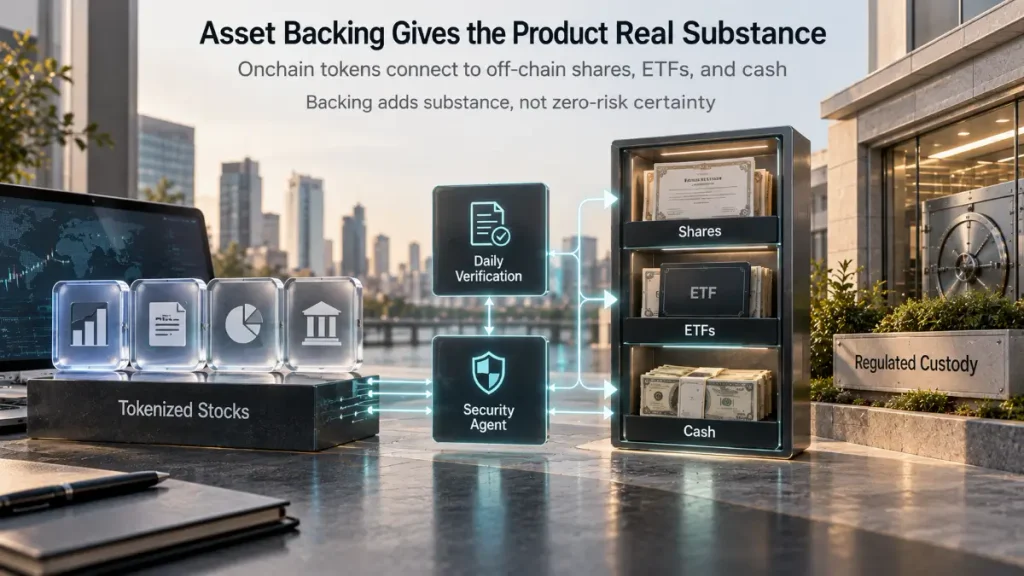
They do not eliminate counterparty risk. Investors still depend on asset custody, legal enforceability, accurate verification, operational controls, and functioning redemption channels. Public blockchains can show token movements, but they cannot independently verify every fact about securities held in brokerage and custody accounts.
Wider Distribution Adds Utility and More Dependencies
Ondo Stocks operates on multiple public networks and selected assets can move into HyperEVM. That connection expands access to an ecosystem covered in our Hyperliquid analysis, but it also adds another technical dependency between the tokenized asset and its destination network.
The important point is not that cross-chain distribution is inherently unsafe. It is that collateral quality, blockchain execution, and cross-chain transport represent different risk layers. A token can remain fully backed even while a bridge or messaging component develops a separate problem.
Product Demand Does Not Automatically Become ONDO Demand
A user acquiring tokenized NVIDIA exposure primarily wants NVIDIA exposure. Someone holding USDY may want Treasury-linked dollar yield, while an institution using OUSG may want short-duration cash management. None of those motivations inherently requires buying ONDO.
This creates the key economic gap. A larger Ondo ecosystem may make its governance layer more important, but activity becomes direct token value capture only when a measurable mechanism connects that activity with ONDO demand.
| Evidence | Current Position | Why It Matters |
|---|---|---|
| Ondo Stocks TVL | About $1.05B in mid-September 2026 | Shows substantial capital using tokenized securities |
| Available assets | 450+ stocks and ETFs in mid-September 2026 | Shows broad product coverage |
| Unique holders | About 221,200 in mid-September 2026 | Indicates meaningful distribution |
| USDY TVL | About $2.21B in mid-September 2026 | Shows demand for Treasury-linked dollar exposure |
| OUSG TVL | About $338M in a September snapshot | Shows a separate institutional Treasury use case |
| Ondo Network | Live with Ondo Perps | Expands Ondo beyond asset issuance |
| Direct ONDO revenue link | No active automatic mechanism verified | Product growth does not itself prove ONDO demand |
Ondo Network Replaced the Original Chain Thesis
Ondo’s infrastructure strategy changed materially during 2026. The company had previously announced Ondo Chain as a purpose-built blockchain for institutional financial markets, but development of Ondo Perps led the team toward a different architecture. In July 2026, Ondo introduced Ondo Network and stated that achieving its objectives did not require a traditional blockchain.
That change makes older descriptions of Ondo technically outdated. Current Ondo Network documentation does not describe the system as a Move-based chain, and Ondo explicitly says the Network is not a blockchain today. Asset settlement still uses public blockchains, while application execution follows a different model.
Secure Enclaves Handle Application Execution
Ondo Network runs application logic inside Trusted Execution Environments. These hardware-isolated enclaves execute approved code privately and produce signed, replayable records of core state transitions. A multi-party attestor set verifies the code allowed to run, participates in key management, and connects the system with public blockchains.
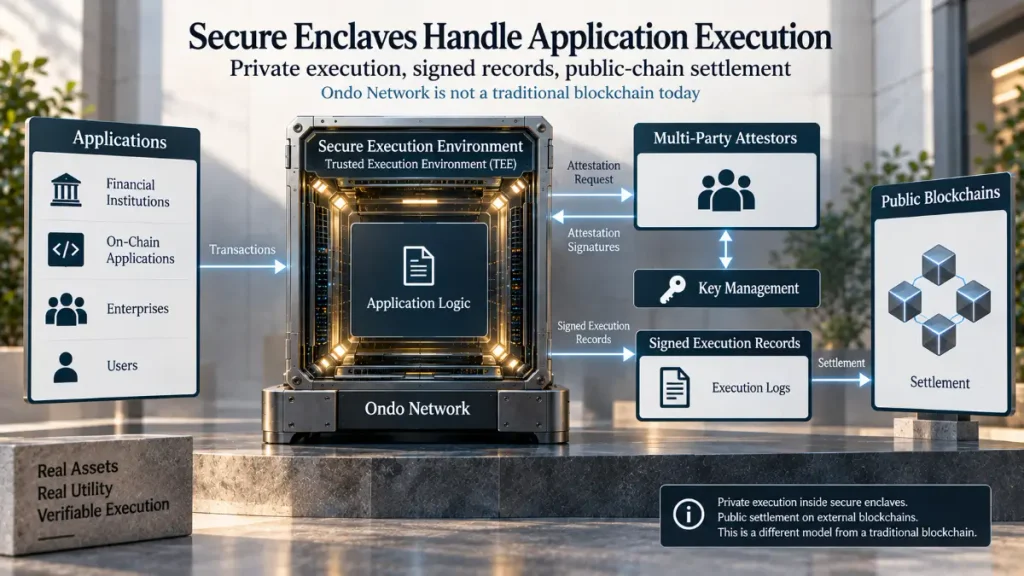
This design separates execution from verification and settlement. Trading applications can process matching, margin, and liquidation logic without requiring every network participant to replicate each event, while approved parties can later verify signed execution records. Ondo Perps is the first live application built on the Network.
Current Decentralization Still Has Limits
Ondo Network currently executes application code inside a single high-performance enclave rather than a replicated execution network. Multiple attestors already participate in the trust layer, but they approve code and manage key shares rather than independently executing every transaction. Ondo describes this as a deliberate trade-off between execution speed and replication.
The roadmap goes further than the current system. Ondo discusses a larger permissionless attestor set, bonded participation, external watchers, additional cryptographic proofs, and a possible proof-of-stake security model as future directions. None of those possibilities should be counted as present ONDO utility until the relevant mechanism exists and the role of ONDO is explicitly established.
Ondo Creates Economic Activity, but ONDO Capture Is Less Direct
Ondo’s products can create real business value through tokenization, asset management, issuance, redemption, trading infrastructure, and related services. Growing balances can also increase the usefulness of the broader ecosystem to institutions, wallets, developers, and liquidity providers. The harder question is who captures that economic value.
Holding ONDO does not create a proportional claim on Ondo Finance operating income. It also does not give holders ownership of the stocks behind Ondo Stocks, the assets supporting USDY, or the OUSG portfolio. Product economics and token economics can therefore move in different directions.
Governance Is the Clearest Verified ONDO Utility
Ondo Foundation’s published framework gives ONDO holders governance rights through the Ondo DAO. Documented powers include decisions involving Flux Finance markets, interest-rate models, oracle addresses, reserves, ONDO emissions, treasury assets, and administrative authority.
Those rights are meaningful, but governance should not be presented as revenue sharing. Control over a protocol parameter can matter economically without giving every token holder a contractual claim on business cash flow. The same distinction applies when governance controls external price inputs because oracle infrastructure can create a separate operational risk without becoming a direct source of token value.
A Proposed Fee Switch Is Not Active Value Capture
A June 2026 Flux governance-forum discussion proposed routing part of protocol revenue into programmatic ONDO buybacks and burns. The post explicitly described itself as a temperature check rather than a binding onchain proposal and stated that actual implementation would require a later formal proposal and ratification.
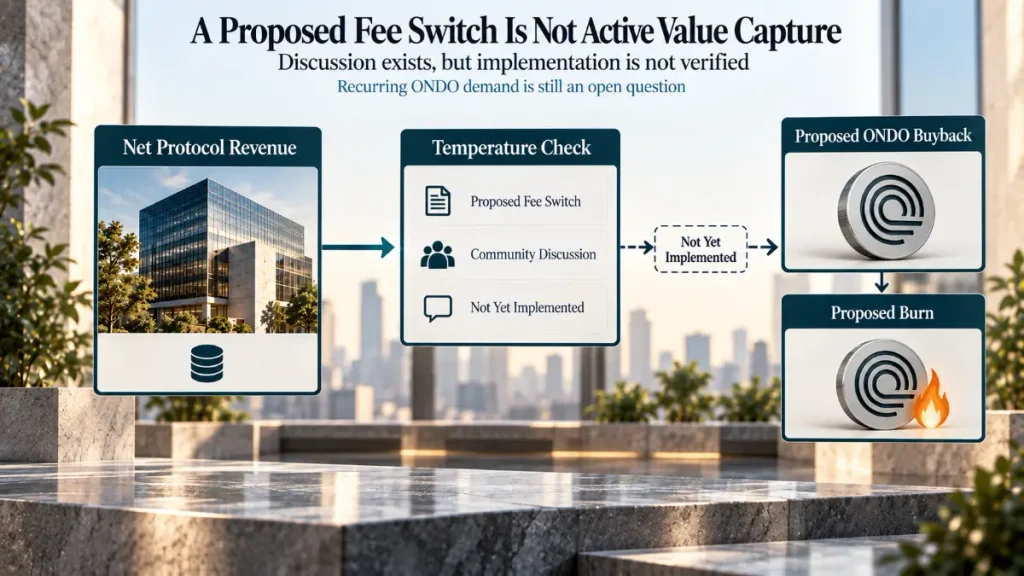
That status matters. A proposed buyback is not an active buyback, and discussion of a burn does not prove that ONDO supply is being reduced through operating revenue. The forum was still showing the item as a temperature-check discussion in September 2026.
The current economic path therefore remains incomplete. Ondo has measurable RWA activity and products with their own economics, but a recurring route from those economics into ONDO demand has not yet been established at the same level of evidence.
ONDO Tokenomics Keep Future Supply Relevant
ONDO has a maximum and total supply of 10 billion tokens. CoinGecko reported 4,869,330,647 ONDO in circulating supply on September 17, 2026, which equals about 48.7% of the maximum. Future dilution risk therefore comes mainly from existing locked allocations becoming transferable rather than from an open-ended issuance schedule.
The published allocation assigns about 52.1% to Ecosystem Growth, 33% to Protocol Development, 12.9% to Private Sales, and roughly 2% to the Community Access Sale. Ecosystem Growth is by far the largest pool, while contributor and private-sale allocations create additional multi-year distribution exposure.
Most of the Original Supply Started Under Lockups
Ecosystem Growth was allocated approximately 5.21 billion ONDO. The Foundation described this allocation as supporting incentives and contributors across development, education, research, and other ecosystem activities. Protocol Development was allocated 3.3 billion ONDO, while Private Sales was allocated about 1.29 billion.
Large allocations are not automatically negative. Their economic effect depends on the release schedule, recipient behavior, incentives, and the amount of genuine demand available when tokens become transferable. Supply analysis therefore needs more than a headline percentage.
A Large Locked Balance Remains Disclosed
Ondo Foundation reported 4,422,519,707 locked ONDO under the control of the Ondo Foundation Group as of August 26, 2026. That figure describes a specific disclosed pool and should not be treated as identical to total non-circulating supply. Some tokens outside circulating supply can belong to different allocations or conditions.
Third-party vesting tracker Tokenomist lists January 18, 2027 as the next scheduled ONDO unlock and reports that approximately 48.69% of supply is currently unlocked. Because vesting trackers can revise schedules or amounts, the event should be checked again near the actual date rather than treated as an immutable forecast.
An Unlock Does Not Prove Selling
An unlock changes transferability, not recipient behavior. Newly transferable tokens can remain in the same wallet, move into custody, participate in governance, provide liquidity, or enter the market. Treating every unlocked token as an immediate sale would turn a known supply event into an unsupported claim about holder behavior.
Circulating supply still matters because the amount of ONDO available for transfer can grow over time. The more useful economic test is whether durable ONDO demand develops strongly enough to absorb that expanding liquid supply without relying on assumptions about future buyer behavior.
| Tokenomics Item | Current Position | Why It Matters |
|---|---|---|
| Maximum supply | 10B ONDO | Sets the long-term supply ceiling |
| Total supply | 10B ONDO | Existing token supply already reaches the cap |
| Circulating supply | 4.869B on Sep. 17, 2026 | About 48.7% of maximum supply is circulating |
| Ecosystem Growth | About 52.1% | Largest allocation and major distribution pool |
| Protocol Development | 33% | Large contributor-related allocation |
| Private Sales | About 12.9% | Adds investor-related vesting exposure |
| Community Access Sale | About 2% | Smallest main allocation |
| Foundation-controlled locked ONDO | About 4.423B as of Aug. 26, 2026 | Shows substantial disclosed locked supply |
| Verified utility | Ondo DAO governance | Provides control rights, not automatic cash-flow rights |
| Active buyback or burn | Not verified as active | Proposed mechanisms should not be treated as deployed |
| Current Network staking | Not established for ONDO | Future PoS concepts are not current token demand |
| Main token test | Demand versus expanding circulation | Shows whether RWA growth reaches ONDO economics |
Ondo Security Extends Beyond Smart Contracts
Ondo’s security model spans more than contract code. Tokenized securities and Treasury products depend on administrators, broker-dealers, custodians, verification agents, legal agreements, redemption systems, price inputs, and public blockchain infrastructure. Ondo Network adds secure hardware, attestors, key management, and application-specific execution to that dependency map.
A security review that asks only whether one contract has been audited would therefore miss most of the architecture. Technical reviews matter, but their scope needs to stay separate from legal, custody, operational, and market risks.
The OUSG Audit Covered a Defined Code Scope
A 2024 Cyfrin review covered a set of OUSG-related smart contracts. Its scope included instant minting and redemption, rOUSG, rate-limiting logic, and KYC-related components. The report recorded 24 findings, including seven low-severity issues, and stated that the protocol team mitigated those seven low-severity findings.
Ondo’s current audit index also lists later reviews covering Ondo Stocks and Ondo Funds/USDY, including reports published through 2026. That broader coverage is useful, but every report remains tied to a defined code version, scope, and point in time. It does not prove that Ondo Stocks, USDY, Ondo Network, bridges, future upgrades, or financial counterparties are safe.
Administrative Control Is Part of the RWA Model
Cyfrin’s report also identified centralization as a deliberate consequence of the regulated assets underlying OUSG. Administrative powers and compliance restrictions existed outside the main vulnerability assessment, including the ability of protocol administrators to exercise controls required by the regulated design.
Those controls should not automatically be labeled flaws. They are trust assumptions that readers need to understand because a token can move on a public blockchain while custody, KYC, redemption, or legal enforcement remain under identifiable institutional control.
Custody and Legal Rights Matter as Much as Code
Ondo Stocks demonstrates the same principle from another direction. Tokens move on public blockchains, while the corresponding stocks, ETFs, and cash remain with regulated financial institutions. Verification and Security Agents help enforce the relationship between token holders and those assets.
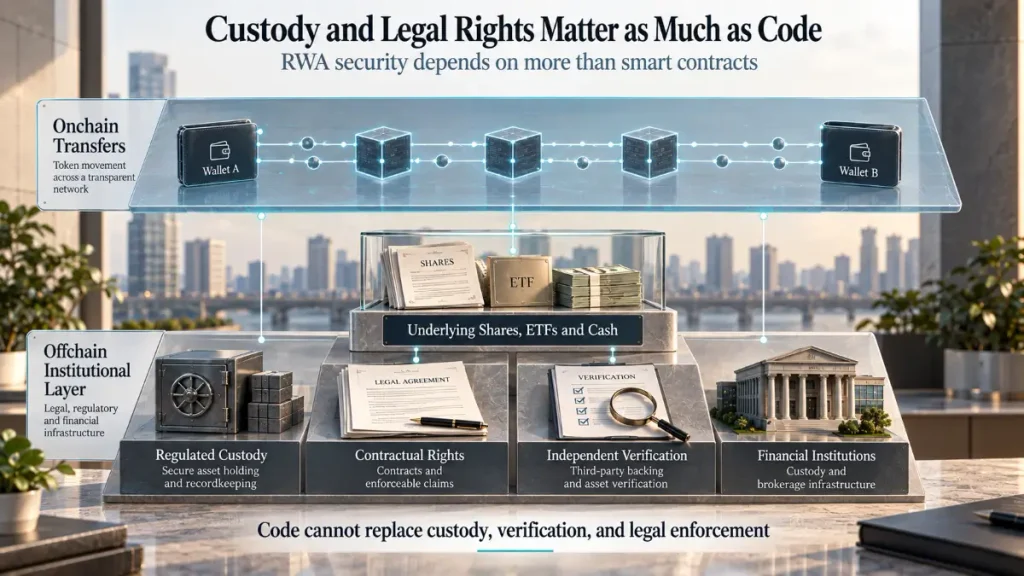
Smart-contract security cannot replace these institutions. A custody failure, legal dispute, verification error, or redemption problem could matter even if every relevant blockchain continued processing transactions normally. RWA security therefore combines technical integrity with enforceable off-chain rights.
Bridges Create a Separate Failure Surface
Cross-chain distribution introduces another dependency. Selected Ondo Stocks can move to HyperEVM through the Ondo Bridge, and the bridge relies on LayerZero messaging for cross-chain communication.
This does not weaken the underlying asset backing by itself. It means the bridge has to be evaluated separately because strong collateral cannot guarantee secure messaging, just as secure messaging cannot compensate for weak custody. Keeping those layers separate prevents one strong part of the system from being used as proof for every other part.
What Ondo Still Needs to Prove
Ondo no longer needs to prove that tokenized real-world assets can attract meaningful capital. Ondo Stocks, USDY, and OUSG already provide measurable evidence that users and institutions will place assets into tokenized financial products. The unresolved questions now concern durability, infrastructure maturity, and the economic role of ONDO.
Those questions require different evidence from the numbers used to establish current adoption. A strong TVL snapshot does not establish multi-year retention, and a governance token does not become a cash-flow asset simply because the surrounding business grows.
RWA Adoption Needs to Remain Durable
Ondo Stocks needs to retain assets and users as tokenized-equity competition grows. Reliable minting and redemption, sufficient liquidity, accurate backing verification, and functioning investor protections matter more over time than one milestone. Demand also needs to survive periods when equity markets, Treasury yields, and crypto liquidity become less supportive.
USDY faces a related but different test because its attraction partly reflects short-term Treasury yields. OUSG depends more heavily on institutional demand, eligibility rules, and dependable fund infrastructure. Durable adoption therefore needs evidence across changing financial conditions rather than one favorable market period.
Ondo Network Needs a Longer Operating Record
Ondo Network is already live, but its current architecture remains young. The multi-party attestor model, single execution enclave, key-management system, and signed execution logs need more operating history before analysts can judge resilience under stress. Future permissionless attestors, external watchers, and proof-of-stake concepts should remain roadmap items until they become deployed features.
The same rule applies to token utility. If ONDO eventually secures a bonded role in Network verification or another economically meaningful function, that would materially change the token analysis. Current evidence does not justify counting that future mechanism today.
ONDO Needs a More Measurable Economic Link
Governance gives ONDO a verified purpose, but the token still lacks a comparably clear connection to the cash flows or economic activity generated by Ondo’s major RWA products. An activated revenue-funded buyback could create one route, while a deployed ONDO-based security role could create another. Other governance-approved mechanisms may emerge later.
Until one of those paths becomes measurable, the evidence supports a narrower conclusion. Ondo’s products can continue gaining users and assets without requiring an equal increase in ONDO ownership, which means ecosystem success and token value capture should remain separate analytical questions.
Ondo Finance Review Verdict
By mid-September 2026, Ondo Finance had built a substantial RWA platform. Ondo Stocks held about $1.05 billion in TVL, supported more than 450 tokenized securities, and had roughly 221,200 reported holders. USDY held about $2.21 billion in TVL, while OUSG continued to serve a distinct institutional Treasury market.
The structure behind those products also has more substance than a simple crypto wrapper. Ondo Stocks combines blockchain transferability with regulated custody, daily backing verification, and legal security interests, while USDY and OUSG use defined asset and fund structures. Ondo Network extends the ecosystem into high-speed private execution, although its present design still relies on a single execution enclave and a multi-party attestor model that needs a longer operating record.
ONDO requires a separate conclusion. Its strongest verified role remains governance, while current public evidence does not establish a direct claim on Ondo Finance revenue, an active automatic fee-funded burn, or a live ONDO staking role securing Ondo Network. At the same time, only about 4.87 billion of the 10 billion maximum supply currently circulates, leaving future distribution relevant to the token’s economic test.
None of those limits proves that ONDO cannot develop stronger value capture. They define the evidence required to strengthen the thesis. A deployed revenue mechanism, verified Network security role, or another recurring source of ONDO demand would materially change the analysis.
For now, the most defensible conclusion remains clear. Ondo has proved RWA adoption more clearly than it has proved durable ONDO value capture. Ondo Finance’s products and the ONDO token belong to the same ecosystem, but the available evidence does not justify treating them as the same economic asset.
Frequently Asked Questions
What Is Ondo Finance?
Ondo Finance develops tokenized financial products and infrastructure that connect traditional assets with blockchain markets. Its current ecosystem includes Ondo Stocks, USDY, OUSG, and Ondo Network, with each product serving a different market and operating under its own economic and legal structure.
What Is ONDO Used For?
ONDO’s clearest verified role is governance through the Ondo DAO. Published governance powers include decisions involving Flux Finance markets, interest-rate models, oracle addresses, reserves, ONDO emissions, treasury assets, and administrative authority.
Does ONDO Represent Equity in Ondo Finance?
No documented mechanism reviewed for this article gives ONDO holders equity ownership in Ondo Finance or a proportional claim on the assets or revenue of Ondo Stocks, USDY, or OUSG. ONDO should therefore be analyzed as a governance token rather than as company shares.
Does Ondo Finance Have Real RWA Adoption?
Yes. Mid-September 2026 Ondo data showed more than 450 tokenized stocks and ETFs, roughly 221,200 unique Ondo Stocks holders, about $1.05 billion in Ondo Stocks TVL, and about $2.21 billion in USDY TVL.
Does ONDO Have an Active Buyback and Burn?
A community proposal published in June 2026 suggested a programmatic revenue-funded ONDO buyback-and-burn mechanism. The proposal explicitly described itself as a temperature check rather than a binding onchain proposal, so this review does not treat buybacks or burns as an active verified value-capture mechanism.
Does ONDO Have a 10 Billion Maximum Supply?
Yes. CoinGecko reports 10 billion ONDO as both total and maximum supply, with about 4.869 billion circulating on September 17, 2026. Ondo Foundation’s published allocation also accounts for the 10 billion token supply across Ecosystem Growth, Protocol Development, Private Sales, and the Community Access Sale.
What Is the Next Scheduled ONDO Unlock?
Tokenomist lists January 18, 2027 as the next scheduled ONDO unlock and identifies Ecosystem Growth as the receiving allocation. The tracker also notes that actual release timing and amounts can vary, so the event should be verified again close to the date.
Is Ondo Network a Blockchain?
Not in its current form. Ondo describes it as a verifiable execution environment where applications run inside secure enclaves, while a multi-party attestor set verifies approved code and participates in key management. Asset transfers settle on public blockchains, and Ondo explicitly states that the Network is not a blockchain today.
Are ONDO Unlocks the Same as Token Sales?
No. Unlocking changes whether tokens can become transferable, but it does not reveal what recipients will do with them. Actual wallet movements, exchange deposits, governance use, liquidity activity, and changes in circulating supply provide better evidence of post-unlock behavior.
What Is the Main ONDO Value-Capture Question?
The key question is whether Ondo’s growing RWA activity can create recurring ONDO demand at a scale that matters relative to future circulating supply. Governance already gives ONDO a real function, but the direct economic bridge from the success of Ondo’s major products to token demand remains less established than the product adoption itself.

Founder & Managing Editor of CryptosMedia. Zahid Hussain leads evidence-based crypto research covering tokenomics, security, governance, adoption, and risk.
CryptosMedia separates verified facts from interpretation, avoids buy/sell recommendations, and updates reviews when major evidence changes.
1 thought on “Ondo Finance Review: RWA Growth vs ONDO Value Capture”