
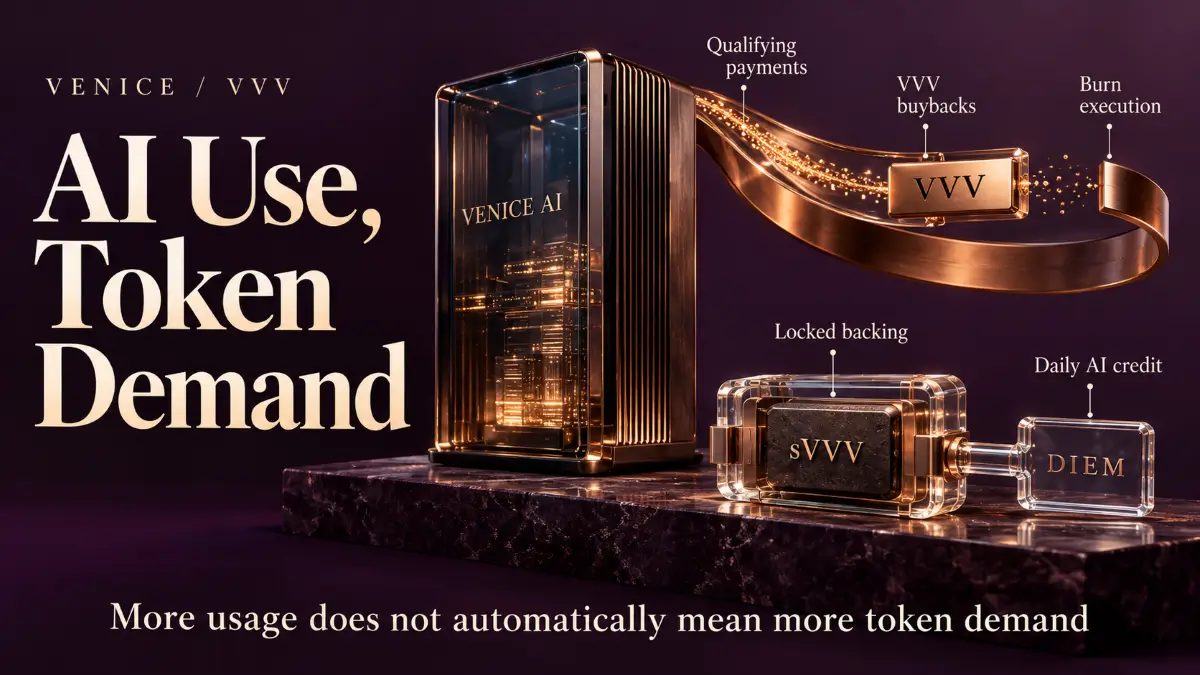
Recurring AI access has value only when customers can use it reliably. Venice adds a financial layer to that practical requirement. Its platform sells access to generative models, while VVV connects to subscriptions, staking, tokenized inference and revenue-funded purchases. This Venice Review follows those connections to determine when a useful service creates measurable token demand and when customers can benefit without holding VVV.
Venice has moved beyond its original model of allocating API capacity directly among VVV stakers. DIEM now separates recurring inference credit from the underlying token commitment. Meanwhile, buyback programs connect qualifying customer payments to market purchases, and lower emissions reduce new issuance. These mechanisms deserve separate accounting. Neither a privacy label nor an expanding model catalog establishes that token economics have become sustainable.
This article provides educational research, not investment, staking, legal or security advice. VVV and DIEM involve market, liquidity, contract and service-provider risks. Verify current product terms before relying on any access arrangement.
Research uses public Venice documentation, dated announcements, security listings and market data checked on October 18, 2026. Project disclosures do not constitute independent assurance. This review did not execute staking transactions, test privacy protections or reconcile every mint and burn onchain.
Quick Verdict
VVV has identifiable connections to an operating AI service. Staking supports product access, locked sVVV backs DIEM minting, and Venice describes programmatic purchases funded by qualifying subscriptions and API credit sales. That gives researchers mechanisms to investigate beyond general interest in AI.
The limits matter just as much. Customers can use other payment routes, existing DIEM can change hands without new VVV purchases, and staking rewards originate in token issuance. Privacy protections vary by model and request flow. Public audit coverage also remains unverified for the current contract system in the material reviewed. The strongest thesis requires sustained customer spending, executed purchases and credible service delivery together.
Key Takeaways
Venice’s Products and the Rights They Provide
What Keeps an AI Customer Paying
Venice combines a consumer application with an API for developers and automated software. Its offering spans text and other generative tasks, with model selection and privacy options forming part of the product. Builders can integrate inference into their own applications rather than depend on the Venice interface.

That is a commercial proposition before it is a token proposition. Customers care about output quality, latency, uptime, available models and the treatment of sensitive information. A convenient funding mechanism cannot compensate indefinitely for poor answers or unreliable service.
Competition also limits pricing power. Developers can compare providers and redirect workloads when another service offers better economics. Privacy may support differentiation, but Venice still needs to deliver useful inference at a cost customers accept. Growth in the AI market alone cannot answer whether this particular platform retains profitable demand.
Privacy Depends on the Route to the Model
Venice describes a proxy architecture that relays requests without retaining normal prompt and response content on its own servers. What happens at the model provider remains a separate question. Its current materials distinguish four modes rather than make one universal promise for every model.
This distinction prevents a common misunderstanding. Concealing identity from an upstream provider does not prevent that provider from processing the message. Contractual non-retention also differs from cryptographic restrictions on access. Both may serve legitimate needs, but readers should understand which protection the selected route actually provides.
Encrypted Inference Still Depends on the Client
Venice documents client-side encryption and attestation checks for supported E2EE text models. Its technical guide calls for checking fresh attestation evidence and binding encryption to the verified environment. Merely choosing a model with an encryption-related name does not establish that an application implemented the complete flow correctly.
Stronger isolation also changes functionality. Current documentation limits E2EE features that require plaintext outside the enclave, including web search and several tool-related capabilities. Developers face a practical trade-off between confidentiality and features rather than a universal upgrade with no operational cost.
Content privacy does not mean the service processes no metadata. Authentication, billing and reliability can involve wallet identifiers, timestamps, model selections and usage amounts. Public wallet activity introduces another observable layer. A review should assess these boundaries without confusing confidential prompts with anonymous financial activity.
From a VVV Stake to Daily Inference Credit
VVV is the Base token. Staking produces sVVV, which represents the staked position. A holder can then lock sVVV to mint DIEM at the applicable mint rate. DIEM can circulate separately and support daily inference credit when staked through the service.
This design separates the person supplying the backing commitment from the person consuming inference. A developer can acquire existing DIEM rather than assemble the entire minting position. A VVV participant can monetize access by selling DIEM while retaining an underlying commitment.
Those rights remain distinct. Owning VVV does not automatically create a particular daily allowance under the current DIEM system. Holding unstaked DIEM is also different from activating credit through a linked account. Older descriptions of proportional API access for every VVV stake should not substitute for current documentation.
Venice states that one staked DIEM provides one dollar of daily API credit. This is a service allowance, not a promise that the DIEM token trades for one dollar. Model prices determine how much work the allowance purchases.
Consider an illustrative developer with ten staked DIEM who uses six dollars of inference each day. The remaining daily allowance does not become four dollars of cash income. Current documentation says unused credit does not roll over. Utilization therefore changes the economic value of access even when the nominal allowance stays constant.
For a consistently busy application, recurring credit may simplify budgeting. For an irregular workload, prepaid usage may offer a better fit. Any comparison needs the capital committed to tokens, actual consumption and service quality. Dividing token cost by the maximum theoretical allowance overstates savings when customers leave capacity unused.
Backing Locks Have an Exit Cost
The DIEM mint rate determines how much sVVV supports newly minted access. Venice describes a curve that becomes more demanding as supply rises relative to a target. This target shapes minting conditions rather than imposing a fixed ceiling on tokens in existence.
Importantly, the company controls that target. Its July 2026 announcement scheduled an increase from 38,000 to 40,000 DIEM across four steps ending September 14. Announced parameter changes establish policy intent. A complete implementation check would also inspect current contract state.
Locked backing can reduce immediately available VVV while the commitment persists. Burning DIEM can release that backing, so this mechanism does not permanently destroy the VVV involved. Research should follow both new commitments and releases instead of presenting all locked balances as irreversible supply reduction.
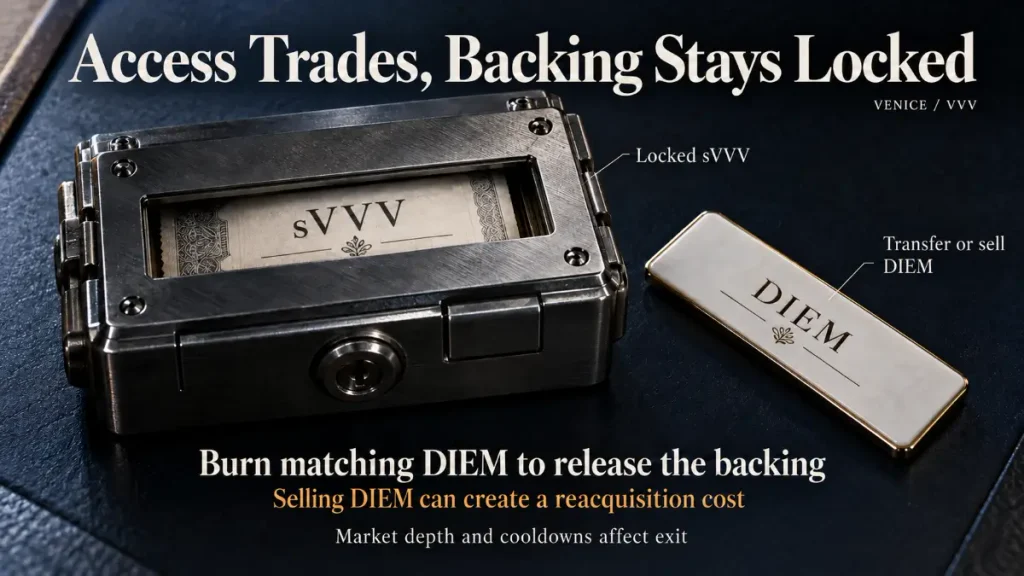
Minting and selling DIEM separates an access entitlement from its backing position. To unlock that position, the original minter needs the corresponding quantity of DIEM to burn. Selling the entitlement therefore creates a future reacquisition requirement if the participant later wants the backing released.
That requirement introduces market risk. A thin DIEM market or a higher acquisition cost can make exit less convenient than the original sale suggested. Continuing staking rewards do not eliminate this exposure, and the value of the underlying VVV can change independently.
Current API documentation also distinguishes cooldowns. DIEM unstaking has a one-day delay, while unstaking freed sVVV has a seven-day delay. These time requirements add to trading depth, transaction costs and token availability when assessing an exit. Transferability alone does not establish immediate, inexpensive liquidity.
Two Routes From Customer Demand to VVV
Customer growth can affect VVV through new access commitments or revenue-funded purchases. The first route depends on demand for newly minted DIEM. Existing DIEM trading does not necessarily produce new locked backing, even when a new customer begins using the platform.
The second route follows commercial spending that qualifies for buybacks. Venice announced purchases triggered by qualifying new subscriptions in April 2026, with different dollar amounts for Pro, Pro+ and Max. Its July update extended the mechanism to API credit purchases, specifying five dollars for every hundred dollars of credits purchased.
These routes should not be merged into one activity number. A request funded by existing DIEM can consume service capacity without triggering a fresh credit purchase. Conversely, prepaid credit sales can generate a qualifying purchase before the customer consumes inference. Timing and payment method shape the token connection.
Following Customer Money Into Token Transactions
Venice maintains a burn tracker, but a rigorous assessment still needs underlying transactions and consistent period boundaries. Announced percentages describe program rules. Executed purchases establish what happened, while a supply reconciliation shows whether those purchases outweighed issuance. This review does not claim to have independently completed that full reconciliation.
Tokenomics
VVV launched on January 27, 2025 with 100 million tokens at genesis. The initial allocation assigned 50 percent to users and the AI community, 35 percent to Venice, 10 percent to an incentive fund and 5 percent to liquidity. The team allocation formed part of the Venice allocation rather than a separate additional bucket.
Launch documentation described 10 million team tokens, with 25 percent initially available and the remainder streaming over 24 months. That original arrangement points toward January 2027 completion. It does not independently establish the precise amount remaining in every vesting wallet today.
Venice’s current FAQ states an annual rate of 2 million VVV from October 1, 2026, compared with the original 14 million. This is lower issuance, not zero issuance. The initial 100 million should not be presented as an immutable maximum supply.
Why Unclaimed Tokens Need Separate Burn Accounting
Venice reports burning 33,539,739 VVV from unclaimed allocations in March 2025. This changed the original distribution outcome. It did not demonstrate that customers had financed market purchases of that quantity through AI spending.
Later revenue-funded programs address a different question. They can connect operating activity to VVV purchases, but their relevance depends on the amounts actually executed. Combining a large unclaimed-token removal with subsequent commercial purchases can make the latter appear larger than the evidence supports.
Supply comparisons also need a consistent definition. Market-data providers may exclude inaccessible balances when reporting effective supply, while a token contract can use different accounting. A useful audit records issuance, inaccessible balances, distribution exclusions and reported circulation separately. Subtracting the same burn twice would produce a misleading scarcity figure.
Measuring Scarcity After New Issuance
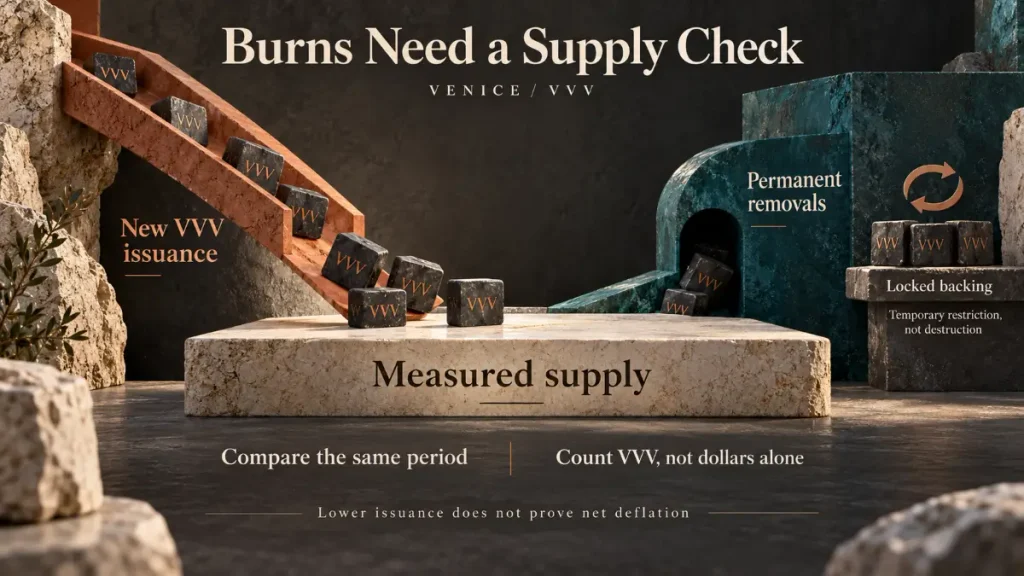
At an annual rate of 2 million VVV, issuance averages approximately 5,480 tokens daily. This arithmetic provides a comparison point, not proof of the exact amount minted in a particular day. Actual issuance and burn execution need matched observation periods.
For supply to decline on a net basis, permanent removals must exceed new issuance under the same accounting definition. Falling issuance makes that threshold easier to meet, but an announcement about future buybacks cannot establish that the threshold has already been crossed.
Dollar figures can also distract. The same buyback budget acquires fewer tokens at a higher token price. Research should therefore compare both dollars spent and VVV removed. Even genuine net deflation would not guarantee price appreciation if customer demand weakened or existing holders reduced their exposure.
What Actually Funds the Staking Reward
VVV staking rewards come from emissions. They are not automatically a distribution of net AI business profits. A participant can receive additional tokens while the aggregate supply expands, and an attractive displayed rate can reflect how rewards divide among eligible positions.
Venice says ordinary stakers receive emissions under the current arrangement, while sVVV locked to back DIEM receives 80 percent of the standard staking yield. That difference belongs in the cost of minting access. The full comparison includes forgone rewards, token exposure and the usefulness of the resulting credit.
Lower emissions may improve supply discipline while reducing rewards available to participants. Whether that trade-off supports lasting commitments depends on the service and access economics. Yield alone cannot establish that external customers value the product enough to support the token system.
Which Usage Represents Paying Customers?
Inference requests, registered users and integrations describe different dimensions of adoption. None reveals by itself how much independent customers pay, how long they remain or whether their spending covers delivery costs.
Venice supports multiple funding paths, including prepaid credits and token-based access. Research should distinguish fresh credit purchases from daily DIEM consumption. Combining them without explaining the method can confuse new cash receipts with previously established access entitlements.
More useful reporting would show repeat paying accounts, realized spending by funding route, capacity utilization and customer concentration. Model availability and integration announcements help explain distribution, but they do not substitute for retention. These are assessment criteria rather than assertions that Venice publishes or independently verifies every metric today.
Customer concentration deserves particular attention. One busy integration can generate many requests while leaving the service exposed to a single routing decision. Distinct wallet addresses also need interpretation because one organization can operate several wallets. Conversely, an integration can serve many people through one commercial account. A reliable adoption series explains the unit it counts and maintains that definition over time.
Daily Credit Depends on Tomorrow’s Service
DIEM promises recurring access to a company-operated service. The blockchain records token ownership, but GPUs, model providers, pricing systems and application infrastructure deliver inference. Token transferability cannot ensure those resources remain available indefinitely.
Unused daily allowances may lower current delivery costs, while heavier utilization increases the workload the company must support. That makes utilization important to both customers and the provider. A large nominal credit capacity does not directly reveal the cash cost of honoring it.
The relevant business question concerns how subscriptions, prepaid sales and other operating income support that obligation over time. Gross revenue and buyback spending alone cannot establish profitability. Reliable service, competitive pricing and a sustainable cost structure matter to DIEM usefulness and therefore to the commitments backing it.
Security Reports Need Deployment-Level Scope
CertiK listings for VVV and DIEM showed no CertiK audit and no listed third-party audit during this check. The launch article includes an audit label without establishing a current, scoped public report. This review therefore does not verify comprehensive public audit coverage for the token, staking and DIEM system.
That finding describes an evidence gap, not proof that no private review ever occurred. Useful assurance would identify contract addresses, reviewed source revisions, findings and remediation. A token scan, explorer verification badge or reputation score cannot replace that report.
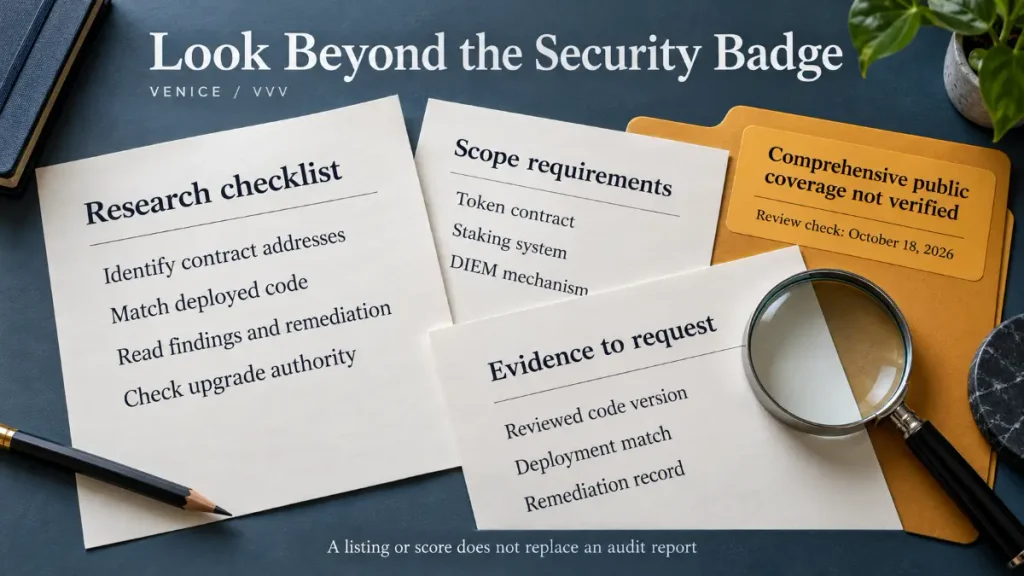
Contract security also differs from privacy security. A sound staking contract would not prove that an upstream model provider honors retention commitments. Successful encrypted inference would not prove that every token upgrade is safe. Each boundary needs evidence appropriate to the system involved.
Who Can Change the Contract Rules?
Venice currently states that the VVV token owner is the staking contract and that a Safe multisig controls the staking contract. Its FAQ describes rate-based minting and says changing the relevant logic would require a multisig-approved upgrade. These disclosures differ materially from an unsupported claim that one ordinary wallet can mint arbitrary quantities immediately.
They do not eliminate administrative dependence. Reviewing a multisig arrangement also requires its signer threshold, upgrade permissions and any applicable delays. This research did not independently verify all of those settings, so it makes no claim that the system is immutable or fully decentralized.
Base provides the execution environment, while Venice operates the inference business. Blockchain settlement and company administration solve different problems. Neither structure grants ordinary VVV holders automatic control over every product decision, provider relationship or commercial parameter.
Where Transferable Access Offers Practical Value
Venice offers an intelligible way to separate recurring inference access from the person financing its backing commitment. Developers can evaluate transferable access against prepaid spending, while token participants can assess minting economics without needing to consume all the available inference themselves.
Revenue-funded purchases also make a potentially observable connection between customers and VVV. This is more informative than relying entirely on a future plan to give a token utility. Falling emissions further reduce the amount of new issuance those mechanisms must absorb.
The advantage remains conditional. It becomes stronger when customers repeatedly choose Venice for its service, use access productively and support commercial spending that leads to verifiable token purchases. Product quality supplies the reason to stay. The token system organizes one set of funding and participation choices around it.
When Platform Growth Bypasses Fresh VVV Demand
Private AI demand can grow without equivalent demand for newly minted DIEM. Existing access may move between customers, and customers may prefer conventional payments. A rising request count could therefore coexist with limited new backing commitments.
Market participants can also value staking rewards more than inference. If commitments mainly follow token incentives, lower emissions may test retention before customer-driven demand becomes large enough to compensate. Buybacks can help establish a connection, but their scale may remain small relative to issuance or sales by existing holders.
Service dependence adds another weakness. Provider changes, outages or an unsuitable model catalog can impair the usefulness of recurring credit. These risks do not require a contract exploit to matter. The economic relationship can weaken simply because customers find a more useful alternative.
What Would Make the Economics More Convincing?
Stronger evidence would combine repeat customer spending with transparent purchase execution and a reconciled supply history. Reporting should distinguish subscription-triggered purchases, API-credit purchases and discretionary programs. The same periods should show new issuance and permanent removals in token units.
DIEM reporting would become more useful with minted supply, redeemed backing, staked access and actual consumption shown separately. This would help readers distinguish a popular trading instrument from recurring access that customers consistently use.
Security confidence would improve through public contract reports tied to current deployments and clearer administrative disclosures. Privacy confidence would improve through independently reviewable implementation evidence and well-defined provider responsibilities. These developments would strengthen the case without requiring a price forecast.
Final Assessment
Venice connects a functioning AI product to several token mechanisms, but those mechanisms do not respond identically to growth. New DIEM minting can lock backing. Qualifying payments can fund purchases. Existing access can serve more users without requiring either event.
VVV therefore needs analysis at the point where commercial activity becomes a token transaction or a lasting commitment. Lower emissions improve one part of that equation. Service quality, privacy boundaries, administrative control and public security coverage determine whether the wider arrangement deserves continued confidence.
The central conclusion of this Venice Review is conditional: private AI demand can support VVV economics, but usage alone does not prove the connection is large, profitable or durable. Executed purchases, useful recurring access and transparent supply accounting provide the stronger test.
Key Questions About Venice and VVV
What does Venice provide?
Venice offers an AI application and API with multiple models, funding methods and privacy modes.
Must every customer own VVV?
No. Customers can use other funding routes, including prepaid credits.
What connects VVV to DIEM?
Participants lock staked VVV to mint DIEM, which they can transfer, sell or stake for recurring credit.
Does one DIEM represent one dollar in cash?
No. One staked DIEM provides one dollar of daily Venice API credit, not a guaranteed cash redemption.
Does unused daily credit accumulate?
No. Current documentation says unused DIEM allowances do not roll over to the next daily epoch.
Does minting DIEM permanently burn VVV?
No. It locks backing sVVV, which can be released by burning the corresponding DIEM.
Is 100 million VVV the maximum supply?
That was the genesis allocation. Ongoing emissions mean it should not be presented as a fixed maximum.
Are staking rewards company profits?
No. The documented staking reward mechanism distributes token emissions.
Does every Venice model provide identical privacy?
No. Protection depends on the selected mode, provider and implementation.
Is comprehensive public audit coverage verified?
No. This review did not verify current public reports covering the complete VVV, staking and DIEM system.

Founder & Managing Editor of CryptosMedia. Zahid Hussain leads evidence-based crypto research covering tokenomics, security, governance, adoption, and risk.
CryptosMedia separates verified facts from interpretation, avoids buy/sell recommendations, and updates reviews when major evidence changes.