
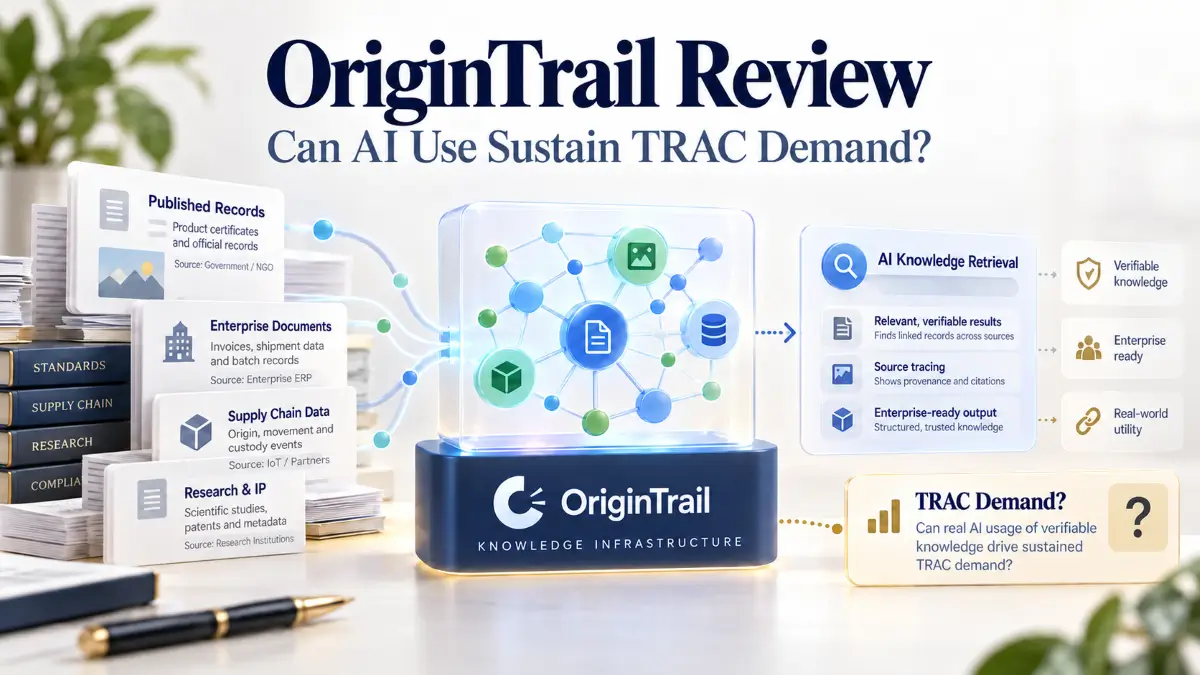
A railway component can outlast the software that records its repairs. A supplier certificate can pass through several companies while different teams disagree about which version is current. OriginTrail is built around this problem. Its Decentralized Knowledge Graph (DKG) helps organizations and AI systems connect structured information, preserve relationships between records, and make published knowledge easier to trace. Its official DKG overview presents the DKG as infrastructure for verifiable knowledge, AI memory, and connected data.
The harder question is TRAC. The token has defined network utility, but not every AI interaction automatically creates fresh token demand. This review focuses on that gap: whether AI use, enterprise deployments, Knowledge Asset publishing, staking, and tokenomics can support durable TRAC demand.
This review is for educational purposes only and is not financial advice. Crypto assets, AI infrastructure, staking, tokenomics, bridges, governance systems, and decentralized networks can involve risk. Always verify current data and understand asset-specific risks before making decisions.
This article is independently written and based on publicly available information available at the time of review. CryptosMedia does not provide buy, sell, or hold recommendations.
Quick Verdict
OriginTrail has documented real-world deployments that extend beyond a purely AI-token narrative. It is not only using artificial intelligence as a marketing label. Its DKG gives applications a way to publish, connect, identify, and verify structured knowledge.
The strongest part of the TRAC case is that the token has defined network roles. OriginTrail’s TRAC token page describes TRAC as the token that powers the OriginTrail network, with roles connected to DKG operations, incentives, and network participation.
The main uncertainty is scale. AI memory, Knowledge Asset growth, integrations, and enterprise examples are useful signals, but they do not automatically show how much new TRAC is being bought, committed, spent, or retained.
The TRAC thesis becomes stronger when paid DKG publishing, publisher funding, node staking, and recipient token flows are reported clearly over time.
Key Takeaways
- OriginTrail is not just an AI-token narrative: its DKG is designed to organize, connect, and verify structured knowledge.
- AI activity is not automatically TRAC demand: agents can perform useful work before anything becomes a paid durable publication.
- Verifiable knowledge is the stronger token link: TRAC demand is clearer when selected information becomes a published Knowledge Asset.
- Enterprise examples matter: SCAN and Swiss Federal Railways show practical use cases, but not full token-flow measurement.
- Knowledge Asset growth is useful evidence: it can show publishing activity, but not necessarily recurring fresh token purchases.
- TRAC utility exists: publishing, updating assets, node participation, delegation, and incentives give TRAC defined network roles.
- The key signal is paid usage: recurring publisher funding and net token flows matter more than broad AI attention.
OriginTrail at a Glance
This table gives a quick research overview of OriginTrail, TRAC, and the main economic question behind the review.
| Field | Current Position | Why It Matters |
|---|---|---|
| Project | OriginTrail | Identifies the knowledge-infrastructure project being reviewed |
| Token | TRAC | The asset connected to DKG operations, publishing, staking, and incentives |
| Core product | Decentralized Knowledge Graph | Connects structured knowledge, provenance, and relationships across systems |
| AI angle | Verifiable knowledge | AI systems need context, source tracking, and durable records |
| Main adoption evidence | SCAN, SBB, Knowledge Assets, and AI integrations | Shows use-case depth, but still needs token-flow measurement |
| Main token question | Can paid DKG use sustain TRAC demand? | Demand test |
| Main risk | AI activity grows without proportional paid publishing | Value-capture risk |
Research takeaway: OriginTrail has real knowledge-infrastructure utility, but the TRAC case depends on paid publishing and net token flows, not AI activity alone.
What OriginTrail Actually Does
Organizations rarely keep important records in one clean database. A manufacturer may hold product specifications, a supplier may issue compliance records, a logistics company may carry shipment data, and a maintenance provider may record inspection history.
Each record can be useful. The difficulty is connecting those records across different companies, software systems, identifiers, and time periods.
A knowledge graph helps by organizing information around entities and relationships. Instead of treating a component, its manufacturer, and its maintenance history as disconnected files, a graph can describe how they relate to each other.
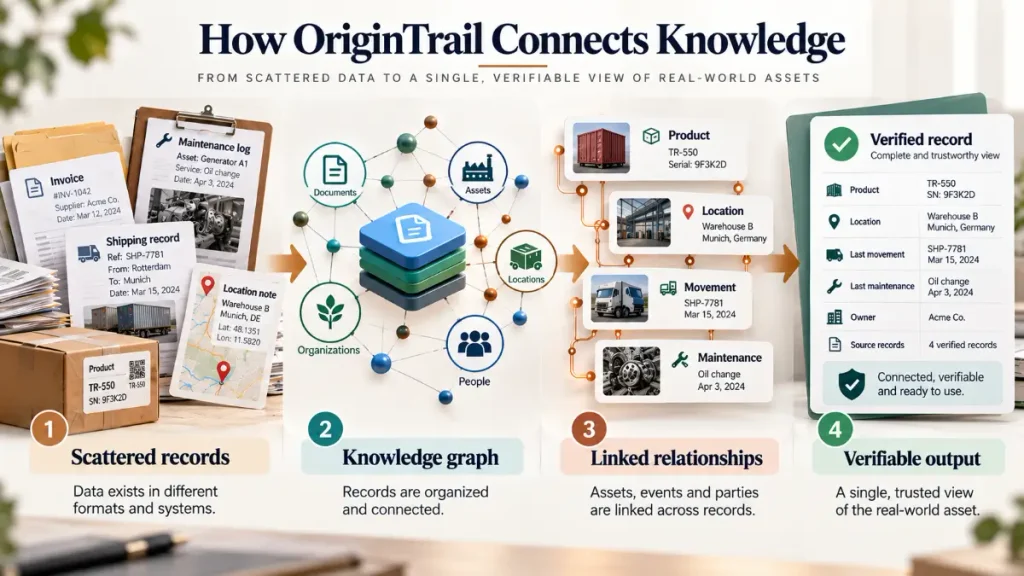
OriginTrail adds a decentralized publication and verification layer to that model. Participants can publish structured information as Knowledge Assets. These assets can preserve identity, ownership, provenance, and integrity information. OriginTrail’s Knowledge Asset documentation describes Knowledge Assets as published graph data with provenance and integrity, and states that the publisher pays the TRAC cost.
This does not mean every underlying document lives directly inside a normal blockchain transaction. The DKG separates graph data, node storage, identity, ownership, and integrity commitments. That matters because business records can be large, private, or commercially sensitive.
The practical value is not that OriginTrail magically makes every claim true. The value is that it helps people and software identify a published record, trace its relationships, and check whether a later version still matches what was published.
A Verifiable Record Can Still Contain a Wrong Claim
A verifiable record is not the same thing as a correct record.
If a supplier uploads an inspection certificate with the wrong result, the DKG can help identify the published version, preserve the source trail, and detect some forms of alteration. It cannot independently prove that the inspection happened correctly or that the reported result was accurate.
The same distinction matters for AI. A model can retrieve a source-linked record and still draw a weak conclusion. A graph can preserve provenance, but the truth of the original claim still depends on the real-world process that created it.
For enterprises, dependable knowledge needs two layers:
- reliable handling of published records
- reliable procedures for creating those records in the first place
OriginTrail can strengthen the first layer. It can support the second, but it does not replace audits, inspections, governance, or real-world verification.
AI Use Is Not Automatically TRAC Demand
The most common mistake with OriginTrail is to assume that “AI agents use knowledge” automatically means “TRAC demand must grow.”
The DKG V10 model is more specific. AI systems can work through temporary notes, shared context, and selected durable knowledge. That makes the system more practical because not every draft, prompt, or working note needs to become a permanent record.
This also makes the token case more nuanced.
An agent can ingest notes, compare files, test drafts, and share findings with a team. Only selected information may later become durable verifiable knowledge. The important question is not how many agent thoughts, prompts, or working notes occur. The important question is how much information becomes paid, verifiable publication and how that payment affects TRAC balances.
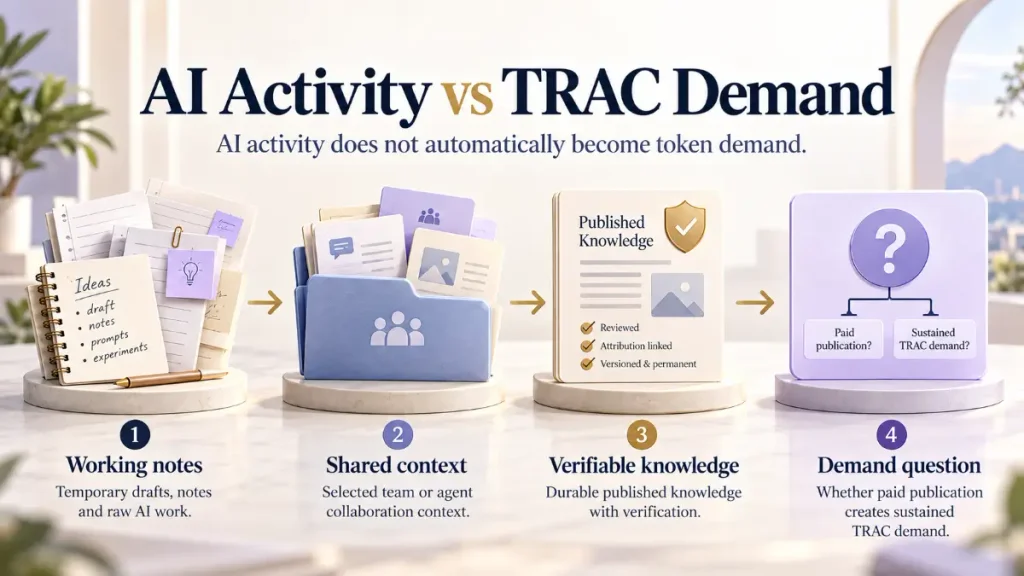
AI activity can be real while token capture remains indirect. That is why OriginTrail should be judged by paid knowledge publication, publisher funding, and net token flows, not by broad AI attention alone.
DKG V10 Memory Model
OriginTrail’s memory model is useful because it prevents the article from becoming vague AI hype. It gives readers a clear way to separate ordinary AI activity from token-linked publication.
| Memory Layer | What It Does | TRAC Demand Question |
|---|---|---|
| Working Memory | Private space for drafts, notes, and unfinished agent work | Useful activity, but not direct paid publication |
| Shared Working Memory | Collaboration layer for selected agents, peers, or teams | Can support workflows, but may not trigger direct TRAC spend |
| Verifiable Memory | Durable publication for selected knowledge | Strongest link to TRAC because publication can carry network cost |
Research takeaway: The TRAC thesis is strongest when AI workflows move beyond temporary working activity into durable verifiable knowledge publication.
Enterprise Adoption Evidence
OriginTrail’s enterprise examples give the project a stronger base than many speculative AI narratives. The most important examples are not price-related. They show why connected, attributable knowledge matters in supply chains and infrastructure.
SCAN and Supplier Compliance
The Supplier Compliance Audit Network, or SCAN, is a compliance network used for supplier audits. OriginTrail’s supply-chain overview describes SCAN as a trusted factory solution connected with major retailers and supply-chain security workflows.
That is meaningful adoption context. It shows a business reason for connected audit information. But it should not be overstated. It does not prove that every retailer separately buys TRAC, runs DKG infrastructure, or funds network operations directly.
The documented use case supports practical utility. It does not provide a complete token-flow model.
Swiss Federal Railways and Asset Records
The SBB case is important because rail infrastructure is a strong example of long-lived physical assets. A railway part can pass through manufacturers, operators, and maintenance teams across many years.
A GS1 case study says Swiss Federal Railways introduced an EPCIS repository powered by OriginTrail DKG and GS1 Switzerland. The case study describes use across train tracking, predictive maintenance, and maintenance-event records.
That is stronger evidence than a vague partnership headline. It identifies an operational repository and practical functions.
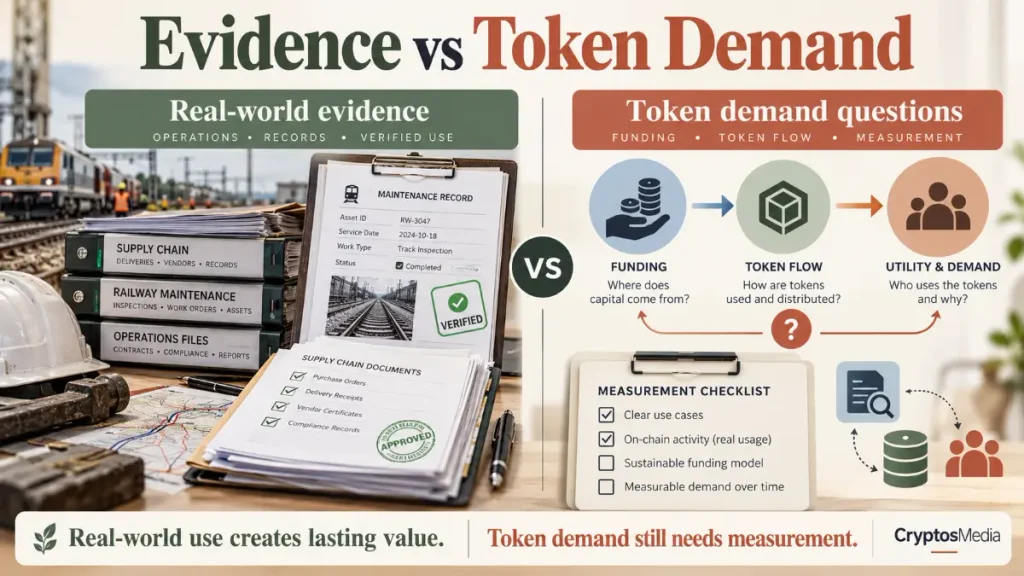
Still, the case study does not disclose how much current TRAC is purchased or spent for SBB-related operations. Practical deployment is not the same as measurable token demand.
Knowledge Asset Growth
OriginTrail’s Knowledge Asset activity is also important, but it must be interpreted carefully. A large number of Knowledge Assets can show real publishing activity, but one application can publish many records.
Historical totals may include earlier versions of the network, migrations, or batch activity. A cumulative asset count does not equal the number of paying customers. It also does not show how much new TRAC was bought in the market to support current activity.
Adoption Evidence vs TRAC Demand
The table below separates what OriginTrail adoption evidence demonstrates from what it does not prove.
| Adoption Evidence | What It Demonstrates | What It Does Not Establish |
|---|---|---|
| SCAN use case | An application for connecting supplier-audit information | Direct TRAC purchases by every SCAN member |
| SBB railway repository | A documented production use for connected asset records | Current railway-related TRAC expenditure |
| Knowledge Asset activity | Publishing activity across the DKG | The number of paying customers or fresh market purchases |
| V10 AI integrations | Ways for agents and applications to connect with the DKG | Sustained paid adoption across those integrations |
| DKG memory layers | A practical route from working notes to verifiable records | That every AI interaction requires TRAC |
Research takeaway: OriginTrail adoption evidence supports the usefulness of connected knowledge, but TRAC demand still requires clearer reporting of paid activity and token flows.
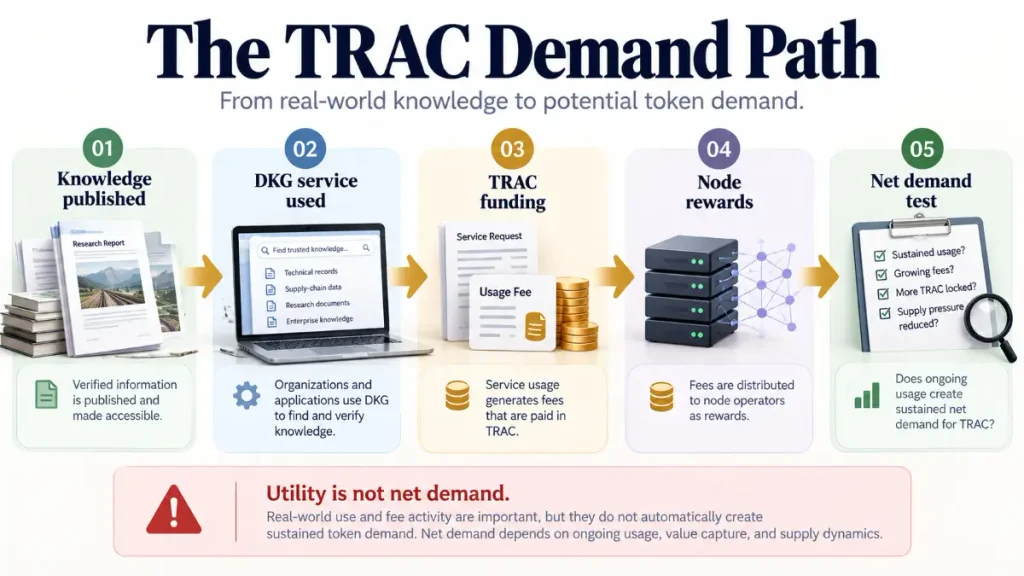
How DKG Activity Can Create TRAC Demand
TRAC is not just a ticker attached to OriginTrail. The token has network roles connected to publishing, updating assets, node participation, delegation, and incentives.
The cleanest version of the TRAC demand path looks like this:
real users publish or update knowledge
→ publishers need DKG services
→ publishing or commitment mechanisms use TRAC
→ node runners receive compensation
→ staking and delegation can commit tokens
→ recurring paid use can support recurring token demand
That chain is meaningful. But every link matters.
A business may need TRAC to publish knowledge, but it might not buy tokens immediately before every operation. It may fund a publisher account in advance. It may use a service provider. It may publish against an existing allowance.
Those arrangements can still reflect genuine network usage, but their effect on current market demand differs.
TRAC paid to network participants is also not automatically removed from supply. Node operators or recipients may hold, restake, delegate, or sell part of what they receive.
For that reason, DKG activity proves utility better than it proves net demand. Net demand needs evidence of new publisher funding, actual expenditure, committed balances, and what recipients do after receiving TRAC.
Publisher Funding, Staking, and Delegation
Publisher funding is important because commitment is different from immediate purchase. A publisher may fund an account and publish against that position over time. Replenishing that account can require additional tokens, but each new Knowledge Asset does not necessarily correspond to a simultaneous market purchase.
Staking also matters, but it should not be overclaimed. Staked TRAC can reduce immediately liquid supply while it remains committed. It does not destroy the token. Node operators can also have costs and may sell some rewards to cover infrastructure, operations, or other expenses.
Delegation can create another reason for holders to commit TRAC, but delegation is still not the same as permanent value capture. Tokens can remain part of the economic system and may later return to liquid markets.
The strongest TRAC demand evidence would show:
- recurring publisher contributions
- paid publication volume
- committed balances over time
- fees paid to node operators
- token retention versus selling by recipients
Without that accounting, token utility is real, but the net demand picture remains incomplete.
OriginTrail Tokenomics: Fixed Supply Is Useful, but Not Enough
OriginTrail identifies TRAC as a fixed-supply token. A fixed supply is meaningful because the network is not simply minting a new inflationary token for every reward cycle.
But fixed supply does not automatically create demand.
Existing holders can still sell. Staked balances can become liquid under withdrawal rules. Recipients of network rewards may retain, recommit, or sell tokens. A fixed maximum supply defines the token cap; it does not prove net demand.
The better framing is simple: supply and demand are separate. Maximum supply defines the token limit. Demand depends on whether publishers, nodes, developers, and users need to acquire or retain TRAC to keep using the network.
TRAC Tokenomics Table
The table below turns TRAC’s supply and utility structure into the main economic questions readers should track.
| Tokenomics Item | Current Position | Why It Matters |
|---|---|---|
| Maximum supply | 500 million TRAC | Defines the stated supply limit |
| Original token standard | Ethereum ERC-20 | Other network representations require contract verification |
| Publishing utility | Knowledge Asset publishing | Continued paid use may require publisher funding or replenishment |
| Node participation | TRAC can be committed by network participants | Can affect liquidity while committed, but does not remove supply |
| Delegation | Staking-related use | Creates a staking-related reason to commit TRAC |
| Network rewards | Eligible participants may receive TRAC through network activity | Recipients may retain, recommit, or sell earned tokens |
| Main transparency gap | Publisher funding, actual spend, and recipient behavior | Token-flow gap |
Research takeaway: TRAC’s fixed supply is useful, but lasting demand depends on paid DKG use, publisher funding, staking behavior, and the movement of tokens received by network participants.
Security and Governance Risks
OriginTrail security should not be reduced to one contract or one audit badge. The system combines token contracts, DKG nodes, Knowledge Asset publication, data access controls, AI-agent behavior, multiple networks, and enterprise workflows.
A valid integrity record cannot make an inaccurate inspection report true. A verified Knowledge Asset cannot guarantee that an AI model will interpret information correctly. A token contract can be valid while a bridge, integration, application, or access-control layer introduces separate risk.
Security evidence also needs precise scope. A Quantstamp assessment reviewed an older Starfleet Staking implementation. That does not automatically establish the security of later DKG components, AI integrations, network software, or every token representation.
For readers, the right security question is not simply “has OriginTrail ever had an audit?” The better question is:
- Which exact contract was reviewed?
- Which software version was reviewed?
- Which bridge or network representation is being used?
- What admin controls exist?
- What access rules apply?
- Does the review cover the current system?
That is the safer way to analyze OriginTrail security.
Case For TRAC
The strongest case for TRAC starts with utility. OriginTrail has a defined use case around Knowledge Assets, verifiable memory, and connected records. This is more concrete than many AI-token narratives.
The second strength is enterprise relevance. Supply chains, compliance networks, rail maintenance, healthcare, construction, and other record-heavy industries can benefit from connected and attributable knowledge.
The third strength is the memory-layer approach. By separating working activity from durable verifiable publication, OriginTrail gives developers a practical path. Not every draft becomes a published record, but important knowledge can still be anchored when it matters.
The fourth strength is TRAC’s defined network role. Publishing, updating assets, node participation, delegation, and incentives create operational uses for the token.
If paid DKG adoption grows and publisher funding becomes recurring, TRAC can have a clearer demand path than tokens with vague governance-only utility.
Case Against TRAC
The main case against TRAC is not that OriginTrail lacks utility. The main risk is that useful infrastructure may not translate into strong net token demand.
AI agents may perform large amounts of work before anything becomes durable paid publication. Enterprises may use service providers rather than directly buying tokens. Publishers may spend existing balances. Node operators may sell rewards. Discounts, efficiency improvements, or funded accounts can weaken the link between usage volume and fresh market demand.
The second risk is measurement. Cumulative Knowledge Asset counts are useful, but they do not show how much new TRAC independent customers contribute over time.
The third risk is security and system complexity. OriginTrail is not a single simple smart contract. It includes nodes, publishing flows, multi-chain representations, agent integrations, and enterprise access controls. Each layer needs its own risk analysis.
The fourth risk is competition. Centralized knowledge graphs, private enterprise databases, cloud AI tools, vector databases, and other Web3 knowledge systems can compete for developer attention.
OriginTrail must show that its verifiable and decentralized approach is worth the added complexity.
What Would Strengthen the TRAC Thesis?
The TRAC thesis would become stronger if OriginTrail or ecosystem dashboards clearly showed recurring paid DKG activity. New Knowledge Assets, updates, migrations, and temporary memory activity should be separated.
Publisher funding would also help. A time series showing new TRAC contributions, fees paid, remaining publishing allowance, and replenishment patterns would make the economic chain easier to evaluate.
Customer concentration matters as well. One large publisher can create many records. A larger number of independent paying publishers would provide stronger demand evidence than a cumulative asset count alone.
Node and recipient behavior would complete the picture. If node operators and recipients retain or recommit a large share of earned TRAC, publisher demand may have a stronger net effect. If most rewards quickly return to liquid markets, the demand picture weakens.
Security transparency would also help. Current audits, contract addresses, bridge assumptions, node software reviews, and governance controls should be easy to identify.
What Would Weaken the TRAC Thesis?
The thesis weakens if AI-agent activity grows mainly in temporary or shared working layers while paid verifiable publication remains limited.
It also weakens if Knowledge Asset counts grow but publisher funding does not. A rising asset count without corresponding spend can indicate efficiency, subsidies, or historical accumulation rather than fresh demand.
The thesis weakens if node rewards are sold faster than publishers replenish TRAC. Utility can exist while net market demand remains weak.
Security incidents, bridge failures, governance uncertainty, unclear access controls, or inaccurate claims about audits would also weaken confidence.
Finally, stronger centralized alternatives could reduce the perceived need for decentralized knowledge infrastructure, especially if enterprises prefer simpler vendor-managed systems.
Final Assessment
OriginTrail is one of the more serious projects in the AI-data infrastructure category because it addresses a real problem: information needs context, provenance, and relationships before people or AI agents can trust it.
The project’s DKG, Knowledge Asset model, and memory-layer approach give readers a concrete framework. Enterprise examples such as SCAN and Swiss Federal Railways support the case that connected knowledge has practical value beyond crypto trading.
TRAC also has clearer utility than many AI-themed tokens. It is linked to DKG operations, Knowledge Asset publishing, node participation, delegation, and incentives. That makes the token relevant to the network rather than purely narrative-driven.
The unresolved issue is measurement. AI activity, integrations, historical Knowledge Asset counts, and enterprise examples do not automatically prove recurring TRAC demand. Stronger evidence would include recurring publisher funding, paid verifiable publication, independent customer growth, committed balances, and post-reward token behavior.
For now, the most balanced conclusion is this: OriginTrail has credible infrastructure and real use-case evidence, but the TRAC thesis depends on whether useful knowledge activity becomes measurable, recurring token demand.
Why Trust This Review?
- This review separates project utility from token demand.
- It treats AI activity carefully instead of assuming every AI workflow creates TRAC demand.
- It separates temporary working activity from durable verifiable publication.
- It avoids buy, sell, or hold recommendations.
- It focuses on what evidence would strengthen or weaken the TRAC thesis.
Frequently Asked Questions About OriginTrail
OriginTrail connects structured information through a Decentralized Knowledge Graph. Applications can publish Knowledge Assets, preserve identifiable records, and retrieve related information across participating systems.
TRAC supports OriginTrail network operations, including Knowledge Asset publishing, asset updates, node participation, delegation, and network incentives.
No. AI agents can perform temporary work, compare information, and share context before anything becomes a durable published record. The stronger TRAC link appears when selected knowledge becomes verifiable published knowledge.
No. OriginTrail can help AI systems retrieve attributable and verifiable information, but it cannot guarantee that a source was correct or that a model will interpret it properly.
Yes. OriginTrail identifies TRAC as a fixed-supply token with a maximum supply of 500 million tokens. Fixed supply limits new issuance under the published model, but it does not prevent existing holders from selling.
The biggest risk is that AI and DKG activity grows without proportional paid publishing, recurring publisher funding, or clear net token demand.
The most useful indicators are recurring publisher funding, paid verifiable publication, independent paying customers, committed TRAC balances, and whether network participants retain, recommit, or sell tokens they receive.

Founder & Managing Editor of CryptosMedia. Zahid Hussain leads evidence-based crypto research covering tokenomics, security, governance, adoption, and risk.
CryptosMedia separates verified facts from interpretation, avoids buy/sell recommendations, and updates reviews when major evidence changes.
3 thoughts on “OriginTrail Review: Can AI Use Sustain TRAC Demand?”