
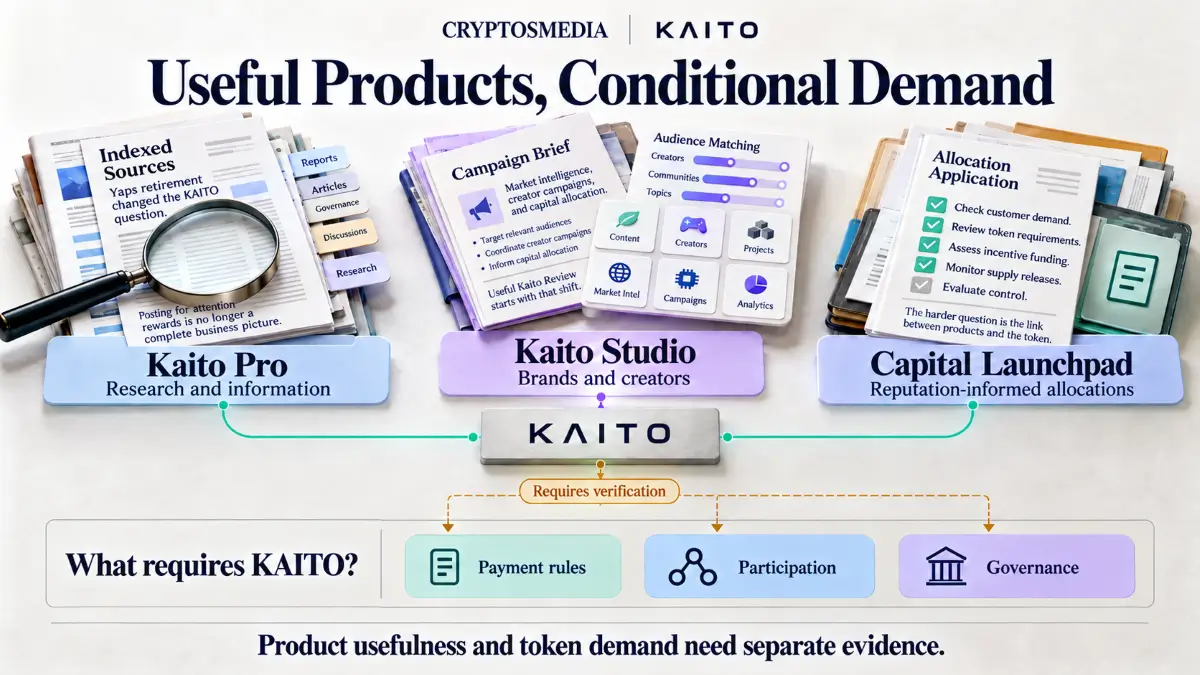
Kaito’s decision to retire Yaps changed the question around KAITO. Posting for attention rewards no longer provides a complete picture of a business that now combines market intelligence, creator campaigns and capital allocation. Any useful Kaito Review must start with that shift, rather than recycle an old guide to earning points.
The harder question sits between the products and the token: when a customer pays for better information or a brand hires a creator, what makes that transaction economically meaningful for KAITO? Answering it requires separate checks on customer demand, token requirements, incentive funding, supply releases and the people who control the system.
This article provides educational research, not financial advice, a price forecast, or a recommendation to buy, sell, hold, or stake any digital asset. Readers should verify current token contracts, supply data, campaign terms, withdrawal rules, and security disclosures before making decisions.
This analysis uses public project documentation, product pages, published terms, market data, and security-provider records. It does not claim private team access, firsthand product testing, or an independent smart-contract audit. Project statements and third-party estimates are assessed according to their evidential strength.
Quick Verdict: A Useful Business With a Separate Token Test
Kaito addresses a recognizable problem: crypto information spreads across too many channels, while brands struggle to identify creators who reach relevant audiences. Search, reputation analysis and campaign coordination can create useful services around that problem. Kaito uses the label InfoFi, short for information finance, for its broader effort to connect information and attention with economic activity.
KAITO presents a more conditional case. Participation, staking and governance provide possible reasons to hold it, but they do not establish a proportional claim on product income. The strongest assessment gives the products credit while requiring clearer evidence that recurring commercial activity creates sustained token demand.
Key Takeaways
Kaito at a Glance
Kaito Pro Starts With a Practical Information Problem
Research teams rarely find everything they need in one feed. A governance proposal may explain a parameter change, a podcast may reveal management priorities, and a technical forum may contain the detail that a short announcement leaves out. Finding the relevant material takes time; checking context takes longer.
Kaito Pro offers purpose-built indexing, search, alerts, sentiment tools and access to transcripts. Those features provide a sensible commercial proposition: help users find and interpret fragmented information faster. The advantage must come from coverage, freshness and useful retrieval, because a polished summary offers little value if it misses the decisive source.

Kaito says Pro has reached profitability. That statement supports further investigation into the business, but it remains a company claim rather than independently audited financial evidence reviewed here. It also says nothing by itself about tokenholder rights. Customers can value a research service without creating an equivalent economic benefit for the associated asset. This distinction between data products and token demand deserves attention before any discussion of category growth or valuation.
Studio Changes the Relationship Between Brands and Creators
Kaito Studio focuses on matching brands with creators and coordinating campaigns. Its commercial logic rests on audience fit: a smaller specialist audience can deliver more useful results than a larger audience with little interest in the product.
The published Studio terms add detail that marketing language cannot replace. Eligible creators can review campaigns, submit quotes and enter agreements with participating brands. Selection and payment depend on campaign conditions; submitting content does not automatically establish a reward entitlement. The terms also place the engagement directly between the creator and the participating brand.
That arrangement matters economically. A campaign budget can include creator compensation and other spending that never becomes Kaito’s retained revenue. Researchers therefore need to distinguish money moving through a campaign from money the platform earns, then identify any subsequent KAITO purchase or holding requirement.
Consider a hypothetical campaign that attracts genuine new users. The brand may receive value, and the creator may earn compensation. Both outcomes support Studio’s usefulness. Neither tells us how much KAITO demand the campaign created without knowing the settlement asset, platform charges and token policy.
Why the Yaps Sunset Belongs in the Current Thesis
Founder Yu Hu announced the sunset of Yaps and incentivized leaderboards in January 2026. Kaito’s announcement channel subsequently described the transition toward Studio and a more curated model of brand–creator matching. A current review should treat the earlier rewards system as history, rather than present old participation instructions as active opportunities.
The change reveals a business constraint. Rewarding public attention can attract participation, but a platform still needs content quality, advertiser trust and continued access to external distribution channels. Paying people to contribute does not ensure that their contributions create enough customer value to fund the rewards.
Moving toward selected campaigns may give brands clearer expectations and better control over spending. It also changes accessibility: campaign participation can depend on approval and audience characteristics, rather than open posting alone.
The pivot supports neither an automatic success verdict nor an automatic failure verdict. It creates a concrete retention test: do brands return, do suitable creators keep participating, and does the resulting activity support a sustainable business model?
Mindshare Needs Context Before It Becomes Evidence
Mindshare describes a share of measured attention within a defined dataset and period. Its interpretation depends on which sources the platform includes, which accounts receive weight and how the model treats repeated or low-quality activity.
A rising score can reflect genuine interest, a paid campaign, controversy or discussion among existing holders. These situations can produce similar-looking visibility while carrying different commercial consequences. An attention score cannot tell researchers which explanation applies without additional evidence.
AI output quality matters here because the scoring system influences decisions about creators, campaigns and reputation. Useful evaluation asks whether the model handles multiple languages fairly, recognizes specialist expertise and resists coordinated attempts to inflate apparent influence. These are research questions, not findings that Kaito has failed those tests.
Brands also need attribution. A campaign may coincide with higher sign-ups while a product launch or broader market movement drives most of the increase. Strong measurement separates those influences where possible and acknowledges the uncertainty that remains. Otherwise, precise-looking numbers can create more confidence than the underlying evidence deserves.
Where Activity Could Create KAITO Demand
Kaito’s token documentation describes KAITO as an ecosystem currency and a means of influencing attention distribution and governance. Those functions provide a starting framework, but a broad utility description cannot establish the payment rules for every product.
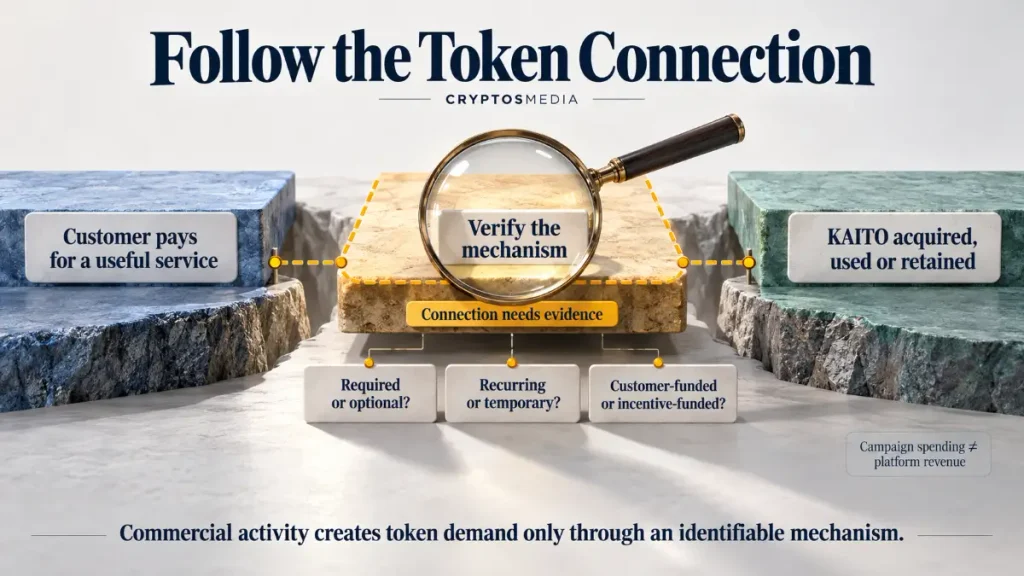
The economic chain needs identifiable steps. A customer purchases something useful; the transaction creates income or a participation requirement; an implemented mechanism then creates a reason to acquire, use or retain KAITO. Researchers should verify each step rather than jump from an expanding product list to stronger token economics.
What Public Evidence Shows and What It Leaves Open
Public product pages establish the scope of Kaito’s offering. Documentation describes the intended mechanisms, while campaign terms explain practical conditions. Market-data services track the asset and supply estimates. Each source answers a different question.
The reviewed materials do not establish a complete, independently audited account of recurring customer revenue, acquisition costs, campaign profitability and the share of commercial activity that reaches KAITO. This gap limits the conclusions a public review can support; it does not prove that the business lacks customers or revenue.
Capital Allocation Is a Different Business From Advertising
Capital Launchpad uses reputation and contribution signals to help determine community allocations. Kaito describes inputs that include social information, onchain participation, holdings, historical alignment and other eligibility factors.
The idea addresses a real allocation problem: projects may want contributors who understand their products rather than participants who appear only for a distribution event. Better selection could improve community quality, but reputation remains an imperfect forecast of future behavior.
Several money flows require separate treatment. Capital committed to a participating project belongs to the fundraising process; it does not automatically represent Kaito revenue. An allocation benefit also does not establish a permanent requirement to buy KAITO. The specific sale terms and current participation rules decide that connection.
Researchers should therefore examine repeat issuers, completed processes and transparent eligibility criteria. A prominent launch can attract attention, while a series of well-executed launches with returning customers would offer stronger evidence of a durable service.
Staking Does Not Turn Incentives Into Business Income
The current staking page offers KAITO staking with sKAITO and states that users can withdraw KAITO seven days after unstaking. That delay matters because market conditions can change while a withdrawal remains unavailable.
Kaito’s earlier staking FAQ identifies liquidity incentives as the reward source and describes participation benefits. Because that FAQ also refers to the older Connect ecosystem, readers should verify current benefit terms rather than carry every historical promise into the present product lineup.
The funding distinction remains essential. Rewards drawn from a token allocation redistribute existing economic resources. Rewards funded through recurring customer income would represent a different relationship. A displayed rate alone cannot establish which model supports a particular period.
Staking can reduce immediately available supply, but it also creates contract exposure and eventual withdrawals. Meaningful analysis asks why users continue holding after a campaign ends, how benefits change and whether participation survives less generous incentives.
Buybacks Need Evidence Beyond an Announcement
Public tracking services include a KAITO buyback category. That provides a research lead, but a category label does not replace a reconciled record of purchases, spending sources and destination wallets. This review does not establish a fixed revenue-allocation percentage or a complete independently verified repurchase total.
The distinction between buybacks and supply growth matters more than a headline announcement. Purchases can create demand at execution, while releases and reward distributions can increase liquid availability. Their net market effect depends on scale, timing and what recipients actually do.
Token handling also matters. A treasury can retain repurchased tokens, distribute them later or destroy them through a verifiable burn. These outcomes have different implications. Readers should not assume that a repurchase permanently reduces total supply, or that any purchase program creates a contractual income right for holders.
KAITO Tokenomics: Supply, Allocations and Distribution
CoinGecko reported approximately 241.4 million KAITO in circulation against one billion total and maximum supply on October 15, 2026. That snapshot describes one provider’s market-data estimate, rather than a complete reconciliation of vested, treasury-held and freely tradable balances.
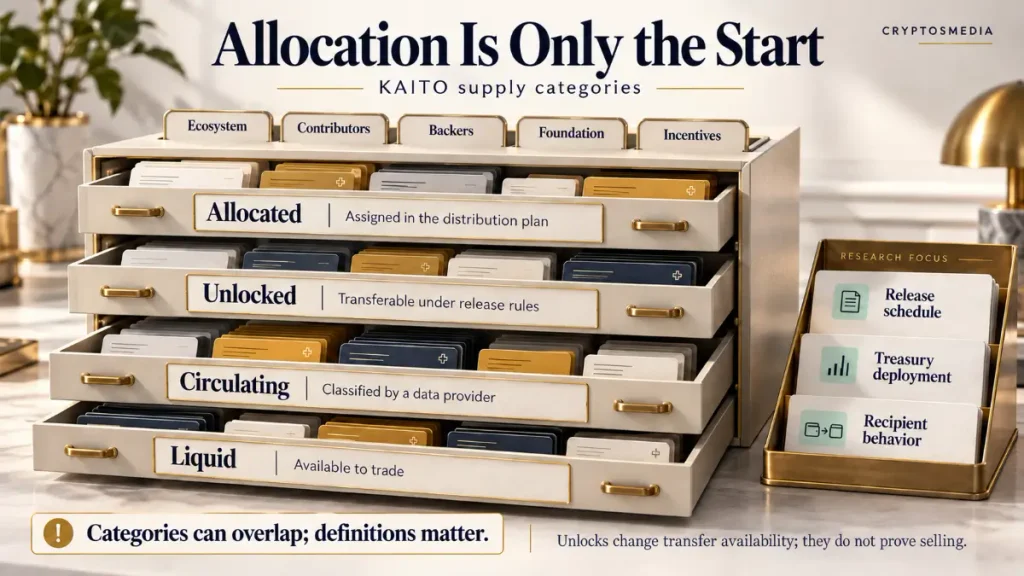
Kaito’s published allocation framework separates ecosystem funding, contributor ownership, backers and participation incentives. The original percentages sum to 100%; the table preserves those categories instead of treating every noncirculating token as the same type of future supply.
Unlocks Change Availability Before They Reveal Selling
An unlock changes a recipient’s ability to transfer tokens. It does not prove that the recipient immediately sells, nor does it necessarily create new tokens beyond an already minted supply.
Circulating, vested, unlocked and liquid describe different conditions. A treasury may control unlocked assets without placing them on an exchange. A staking contract may hold circulating tokens that cannot exit immediately. Market-data providers can classify these balances differently or update their figures at different times.
For KAITO, the useful monitoring sequence follows recipient categories, release dates, destination movements and liquidity conditions. Exchange transfers can justify closer investigation, but even those transfers do not independently prove a completed sale.
Demand absorption also requires more than comparing token counts. A release into a deep market can have a different effect from the same release during weak liquidity. Original allocation percentages explain the distribution plan; they cannot establish today’s ownership concentration or tomorrow’s market response.
Governance Rights Need Visible Decision Power
Kaito’s token materials describe community governance over protocol and algorithm changes. The practical question concerns implementation: which decisions can holders initiate, which votes bind the operators and who executes approved changes?
Product administration and token governance can coexist without sharing the same control structure. Studio’s terms give the operator discretion over creator eligibility and access. Those operating powers matter because they influence who can participate in commercially relevant activities.
A stronger governance assessment would examine proposal history, voter distribution, delegations, execution records and administrator permissions. Token ownership alone does not establish control over the company’s finances, ranking models or commercial contracts.
This distinction also affects decentralization claims. A token can circulate on a public blockchain while a company manages data access, scoring and customer relationships. Readers need to understand each control layer rather than apply one label to the entire business.
Security Must Cover More Than an ERC-20 Token
CertiK’s public Kaito page stated that CertiK had not audited the project and showed no third-party audit in its listed audit history during this review. That record does not prove that no review exists elsewhere. It does mean a security score or monitoring page cannot serve as evidence of a completed contract audit.
Any claimed assessment should identify the reviewer, report date, contract addresses, reviewed version and unresolved findings. A token review cannot automatically cover a staking contract, campaign payment flow or later software release.
Operational security adds separate concerns. Account compromise, misleading campaign messages and fake crypto tokens can harm users even when the genuine token contract behaves as intended. Users need reliable contract references and careful permission checks when connecting accounts or signing transactions.
The overall risk therefore spans contracts, frontends, accounts and administrative processes. No single badge can summarize all four, and public code visibility does not establish that someone has independently reviewed the deployed system.

Privacy and Development Transparency Deserve Separate Checks
Kaito Studio’s privacy policy describes collection that can include connected wallet information, social-account details, submitted content and usage data. Linking these records can help campaign measurement while also creating a more detailed profile of a participant’s activity.
Public blockchain addresses do not make every connection to a social identity harmless. Creators should understand which information a campaign needs, who can access it and what the platform’s retention terms permit. These questions concern data handling, independently of whether a campaign pays successfully.
Development transparency offers another useful distinction. The public Kaito Pulse extension repository allows inspection under a source-available license; it explicitly distinguishes that status from open source. The repository describes account verification and social-signal features, but its existence does not establish open access to the core ranking models.
Pulse’s terms, dated August 14, 2026, also distinguish verification status from an endorsement or guarantee. They allow methodologies and supported features to change, which makes current disclosures more useful than assumptions based on an older interface.
These materials provide concrete items researchers can inspect. They do not justify broad claims about the whole platform’s audit coverage, software quality or resistance to manipulation. Development visibility helps most when readers can connect a release to a defined feature, permission set and review scope.
Where Kaito Has a Credible Advantage
Kaito’s most credible strength lies in bringing related workflows together. Research teams need information, brands need relevant distribution, and projects need ways to identify potential contributors. Those needs can reinforce one another when the underlying data stays useful.
A history of identifying relevant sources and audiences could also improve matching. If customers consistently obtain better results, they have a reason to return without relying on a token reward. That is the commercial opportunity worth studying.
The business also has room to develop a clearer token connection through specific, implemented participation rules. The positive case rests on improving customer outcomes and transparent economics, rather than assuming that every new feature increases KAITO’s necessity.
Where the Token Case Remains Vulnerable
The largest weakness is an incomplete public bridge between useful products and recurring token demand. Information services and creator work can generate commercial value while distributing much of that value through arrangements that provide limited benefits to KAITO holders.
External platform dependencies add another constraint. Changes in access, distribution or participation policies can alter the economics of products built around social information. Kaito’s own product transition makes that dependency relevant to the research case.
Incentive spending, future distributions and discretionary operating decisions compound the uncertainty. None guarantees failure, but each raises the standard of evidence required before treating attention growth as durable economic progress.
Evidence That Would Improve the Assessment
Recurring customer cohorts would provide the clearest improvement: brands returning for later campaigns, research customers renewing and creators completing paid work after introductory incentives decline. Aggregate sign-ups offer less information than retention and repeat spending.
Product-level reporting would help explain the economics. Researchers need to distinguish campaign budgets, creator compensation, platform charges, operating costs and any amount committed to token-related mechanisms. Clear accounting would make commercial growth easier to evaluate without overstating holder benefits.
On the token side, current utility rules, traceable repurchase records and visible governance execution would narrow the main evidence gaps. Better audit disclosures and transparent change records would strengthen confidence in the supporting infrastructure. These improvements would matter because they answer specific questions, rather than simply add more announcements.
Developments That Would Undermine Confidence
Confidence would weaken if brand spending repeatedly disappeared after incentives ended, if creators optimized scores without delivering useful outcomes, or if product income grew while token requirements remained economically marginal.
Supply-related concerns would rise if treasury deployment lacked explanation or if reports blurred allocated, unlocked and circulating balances. Unclear repurchase reporting would create similar difficulty by preventing researchers from comparing purchases with distributions.
Security and governance concerns would grow if the platform presented monitoring scores as audit assurance, changed material participation conditions without clear notice or failed to explain who controls consequential decisions. The common issue is accountability: users and readers need enough information to understand both the rules and their economic effects.
Final Kaito Review Assessment
Kaito deserves analysis as a business with practical information and distribution products. Its shift away from Yaps makes current product research essential, while Pro, Studio and Capital Launchpad offer distinct routes to customer value.
KAITO requires a separate conclusion. Participation and governance provide potential utility, but the public record reviewed here does not establish a clear, recurring link between commercial activity and KAITO demand. Supply distribution, incentive funding and operational control remain material parts of the assessment.
The decisive evidence will come from customers who return, economics that remain viable after rewards and token mechanisms that readers can trace. Until those layers become clearer, the balanced position recognizes Kaito’s commercial proposition while treating sustained KAITO demand as a question that still needs measurable answers.
Why Trust This Review
The review separates current products from legacy rewards, company statements from independently established results, and token allocations from actual selling. It uses a dated supply snapshot and identifies the limits of public financial and security evidence.
The analysis does not claim personal platform use, private interviews, wallet-level ownership attribution or direct code auditing. Where the available evidence cannot resolve an economic question, the text identifies the missing information instead of filling the gap with a confident forecast.
Key Questions About Kaito and KAITO
What does Kaito actually do?
Can users still earn through the original Yaps system?
What does KAITO provide utility for?
Does buying KAITO give ownership of Kaito’s business?
Which blockchain hosts KAITO?
What is sKAITO?
What is KAITO’s maximum supply?
Do unlocks guarantee selling pressure?
Does higher mindshare prove commercial success?
What matters most for the long-term KAITO thesis?

Founder & Managing Editor of CryptosMedia. Zahid Hussain leads evidence-based crypto research covering tokenomics, security, governance, adoption, and risk.
CryptosMedia separates verified facts from interpretation, avoids buy/sell recommendations, and updates reviews when major evidence changes.