
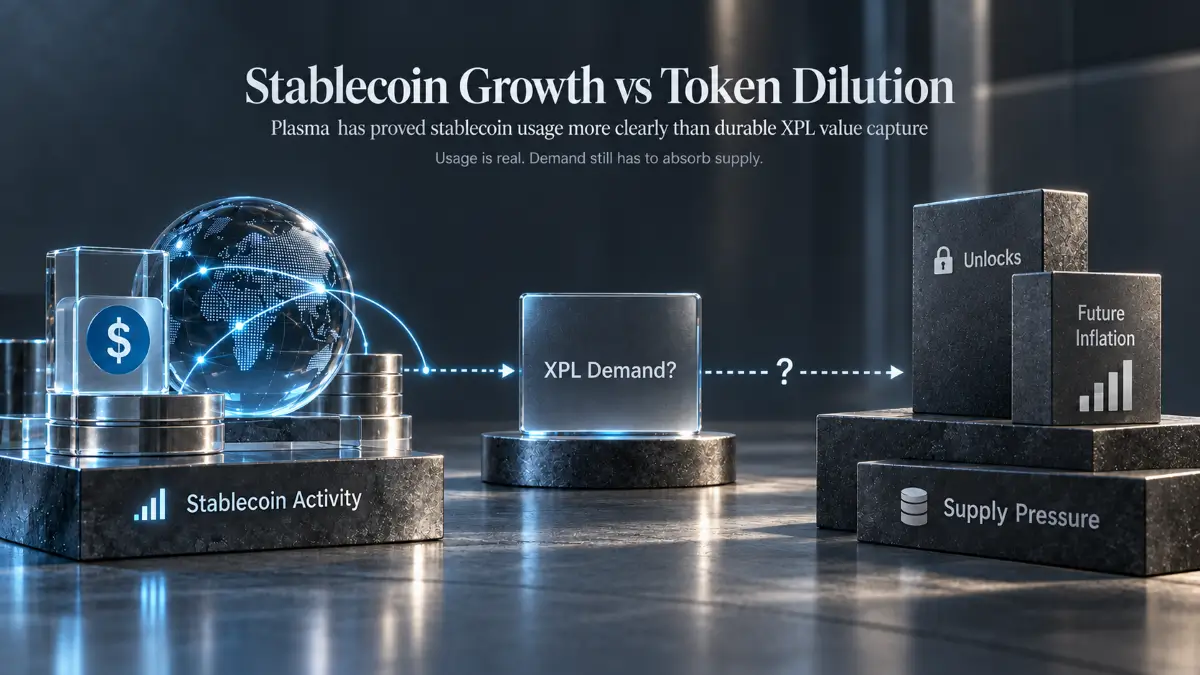
Plasma entered the market with a focused proposition: stablecoins should have a Layer 1 designed around payments rather than being treated as one asset class on a general-purpose chain. Nearly a year after mainnet beta launched, the network has enough activity to test that idea with real data. This Plasma XPL review finds a meaningful stablecoin footprint, but a harder question around the native token.
XPL sits behind network execution and future proof-of-stake security, yet Plasma deliberately removes the token from parts of the user experience. Eligible USD₮ transfers can receive gas sponsorship, while approved ERC-20 assets can cover fees through protocol-managed paymasters. That design can improve payments, but it weakens the simple assumption that more stablecoin activity must create proportional XPL demand.
Supply adds a second pressure point. Team and investor allocations reach their first major cliff on September 25, 2026, ecosystem tokens continue to unlock monthly, and Plasma plans additional validator issuance after external validators and delegated staking go live. The central question is therefore not whether Plasma has users and capital. It is whether fee burns, staking, product locks and other forms of XPL demand can grow enough to absorb expanding supply.
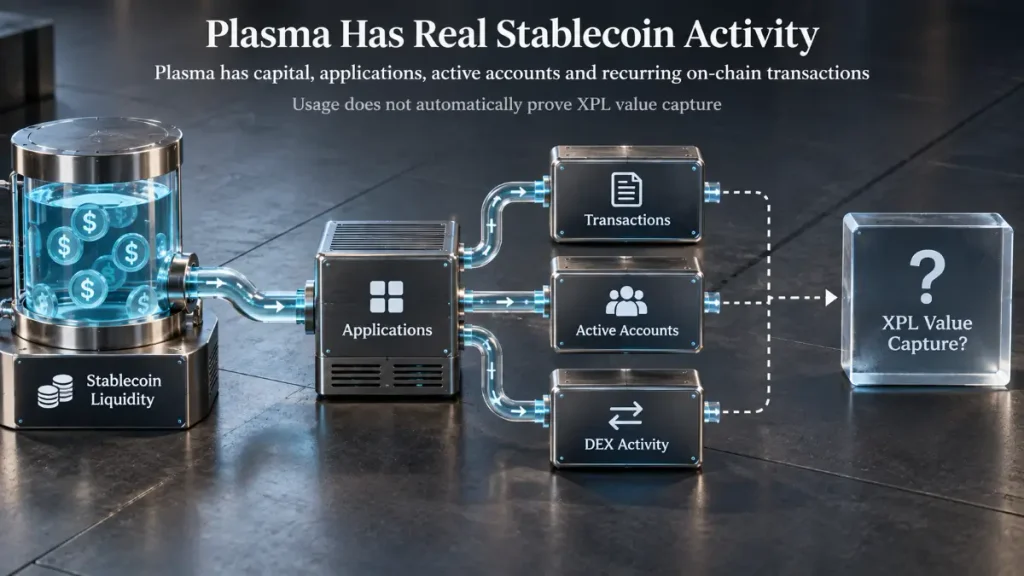
Plasma Has Real Stablecoin Activity
Plasma no longer needs launch announcements alone to demonstrate adoption. Current live chain metrics showed about $1.06 billion in stablecoins and roughly $579 million in DeFi TVL on September 16, 2026. DefiLlama also recorded 36,927 active addresses and 588,953 transactions over 24 hours, which gives the network a measurable operating footprint.
DEX volume reached about $8.03 million over the same snapshot. Bridged TVL was above $3 billion, although bridged assets and DeFi TVL measure different things and should not be combined into one adoption figure. Together, the data shows that Plasma has capital, applications, active accounts and recurring on-chain transactions.
Usage Does Not Equal XPL Demand
Usage still needs the right interpretation. TVL measures assets committed to applications, not protocol revenue, while transaction count does not show how much users paid or how much XPL anyone bought. Stablecoin balances can also grow while users hold little or no XPL themselves.
Current fee data makes that distinction unusually clear. DefiLlama recorded about $358 in Plasma chain fees during the September 16 daily snapshot, while applications on Plasma generated roughly $126,000 in fees over the same broad period. Those categories use different accounting methods, so the comparison does not represent a loss to Plasma. It shows that substantial application activity can coexist with relatively low Layer 1 fee capture.
| Evidence | Current Position | Why It Matters |
|---|---|---|
| Stablecoin market cap | About $1.06B | Shows substantial stablecoin liquidity on Plasma |
| DeFi TVL | About $579M | Confirms meaningful capital deployed in applications |
| Active addresses | 36,927 over 24 hours | Shows measurable current account activity |
| Transactions | 588,953 over 24 hours | Confirms significant on-chain use |
| DEX volume | About $8.03M over 24 hours | Shows active trading rather than idle liquidity alone |
| Chain fees | About $358 over 24 hours | Indicates limited current Layer 1 fee capture |
| App fees | About $126K over 24 hours | Shows application activity can exceed base-chain fee capture by a wide margin |
That gap matters for any native-token value capture thesis. A useful network can attract users and capital without transferring the same amount of economic value to its native token. That separation matters especially on Plasma because lower native-token friction is part of the product design.
Plasma Makes Stablecoin Payments Easier by Hiding XPL
Plasma is an EVM-compatible Layer 1 with Reth-based execution and PlasmaBFT consensus. Developers can use familiar Solidity tooling while the network adds stablecoin-focused features. Fee abstraction is the most important for XPL economics.
Zero-Fee USD₮ Transfers Reduce Native-Token Friction
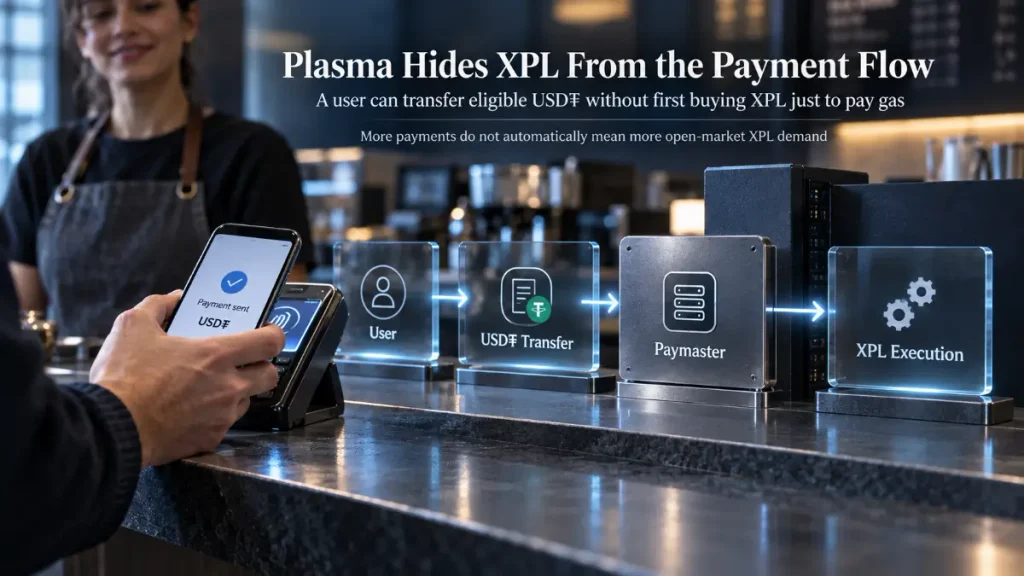
Plasma’s official fee abstraction design describes a protocol paymaster for eligible USD₮ transfers. The Plasma Foundation maintains a managed XPL allowance that sponsors qualifying transactions after the paymaster checks transaction type, eligibility and rate limits. A user can therefore send eligible USD₮ without first acquiring XPL just to pay gas.
That design removes a crypto-specific step from the payment flow. Someone still covers execution, but the user does not necessarily hold the native token. The Foundation can fund the paymaster from XPL it already controls, so sponsored transfers do not prove repeated open-market purchases.
This creates an important analytical limit. A rise in zero-fee stablecoin transfers can show stronger product usage without proving an equal rise in market demand for XPL. The payment experience may improve precisely because the token becomes less visible to the person making the payment.
Custom Gas Tokens Extend the Same Trade-Off
Plasma also allows approved ERC-20 assets to work as gas tokens through a protocol-maintained paymaster. Applications can keep users inside a stablecoin-focused experience rather than requiring a separate XPL balance. That makes the chain easier to use, particularly for products that want payments to feel closer to ordinary digital money.
The token consequence is less direct. If users can transact without holding XPL, transaction growth cannot show whether the native asset benefits economically. Other mechanisms must connect network activity to XPL demand or reduced liquid supply.
Where XPL Can Capture Value
Four mechanisms matter most: gas settlement, fee burns, validator staking and product-linked token locks. None should be treated as automatic value capture. The useful question is whether their combined scale can become large relative to unlocks and future issuance.
Gas Settlement and Burns Create a Direct Supply Sink
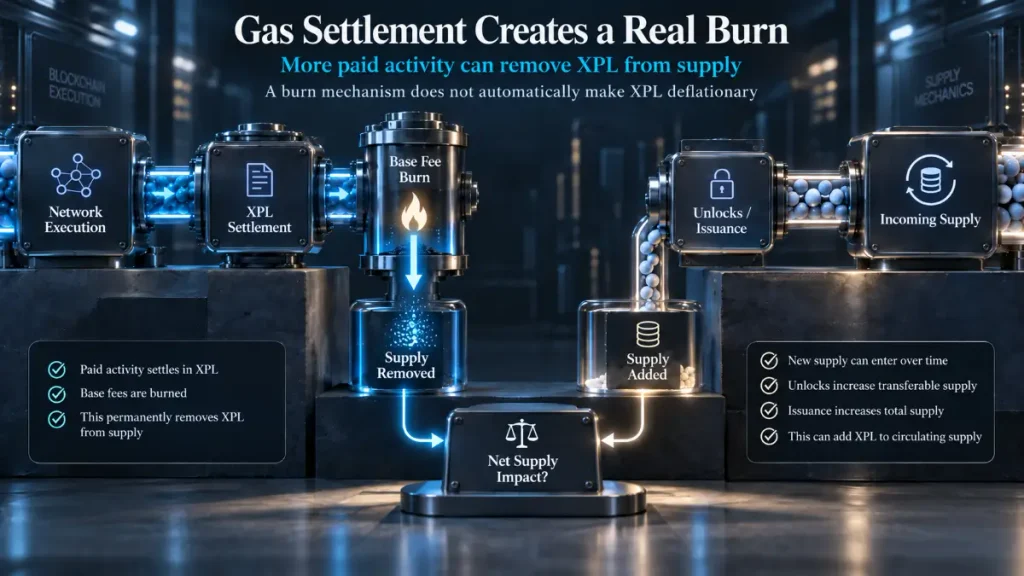
XPL remains the native asset underneath Plasma execution even when a paymaster hides that relationship from the end user. Protocol-managed paymasters need XPL balances to sponsor execution, and paid transactions follow an EIP-1559 style mechanism that burns base fees. More paid activity can therefore remove some XPL from total supply.
Scale is the unresolved issue. A burn funded by a few hundred dollars of daily chain fees cannot currently offset vesting events measured in hundreds of millions or billions of tokens. Much stronger fee generation could change that relationship, but current evidence does not support treating XPL as net deflationary.
A burn mechanism and net deflation are different claims. Analysts need to compare tokens destroyed with new validator issuance, ecosystem releases and other additions to available supply. The same discipline applies to staking, because locking tokens and reducing total supply are not the same thing.
Staking Could Become the Strongest Structural XPL Demand
XPL also supports Plasma’s proof-of-stake security model. Once external validators and delegated staking are active, validators and delegators can commit XPL to network security, creating a stronger structural reason to hold the asset than transaction gas alone. Staked balances can reduce immediately liquid supply while participants remain exposed to protocol rewards and token-price risk.
The mechanism also creates dilution. Plasma’s published tokenomics starts validator rewards at 5% annual inflation, falling by 0.5 percentage points per year until a 3% baseline. Plasma says inflation activates only when external validators and stake delegation go live, so planned rewards are not current emissions.
After activation, the correct comparison will be XPL locked for security versus XPL created as rewards. A larger validator set and substantial delegated stake could strengthen the network and absorb liquid supply, while weak staking participation would make new issuance harder to offset. Projects with more direct revenue-linked token demand face a different test because their token economics connect usage to value capture through other mechanisms.
Plasma One Adds a Consumer Locking Mechanism
Plasma has also tied XPL to its consumer payments product. Updated Plasma One lock rules allow eligible users to lock XPL for 12 months to access certain membership tiers, with the on-chain vault restricting normal transfer or early redemption before maturity. That creates a temporary liquidity sink because participating XPL becomes unavailable for transfer during the lock.
The mechanism still needs adoption evidence. A lock contract proves that the route exists, not how many people will use it or how much XPL they will commit. Current evidence does not show that Plasma One can absorb a material share of future supply.
XPL Tokenomics Put Dilution at the Center
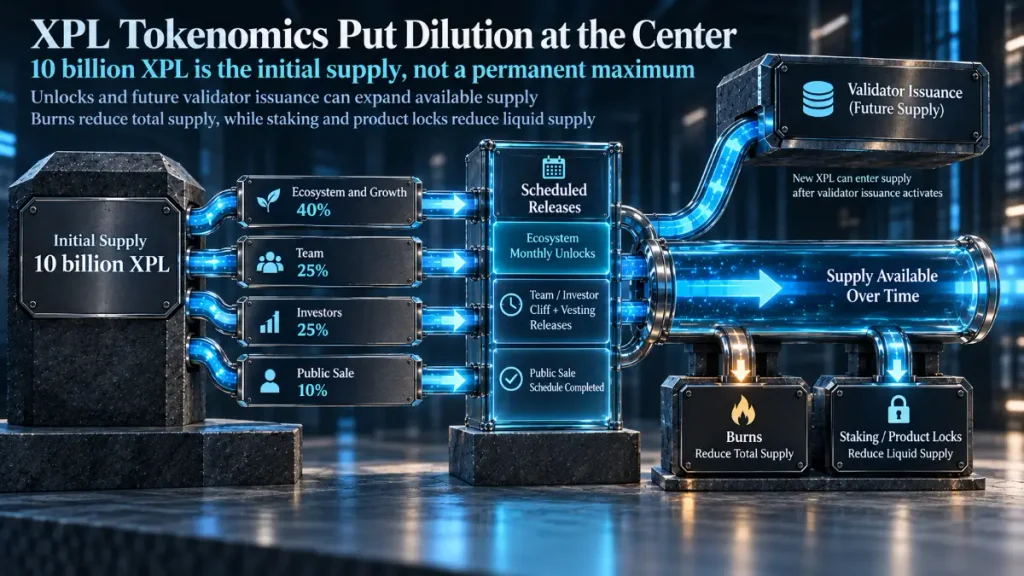
XPL launched with an initial supply of 10 billion tokens. Plasma does not describe that figure as a permanent maximum because its validator model includes programmatic issuance after expanded staking activates. Market trackers reported about 2.78 billion XPL circulating on September 16, 2026, which should be treated as a time-sensitive third-party estimate rather than the official vesting schedule.
According to the official XPL distribution schedule, 40% of the initial supply goes to Ecosystem and Growth, 25% to the team, 25% to investors and 10% to the public sale. Non-US public-sale tokens were unlocked at mainnet beta, while US public-sale tokens carried a 12-month lock that ended on July 28, 2026. The other allocations create a longer release schedule.
Ecosystem Supply Enters the Market Every Month
Plasma allocated 4 billion XPL to Ecosystem and Growth. It made 800 million XPL available at mainnet beta, while the remaining 3.2 billion unlock pro rata each month across the following three years. Dividing that amount across 36 months gives a schedule-derived tranche of about 88.9 million XPL per month.
Those tokens can fund liquidity, integrations, incentives and ecosystem growth, so an unlock is not evidence of selling. It still matters because unlocked tokens become available for transfer, deployment or potential sale. Product growth and dilution can happen at the same time.
September 25 Brings the First Major Team and Investor Cliff
Team and investors were each allocated 2.5 billion XPL. One-third of each allocation reaches its first cliff one year after the September 25, 2025 public mainnet beta launch, which works out to about 833.3 million team tokens and another 833.3 million investor tokens on September 25, 2026. Together, those two cliff amounts total roughly 1.667 billion XPL.
Adding the normal monthly ecosystem tranche of about 88.9 million produces a schedule-derived total near 1.756 billion XPL around that date. That amount equals about 17.6% of the original 10 billion initial supply, making it a major change in unlocked supply. It is not evidence that 1.756 billion XPL will be sold.
An Unlock Is Not a Sale
Vesting only determines when tokens become transferable under the published schedule. Recipients may hold, stake, provide liquidity, transfer between wallets or sell, and the schedule alone cannot reveal which behavior will occur. Treating a cliff as guaranteed selling would turn a verifiable supply event into an unsupported market prediction.
| Tokenomics Item | Current Position | Why It Matters |
|---|---|---|
| Initial supply | 10B XPL | Starting supply, not a permanent maximum |
| Estimated circulating supply | About 2.78B XPL on Sep. 16, 2026 | Time-sensitive market-tracker figure, separate from the vesting schedule |
| Ecosystem and Growth | 40%, or 4B XPL | Largest allocation and source of recurring monthly unlocks |
| Team | 25%, or 2.5B XPL | One-third reaches its first cliff on Sep. 25, 2026 |
| Investors | 25%, or 2.5B XPL | Follows the same main unlock structure as the team allocation |
| Public sale | 10%, or 1B XPL | Distribution timing differed for US and non-US participants |
| Ecosystem monthly tranche | About 88.9M XPL | Adds recurring transferable supply during the vesting period |
| Sep. 25 schedule-derived amount | About 1.756B XPL | Large increase in unlocked supply, not proof of automatic selling |
| Validator inflation | Planned at 5% initially, declining toward 3% | Creates new supply after expanded staking activates |
| Base-fee burn | Protocol burns base fees | Can offset part of issuance if paid network activity becomes large enough |
| Plasma One locking | Certain tiers require 12-month XPL locks | Can temporarily reduce liquid supply |
| Main tokenomics test | XPL demand versus expanding supply | Shows whether network use translates into durable token economics |
Future Inflation Keeps the Supply Ceiling Open
The initial 10 billion figure is not XPL’s fixed maximum supply. Plasma plans validator issuance after external validators and delegated staking activate, beginning at 5% annual inflation and declining toward 3%. Base-fee burns work in the opposite direction by destroying part of the XPL used for paid execution.
Future net supply will therefore depend on several moving parts. Vesting releases can increase transferable supply, validator rewards can create new XPL, burns can reduce total supply, and staking or Plasma One locks can reduce liquid availability without destroying tokens. That makes the token economy more complex than a fixed-cap asset with a simple unlock calendar.
Security Depends on More Than EVM Compatibility
Plasma’s EVM compatibility gives developers familiar tools, but it does not remove chain-specific risk. The network combines custom consensus, project-operated infrastructure, paymasters, bridges, oracle dependencies, DeFi contracts and consumer payment services. Each layer has a different failure mode, so one audit or one healthy validator set cannot cover the entire risk surface.
Validator and Client Diversity Still Matter
Current validator disclosure states that Plasma and its affiliates operate certain validators and supporting infrastructure. The terms also say that this role does not allow Plasma to modify or reverse validly submitted transactions. That confirms project-operated infrastructure remains part of the live trust model without proving that Plasma controls the entire validator set.
Plasma described the launch structure as part of progressive decentralization. The relevant current question is how validator participation, stake concentration, client diversity and operational control evolve as the external validator system expands. Security analysis should follow those changes instead of treating the launch configuration as permanent.
A pre-launch technical evaluation prepared for the Aave community described a small validator group at launch with no permissionless validator participation and identified exclusive reliance on Reth as a client-diversity concern. The evaluation also recorded several consensus-client security reviews, including work by Cantina, Zellic and Zenith. Those reviews are useful evidence about reviewed code, but they do not prove the live network is safe.

Paymasters Create a Separate Operational Dependency
The Plasma Foundation manages the XPL allowance behind sponsored USD₮ transfers and can apply eligibility rules and rate limits. Those controls help contain abuse and subsidy costs, but they also create an operational dependency around one of Plasma’s most distinctive payment features. A paymaster failure would not automatically stop PlasmaBFT consensus, yet it could disrupt the zero-fee experience that makes the chain attractive to payment users.
Application reliability and consensus safety are not the same thing. Plasma can keep producing valid blocks while a payment feature, bridge or application suffers an outage or exploit. Each dependency needs assessment at the layer where it operates.
Bridges and Oracles Extend Risk Beyond PlasmaBFT
Stablecoin applications depend on infrastructure outside the base chain. Users move assets across networks, lending markets rely on external prices, and DeFi protocols integrate third-party systems. A bridge can fail while both chains keep operating, which is why cross-chain messaging risk needs separate treatment from Plasma consensus.
Lending and derivatives markets also depend on accurate pricing. Weaknesses in oracle infrastructure can damage an application even when Plasma keeps finalizing valid blocks. Plasma One adds another dependency set through cards, ramps, swaps and consumer-facing services, so network security and product security should remain separate parts of the analysis.
What Plasma Still Needs to Prove
Plasma has shown that it can host substantial stablecoin liquidity and regular on-chain activity. The next stage is showing that activity can persist without relying mainly on launch-era incentives. Stablecoin balances, active addresses and application use should remain meaningful as the ecosystem matures.
Retention matters because launch size can be misleading. A durable network should keep attracting useful financial activity after initial campaigns and liquidity incentives fade. One strong snapshot supports current usage, but it cannot establish long-term retention.
XPL Demand Needs to Become Measurable at Larger Scale
XPL already has several demand routes. Paymasters need the token underneath execution, paid activity burns base fees, future validators and delegators can stake XPL, and Plasma One users can lock tokens for membership benefits. The open question is not whether these mechanisms exist but whether they become large enough to compete with supply expansion.
Current chain fees remain small relative to the scheduled cliff. Delegated staking has not yet shown its eventual effect, and consumer locking still needs transparent adoption data. After September 25, useful evidence will include circulating supply, identifiable allocation-wallet movements where attribution is reliable, staking participation, locked balances and fee burns rather than price movement alone.
Validator Expansion Creates Both Security Demand and Inflation
External validators and delegated staking could improve decentralization while giving XPL a stronger security role. They also activate the planned inflation schedule, which means the same upgrade can create both token demand and new supply. Measuring only one side would give an incomplete picture.
A stronger outcome would combine broader validator participation with substantial XPL locked for security and a fee base able to offset part of issuance. A weaker outcome would pair new reward emissions with limited staking and low burns. Live data after activation will determine which outcome is closer to reality.
Plasma XPL Review Verdict
Plasma has stronger evidence of real activity than many newer Layer 1 projects. More than $1 billion in stablecoins, substantial DeFi liquidity and hundreds of thousands of daily transactions give it an operating footprint rather than just a roadmap. Stablecoin-first features also reduce the need to manage a volatile native token for routine payments.
That same design makes the XPL thesis harder to prove. Zero-fee USD₮ transfers and custom gas assets can improve adoption while weakening direct transaction-driven demand for XPL. Staking, fee burns, paymaster balances and Plasma One locks offer stronger economic links, but current evidence does not show that their combined scale already offsets future supply expansion.
The dilution side is easier to quantify. Roughly 1.756 billion XPL reaches schedule-derived unlock status around September 25, 2026 when the first team and investor cliffs combine with a normal monthly ecosystem tranche. Further ecosystem releases continue after that, while future validator rewards can eventually raise supply above the initial 10 billion tokens.
The evidence supports a narrow conclusion: Plasma has proved stablecoin usage more clearly than it has proved durable XPL value capture. That is not a prediction about XPL price, and it does not mean the two sides cannot converge. The next phase needs measurable staking, token locks, fee burns and retained stablecoin activity strong enough to show whether network growth can outpace dilution.
Frequently Asked Questions
Plasma is an EVM-compatible Layer 1 focused on stablecoin payments and financial applications. XPL is its native asset for execution and proof-of-stake security, while delegated staking is planned as the validator system expands.
Yes, current data shows meaningful activity. On September 16, 2026, DefiLlama showed about $1.06 billion in stablecoins, roughly $579 million in DeFi TVL, 36,927 active addresses and 588,953 transactions over 24 hours. These metrics demonstrate usage, but they do not equal Plasma revenue or direct XPL demand.
Eligible USD₮ transfers can receive gas sponsorship through a protocol paymaster funded with XPL. The end user can avoid paying gas directly, although the paymaster still covers the underlying execution cost.
The published schedule puts one-third of the 2.5 billion team allocation and one-third of the 2.5 billion investor allocation at their first cliff, or roughly 1.667 billion XPL combined. Adding a normal monthly Ecosystem and Growth tranche produces a schedule-derived amount of about 1.756 billion XPL around that date. An unlock makes tokens transferable but does not prove recipients will sell them.
No fixed 10 billion maximum appears in Plasma’s published tokenomics. The project describes 10 billion XPL as the initial supply and plans additional validator issuance after external validators and delegated staking activate.
Plasma says validator inflation starts only when external validators and delegated staking go live. The published schedule begins at 5% annually and declines by 0.5 percentage points each year until it reaches a 3% long-term baseline, so planned future issuance should not be confused with current emissions.
Potential routes include XPL used underneath network execution, base-fee burns, validator staking and Plasma One token locks. Fee abstraction means stablecoin transaction growth alone does not prove equivalent open-market demand for XPL.
Supply expansion deserves close attention alongside demand. The September 25 cliff, continued ecosystem releases and eventual validator inflation need to be compared with measurable staking, XPL locks, fee burns and retained network activity rather than treated as standalone bearish or bullish signals.

Founder & Managing Editor of CryptosMedia. Zahid Hussain leads evidence-based crypto research covering tokenomics, security, governance, adoption, and risk.
CryptosMedia separates verified facts from interpretation, avoids buy/sell recommendations, and updates reviews when major evidence changes.