
Nosana has moved beyond the stage where its main question was whether a decentralized GPU network could run real workloads. Its public GPU marketplace opened on January 14, 2025, allowing developers to access independently operated NVIDIA GPUs for AI inference and related compute tasks. Nosana later reported more than 3 million completed jobs, more than 3 million GPU job hours, and 650 unique clients during the marketplace’s first year through its first-year marketplace data.
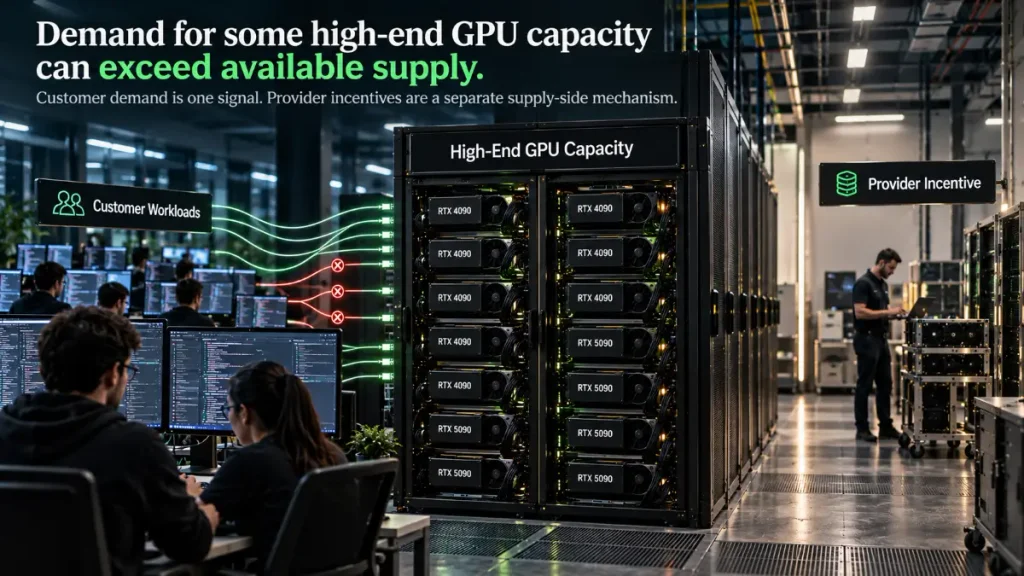
More recent activity provides another demand signal. On September 17, 2026, Nosana reported that customer demand for RTX 4090 and RTX 5090 capacity had exceeded the supply available in those markets. Its current RTX campaign responds with a two-month provider incentive equivalent to 20% daily utilization for qualifying hosts, separate from earnings generated by actual customer workloads.
Those two facts need to stay separate. A shortage of specific GPU capacity supports the case that developers are requesting real compute, while an incentive for providers shows that Nosana is still spending resources to expand marketplace supply. Neither fact alone proves profitability or durable NOS token demand.
That distinction defines this Nosana Review. Nosana has increasingly credible evidence of real GPU usage, but the economic connection between that activity and durable NOS demand is less clearly demonstrated. Jobs, compute hours, provider earnings, rewards, customer spending, and token demand are related measurements, but they are not interchangeable.
This article is for research and education only and does not provide financial, investment, tax, or legal advice.
What Nosana Actually Provides
Nosana operates a distributed GPU marketplace focused mainly on AI workloads. Developers can deploy applications onto available GPU capacity while independent providers make compatible hardware available to the network. Solana programs coordinate important onchain functions, while Nosana software handles deployment, scheduling, APIs, host interaction, and other marketplace operations.
Nosana divides GPU capacity into separate markets instead of treating it as one uniform resource. That matters because GPUs such as the RTX 3060, RTX 4090, RTX 5090, A100, and H100 differ significantly in memory, performance, power requirements, and operating economics. Matching each workload with suitable hardware is more useful than advertising one aggregate GPU number.
AI inference is particularly relevant to Nosana’s model because it can create recurring demand. Training may involve large but temporary workloads, while a live application can require GPU execution whenever somebody generates an image, processes video, runs a language model, or launches an agent workflow.
Nosana therefore does not need to replace every service supplied by a hyperscale cloud provider to establish a viable market. Its narrower test is whether distributed hardware can deliver enough suitable capacity, predictable execution, and competitive economics for developers who do not need the complete service stack of a traditional cloud.
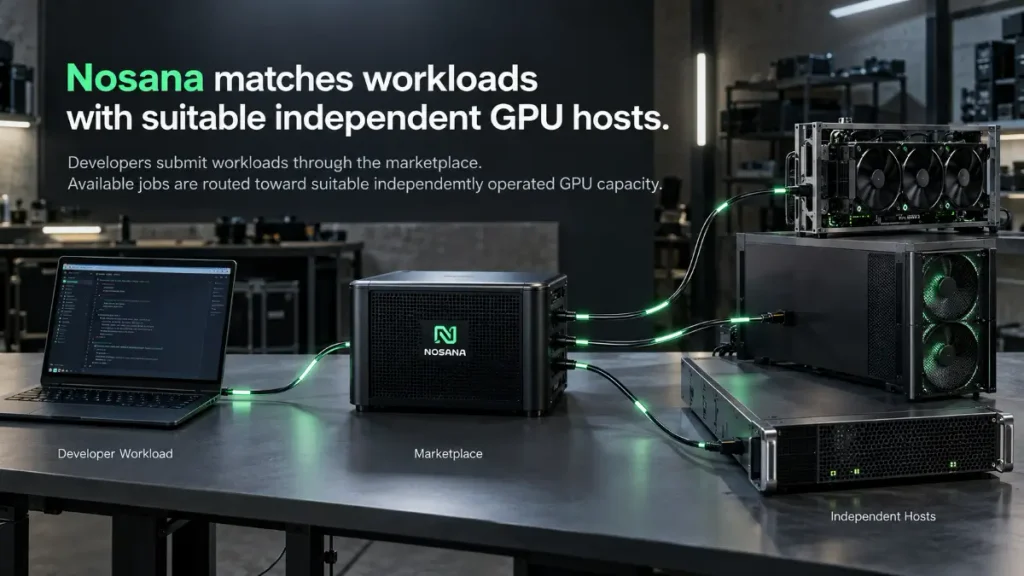
The same economic test appears across decentralized compute markets. Available hardware matters, but repeat customer demand and completed paid workloads provide stronger evidence than theoretical infrastructure size.
Independent Hosts Change the Risk Model
Nosana does not own every GPU executing customer workloads. Providers retain control of their hardware while Nosana coordinates access, workload scheduling, and payments. The September 2026 campaign requires qualifying RTX 4090 and RTX 5090 hosts to meet technical requirements and maintain at least 85% daily uptime to receive its additional incentive.
This model can bring underused hardware into a global compute marketplace, but it creates a different trust structure from a tightly controlled data center. Application security can depend on host software, containers, remote hardware, credentials, networking, APIs, operational controls, and the Solana programs used by the network.
Distributed infrastructure is not automatically unsafe, just as centralized infrastructure is not automatically safe. The useful question is which party controls each layer, what can fail, and what evidence exists that the layer behaves as expected.
Nosana Has Measurable GPU Usage
The strongest part of the Nosana thesis is now product activity rather than planned adoption. Nosana reported more than 3 million completed jobs and more than 3 million GPU job hours by January 30, 2026. It also reported 650 unique clients during the first year of the public marketplace.
These figures come from Nosana rather than an independent financial audit, so this review treats them as project-reported operating metrics. Even with that limitation, GPU job hours add useful context because large numbers of very short executions can inflate raw job counts.
Sogni provides a visible example of recurring workload activity. Nosana reported that Sogni users had generated more than 25 million images using Nosana GPUs by November 2025. The same November network update also disclosed free GPU credits, which is important context when interpreting total network activity.
The image total demonstrates substantial application usage, but it does not disclose how much customer-funded revenue each image generated. Promotional workloads can still represent genuine computation, yet subsidized activity and repeat full-price customer demand provide different economic evidence.
High-End GPU Demand Is a Fresh Signal
The September 2026 RTX campaign provides one of the freshest pieces of evidence in this review. Nosana says demand for RTX 4090 and RTX 5090 capacity currently exceeds available supply, meaning customers are requesting more capacity in those specific markets than participating providers can currently offer.
Nosana is simultaneously paying an additional incentive equivalent to 4.8 hours of daily utilization for eligible providers that maintain at least 85% uptime. Actual customer-job earnings are added separately, so provider income during this campaign can contain both organic workload payments and Nosana-funded incentives.
That distinction prevents an important analytical mistake. Higher host earnings during the campaign would not, by themselves, demonstrate an equal increase in customer spending because part of those earnings can come from the temporary incentive.
| Evidence | Current Position | Why It Matters |
|---|---|---|
| Public GPU marketplace | Live since Jan. 14, 2025 | Confirms production infrastructure |
| Completed jobs | 3M+ reported by Jan. 2026 | Shows measurable workload activity |
| GPU job hours | 3M+ reported by Jan. 2026 | Adds depth beyond job count |
| Unique clients | 650 reported in first year | Indicates client distribution |
| Sogni workload | 25M+ images reported by Nov. 2025 | Shows one high-volume application |
| RTX 4090 and 5090 demand | Reported above available supply on Sep. 17, 2026 | Supports demand for specific GPUs |
| Provider campaign | Extra 20% daily utilization incentive | Subsidies must stay separate from customer payments |
| Network earnings | $2M+ reported by Dec. 2025 | Shows network activity, not NOS holder revenue |
Network Earnings Are Not Nosana Revenue
Nosana reported more than $2 million in total network earnings by the end of December 2025 through its network earnings milestone. The figure is economically useful because it shows value moving through the marketplace, but Nosana described it as total network earnings rather than company revenue, protocol income, or token-holder revenue.
A customer paying for GPU time can create income for a hardware provider without creating a proportional economic claim for NOS holders. Customer spending, provider payouts, protocol-retained income, promotional subsidies, and token-holder value capture therefore need to be measured separately.
Future disclosure could improve this part of the Nosana thesis substantially. Consistent reporting of customer-funded compute spend, provider payouts, promotional credits, protocol-retained fees, and repeat paying customers would make it easier to determine how much activity is economically self-sustaining.
NOS Has Real Utility, but the Demand Path Is Not One-to-One
NOS is the native SPL token of the Nosana Network. The official token documentation lists a total supply of 100 million NOS and identifies the token address as nosXBVoaCTtYdLvKY6Csb4AC8JCdQKKAaWYtx2ZMoo7. The documentation also states that NOS can be exchanged for access to AI workloads.
This gives NOS a genuine product role. Nosana also describes NOS as part of its staking, incentive, and governance systems, while the NNP-0001 vote provides evidence that holders have participated in a governance process rather than governance existing only as a future roadmap item.
The limitation comes from payment abstraction. Nosana’s API uses credits for deployments authenticated through API keys, while its June payment update added the ability to purchase credits with NOS or USDC alongside the existing card option.
That design reduces friction for developers, but it also breaks any simple assumption that every compute job requires a direct open-market NOS purchase by the customer. Someone can create genuine GPU demand through a card-funded or USDC-funded credit balance without personally acquiring NOS for every deployment.
Token conversion or settlement could still occur elsewhere in the economic flow. Unless that path is consistently disclosed and measured, however, workload growth should not be translated mechanically into equal NOS buying pressure.
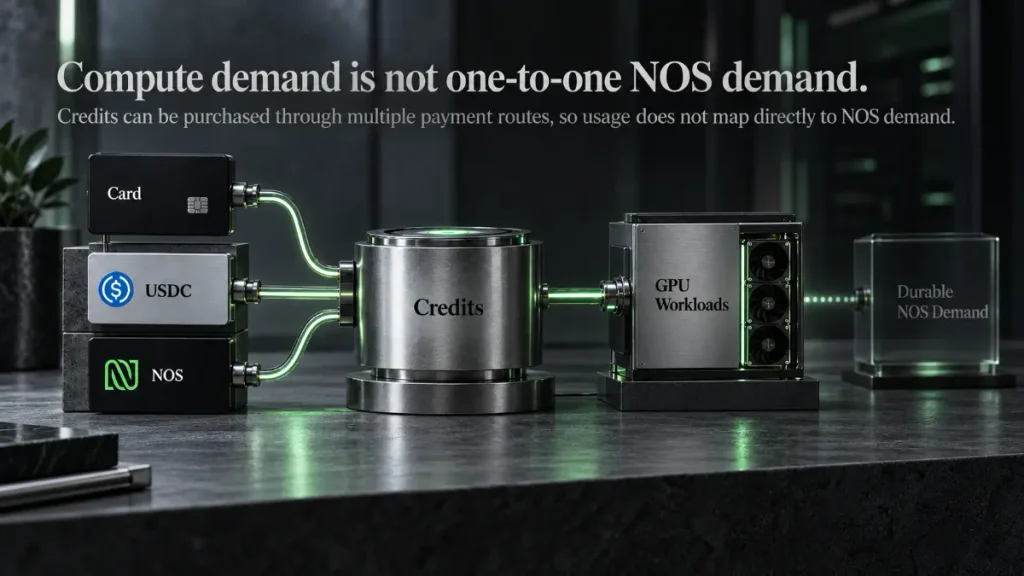
This same distinction matters across distributed GPU networks. A network can deliver useful compute while the economic connection between customer spending and its native token remains a separate question.
NNP-0001 Is Changing the Reward Model
Nosana itself identified a weakness in its earlier reward design during 2025. NNP-0001 argued that passive yield was largely disconnected from real network usage and proposed redirecting rewards toward capacity, reliability, and returning demand.
The governance vote took place in November 2025 and Nosana subsequently reported that the proposal passed. Its current staking application states that passive staking rewards will sunset over a 12-month transition.
The intended direction is more closely connected with marketplace performance than passive yield alone. Paying rewards for useful capacity and reliable service can align distribution with network needs more directly than rewarding tokens simply because they remain staked.
Approval does not prove that the new model will succeed economically. Its result depends on whether the transition produces reliable GPU supply and repeat paid workloads without requiring incentive spending that grows faster than the useful economic activity it supports.
Another wording distinction matters here. Nosana uses the term emissions when discussing reward distribution, but current official documentation still reports a 100 million NOS total supply. In this review, emissions therefore refer to reward-designated tokens entering circulation or being distributed, not evidence that NOS has an unlimited supply or that new tokens are necessarily being minted above the published total.
Staking Should Not Be Confused With Every Host Penalty
Nosana describes NOS staking as part of network security and says participants lock tokens as collateral. That is the project’s description of the staking mechanism and should not be expanded into a claim that every GPU provider automatically loses NOS whenever a machine becomes unavailable.
Staking, provider qualification, uptime requirements, collateral, reward eligibility, and specific slashing rules are separate mechanisms. The current RTX campaign, for example, withholds the campaign incentive when daily uptime falls below 85%, which is different from demonstrating that a host’s existing NOS balance is automatically slashed.
NOS Tokenomics Keep Distribution Relevant
Official Nosana documentation lists 100 million NOS as total supply. It does not publish a separate higher maximum-supply figure on the current token documentation page, so this review does not invent one.
The original allocation contains seven pools. Public Sale received 3%, Airdrop 5%, Liquidity 10%, Team 20%, Company 25%, Mining 20%, and Backers 17%, accounting for the full published supply.
Release schedules differed by allocation. Mining tokens were scheduled for linear release over 24 months and Team tokens over 48 months. Company tokens were scheduled over 36 months with 10% of that pool initially released, while Backer tokens had a nine-month schedule with 10% initially released.
These are original distribution terms, not proof of the amount still locked today. Historical vesting schedules should not be used alone to infer present transferable supply after years of releases, wallet transfers, staking activity, and reward distributions.
Current Circulation Needs a Dated Figure
On September 17, 2026, Nosana’s live token page displayed 83.4 million NOS in circulating supply and 100 million NOS in total supply. Because circulating-supply figures can change and methodologies can differ, 83.4 million should remain a dated Nosana-reported figure rather than a permanent constant.
NNP-0001 also uses emissions language when discussing rewards. With a published total supply of 100 million NOS, the immediate economic issue is how reward-designated tokens and other allocations enter circulation and who receives them, rather than an unsupported assumption of unlimited token creation.
The central tokenomics test is therefore straightforward. Does customer-funded compute create durable NOS demand that remains economically meaningful after staking rewards, provider incentives, ecosystem distributions, and other token flows are considered?
| Tokenomics Item | Current Position | Why It Matters |
|---|---|---|
| Token | NOS on Solana | Native network asset |
| Total supply | 100M NOS | Defines the published supply base |
| Maximum supply | No separate figure stated in current official docs | Avoids inventing a cap |
| Circulating supply | 83.4M on Sep. 17, 2026 | Dated project-reported float |
| Public Sale | 3% | Small original public allocation |
| Airdrop | 5% | Early community distribution |
| Liquidity | 10% | Allocated to liquidity |
| Team | 20% | Significant original team allocation |
| Company | 25% | Largest original allocation |
| Mining | 20% | Reward-related supply pool |
| Backers | 17% | Private-sale allocation |
| Compute utility | NOS can fund workloads | Connects token with product use |
| Staking | Active with passive rewards being phased out | Reward model remains in transition |
| Governance | NNP voting demonstrated | Gives holders voting participation |
| Main token test | Paid compute demand versus incentives and distribution | Tests durable NOS economics |
Security Extends Beyond Solana Programs
Nosana’s security model cannot be summarized by one security label. It includes Solana programs, APIs, deployment services, wallets, host software, containers, GPU machines, upgrade permissions, and the operating environments maintained by independent providers.
The clearest limitation appears in Nosana’s own program repository. The repository warns that most code is unaudited and lists four main programs covering Staking, Rewards, Pools, and Jobs. It publishes two external Op Codes reviews from August 2022, both covering the Staking program.
Those reports provide evidence about the Staking code included within their scope at that time. They do not establish equivalent independent audit coverage for the current Jobs program, Rewards program, deployment infrastructure, APIs, host software, or later code changes.
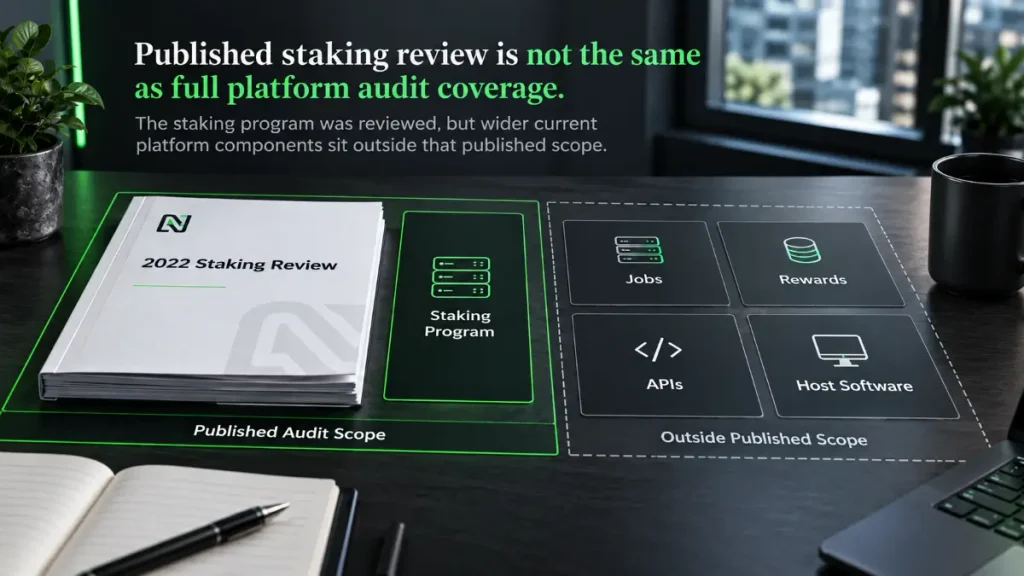
Nosana also reported in July 2026 that its Solana programs had received Verified Build badges, meaning published source could be matched with deployed programs. That improves transparency, but source verification and a security audit solve different problems. A verified build should not be treated as proof that the underlying code is free from vulnerabilities.
Mainnet Upgrades Use a Multisig Process
Nosana’s repository says mainnet upgrades are prepared through its development process and executed through a Squads multisig. Using a multisig reduces reliance on one upgrade key, but the multisig itself remains an administrative control layer.
The public repository information does not establish every signer identity, threshold, internal procedure, or emergency policy needed for a complete governance assessment. Those details should not be inferred merely because the multisig process is documented.
Independent GPU providers create another security boundary outside the Solana programs. Secure onchain code alone cannot guarantee the configuration, availability, confidentiality, or physical integrity of every remote machine executing customer workloads.
Security therefore needs to be assessed as a system rather than a badge. Code review, upgrade controls, API security, workload isolation, host integrity, credentials, monitoring, and operational reliability address different failure surfaces.
What Nosana Still Needs to Prove
Nosana no longer needs to prove that its marketplace is capable of executing substantial GPU workloads. Millions of project-reported jobs, millions of GPU job hours, Sogni’s high-volume workload, and the September 2026 shortage of RTX 4090 and RTX 5090 capacity provide meaningful evidence that real applications are using the infrastructure.
The next challenge is separating organic repeat demand from incentive-supported growth. Free credits, grants, provider campaigns, staking rewards, and other subsidies can be sensible tools while a marketplace expands, but they make gross activity harder to interpret economically.
A returning customer who repeatedly pays for compute without promotional support provides stronger evidence of durable commercial demand than a workload fully financed by free credits. Nosana could make this distinction easier to assess by publishing consistent data for customer-funded spending, incentive-funded usage, repeat paying clients, provider payouts, and protocol-retained economics.
NNP-0001 faces the same empirical test. Redirecting passive rewards toward useful network contribution appears more closely connected with the product, but token economics improve only if those incentives produce enough reliable capacity and recurring paid demand to justify their cost.
Nosana Review Verdict
Nosana has developed beyond a roadmap-only decentralized compute project. Its public GPU marketplace has operated since January 2025, the project reports millions of completed jobs and GPU hours, Sogni has supplied a visible high-volume workload, and the September 2026 campaign indicates that customer demand for some high-end GPU markets currently exceeds available capacity.
NOS also has genuine utility within the system. Official documentation connects it with AI workloads, staking, network incentives, and governance, while NNP-0001 provides evidence that token holders have participated in a real governance vote.
The weaker part of the thesis remains value capture. Credits purchased with NOS, USDC, or cards make the product easier to use, but they also mean compute growth does not map one-to-one onto direct customer purchases of NOS. Provider campaigns and token rewards create another reason to distinguish customer-funded activity from incentive-funded activity.
Tokenomics remain relevant because Nosana is still changing how rewards are distributed. The project currently reports 83.4 million NOS circulating from a published total supply of 100 million, while passive staking rewards are being phased down under the NNP-0001 transition.
Security also requires qualification. Nosana maintains open-source programs and documents a Squads multisig upgrade process, but its own repository warns that most code is unaudited. The external reports listed there cover the older Staking program rather than the complete current platform.
The evidence therefore supports a narrower conclusion than either a bullish or bearish token narrative. Nosana has increasingly credible evidence of real GPU demand, while durable NOS value capture remains less fully demonstrated. Better disclosure of customer-funded compute spending, incentives, protocol economics, repeat paying users, and post-NNP-0001 results would make that relationship much easier to measure.
Frequently Asked Questions
Nosana is a distributed GPU compute marketplace focused on AI and related workloads. Developers access independently operated GPU hardware while Nosana software and Solana programs coordinate parts of deployment, scheduling, incentives, and marketplace activity.
NOS is the native Solana-based token of the Nosana Network. Official Nosana material connects it with workload access, staking, incentives, and governance, although those functions do not mean every customer workload requires a direct NOS purchase.
No. API-key deployments can consume Nosana credits, while Nosana supports purchasing credits with NOS or USDC alongside card payments. Real compute usage therefore should not automatically be counted as equivalent open-market NOS demand.
Nosana reported more than 3 million completed jobs and more than 3 million GPU job hours by January 2026, along with 650 unique clients during the marketplace’s first year. These are project-reported operating figures rather than independently audited revenue measurements.
Nosana’s token page displayed 83.4 million NOS in circulation from a total supply of 100 million on September 17, 2026. The circulation figure should remain dated because distribution and reporting methodology can change.
Yes. Nosana’s staking application remains active, but it states that passive staking rewards will sunset over a 12-month transition following approval of NNP-0001.
Nosana’s public program repository lists two Op Codes reviews from August 2022 for the Staking program. The same repository warns that most code is unaudited, so those reports should not be presented as security coverage for the entire current Nosana platform.
The main question is whether recurring customer-funded GPU workloads create durable NOS demand after credits, provider incentives, staking rewards, and other token distributions are separated from organic spending. Current evidence is stronger for product usage than for a fully measured token value-capture path.

Founder & Managing Editor of CryptosMedia. Zahid Hussain leads evidence-based crypto research covering tokenomics, security, governance, adoption, and risk.
CryptosMedia separates verified facts from interpretation, avoids buy/sell recommendations, and updates reviews when major evidence changes.
2 thoughts on “Nosana Review: Real GPU Demand vs NOS Economics”