
The Theta Network coordinates decentralized cloud infrastructure for heavy AI, media, and entertainment workloads today. Crypto projects often look remarkably simple from a high-level marketing perspective. A sleek logo, an ascending chart, and a passionate community can hide structural flaws. The far more difficult task is looking past the branding to see whether the underlying architecture holds up under rigorous inspection. This technical audit provides a cold, research-driven look at the project’s dual-token system and network stability.
My Research Method For This Technical Audit
- Core Documentation Analysis: Verified the original and updated technical whitepapers, focusing on Multi-Level Byzantine Fault Tolerance consensus mechanics.
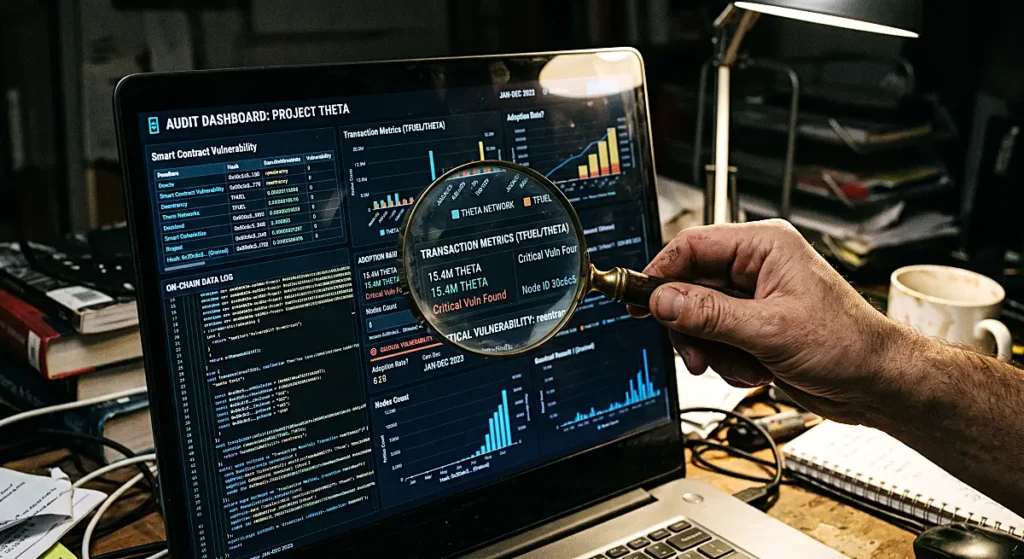
- On-Chain Explorer Inspection: Reviewed transaction metrics, validator structures, and wallet distributions using the mainnet explorer.
- Code Quality Assessment: Examined public GitHub repositories to observe developer activity and commit frequency.
- Community Feedback Monitoring: Analyzed forum discussions to separate official marketing narratives from the real-world experiences of node operators.
Core Ecosystem Architecture and Utility
Mitch Liu and Jieyi Long founded this infrastructure platform in 2018. The project raised early venture capital from global entities to solve the last-mile delivery bottlenecks of high-resolution video streaming. To give the ecosystem added industry credibility, the team secured a notable advisory board including the co-founders of YouTube and Twitch. The network operates as a dual system comprised of two distinct layers.
- The Layer 1 Blockchain: An Ethereum Virtual Machine compatible ledger that manages payments, rewards, staking, smart contracts, and governance.
- The Distributed Edge Network: A network of physical nodes run on consumer-grade hardware contributing spare bandwidth, storage, and GPU power.
Hierarchical Consensus Framework
Many Layer 1 blockchains struggle with the traditional trilemma of decentralization, security, and scalability. This platform relies on a hierarchical consensus framework to split network responsibilities.
- Enterprise Validator Nodes: A small, highly centralized committee of 10 to 20 nodes that proposes and produces blocks as quickly as possible. Major global corporations like Google, Samsung, and Sony operate these positions.
- Guardian Nodes: A larger, community-run tier consisting of thousands of nodes that validate the blocks produced by the corporate committee.
- Signature Aggregation: Utilizing Boneh-Lynn-Shacham signature aggregation, a node combines partial signatures from its neighbors. This keeps message sizes small and drops communication complexity significantly.
Resource-Oriented Micropayment Pools
Recording every single tiny peer-to-peer transaction on-chain would immediately clog the network and erase profitability through high gas fees. The protocol uses a custom off-chain payment structure to scale micro-payments.
- Pool Creation: A user deposits tokens into an on-chain micropayment pool, specifying a unique resource identification alongside a time-lock.
- Off-Chain Payments: As users receive video or compute chunks from peer nodes, they sign off-chain service certificates and hand them directly to peers.
- Settlement: Peer nodes bundle these double-spend-resistant certificates and withdraw their earned rewards on-chain at a later time.
Theta EdgeCloud: The Pivot To AI GPU Compute

The real-world economics of streaming video over pure peer-to-peer networks proved incredibly difficult to scale commercially. Consequently, the project has executed a massive strategic shift toward highly trending decentralized physical infrastructure networks. Theta EdgeCloud operates as the cornerstone of this hybrid cloud computing platform.
- The AI GPU Marketplace: EdgeCloud allows developers and researchers to rent GPU computing power from a distributed pool. To secure enterprise-grade silicon, the team partnered with the distributed GPU network Aether to access Nvidia H100 hardware.
- Model Context Protocol Integration: The team released an official Model Context Protocol server in early 2026. This integration allows AI assistants to connect directly to the system programming interfaces for tasks like image generation and audio transcription.
- AI Gaming And NPCs: The platform launched its artificial intelligence gaming services vertical in July 2026. This product lets game developers deploy AI-powered non-player characters with unique personalities on decentralized edge nodes.
Theta Network Tokenomics And Supply Structure
Evaluating the dual-token architecture is crucial for understanding how value accrues within the ecosystem. Staking and network utility are separated into two distinct assets to manage volatile transaction demands.
| Supply and Staking Metric | Verified Blockchain Metrics | Why It Matters For Holders |
|---|---|---|
| THETA Max Supply | 1,000,000,000 Tokens | The absolute hard cap on governance assets with zero dilution risk. |
| THETA Circulating Supply | 1,000,000,000 Tokens | One hundred percent of the supply is fully circulating in public hands. |
| TFUEL Supply Model | Inflationary Utility Token | Initial supply of 5 billion increases annually to pay staking rewards. |
| Minimum Guardian Stake | 1,000 THETA Coins | The entry barrier required for community nodes to secure block finality. |
Centralization and Governance Control
While marketing materials use highly decentralized language, the structural reality points to a significant concentration of authority. The first tier of consensus is fully gatekept by the Enterprise Validator Council, which remains capped at a very small number of corporate entities.
Regular users cannot propose blocks or meaningfully influence state transitions, they must rely entirely on these corporate validators. Furthermore, all core development, software clients, and strategic roadmaps are dictated by Theta Labs, Inc. The average token holder has zero on-chain mechanisms to override decisions made by the core company.
Real Transaction Volumes and Node Performance
The developer and node operator ecosystems present a highly mixed picture when cross-referencing community sentiment against on-chain stats. The network boasts over 30,000 distributed nodes, but community reports highlight persistent software instability. Operators frequently complain of their edge hardware getting stuck on jobs or randomly dropping offline.
Even the robust delegated nodes suffer from uptime issues, multiple prominent delegated guardian nodes went completely offline for over a month in early 2026. Independent on-chain analysis reveals a quiet network footprint, where the net absorption rate of TFUEL only sits around 10 to 16 percent of daily block issuance. This means the token continues to face inflationary supply pressures under quiet network conditions.
Verified Strengths and Theta Network Risks
- Zero Dilution Threat: The fixed supply of the governance token shields long-term holders from unexpected treasury dumps.
- Enterprise Infrastructure: Direct validation from massive tech conglomerates provides robust security against traditional sybil attacks.
- The Value Accrual Dilemma: The most significant tokenomics concern is that network activity uses and drives economic demand for TFUEL, not THETA. Retail investors who hold governance coins do not see direct economic value from network usage flow back to their asset.
- Transparency and Narrative Shifts: The aggressive pivot from video streaming to general AI compute represents a major shift. Some community members voice concerns over executive departures, highlighting a lingering gap between corporate marketing and actual on-chain adoption.
Web3 Infrastructure Competitor Matrix
- Theta Network: Focuses on AI and media DePIN, utilizes a Multi-Level BFT consensus with a corporate council, and faces main strategic risks regarding weak value accrual for its governance coin.
- Livepeer: Focuses on decentralized video transcoding, utilizes a Delegated Proof of Stake model, and faces a highly niche sector limit.
- Render Network: Focuses on decentralized GPU rendering, utilizes a Proof-of-Render model on Solana, and faces intense cost competition from Web2 hyperscalers.

Common Questions About The Ecosystem
- Is THETA a coin or a token? It is the native utility and governance coin of the custom, Layer 1 blockchain. It is not an ERC-20 token, as the project successfully executed its mainnet swap years ago.
- What is the main difference between THETA and TFUEL? THETA is the fixed-supply coin used exclusively for securing the network through staking. TFUEL is the operational gas coin used to pay for smart contracts and compensate node operators.
- Who validates and secures the ledger? A small Validator Committee of prominent enterprises proposes blocks, which are then verified and finalized at regular checkpoints by thousands of community-operated Guardian Nodes.
- What are the primary Theta Network risks? The biggest fundamental risk is poor value accrual for governance holders. Additionally, technical bugs in edge software, heavy competition in the AI compute sector, and centralized corporate control represent major hurdles.

Founder & Managing Editor of CryptosMedia. Zahid Hussain leads evidence-based crypto research covering tokenomics, security, governance, adoption, and risk.
CryptosMedia separates verified facts from interpretation, avoids buy/sell recommendations, and updates reviews when major evidence changes.
2 thoughts on “Theta Network: Decentralized AI Or Tech Corporate Trap?”