
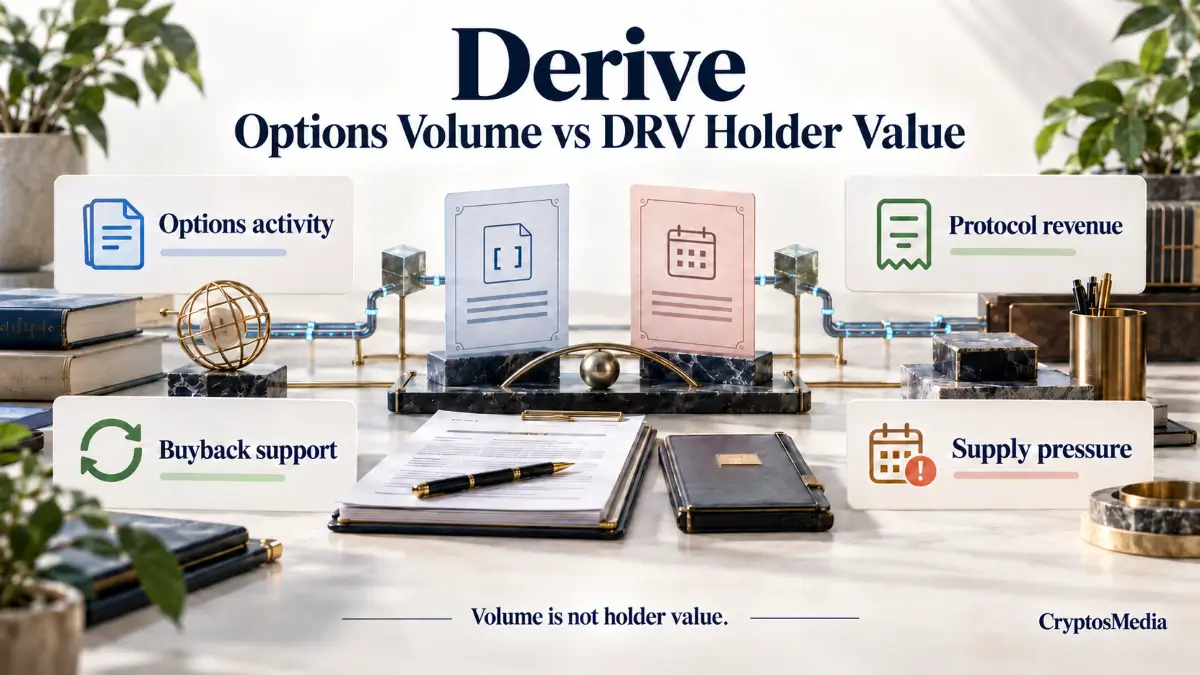
Derive review examines whether options volume, protocol revenue, staking, governance, and buybacks can create durable value for DRV holders. Derive is an onchain derivatives protocol focused on options, perpetuals, structured products, and advanced crypto trading.
The harder question is whether that activity actually reaches DRV holders in a durable way. Options volume, fee revenue, staking, governance, and buybacks can support the DRV thesis, but only if the economics remain transparent, recurring, and strong enough to offset incentives, emissions, unlocks, and selling pressure.
Disclaimer
This Derive review is for research and educational purposes only. It does not provide buy, sell, hold, staking, governance, tax, legal, or technical-audit advice. Readers should recheck current DRV supply data, staking rules, buyback terms, contract details, governance decisions, audit scope, and market conditions before making any decision.
Disclosure
CryptosMedia does not present this Derive review as investment, trading, staking, or technical-audit advice. This analysis is based on public project materials, market-data references, protocol revenue trackers, token-transparency information, and governance-related evidence reviewed during research. Options volume, fee generation, staking rewards, or buybacks should not be treated as automatic proof of durable DRV demand.
Quick Verdict in This Derive Review
Derive has a stronger research case than many narrative-driven tokens because its protocol activity can be measured. The protocol operates in a real trading category where options, perpetuals, and structured products can generate fees instead of depending only on vague utility claims.
That evidence supports the product case, but it does not automatically prove DRV value capture. Trading activity, fee revenue, buybacks, staking, and governance all sit on different layers. A useful product can exist while the token captures only part of the economics.
The balanced view is simple: Derive has real product activity, but DRV remains a net-demand test. Traders can use the protocol, fees can grow, and buybacks can support demand, yet holders still need evidence that buybacks and staking benefits are stronger than incentives, emissions, unlocks, and selling pressure.
Key Takeaways
Derive has a real product base. Options, perpetuals, and structured products are serious trading markets, not invented token utility.
Protocol revenue is the core signal. Volume matters less than the fees and revenue that remain after rebates, incentives, liquidity costs, and market-maker support.
Buybacks improve the DRV thesis. They do not guarantee holder value because allocation, execution, funding source, and token handling all matter.
DRV governance can matter economically. It becomes stronger when token holders control fee allocation, treasury decisions, emissions, staking rules, and buyback policy.
Supply data needs caution. Circulating supply and market-data figures can change, so final publication should use the latest verified numbers instead of stale snapshots.
The strongest future evidence is measurable. Recurring revenue, transparent buybacks, lower incentive dependence, healthy trader retention, and clear governance execution would strengthen the case.
Security risk remains material. Derivatives protocols depend on margin design, oracles, liquidation logic, risk engines, market liquidity, and operational controls.
Derive Snapshot: Product, Token, and Value Capture
| Area | Current Position | DRV Demand Relevance |
|---|---|---|
| Core product | Onchain options, perpetuals, and structured products. | Trading activity can create fees, but volume alone does not prove token demand. |
| Main users | Traders, market makers, liquidity providers, and structured-product users. | Retained usage matters more than short-term incentive-driven activity. |
| Token role | Governance, staking, incentives, fee policy, and buyback alignment. | These roles need real fee flow and governance execution. |
| Buyback path | Public materials describe a revenue-funded DRV buyback model. | Buybacks can support demand, but the allocation can change through governance. |
| Supply profile | DRV supply must be checked from current verified market data before publication. | Supply pressure can offset buyback demand if new liquid supply is large. |
| Main uncertainty | Net value capture after incentives, emissions, and supply pressure. | DRV needs durable demand, not only trading activity. |
Research takeaway: Derive has a clearer economic base than many DeFi tokens because trading can create measurable fees. The final test is whether revenue-funded buybacks and staking demand create net DRV demand after incentives and supply pressure.
What Derive Actually Does
Derive is built around onchain derivatives. Its market includes options, perpetuals, structured products, and trading infrastructure designed for more advanced crypto users. This makes Derive different from a simple spot-swap protocol or a token with only broad governance language.
Options are more complex than spot trading. Traders care about strikes, expirations, implied volatility, collateral, margin, liquidity, pricing, and settlement. Structured products add another layer because they can combine derivative payoffs with specific risk-return outcomes.
This makes Derive’s product case serious. Onchain derivatives are not just another governance narrative. If traders use the protocol and fees remain visible, Derive has an economic base that readers can test.
DRV holders do not benefit automatically from every trade. The value path depends on how fees are collected, how much revenue remains, how buybacks are funded, how governance controls allocation, and whether token supply pressure offsets demand.
The Main Misconception: Volume Is Not Holder Value
Derive’s biggest research risk is that readers may see options volume and assume DRV benefits directly. That is too simple.
Options notional volume can become very large because it measures exposure, not necessarily fees retained by the protocol. Premium volume is more informative than notional exposure, but even premium volume does not equal token-holder value.
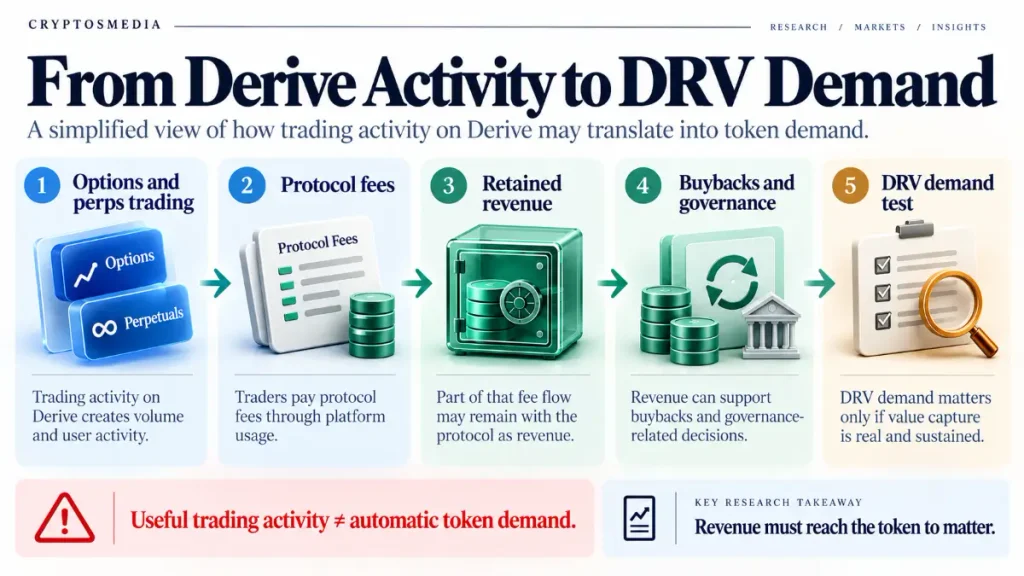
Fees, rebates, incentives, market-maker costs, treasury decisions, and buyback execution all sit between trading activity and DRV demand. A serious Derive review therefore needs four layers: trading activity, protocol fees, revenue available for token-linked use, and the actual net effect on DRV demand.
This distinction matters because derivatives can create impressive activity numbers without proving durable token value capture. DRV becomes stronger only when activity converts into retained revenue and that revenue creates meaningful demand after all supply pressure is considered.
How Trading Activity Can Reach DRV
Derive activity can reach DRV through a few possible channels.
The first channel is protocol revenue. If traders generate fees and the protocol retains revenue, Derive has an economic base that can support treasury operations, insurance reserves, incentives, or buybacks.
The second channel is buybacks. Derive materials describe revenue-funded DRV buybacks, which creates a clearer value path than vague governance utility alone. However, the exact allocation should be treated as governance-sensitive and rechecked before publication.
The third channel is staking. DRV can be connected to staking and governance participation through staked-token mechanics. Staking can reduce liquid supply, but it also introduces exit-delay risk and does not prove value capture by itself.
The fourth channel is governance. If DRV or staked DRV holders can influence fee allocation, treasury policy, emissions, staking rules, or buyback policy, governance becomes economically relevant. It matters less if participation is weak, concentrated, or difficult to verify.
The fifth channel is trader retention. If Derive keeps real traders after incentives cool down, fee revenue becomes more meaningful. If activity depends mainly on rewards, the DRV thesis weakens.
How DRV Connects to Fees, Buybacks, and Governance
| Value Path | What Happens | Demand Test |
|---|---|---|
| Traders use Derive | Options, perps, and structured products create trading activity. | Activity matters only if it creates sustainable fees. |
| Fees become revenue | Protocol fees may become retained revenue after rebates and incentives. | Revenue should remain visible after incentive costs. |
| Buybacks use revenue | Revenue-funded buybacks can create DRV demand. | Buybacks need enough scale to matter against supply pressure. |
| Users stake DRV | DRV can support staking and governance participation. | Staking demand should not depend mainly on emissions. |
| Governance controls allocation | Token holders may influence fee policy, treasury use, and buyback rules. | Governance value depends on real voting power and execution. |
| Supply meets demand | Circulating supply and incentives can add market pressure. | Net demand must exceed new liquid supply over time. |
Research takeaway: This table shows how trading activity can move toward DRV demand through fees, buybacks, staking, and governance. The final test is whether this path creates net demand after emissions, incentives, and supply pressure.
Buybacks Help, But They Need Scale
Buybacks are important because they create a clearer bridge between protocol revenue and token demand. A revenue-funded buyback model is stronger than a token model that relies only on abstract governance utility.
This is a positive signal, but it still requires careful wording. Buyback allocation can change through governance, and older launch materials may not always match later transparency or governance updates. A final article should avoid treating any buyback percentage as permanent unless it is verified at publication time.
Buybacks are not magic. They help only when the buyback amount is meaningful compared with emissions, unlocks, incentives, liquidity needs, and sell pressure. If revenue rises and buybacks remain consistent, the token case improves. If revenue weakens or incentives remain high, buyback support may not be enough.
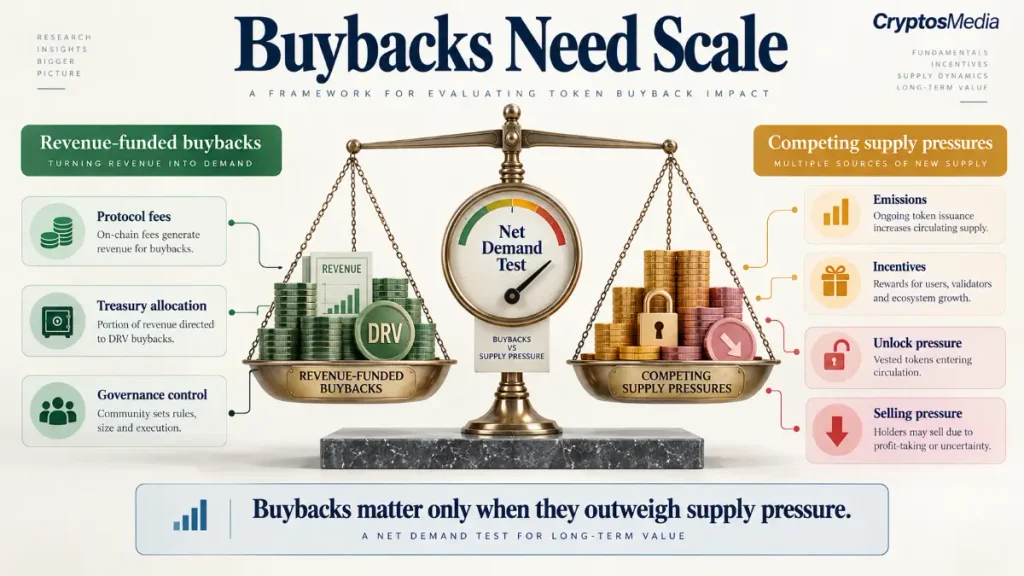
The strongest version of the DRV thesis would show clear buyback reports, revenue source breakdowns, bought-token handling, emissions schedules, and governance decisions that make the mechanism easy to verify.
What Derive Evidence Supports and What It Does Not Prove
| Evidence | What It Supports | What It Does Not Prove |
|---|---|---|
| Revenue tracking | Derive has measurable fee and revenue activity. | It does not prove all revenue reaches DRV holders. |
| Options notional volume | Traders are using derivatives markets. | It does not prove high net protocol value capture. |
| Revenue-funded buybacks | DRV has a stated demand-support mechanism. | It does not prove buybacks exceed emissions or selling. |
| Staking and governance | Token-linked participation exists. | It does not prove broad governance distribution or strong voter turnout. |
| Market-data listings | DRV supply and markets are publicly trackable. | Live values can change and must be rechecked. |
| Structured product category | Derive serves a real but complex market. | Complexity increases pricing and risk-management challenges. |
Research takeaway: This table shows that Derive has stronger evidence than a purely narrative token because trading and revenue can be tracked. The final test is whether that evidence becomes durable DRV demand after incentives, supply changes, and buyback execution.
Reading Options Data Correctly
Derive’s options data needs careful interpretation. Notional volume shows contract exposure, but it does not show how much revenue reaches the protocol or the token. Premium volume is closer to the money paid for options exposure, but it still sits above fees, rebates, and net revenue.
This matters because derivatives can create large-looking activity without large token value capture. A platform may show strong notional volume while fee margins remain small. It may also use incentives to attract traders or market makers, which can reduce the net benefit to DRV.
The best future signal would be trading activity that stays strong without excessive incentives. If options users remain active, revenue grows, and buybacks continue, DRV has a stronger demand path.
The weaker signal would be a large volume number with unclear fee capture, weak revenue retention, heavy incentives, and small buybacks. In that case, activity exists, but token capture remains uncertain.
Staking, stDRV, and Governance Utility
DRV staking can support the token case when it creates real participation, governance rights, and alignment with protocol economics. Staking can make holders more active in governance and may reduce liquid supply during lock or unstaking periods.
Staking can reduce float, but it does not guarantee value capture. If rewards mostly come from token emissions, stakers may receive more tokens while the market faces more supply. If rewards and benefits connect to protocol revenue, staking becomes more economically meaningful.
Governance has a similar test. It matters when token holders can influence fee allocation, treasury decisions, emissions, staking rules, buybacks, or risk parameters. It matters less when governance rights exist on paper but decisions remain concentrated or inactive.
A strong governance case would show active proposals, material parameter changes, transparent treasury decisions, and clear execution. A weaker case would show governance rights without meaningful economic control.
Tokenomics and Supply Pressure
DRV supply data needs caution because circulating supply figures and market-data pages can change. Final publication should recheck current circulating supply, max supply, fully diluted valuation, market pairs, contract details, and any known unlock or emissions information.
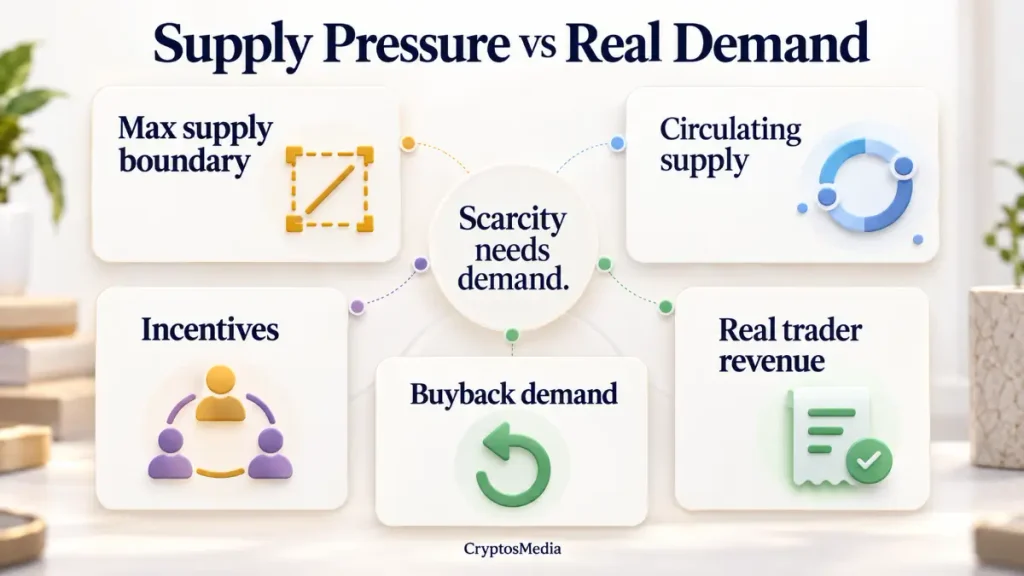
The core tokenomics issue is not only the max supply. It is the balance between revenue-funded demand and new supply pressure. If buybacks are steady, incentives decline, and trading revenue grows, DRV has a stronger value-capture case.
If revenue weakens or incentives remain high, buybacks may not be enough. A token can have a visible value path and still face pressure if too much supply enters the market or if users mainly participate for rewards.
A max supply can help define the outer boundary, but it does not guarantee scarcity. Scarcity only matters when real demand competes for the available token supply.
DRV Tokenomics and Supply Pressure
| Supply Factor | Current Meaning | Risk Test |
|---|---|---|
| Max supply | Must be verified from current market-data pages before publication. | Max supply helps clarity, but does not create automatic scarcity. |
| Circulating supply | Live circulating supply can vary by provider and timing. | Use cautious language and recheck before publishing. |
| Buybacks | Revenue-funded buybacks can support demand. | Buybacks must exceed emissions and selling pressure to matter. |
| Staking | DRV can support staking and governance participation. | Locking can reduce float, but rewards need sustainable backing. |
| Governance-adjustable economics | Buybacks, rewards, and staking terms may change through governance. | Future governance decisions remain a monitoring point. |
| Incentives | Rewards can support liquidity and user growth. | Incentives can offset buyback demand if too high. |
| Token-demand test | Trading revenue should reach DRV demand. | Activity must become net demand, not only headline volume. |
Research takeaway: This table shows that DRV has a more visible value-capture mechanism than many DeFi tokens. The final test is whether revenue, buybacks, incentives, and trader retention create durable net demand.
Security, Market Structure, and Execution Risks
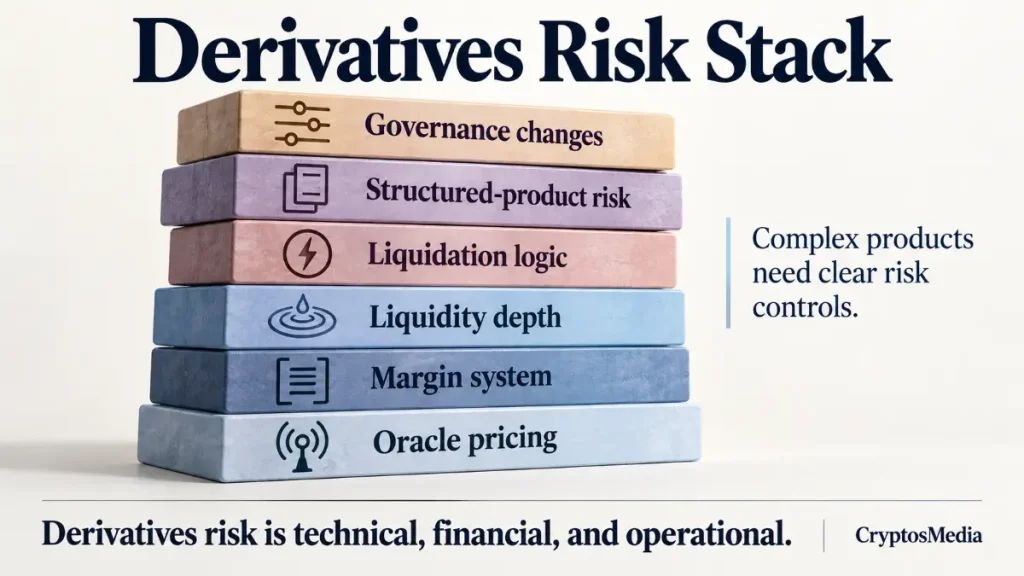
Derive operates in a difficult category. Options and perpetuals need margin systems, liquidation logic, oracle design, pricing assumptions, risk engines, and liquidity management. These risks are higher than in a simple token transfer system.
A derivatives protocol can face stress when markets move fast. Poor margin settings, oracle delays, liquidity gaps, or liquidation failures can create losses or disputes. Smart contract audits help, but they cannot remove market-structure risk or guarantee every future governance change, product launch, frontend, integration, or operational process.
The structured-product side also needs caution. Structured products can create tailored outcomes, but they are often complex and can include payoff constraints, liquidity limits, fees, and hard-to-understand risk exposure.
The strongest future proof would combine product growth with risk transparency: audited contracts, clear margin rules, market-risk disclosures, oracle design, liquidation data, governance logs, and transparent buyback reporting.
Case For Derive
- Real market exposure: Derive operates in options, perpetuals, and structured products, which are genuine financial use cases.
- Measurable activity: Fees, revenue, notional volume, and premium volume can be tracked instead of relying only on project slogans.
- Buyback model: Revenue-funded buybacks create a clearer value path than vague governance utility alone.
- Governance relevance: If DRV holders control fee allocation, treasury decisions, emissions, staking rules, and buyback policy, governance can matter economically.
- Category upside: Onchain options remain less mature than spot swaps and perpetuals, so retained trader demand could strengthen the thesis.
Case Against DRV
- Buyback scale risk: Buybacks may not create enough net demand if emissions, incentives, or selling pressure exceed buyback support.
- Data interpretation risk: Options notional volume can look large without proving high net revenue or direct DRV demand.
- Supply uncertainty: Live supply values, incentives, and governance decisions need regular checking because token economics can change.
- Retention risk: Derivatives protocols can attract activity during incentive periods, but durable trader retention is harder.
- Governance execution risk: Governance value depends on real participation, transparency, parameter control, and enforceable decisions.
What Would Strengthen the DRV Thesis
The thesis would strengthen if Derive shows recurring fee growth, stable options activity, and clear revenue after rebates and incentives.
It would also strengthen if buyback reporting becomes easy to track. Readers should be able to see funding sources, execution timing, purchased amounts, and what happens to bought DRV.
Lower incentive dependence would improve the case. If trading remains strong while incentives decline, Derive’s product-market fit looks more durable.
Governance transparency would help too. Proposal history, voter turnout, delegated voting, treasury decisions, fee allocation changes, and execution records should be easy to verify.
The strongest signal would be simple: real traders stay, revenue grows, buybacks remain transparent, and DRV supply pressure becomes easier to absorb.
What Would Weaken the DRV Thesis
The thesis would weaken if options volume falls after incentives decline. That would suggest activity depends more on rewards than product fit.
It would also weaken if buybacks remain small compared with emissions, unlocks, or market selling. Buybacks sound strong, but scale matters.
Unclear revenue accounting would be another weak signal. If readers cannot separate fees, rebates, incentives, revenue, insurance-fund allocation, and buyback funding, the value-capture case becomes harder to trust.
Governance risk would rise if important decisions remain concentrated, opaque, or difficult to audit.
Security concerns would increase if older reviews or limited audit scopes are treated as blanket safety coverage for newer products, markets, or integrations.
Final Derive Review Assessment: Real Revenue Path, Still a Net-Demand Test
Derive has a real product thesis. Options, perpetuals, and structured products are serious trading markets, and Derive’s activity can be examined through fees, revenue, premium volume, and notional volume. That gives DRV a stronger evidence base than tokens that rely only on vague utility.
The DRV token thesis remains conditional. Staking, governance, and buybacks can support the token only if protocol revenue stays durable and buybacks create meaningful demand after incentives, emissions, and supply pressure.
The biggest improvement in this thesis is transparency. Derive already has a clearer value-capture story than many tokens because its model connects trading revenue to buybacks and governance-sensitive allocation. The next test is whether the market can clearly track buyback execution, fee allocation, governance changes, and token supply effects over time.
The balanced conclusion is that Derive deserves serious coverage as an onchain derivatives protocol, but DRV holders should focus on net demand. Options volume is useful evidence. Protocol revenue is better evidence. Transparent buybacks, controlled emissions, real trader retention, and active governance are the signals that matter most.
Why Trust This Review
This Derive review separates trading activity from token demand. It treats options volume, protocol revenue, buybacks, staking, governance, and supply pressure as separate research layers.
The review does not claim private team access, first-hand protocol testing, direct code auditing, or trading experience on Derive. It treats public materials and third-party data references as evidence sources, not as proof of future token performance.
Where figures can change, the review avoids false precision. DRV supply, buyback allocation, revenue, fees, staking terms, governance parameters, markets, and incentive programs should be rechecked before publication.
Key Questions About Derive and DRV
What is Derive?
Derive is an onchain derivatives protocol for options, perpetuals, structured products, and advanced crypto trading.
What is DRV used for?
DRV is linked to staking, governance, fee policy, incentives, and revenue-funded buyback mechanisms.
Do options volumes automatically help DRV?
No. Options volume matters only if it creates sustainable fees that reach DRV through buybacks or other token-linked mechanisms.
Are DRV buybacks good for holders?
They can help, but only if buybacks are transparent, recurring, and large enough to offset emissions and selling pressure.
Does staking DRV guarantee value capture?
No. Staking can reduce liquid supply, but rewards and benefits need sustainable economic backing.
Why does protocol revenue matter?
Revenue shows whether trading activity creates economic output that can support buybacks, treasury growth, or token-linked incentives.
What is the biggest DRV risk?
The biggest risk is that trading activity, buybacks, and staking rewards do not create enough net demand for DRV.
Is DRV supply data consistent?
Live supply data can vary by provider and timing, so final publication should recheck current circulating and max supply.
What would make the DRV thesis stronger?
Recurring fees, transparent buybacks, lower incentive dependence, retained traders, and active governance would strengthen it.
Is this Derive review investment advice?
No. It is research content only and does not provide buy, sell, hold, staking, governance, tax, or legal advice.

Founder & Managing Editor of CryptosMedia. Zahid Hussain leads evidence-based crypto research covering tokenomics, security, governance, adoption, and risk.
CryptosMedia separates verified facts from interpretation, avoids buy/sell recommendations, and updates reviews when major evidence changes.