

AltLayer solves a real infrastructure problem: launching and operating a rollup is difficult, and a single sequencer gives users speed without the same economic assurance as Ethereum finality. Its service stack helps teams deploy custom rollups and add independent verification, faster confirmation and alternative sequencing. The difficult question is whether this technical activity creates durable demand for ALT while roughly one-third of the fixed supply remains outside circulation.
The token is not simply a share in a rollup company, nor is AltLayer itself another general-purpose Layer 2. ALT is designed as an economic bond, reward asset, fee currency and governance instrument for a collection of rollup services. Those uses are credible on paper, but their value depends on paid adoption, operator participation and governance that token holders can actually exercise. This review separates those elements from exchange price movements and unsupported contract-scanner claims.
The short answer
AltLayer has shipped more than a concept. Its MACH fast-finality service went live as an EigenLayer Actively Validated Service in April 2024, initially serving OP Mainnet and an Xterio rollup with more than 20 institutional operators. Later deployments listed in the public code repository include Arbitrum One, DODOChain, Cyber, GM Network and Soneium. The Rollups-as-a-Service business also supports established software stacks rather than forcing developers into a proprietary execution environment.
The token case is less complete. ALT can be staked and used in service pools, but the public record does not show how much recurring protocol revenue is paid in ALT, how much demand comes from customers rather than reward programmes, or whether formal on-chain governance controls material parameters. Meanwhile, monthly vesting continues across investors, team, advisers, protocol development, ecosystem and treasury allocations.
| Question | Evidence | Remaining limitation |
|---|---|---|
| Is there a usable product? | RaaS deployments and live MACH services | Client retention and paid revenue are not clearly reported |
| Does ALT have utility? | Staking, operator rewards, fees and stated governance | Usage and fee volumes are not reconciled publicly |
| Is supply capped? | 10 billion fixed total and maximum supply | Large locked allocations still vest monthly |
| Has code been reviewed? | MACH M2 audit reports are public | Scope does not cover every token, RaaS and operational dependency |
What AltLayer actually does
A rollup executes transactions away from a base chain and later posts data or proofs back to it. This can increase throughput, but a production rollup still needs sequencers, monitoring, data availability, bridges, explorers and upgrade procedures. AltLayer’s RaaS product packages those components for teams using OP Stack, Arbitrum Orbit, Polygon CDK, ZK Stack and other frameworks.
That makes the service closer to managed blockchain infrastructure than a new settlement chain. A customer chooses a stack and supporting services; the deployed rollup retains dependencies on its settlement layer, proof system, data-availability provider and administrative keys. Our Ethereum Layer 2 risk guide explains why faster execution never removes those underlying trust assumptions.

MACH, VITAL and SQUAD have different jobs
MACH is the most tangible component. Operators monitor a rollup, validate proposed state updates and attest when a block meets the service’s confirmation rules. Applications, bridges and exchanges can read this signal through an endpoint instead of waiting for slower base-layer finality. The assurance is economic rather than magical: a quorum of operators and delegated collateral backs the attestation, while the rollup’s canonical settlement process still determines final ownership.
VITAL is intended to verify rollup state correctness and raise challenges when an operator detects an invalid transition. SQUAD addresses sequencing by spreading transaction-ordering responsibility beyond one operator. These are modular services, so a project may use one without adopting the entire stack. Their security also varies with operator count, quorum rules, upgrade controls and the value of slashable collateral.
That design has a genuine niche. A gaming or social application may value rapid, economically backed confirmation even though it cannot wait for base-layer finality on every interaction. A bridge may use an additional signal before crediting funds. The trade-off is another layer of software and governance between the user and canonical settlement. More collateral can deter dishonest attestations; it cannot eliminate faulty code, correlated operators or an incorrectly configured rollup.
The modular thesis overlaps with data-availability networks covered in our Celestia review. Celestia can store and make rollup data available, while AltLayer focuses on deployment, verification, finality and sequencing services. They may be complementary rather than direct substitutes.
Where ALT fits into the system
Four token functions were published at launch. ALT may act as slashable economic collateral, pay operators, settle intra-network service fees and support governance votes. Staking went live in March 2024, followed by reALT, an auto-compounding representation of staked ALT. Holders can use reALT in selected restaked-rollup pools without first withdrawing the underlying stake.
The staking portal states that rewards accrue continuously and withdrawals are subject to a 21-day cooldown. This creates token lock-up and exposes participants to smart-contract and reward-policy risk. A high displayed yield would not by itself demonstrate value creation: if rewards originate from reserved tokens rather than customer fees, holders receive more units while the circulating supply also expands.
Restaking adds another layer. The same economic asset can support multiple services, improving capital efficiency but increasing correlated-loss risk if contracts, operators or slashing rules fail. Our EigenLayer and EigenCloud analysis covers this shared-security trade-off in more detail.
Governance and value capture are not yet equivalent
Launch material says ALT holders can vote on governance decisions, but it does not establish that every important decision is controlled by binding on-chain proposals. Readers should look for a live proposal system, delegation records, quorum requirements and authority over upgrades, treasury spending and service parameters. Without those details, governance is a stated utility with limited measurable value.
Fee utility has a similar evidence gap. Network participants may need ALT for services, but the amount paid by RaaS customers, MACH integrations and operators is not presented in a consistent public revenue ledger. Technical adoption can grow while token demand remains modest if contracts are priced in other assets, subsidised or handled through private commercial agreements. The most useful future disclosure would separate customer revenue, ALT-denominated fees, operator rewards and treasury incentives.
ALT tokenomics: fixed supply, active dilution
ALT launched on 25 January 2024 with 1.1 billion tokens circulating, or 11% of the fixed 10 billion supply. Aggregators reported approximately 6.886 billion circulating on 25 August 2026. Total and maximum supply remain 10 billion, so the main supply risk is vesting rather than an uncapped inflation mechanism.
| Allocation | Share | Tokens | Why it matters |
|---|---|---|---|
| Treasury | 21.5% | 2.15 billion | Largest discretionary allocation |
| Protocol development | 20% | 2.0 billion | Funds product and infrastructure work |
| Investors | 18.5% | 1.85 billion | Seed and strategic rounds have monthly vesting |
| Team | 15% | 1.5 billion | Longer three-year monthly schedule after the pause |
| Ecosystem and community | 15% | 1.5 billion | Supports airdrops, rewards and adoption programmes |
| Advisers | 5% | 500 million | Vests alongside other long-term stakeholders |
| Binance Launchpool | 5% | 500 million | Fully available at launch |
Investors purchased 18.5% of the supply in two private rounds at $0.008 and $0.018 per token. Entry prices do not prove that those holders will sell, but they create different incentives from public-market buyers. Team, advisers, treasury and development allocations together represent a larger share than the public launch float, making the release schedule a central part of the risk assessment.
The vesting pause delayed, rather than removed, supply
The first stakeholder unlock occurred on 25 July 2024. The project then paused vesting for six months and restarted it on 25 January 2025. Its official ALT vesting update states that investor tokens release monthly over two years, while team, advisers, treasury and other allocations release over three years.
That means August 2026 sits inside active schedules for every long-term group. Token-tracking services estimated a 240.1 million ALT release on 25 August 2026 across treasury, investors, team, protocol development, advisers and ecosystem allocations. This is 2.4% of total supply. The amount should be treated as a schedule estimate until reconciled with labelled wallets, and an unlock does not mean an immediate sale. It does mean recipients gain the ability to transfer tokens.
No documented protocol burn materially reduces the fixed cap. Staking may temporarily remove liquid supply, but it does not destroy tokens. The practical equation is therefore circulating growth minus any tokens voluntarily locked by participants. With roughly 31% still outside the reported float, dilution remains relevant even after most tokens have entered circulation.
Wallet concentration needs careful interpretation as well. A large top-address share does not prove that one private whale owns the tokens, because vesting contracts, bridges, exchange custody and treasury wallets can each aggregate balances for many beneficiaries. The useful questions are whether addresses are labelled, what transfer restrictions apply and who controls the relevant keys. The earlier article converted raw top-holder percentages into claims of “absolute control” without separating those categories. This reset does not treat concentration as harmless; it treats labelled stakeholder allocations and scheduled releases as stronger evidence than an unexplained leaderboard.
Security: replace scanner scores with scope
The previous article said an owner wallet could mint unlimited ALT, pause transfers and control 36% of supply. It also presented a 25/100 scanner score as proof of a vulnerability. Those claims were not accompanied by the exact contract, function, administrator address or reproducible transaction evidence. They should not be treated as established facts.
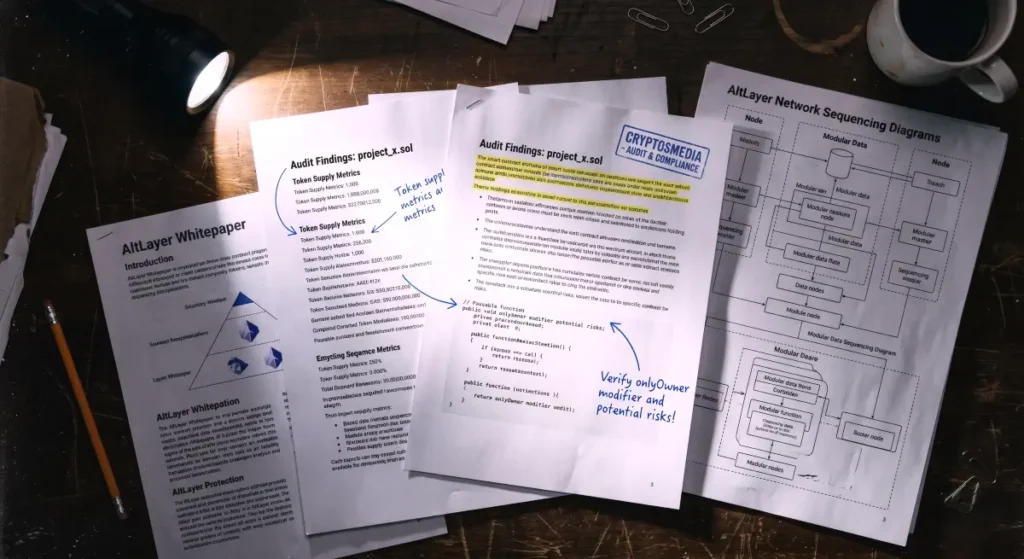
Public audit files from PeckShield and N-Var cover the MACH M2 codebase. That is useful evidence for a defined component and version, not a blanket certificate for the ALT token, staking portal, RaaS dashboard, bridges or every customer rollup. The MACH repository containing those reports was archived on 15 June 2026, so readers also need the maintained successor repository and current deployment mapping before assuming an older report covers live code.
The larger risk surface includes upgradeable service-manager contracts, operator concentration, quorum thresholds, off-chain RPC availability and dependencies on EigenLayer and each rollup stack. MACH provides an additional attestation; it does not replace canonical settlement or prove that a bridge will honour that signal correctly. Security should be evaluated deployment by deployment.
This distinction also applies to rollups built with Arbitrum Orbit. Our Arbitrum tokenomics review separates the underlying technology from governance and token-distribution risk.
What would strengthen the investment case?
First, AltLayer could publish recurring service metrics: active production rollups, paying customers, retained deployments, MACH requests and fees by currency. Second, a token dashboard could reconcile stakeholder unlocks, treasury transfers, staking rewards and circulating-supply methodology. Third, governance documentation should identify live proposal contracts and the decisions they control. Fourth, security disclosures should map each current deployment to its repository, commit and audit report.
- Demand: paid deployments and repeat customers, not partnership counts.
- Token capture: ALT fees and bonds compared with reward emissions and unlocks.
- Security: current code, operator distribution and upgrade authority.
- Governance: binding proposals, turnout, quorum and treasury control.
- Supply: dated float and labelled releases for every allocation.
Verdict: useful middleware, persistent supply test
AltLayer has delivered meaningful rollup infrastructure. MACH is live, the RaaS product supports several established stacks, and ALT staking is functional. These facts make the project more credible than a token attached only to a roadmap.
The weakness is not an unlimited-mint allegation. It is the measurable gap between a 10 billion fixed supply and the 6.886 billion reported float, combined with limited disclosure of token-denominated service revenue. Monthly releases can continue while adoption grows, so product progress and token performance need not move together.
A stronger case would show that production rollups create recurring ALT fees and bonds large enough to absorb rewards and vesting supply. Until that evidence is published consistently, the fairest conclusion is that the infrastructure has real utility while token value capture remains conditional.
Frequently asked questions
Is AltLayer an Ethereum Layer 2?
No. It provides managed rollup deployment and modular services that can support multiple rollup stacks. Individual customer rollups may settle on Ethereum or another supported chain.
What is ALT used for?
Its published uses are economic bonding, operator incentives, service fees and governance. Staking and reALT are live, while fee volume and binding governance activity remain less transparent.
Does ALT have inflation?
The supply is fixed at 10 billion. Practical dilution comes from previously allocated tokens becoming transferable, not from an uncapped issuance policy.
What is reALT?
reALT represents staked ALT and automatically compounds rewards. It can be used in selected staking pools, adding utility but also smart-contract, cooldown and reward-policy risk.
What is the main unresolved risk?
The central issue is whether recurring customer demand creates enough transparent ALT fees and staking demand to absorb monthly unlocks from large stakeholder allocations.

Founder & Managing Editor of CryptosMedia. Zahid Hussain leads evidence-based crypto research covering tokenomics, security, governance, adoption, and risk.
CryptosMedia separates verified facts from interpretation, avoids buy/sell recommendations, and updates reviews when major evidence changes.
4 thoughts on “AltLayer Review: Useful Rollups, Relentless Unlocks”