
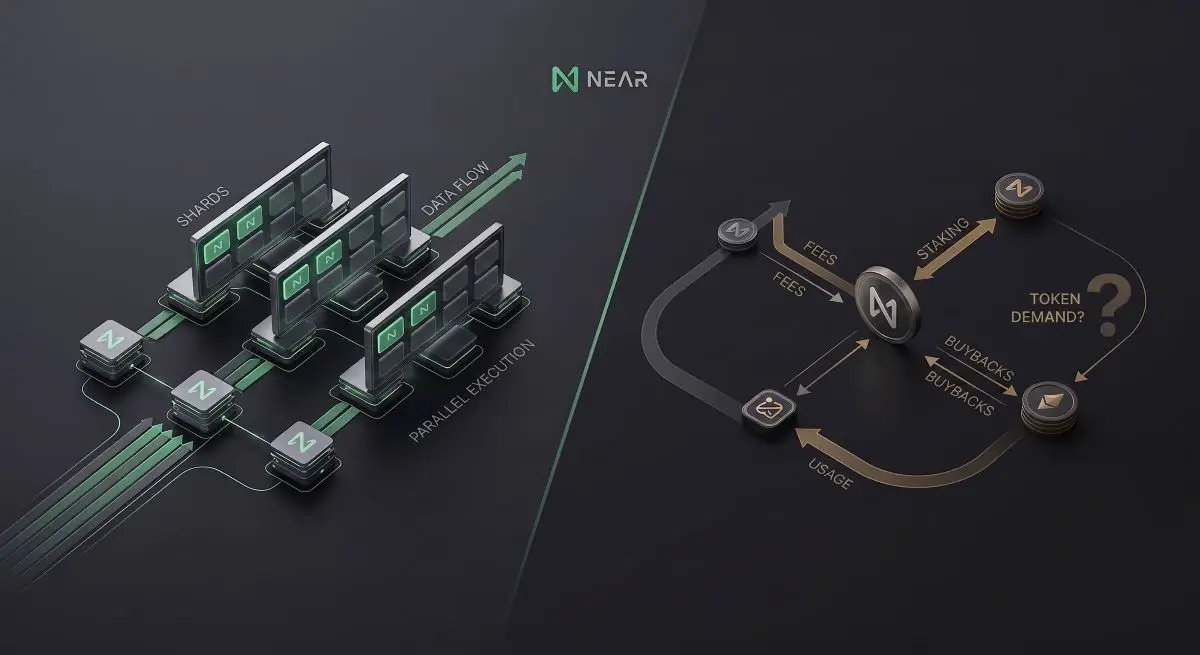
My review focused on two separate questions: can Nightshade scale NEAR effectively, and can that extra capacity create durable demand for the NEAR token?
Those questions are related, but they are not the same.
NEAR now combines sharded execution with Intents, MPC-based Chain Signatures and confidential infrastructure. Each layer removes friction somewhere in the user journey, while also adding dependencies beyond ordinary Layer 1 consensus.
What stood out during review was the gap between technical capacity and economic capture. NEAR has credible evidence that its architecture can process more work. Turning that capability into recurring fees, retained revenue and sustained token demand remains a separate test.
What NEAR Actually Does
NEAR is a proof-of-stake Layer 1 where validators produce blocks, verify shard-specific chunks and stake NEAR as economic collateral.
Nightshade handles scaling by dividing state and execution across shards. Work no longer needs to pass through one execution lane, yet those shards remain coordinated inside the same base protocol.
Stateless validation reduces how much state validators need to retain. Chunk producers provide state witnesses containing the information required to verify transitions, shifting more of the verification process toward witness production and checking.
Dynamic resharding adds another layer of flexibility. NEAR can split or merge shards as network demand changes instead of depending only on fixed partitions. NEAR’s current architecture describes nine shards, 600 millisecond blocks and about 1.2 second finality.
A modular data-availability design such as Celestia separates more of the execution, settlement and data-publication stack. NEAR keeps public sharded execution within one coordinated base layer.
For users, that can create a more unified environment. For validators and developers, cross-shard receipts, state movement and resharding still need to work reliably when traffic changes.
One Million TPS Shows Headroom, Not Everyday Demand
NEAR reported a benchmark above one million transactions per second across 70 shards.
Native-token transfers were used for the test, a lighter workload than many DeFi transactions, smart-contract interactions or multichain routes. My reading of the result is narrow: Nightshade can scale a defined workload horizontally when more shards are added.
It does not mean current mainnet sustains one million transactions every second.
Mainnet uses far fewer shards, while real applications create very different workloads. A benchmark can prove technical headroom without proving that users will fill the available capacity.
From a token-demand perspective, retained activity matters more than headline TPS. Spare capacity creates little economic value unless users return, applications generate fees and those fees eventually feed into NEAR’s economic model.
Chain Signatures Move Complexity Behind the Interface
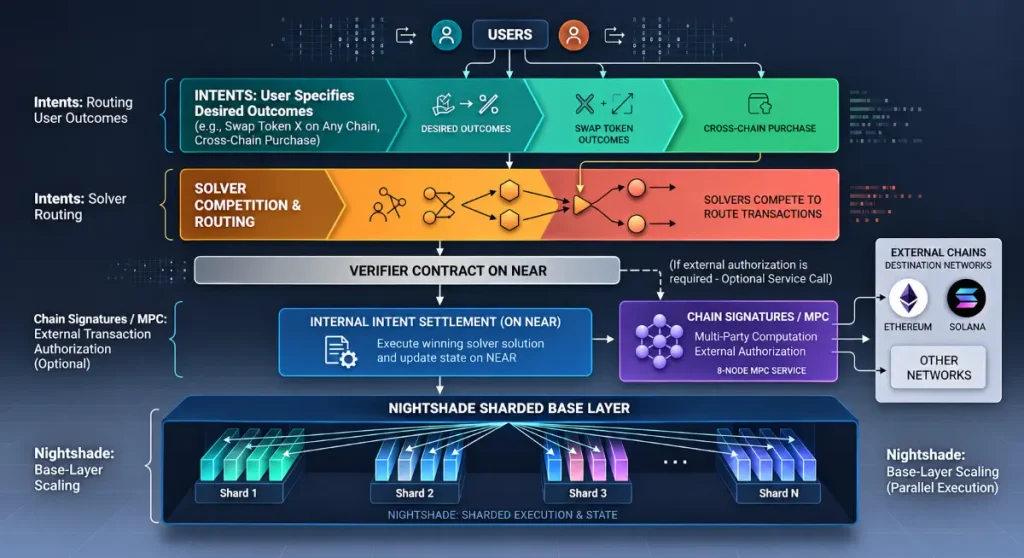
Chain Signatures allow a NEAR account or smart contract to authorize transactions on external networks through multi-party computation.
Current NEAR documentation describes an eight-node MPC service. No single node can sign alone, threshold consensus is required.
Such a setup can remove several wallet, gas-token and bridge-management steps from the user experience. One application may coordinate actions that previously required separate wallets and manual transfers.
Convenience, however, widens the dependency map.
MPC operators, threshold rules, software availability and destination-chain security remain part of the transaction path. NEAR consensus cannot repair an outage on Bitcoin, reverse a faulty external contract or guarantee that every connected chain remains available.
A cross-chain model such as LayerZero provides a useful comparison. Supporting more networks does not automatically make interoperability safer. Verification paths, upgrade authority and failure recovery matter more than integration count alone.
Intents Create a Measurable Revenue Channel
NEAR Intents use an outcome-based model.
Users specify what they want to receive, while solvers compete to find and execute a route. A verifier contract on NEAR checks settlement.
Intents can remove much of the routing, bridge selection and gas-token management from the user’s side. Solver competition may also improve execution when enough liquidity is available.
External markets, solver behaviour, liquidity and destination-chain conditions still determine whether a route works as expected. A cleaner interface does not remove those dependencies.
My 3 September 2026 check of NEAR’s revenue dashboard showed about $3.85 million in gross fees and $1.00 million in net revenue over the previous 30 days.
Net revenue carried more weight in this review than routed volume because transaction size does not show how much value NEAR actually retains after payouts.
NEAR’s dashboard also tracks a dedicated buyback wallet. Those purchases create a measurable demand channel, but they should not automatically count as a burn. Permanent supply reduction only occurs if repurchased NEAR is irreversibly removed from circulation.
Validator Participation Is Broad, but Stake Still Clusters
NEAR uses several validator roles, allowing some operators to produce blocks and chunks while others perform narrower validation duties.
A 1 September 2026 NearBlocks snapshot showed 423 active validator entries, about 624.2 million NEAR staked and total supply near 1.305 billion NEAR. Seat price stood close to 10,000 NEAR.
| Validator metric | 1 Sep 2026 snapshot | Why it matters |
|---|---|---|
| Active validator entries | 423 | Broad participation at account level |
| Total staked | 624.2M NEAR | About 47.8% of total supply |
| Total supply | 1.305B NEAR | Context for staking and issuance |
| Seat price | About 10,000 NEAR | Entry changes with network conditions |
| Last-epoch APY | About 5.2% | Staker yield differs from supply-wide issuance |
| Top-eight cumulative stake | About 33.5% | Material concentration among largest entries |
423 active validator entries suggest broad participation, but the stake distribution changes that picture.
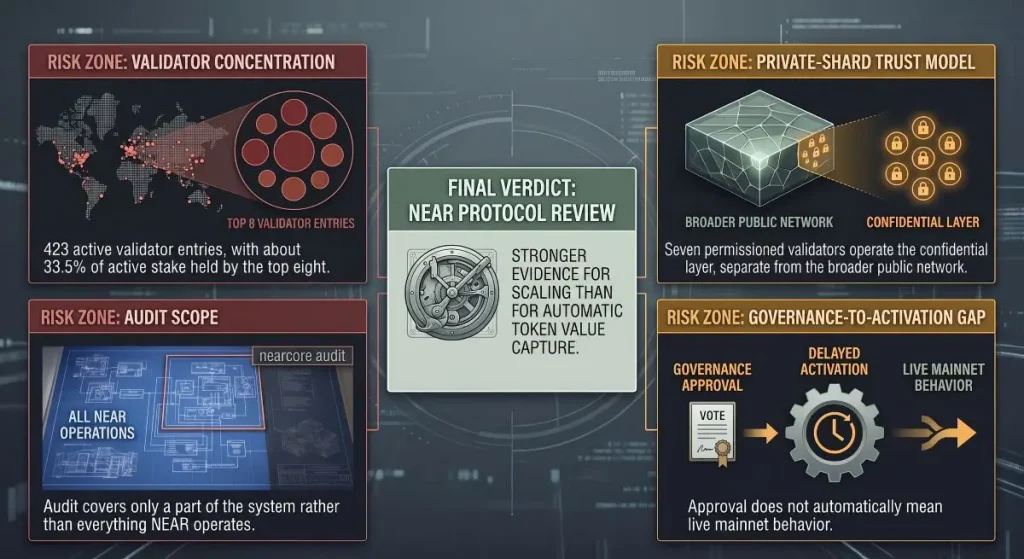
In the snapshot, the eight largest validator entries together held roughly one-third of active stake. That figure does not prove common ownership, coordination or malicious behaviour. It does show why validator count alone gives an incomplete picture of decentralization.
A similar issue appears in networks with validator concentration trade-offs. Beneficial ownership, delegation flows, shared infrastructure and cumulative voting weight can matter more than the number of names shown in an explorer.
NEAR Tokenomics: Issuance Still Matters
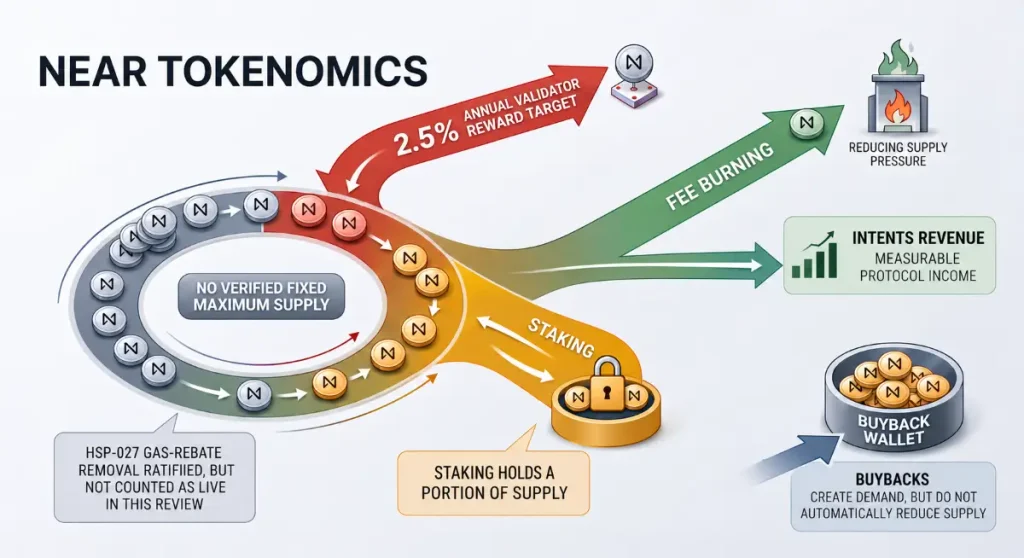
NEAR started with one billion coins at genesis.
Current total supply has grown above 1.3 billion, with no verified fixed maximum under the current monetary model.
Validator rewards now target 2.5% of total supply annually. Older material often repeats the former 5% figure, which no longer reflects the current target.
Legacy token allocations are described as fully unlocked. Old vesting cliffs therefore matter less, but validator issuance can still expand total supply.
| Tokenomics force | Current position | Economic effect |
|---|---|---|
| Genesis supply | 1.0B NEAR | Starting point, not a permanent cap |
| Current total supply | About 1.305B NEAR | Shows historical supply expansion |
| Fixed maximum | None verified | Supply can continue changing |
| Validator issuance target | 2.5% annually | Adds new NEAR over time |
| Staked share | About 47.8% | Supports security without removing supply |
| Transaction-fee burn | Active under current fee rules | Can offset part of issuance |
| Developer gas rebate | Current documentation still describes 30% | Reduces eligible fee share reaching burn |
| Intents revenue | Measurable | Creates protocol income separate from routed volume |
| Buybacks | Visible on-chain | Demand channel, not a burn by default |
No single metric settles NEAR’s token case.
Lower issuance, fee burns and buybacks can all improve the supply-demand balance, but none guarantees falling supply or stronger token demand. My tokenomics review therefore compares annual issuance with fee burns, completed buybacks, the treatment of repurchased coins and genuine network usage.
The same distinction matters in any token utility and value-capture analysis: useful technology does not guarantee that the native token captures all of the economic value created.
Gas-Rebate Reform Is Approved, Not Yet Counted as Live
House of Stake ratified HSP-027 on 3 July 2026.
HSP-027 calls for removing the 30% developer gas rebate and directing eligible execution fees toward the protocol burn mechanism.
Ratification alone did not change mainnet behaviour. Developers still needed to implement and test the change before validators could activate it.
My checks did not verify completed mainnet activation, while current documentation still described the 30% rebate. For this review, the additional burn therefore does not count as live.
Governance approval and production behaviour can diverge for weeks or months. Tokenomics should reflect the rule mainnet actually runs rather than a change approved for future activation.
Nightshade 3.0 Adds a Separate Private-Shard Trust Model
NEAR presents Nightshade 3.0 as the latest stage of its architecture.
Nightshade 3.0 further separates consensus from execution, supports atomic multi-contract interactions and introduces a private shard for confidential workloads.
Seven permissioned validators operate that private shard, while a TEE-based bridge connects it to public NEAR mainnet.
Trusted execution environments use hardware isolation to protect sensitive code and data. Such infrastructure can support confidential transactions and selective disclosure, but private execution relies on a different trust model from public NEAR consensus.
Public mainnet depends on a broader proof-of-stake validator set. Private-shard confidentiality depends on seven permissioned operators plus hardware attestation.
My review treats those as separate decentralization models rather than placing both under one label.
Audit Evidence Has a Defined Scope
Hacken audited the nearcore codebase in 2023.
Its review covered a specific repository state and recorded nine findings, with eight resolved and one observation accepted.
Hacken’s audit provides useful evidence for the code actually examined. It does not certify every system NEAR operates in 2026.
Chain Signatures, Intents, solver infrastructure, private shards, bridge routes and later protocol releases each create separate scope questions.
A base-layer audit can reduce uncertainty around nearcore, but it cannot guarantee MPC availability, solver behaviour, TEE security or the reliability of external chains.
Audit evidence deserves weight only within the component and version that was actually tested.
Governance Still Depends on Execution
House of Stake gives NEAR a formal process for economic and governance proposals.
Tokenholders can approve policy direction, while developers and validators still determine how and when those decisions reach production.
HSP-027 shows that sequence clearly. Governance approved the economic change, developers still needed to update the code, testnet had to prove compatibility, and validators ultimately had to run the upgrade.
Authority is therefore spread across several layers: public validators, governance bodies, engineering teams, MPC operators and private-shard infrastructure.
A simple centralized-versus-decentralized label misses that structure.
My Verdict: Sharding Has Stronger Evidence Than Token Capture
My review found stronger evidence for NEAR’s scaling architecture than for automatic token value capture.
Nightshade has a credible technical case. Stateless validation reduces state-storage pressure, dynamic resharding adds capacity, and the one-million-TPS benchmark demonstrates horizontal headroom under a narrow workload.
Chain Abstraction, Intents and Chain Signatures also address real usability problems. They can hide steps that once required separate wallets, gas assets and manual bridge interactions.
None of that makes the economic outcome automatic.
Validator issuance targets 2.5%. Fee burning exists. Intents produces measurable revenue. Buybacks create a visible demand channel.
Supply still has no verified hard cap, stake remains materially concentrated among the largest validator entries, and repurchased NEAR should not be treated as burned unless those coins cannot return to circulation.
What matters next is straightforward: retained revenue, recurring user demand, validator distribution and the amount of supply that fees or buybacks actually absorb.
NEAR has already shown that sharding can create capacity. Whether that capacity creates lasting demand for NEAR remains an economic question, not a throughput question.
Frequently Asked Questions
NEAR reported more than one million TPS in a controlled benchmark across 70 shards using native transfers. The result shows horizontal capacity under the tested workload, not sustained current-mainnet throughput across every type of transaction.
Yes. NEAR’s current architecture describes shards splitting and merging as network load changes.
No verified fixed maximum applies under the current monetary model. Validator issuance can increase supply, while fee burns and buybacks may offset part of that expansion.
House of Stake approved the removal through HSP-027, but this review did not verify the zero-rebate rule as active on mainnet. Current documentation still described the 30% rebate during the check.
No. Chain Abstraction reduces visible complexity for users, while MPC operators, solvers, external contracts, liquidity and destination-chain security remain part of the transaction path.

Founder & Managing Editor of CryptosMedia. Zahid Hussain leads evidence-based crypto research covering tokenomics, security, governance, adoption, and risk.
CryptosMedia separates verified facts from interpretation, avoids buy/sell recommendations, and updates reviews when major evidence changes.
1 thought on “NEAR Protocol Review: Can Sharding Create Token Demand?”