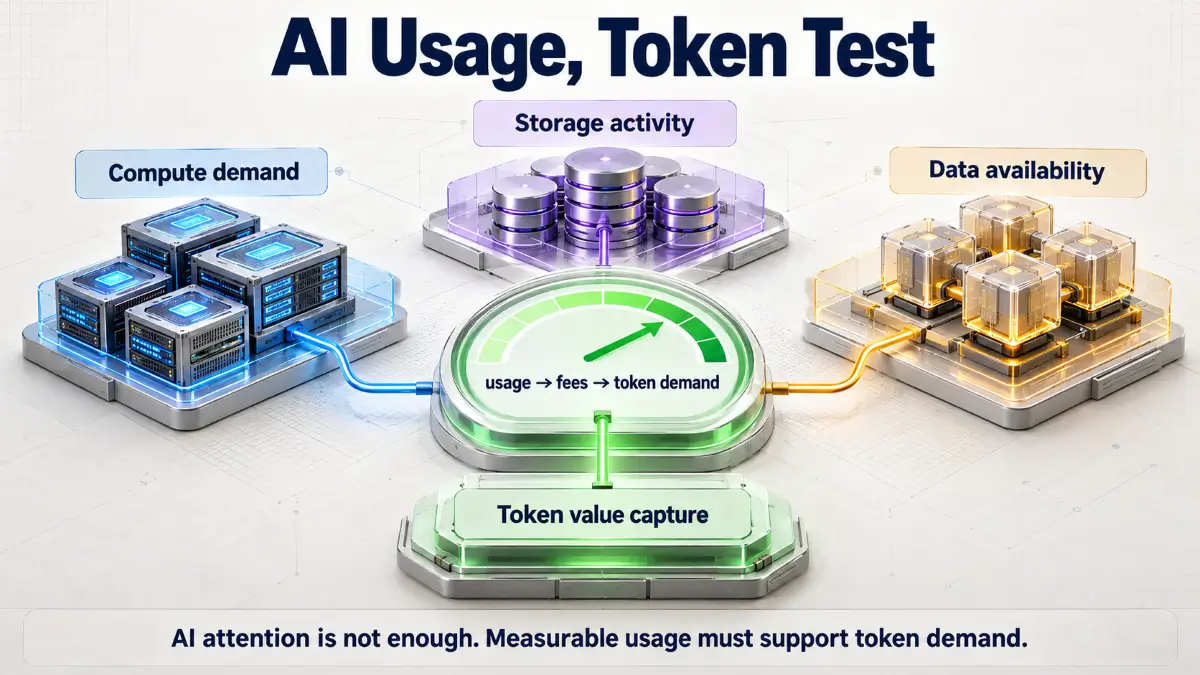
AI infrastructure is one of crypto’s strongest narratives, but narrative strength is not the same as token value capture. A project can sound important, raise serious capital, attract builders, and still leave investors asking one uncomfortable question: where does the token actually gain demand?
This 0G Review examines the 0G network, its AI-native infrastructure stack, compute and storage model, token utility, supply pressure, execution risks, and the central thesis: can real AI usage create measurable demand for 0G?
This 0G review is for research and education only. It is not financial advice or a buy/sell recommendation. Crypto assets and AI infrastructure networks can face technical, market, governance, liquidity, and token-supply risks.
CryptosMedia does not guarantee future 0G performance. This article uses public information to review network design, token utility, adoption quality, and risk.
Quick Verdict
0G is trying to build a full AI infrastructure stack for Web3. The project describes itself as a trust layer for AI, combining an AI-native EVM Layer 1, private compute, encrypted storage, data availability, and on-chain settlement.
That gives 0G a more serious story than a simple AI-themed token. The project is not only saying “AI will grow.” It is trying to support AI workloads: model activity, datasets, storage, inference, agent execution, and verification.
The token case is less automatic. AI usage only matters for 0G if it creates recurring token-linked demand through payments, staking, compute access, storage, settlement, or network security. If users can benefit from the infrastructure without meaningful 0G demand, the product can grow while the token stays weak.
So the clean verdict is this: 0G has a strong infrastructure narrative and a high-upside AI angle, but the token thesis still needs measurable usage, transparent value capture, and enough demand to absorb future supply.
Key Takeaways
0G In One Research View
What 0G Is Trying To Build
0G is designed as infrastructure for decentralized AI. Its official positioning combines an AI-native EVM Layer 1, private compute, encrypted storage, data availability, and AI-focused settlement.
That matters because AI workloads are different from normal blockchain transactions. AI applications may need large datasets, model weights, inference requests, user state, AI agents, and proof that outputs were produced correctly.
A typical blockchain is not built to handle all of that efficiently. 0G’s thesis is that AI needs a dedicated infrastructure stack where compute, storage, settlement, and verification work together.
This is the best part of the project’s story. Instead of using AI only as marketing language, 0G is trying to solve real infrastructure problems around AI execution and data.
The challenge is proving that this infrastructure creates demand for the 0G token, not only demand for the product.
The Mistake Investors Can Make With 0G
The biggest mistake is assuming AI growth automatically means 0G token demand.
AI can grow across the world without benefiting one specific crypto asset. Developers may use centralized cloud platforms, open-source models, private servers, or cheaper off-chain services. Even if 0G attracts users, that activity still needs to touch the token in a meaningful way.
This is where serious analysis begins. A project can have useful technology, strong branding, and major investor interest, but the token still needs a direct economic role.
For 0G, the right questions are simple:
- Do AI inference requests require 0G?
- Do storage and data availability payments create demand for 0G?
- Does staking secure useful services, or does it mainly create rewards?
- Do developers need the token to access, settle, or verify AI activity?
- Can usage data prove that the network is becoming economically important?
If these answers stay unclear, the 0G thesis remains more narrative-driven than demand-driven.
AI Demand Needs A Token Path
AI infrastructure sounds valuable because AI itself is growing quickly. Still, crypto investors need to separate product relevance from token value capture.
Product relevance means the network may solve a real problem. Token value capture means the token gains a reason to be used, held, staked, paid, or demanded because of that problem.
0G’s strongest argument is not simply “AI is big.” That is too broad. The stronger argument is that AI applications need compute, storage, data availability, verification, and settlement, and that 0G can provide those services in a way that requires meaningful token usage.
That is the thesis worth testing.
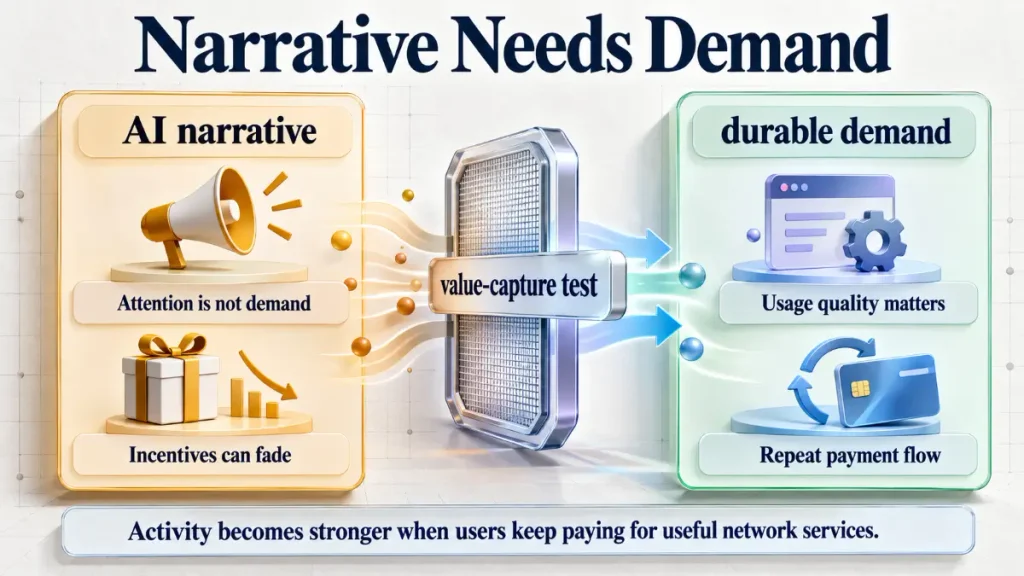
If AI agents and developers use 0G mostly because incentives are available, demand may fade when rewards slow down. If they use 0G because it provides reliable, priced, verifiable, and composable AI infrastructure, the token story becomes stronger.
Utility is not the same as net demand. The network must show that activity creates recurring economic pressure for 0G.
Possible 0G Demand Pathways
Compute Is Where The Thesis Gets Tested
Compute may become the clearest test for 0G.
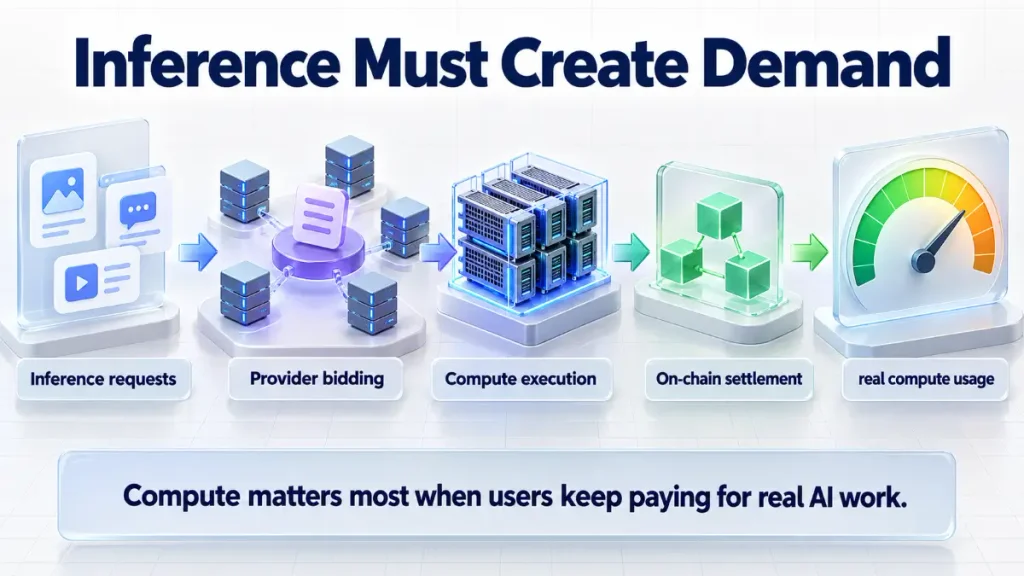
The project presents 0G Compute as decentralized AI inference for builders, with open model access, provider bidding, API-based usage, and on-chain settlement. This matters because inference can be measured more clearly than broad ecosystem claims.
If developers send real requests through 0G Compute, the network can show usage through request volume, payment flow, pricing, and settlement activity. That would make the token thesis stronger because the project could point to real AI workloads instead of only future promises.
The challenge is competition.
Compute is a tough market. Centralized providers, open-source hosting, GPU clouds, and other decentralized compute networks all want developer demand. 0G must prove that its service is not only decentralized, but also reliable, priced well, easy to integrate, and valuable enough to keep developers returning.
A cheap service that developers do not trust will not scale. A decentralized service that is hard to use will struggle. A fast service without token value capture may help the product but not the token.
For 0G, compute must become a real demand engine, not just a strong headline.
Storage And Data Availability Are Core To The Pitch
AI systems need data. They also need ways to access, verify, update, and protect that data. This is why storage and data availability are central to the 0G pitch.
The project describes high-throughput storage for AI datasets, model weights, and live state. In theory, that can be powerful because AI applications may need large and persistent data layers. If 0G can make that data available, verifiable, and useful for on-chain AI systems, the network could occupy a valuable position.
Still, storage demand must be judged carefully.
Storage usage does not automatically create strong token value. The pricing model, payment asset, demand frequency, node incentives, and user retention all matter. If storage is useful but token demand is weak, the network may grow without creating enough economic pressure for 0G.
Data availability has the same issue. High throughput sounds impressive, but throughput is not revenue. The question is whether applications keep paying for the service and whether those payments support the token economy.
Signals That Need Careful Reading
Where 0G Token Value Has To Come From
0G token value depends on how deeply the token connects to the network’s AI services.
If 0G is needed for fees, compute access, staking roles, AI alignment nodes, settlement, storage payments, or network security, the token has a clearer utility path. If users can benefit from the infrastructure without meaningful 0G exposure, value capture becomes weaker.
This is where many AI crypto projects struggle. They may build useful tools, but the token sits outside the strongest economic flow.
0G needs to avoid that problem.
The best version of 0G creates a loop where AI applications need the network, network services require token-linked payments or staking, and repeated usage creates demand beyond speculation.
The weaker version is an AI infrastructure brand where product attention grows but token value remains dependent on incentives, market cycles, and AI hype.
That difference will decide the long-term thesis.
Tokenomics And Supply Pressure
Official token information says the 0G token supply at TGE was 1 billion. The official allocation post describes 56% for community and ecosystem growth and 44% for core team and early backers.
That structure gives the ecosystem a large growth budget. It can help fund builders, validators, AI alignment nodes, community rewards, grants, and network expansion. It also means the market must eventually absorb a large amount of token supply.
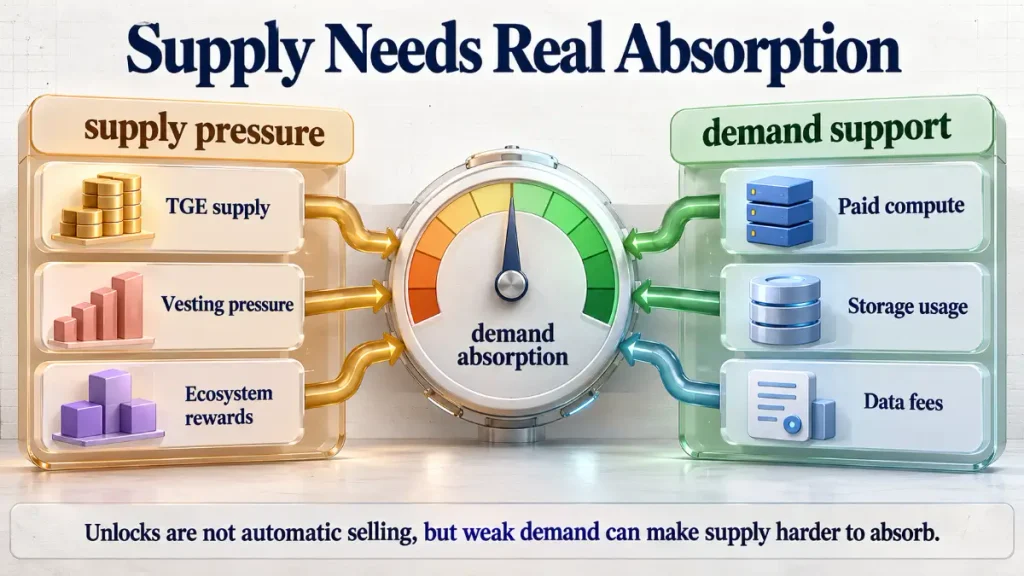
The unlock structure matters. Official vesting information says 21.32% of total supply unlocks at TGE from community allocations. Team and backer allocations have a 12-month lockup and then vest over 36 months.
That is better than immediate full unlocks, but it does not remove supply risk.
Unlocks do not mean automatic selling. Some tokens may support growth, grants, node participation, staking, or long-term alignment. But future token availability still needs real demand. If demand is weak when vesting expands, market pressure can rise.
0G Supply And Demand Pressure
Execution And Governance Risks
0G is ambitious, and ambitious infrastructure carries execution risk.
The project is trying to combine several difficult markets: AI compute, decentralized storage, data availability, EVM execution, model verification, and AI application tooling. Each layer has its own technical and economic challenge.
Security also matters because AI infrastructure can touch sensitive data, model access, private compute, and automated agent activity. If users trust the network with important AI workflows, reliability and verification become essential.
Governance is another risk. Ecosystem incentives, node rewards, token unlocks, grants, compute pricing, and network upgrades all require disciplined coordination. Poor governance can weaken confidence even when the technology looks strong.
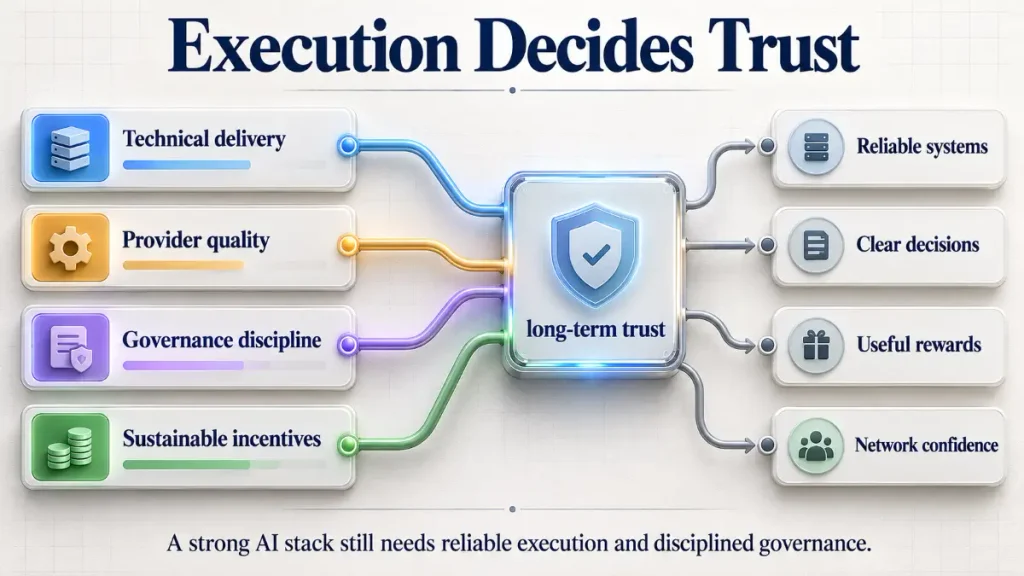
0G also faces market competition. Decentralized compute networks, AI agent platforms, storage protocols, DA layers, and AI-focused chains are all fighting for attention. The project must prove why developers should choose 0G instead of cheaper, older, or more liquid alternatives.
Case For 0G
The bullish case starts with the idea that AI needs a trust layer.
If AI agents become more common, users may need verifiable compute, on-chain settlement, data availability, encrypted storage, and composable AI services. 0G is trying to position itself in that flow before the market fully matures.
The EVM-compatible Layer 1 can help because developers already understand Ethereum-style tooling. The compute and storage layers can make the project more useful than a simple smart-contract chain. The ecosystem allocation can support builders and early network activity.
If real usage grows across inference, storage, AI apps, and settlement, 0G could become one of the more serious AI infrastructure networks.
The stronger bull case is not “AI is popular.” It is that 0G becomes a practical infrastructure layer for AI workloads that need verification, payment, and settlement.
Case Against 0G
The bearish case is that the AI narrative may be stronger than measurable demand.
0G may attract attention because AI is popular, but token value depends on usage quality. Developer activity built mainly around incentives can fade once rewards slow down. Small compute demand would also keep token demand weak. Storage and data availability need real scale, otherwise the infrastructure story becomes harder to defend.
Supply pressure is another issue. Future unlocks can matter if demand is not strong enough. Ecosystem incentives can support adoption, but they can also create selling pressure if rewards do not lead to durable usage.
Competition is also serious. Many developers may prefer centralized providers for speed, reliability, and simplicity. 0G must prove that decentralization adds enough value to overcome friction.
The weakest version of the 0G thesis is simple: strong AI story, limited measurable usage, and token demand driven mostly by market cycles.
What Would Strengthen The Thesis?
The 0G thesis becomes stronger if the project shows transparent compute usage, recurring storage demand, active AI applications, and visible settlement flows.
It also improves if developers keep using the network after incentives slow down. Organic usage is more important than temporary campaigns.
Token demand would look stronger if 0G becomes necessary for paying fees, accessing compute, staking for service roles, or securing important network functions. The clearer the token’s role, the easier it becomes to analyze value capture.
The best signal would be a clean demand loop:
AI apps need compute and storage → usage settles through 0G infrastructure → token-linked payments or staking increase → network demand absorbs supply.
Until that loop becomes visible, 0G should be treated as promising but still unproven.
Final Assessment
0G is one of the more interesting AI infrastructure projects because it is trying to build around real AI workload needs: compute, storage, data availability, settlement, and verification.
That makes it more serious than many AI-themed crypto projects. The official positioning is clear, the infrastructure stack is ambitious, and the token design includes ecosystem-focused allocations meant to support growth.
But the key question remains open.
Can AI usage create measurable 0G demand?
Right now, that is the core test. The project needs to prove that developers, AI agents, and applications will use the network in ways that create recurring token-linked demand. Compute requests, storage usage, and settlement activity must become visible and economically meaningful.
0G has a strong narrative. The stronger research thesis is that narrative alone is not enough.
For 0G to become a durable token story, AI infrastructure usage must move from promise to measurable demand.
Key Questions About 0G and AI Token Demand
What is 0G?
What is the 0G token used for?
Is 0G only an AI narrative token?
Can AI usage increase 0G demand?
What is 0G Compute?
Why does storage matter for 0G?
Does 0G have supply pressure?
Do unlocks mean automatic selling?
What is the biggest strength of 0G?
What is the biggest risk for 0G?

Founder & Managing Editor of CryptosMedia. Zahid Hussain leads evidence-based crypto research covering tokenomics, security, governance, adoption, and risk.
CryptosMedia separates verified facts from interpretation, avoids buy/sell recommendations, and updates reviews when major evidence changes.