
RollApps give Dymension a different scaling problem from a conventional Layer 1. The hub does not try to execute every application itself. It settles and coordinates application-specific chains that can choose their own execution and data-availability setup. This Dymension Review focuses on the economic consequence of that design: DYM has real roles in staking, governance, sequencer bonds and fee burns, but newer base assets and governance-funded liquidity can let the product grow without forcing every action through DYM.
Several 2026 signals make that tension measurable. Permissionless RollApp launches are live. The approved Beyond design and v4.0.0 software add support for wider asset, bridge and launchpad functionality, but proposal and release material alone do not prove that every Beyond feature is active on mainnet. A late-August 2026 validator snapshot showed bonded DYM at roughly 10.7% of issued supply while inflation remained at its 8% ceiling. Governance also moved 40 million DYM from the community pool into a market-making program. None of these facts settles the token case alone. Together, they show why product adoption, token demand and treasury activity need separate tests.
Dymension Separates Execution From Settlement
Dymension is a proof-of-stake Layer 1 that connects application-specific chains called RollApps. A RollApp handles its own execution, while the hub provides settlement, shared liquidity, governance and coordination. The RollApp can publish transaction data to an external data-availability network instead of placing every piece of execution data on Dymension itself.
A sequencer orders RollApp transactions, batches blocks and publishes data to the selected availability layer. After that layer accepts the data, the sequencer submits a state update to the Dymension hub. The hub can then use the published information when it evaluates fraud proofs and settlement.
This division lets builders customize execution without asking every application to compete for the same blockspace. It also widens the dependency map. A healthy hub cannot guarantee that a RollApp sequencer stays online, an external data provider serves the required data, or a bridge route remains liquid.
| Layer or component | Primary job | Material dependency |
|---|---|---|
| Dymension L1 | Consensus, settlement, governance and shared liquidity | Validator participation, hub software and governance execution |
| RollApp | Application-specific execution | RollApp code, configuration and operator availability |
| Sequencer | Orders transactions and posts state updates | Liveness, bond, software and replacement process |
| Data-availability layer | Keeps transaction data available for verification | Chosen provider, integration and data retrieval |
| eIBC and bridge paths | Move assets and accelerate some withdrawals | Liquidity providers, operators, relayers and bridge logic |
The architecture therefore shifts several risks instead of eliminating them. That is normal for a modular system, but readers should identify which layer controls each failure before treating “Dymension security” as one thing.
Token-First RollApps Lower the Launch Barrier
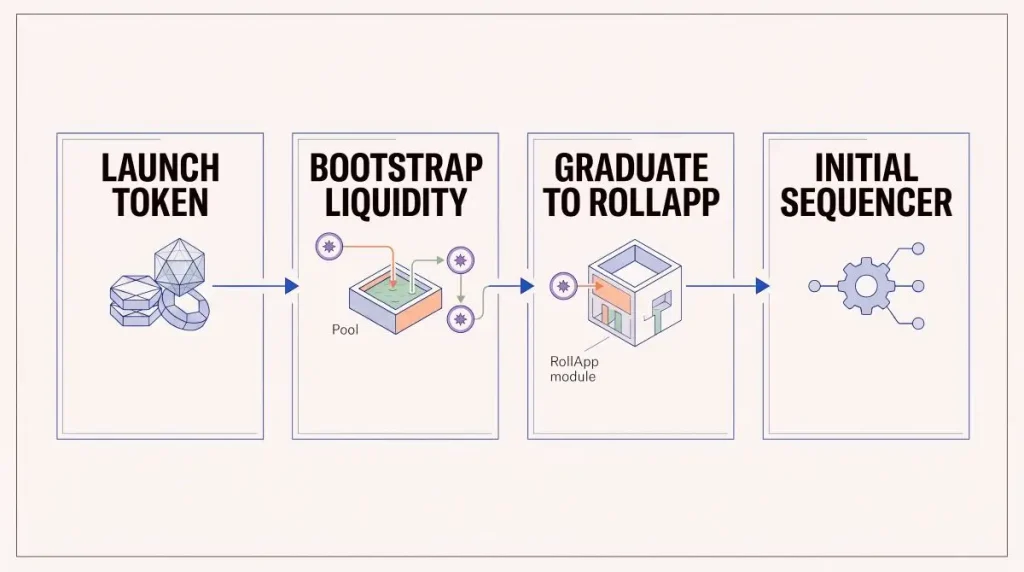
Dymension lets a project start before it operates a full chain. An Initial RollApp Offering creates a tradeable token and uses a creator-selected bonding curve to bootstrap liquidity. If the project later launches its RollApp, holders can burn the IRO token and claim the native RollApp token at a one-to-one ratio.
The mechanism combines fundraising, price discovery and chain launch inside one stack. DYM used to purchase IRO tokens can help seed a standard liquidity pool after graduation. That reduces coordination work for a new project.
Lower launch friction also lowers the cost of experimentation. It does not tell readers how many launches retain users, liquidity or operators after the initial event. A launchpad can create many tokens without creating many durable chains.
That distinction matters more than raw RollApp count. Useful adoption measures include retained users, recurring fees, stable liquidity, active sequencers and continued activity after incentives decline.
Permissionless Creation Is Not the Same as Decentralized Operation
The 3D phase removed an important gate. Earlier production RollApps passed through a governance-controlled deployment process. Current creation happens on-chain without requiring governance to approve each new RollApp.
Permissionless registration improves access, but operation has a separate control path. Dymension’s documentation says the creator chooses the initial operator. Other operators can join based on the economics of running that RollApp, and sequencer bonds, jailing and replacement rules can support recovery.
Project materials also use stronger language and describe RollApp operation as fully decentralized. A May 2026 roadmap, however, says the network still intends to complete and harden the move toward fully decentralized sequencers. Those statements do not fit neatly together.
The safer conclusion is narrower: Dymension has mechanisms for permissionless operator participation and sequencer replacement, while the degree of decentralization still depends on how many independent operators actually serve each live RollApp. Our review of sequencer and bridge control shows why deployment access and day-to-day operational control need different measurements.
Beyond Targets Easier Access With Less Mandatory DYM Use
Dymension’s Beyond upgrade addressed a problem the project itself acknowledged: the earlier design had not attracted a loyal user base or produced sustainable revenue. Dymension made that statement in its own proposal, so readers should treat it as the project’s diagnosis rather than an independent market finding.
The approved Beyond design moves Dymension beyond a DYM-only base-asset model. Dymension’s v4.0.0 software release wires in major parts of that design, including Hyperlane, KAS bridge support, rate limits, TEE-based finalization and expanded IRO mechanics. Public proposal and release records, however, do not establish that every Beyond feature is active on mainnet at the same time. Where allowlisted base assets are activated, assets such as USDC or KAS can perform functions that previously pushed users or builders toward DYM first.
This makes the product easier to enter. A builder can use a familiar asset for liquidity or fees instead of forcing every participant through an extra DYM conversion.
The economic trade-off runs in the opposite direction. If alternative base assets handle more user activity, growth does not automatically create the same direct DYM demand that a DYM-only design would have produced.
That design is not automatically negative for DYM. Bridge and protocol fees can still buy DYM before burning it, and sequencer bonds still require DYM. The important step is to verify which Beyond features are live, then measure those remaining capture channels instead of assuming every RollApp interaction supports the token equally.
DYM Demand Comes From Mechanisms, Not RollApp Count
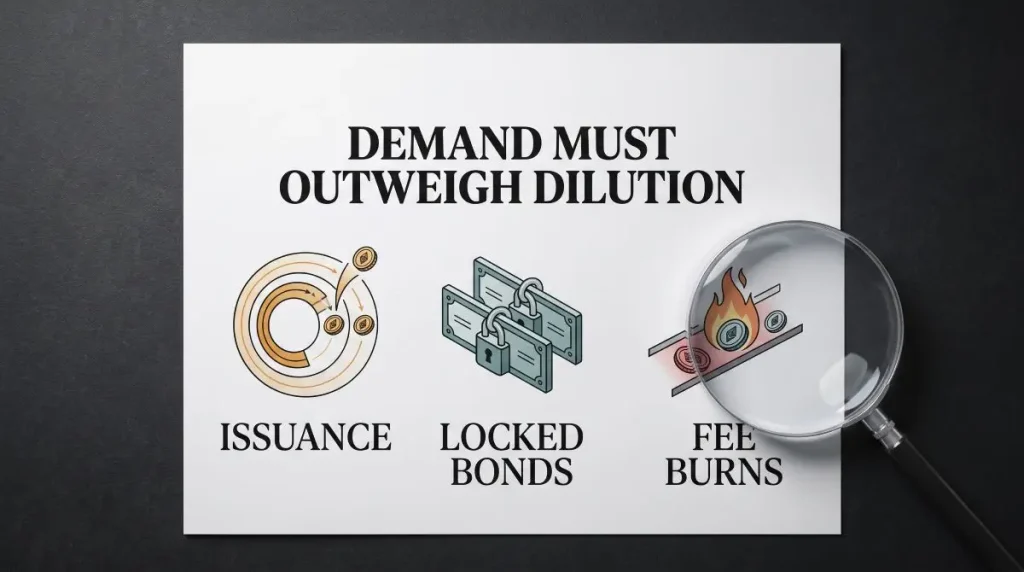
DYM has several defined jobs. Validators and delegators stake it to secure the hub. Staked tokens carry governance power. RollApp sequencers post DYM bonds when they propose state updates. Fees from specified bridge and swap activity can create market purchases before the protocol burns the acquired DYM.
Current documentation lists a 0.10% bridging fee. The mechanism converts collected bridge fees into DYM and burns the result. Standard liquidity pools also direct part of their swap fee toward DYM purchases and burns, while IRO trades use a separate fee schedule.
The current minimum RollApp bond is 100 DYM. That creates a token requirement, but the minimum alone says little about economic security. A lightly bonded RollApp and a heavily bonded one should not receive the same risk assumption simply because both satisfy the protocol minimum.
Burns need the same discipline. A burn is real supply removal, but its economic importance depends on volume. Small recurring burns can coexist with much larger issuance or vesting flows.
This is where economic-security trade-offs become useful. A protocol can create a bond, staking or slashing mechanism without proving that the value at risk is large enough for the activity it protects.
Dymension Review: Live Monetary Policy vs Token Demand
DYM began with an initial supply of one billion tokens, not a permanent one-billion-token cap. Ongoing issuance has already pushed total supply to about 1.07 billion.
Dymension’s public monetary-policy documentation states a 2% minimum annual issuance rate, an 8% maximum and a 50% target staking ratio. The same page contains an illustrative example that mentions 21% current inflation even though the page defines an 8% ceiling.
Governance later changed another key parameter. Proposal 35 passed in December 2025 and reduced the live GoalBonded target from 50% to 30%. A dym.fyi validator snapshot checked at the end of August 2026 showed 69 active validators and about 114.9 million DYM bonded. CoinGecko reported total supply near 1.071 billion DYM around the same review date.
Using those late-August figures, bonded DYM represented roughly 10.7% of issued supply, well below the live 30% target. Current chain tracking also showed inflation at 8%, the configured ceiling. Under the dynamic issuance design, a staking ratio below target pushes inflation upward until it reaches that ceiling. The live rate therefore matches the operational parameters rather than the stale ‘21%’ illustration on the static documentation page.
| DYM metric | Current or published position | Why it matters |
|---|---|---|
| Initial supply | 1.0B DYM | Genesis amount, not a fixed maximum |
| Total supply | About 1.07B DYM | Shows that protocol issuance has moved supply above genesis |
| Live inflation | 8% | Current configured ceiling |
| Live GoalBonded | 30% | Governance lowered the target from the older 50% setting |
| Bonded tokens | About 114.97M DYM | Roughly 10.7% of issued supply in the late-August snapshot |
| Active validators | 69 | Participation count does not show voting-power distribution |
| Top-four voting power | About 49.1% | Shows material concentration inside the active stake |
| Bridge fee | 0.10% | Creates a DYM buy-and-burn path when withdrawals generate fees |
| Minimum RollApp bond | 100 DYM | Creates direct DYM demand, but the minimum is small by itself |
These figures make the central tokenomics test clearer. DYM has mechanisms that remove or lock supply, while issuance currently runs at the maximum rate. The token case improves only when burns, bonds, fee demand and staking participation become large enough to change that balance.
Vesting and Governance-Controlled Supply Need Separate Treatment
The genesis distribution also matters, but “unlock” is too broad a word for every category.
Dymension allocated 20% to Ecosystem and R&D, 20% to the core contributing team, 14% to backers, 33% to the Incentives Manager, 8% to the public allocation and 5% to the community pool. The official schedule gave the ecosystem allocation 33% availability at genesis with the remainder vesting over three years. Backers and the core team had a 12-month lock followed by 24 months of linear vesting.
Those schedules mean some genesis allocations still move through vesting during 2026. The Incentives Manager and community pool are different. Governance could access them from genesis, while the documentation describes those balances as non-circulating until distribution.
Combining these categories into one “future unlock” number would blur important differences. Vested team tokens, newly issued staking rewards, bonded DYM, treasury balances and incentive distributions can all affect available supply through different mechanisms.
Readers should therefore track what actually enters circulation rather than treating every governance-controlled token as already sold or every vested token as immediately liquid.
Forty Million DYM Now Supports a Market-Making Program
Governance made the community-pool question more concrete in August 2026. Proposal 42 passed and executed a transfer of 40 million DYM from the community pool to fund professional market making on centralized exchanges, beginning with Binance and Bybit.
The proposal describes the tokens as loaned inventory for one or two market makers. It also sets public performance targets, including market depth and spread requirements. Under the stated terms, the loaned inventory should return at the end of the arrangement, subject to the program’s contract terms and any option mechanics.
That distinction prevents a misleading supply claim. The 40 million DYM transfer is not a burn. The proposal also does not describe a simple permanent giveaway. It moves a large governance-controlled balance into an active liquidity program whose execution and eventual return need follow-up.
The program may improve order-book depth and reduce trading friction. Those are market-quality goals, not proof of organic RollApp demand.
Future reviews should compare the promised liquidity metrics with actual exchange conditions and confirm what happens to the inventory when the term ends. Governance spending deserves the same evidence standard as protocol revenue.
Validator Count Hides a Concentrated Voting-Power Distribution
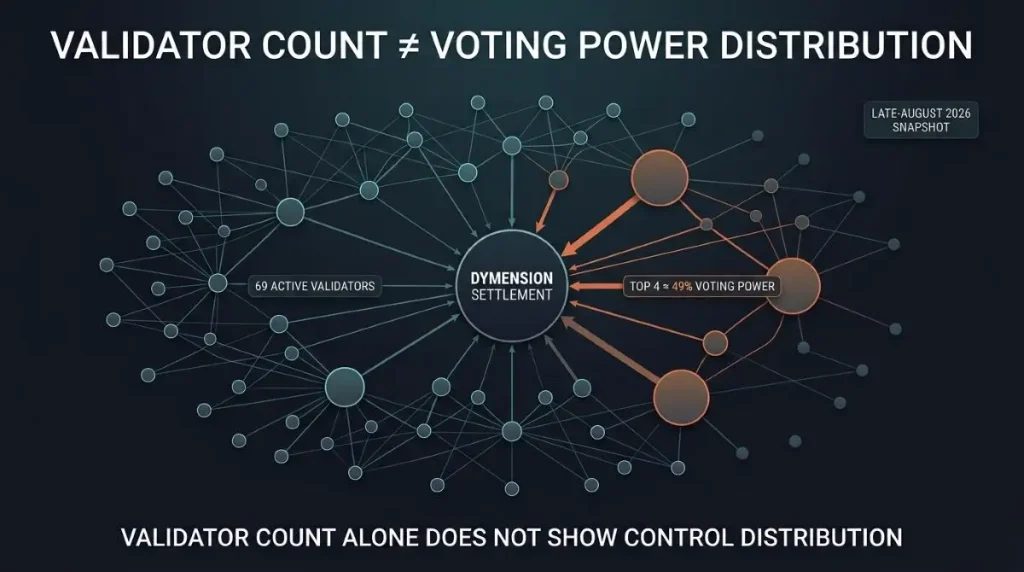
A late-August explorer snapshot listed 69 active validators. That number sounds broad until voting power enters the picture.
The largest validator held about 25.2% of bonded voting power. The top two held about 35.4%, and the top four reached roughly 49.1%.
Those figures do not prove coordination or common ownership. They do show that a validator count alone overstates how evenly consensus influence is distributed.
The distinction resembles other networks where validator concentration changes the practical control picture. Stake distribution, related infrastructure, delegation sources and governance participation matter alongside the number of active operators.
Dymension’s own delegation-program documentation targets no more than 5% voting power for validators that receive foundation delegation. The current largest-validator share shows why concentration still deserves monitoring even when the protocol supports a much larger maximum validator set.
External Data Availability Moves Risk Rather Than Removing It
RollApps can publish their transaction data outside the Dymension hub. That separation can reduce execution costs and let builders choose a data-availability system that fits their workload.
The design also creates a dependency that the hub cannot remove. If the chosen provider fails to make required data available, users and fraud-proof participants may struggle to reconstruct or verify RollApp state.
Dymension documentation itself warns that users can face risk when a fraudulent state transition goes unreported. Operators, liquidity providers and monitoring therefore remain part of the security path for withdrawals.
Our analysis of external data-availability dependencies explains the broader trade-off. Modular systems can lower costs by separating responsibilities, but each boundary needs its own availability, verification and recovery assumptions.
This is why “settled on Dymension” should not become shorthand for every component inheriting identical security.
Audit Claims Need Component and Version Boundaries
BlockApex publicly lists completed 2024 manual reviews for Dymension components including the RDK, Dymint, RollApp EVM and WASM implementations, the hub and Ethermint. The firm classifies those engagements as private audits, so its repository does not provide the full reports for public inspection.
That matters for the weight readers can place on the audit claim. A public listing supports the fact that reviews occurred. It does not let an outside reader independently inspect every finding, commit hash, remediation decision or unresolved issue.
Dymension has also changed since those 2024 reviews. Version 4 added new IRO features, Hyperlane, KAS bridging, rate limiting, TEE-based finalization and other controls. Version 4.0.2 later included a CometBFT security patch.
Older reviews should therefore stay inside their scope. They cannot serve as a blanket certificate for every current bridge route, TEE flow, relayer, RollApp implementation or later code change.
Adoption Is the Missing Bridge Between Product and Token
Dymension has already proven that the hub runs, staking works and RollApps can launch. That is product availability, not durable adoption.
The stronger evidence would show retained production users, repeat bridge and swap activity, fee revenue, realized DYM burns, independent RollApp operators and liquidity that persists without heavy subsidies.
Incentives complicate the picture because DYM governance can direct tokens toward RollApps and liquidity pools through endorsement programs. Those programs can help bootstrap a network, but analysts should not call subsidized participation organic demand until activity survives after the subsidy falls.
As Beyond features reach mainnet, they should face the same test that motivated the upgrade. If activated alternative base assets bring lasting users and revenue while bridge fees, protocol burns, bonds and staking preserve meaningful DYM demand, both the product and token case improve.
If activity rises mainly because treasury programs supply liquidity while inflation stays at the ceiling, the product can progress without producing the same economic result for DYM.
What Would Change the DYM Case?
Dymension does not need another statement that RollApps are easy to launch. It needs a clearer connection between real RollApp use and DYM economics.
Four measurements would change the picture most: sustained fee-generating activity, realized DYM burns versus annual issuance, broader bonded participation, and less concentrated validator voting power. A fifth test now matters as well: transparent reporting on the 40 million DYM market-making program and the eventual return or treatment of that inventory.
Operational evidence should improve alongside economics. More independently run sequencers, clear fraud-proof performance and current audit coverage would make the security case easier to evaluate.
Until those measures strengthen, a growing launchpad should not automatically become a growing token thesis.
Verdict: RollApps Are Easier to Launch Than DYM Demand Is to Prove
Dymension has built a more coherent product than its original modular-rollup pitch suggested. Token-first launches, permissionless RollApp creation and shared liquidity already give projects a practical route from an idea to an application-specific chain.
DYM also has genuine protocol utility. Validators stake it, governance uses it, sequencers bond it, and specified bridge and swap fees can purchase and burn it.
The economic evidence remains less mature than the product.
Inflation sat at the 8% ceiling in the late-August snapshot, while bonded supply remained far below the 30% live target. Roughly half of bonded voting power sat with the top four validators. Vesting continues for some genesis allocations, and governance has moved 40 million DYM into an active market-making program.
Beyond’s alternative-base-asset design creates another deliberate trade-off when those features are active. It can make the network easier to use while reducing the need for every user journey to begin with DYM.
That leaves a measurable rather than ideological conclusion. Dymension can succeed as a RollApp platform without guaranteeing proportional DYM demand. The token case becomes stronger when recurring activity produces enough burns, bonds, fees and staking demand to compete with issuance and other sources of available supply.
Frequently Asked Questions
No. Dymension is its own proof-of-stake Layer 1 and settlement network. RollApps are application-specific chains that connect to Dymension. Some can use EVM execution, but the hub has its own validators, governance and settlement rules.
No. One billion DYM was the initial supply. Dynamic protocol issuance has already pushed total supply above that level.
A 30 August 2026 chain snapshot showed 8% inflation, which is the configured maximum. Governance lowered the live GoalBonded target to 30% in December 2025.
The public monetary-policy page still lists a 50% target, while Proposal 35 records the later change to 30%. Current operational analysis should therefore use the live parameter rather than the older static value.
The current unbonding period is 21 days. Tokens remain unavailable for immediate transfer during that period.
No. Permissionless creation removes a deployment gate. Operational decentralization still depends on sequencer participation, operator diversity, recovery controls, data availability and the specific RollApp configuration.
No. Governance transferred the tokens as market-making inventory under a program that describes them as a loan. The program can affect liquidity and circulating availability, but it does not permanently destroy those tokens.

Founder & Managing Editor of CryptosMedia. Zahid Hussain leads evidence-based crypto research covering tokenomics, security, governance, adoption, and risk.
CryptosMedia separates verified facts from interpretation, avoids buy/sell recommendations, and updates reviews when major evidence changes.
1 thought on “Dymension Review: Can RollApps Sustain DYM Demand?”