
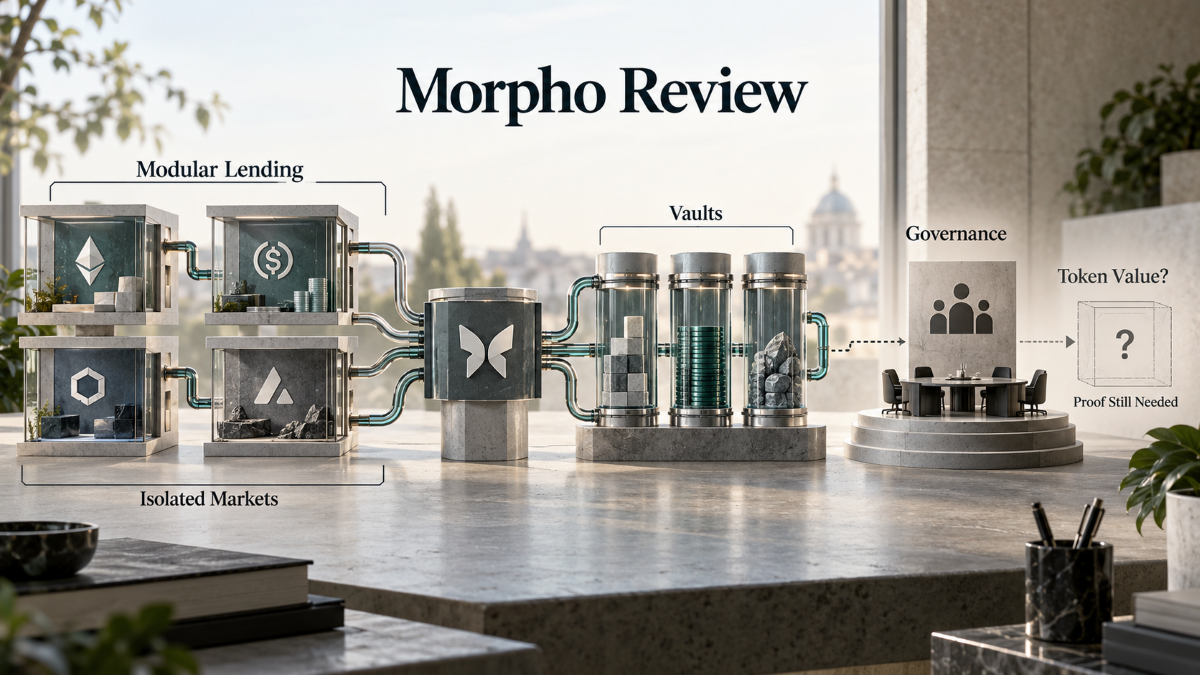
Morpho has become one of the most important lending protocols in DeFi because it changes how lending risk gets arranged. Older lending systems often use large shared pools. Morpho moves toward isolated markets, curated vaults, and modular credit products that let builders choose more specific risk settings.
This Morpho Review focuses on that difference. Morpho has real traction, Coinbase distribution, institutional interest, and a design that showed why isolated markets can matter during stress. Those points make the protocol serious.
Still, strong lending architecture does not make MORPHO a simple investment case. The token mainly represents governance power. That means product growth, vault usage, and institutional adoption need a clear bridge toward token relevance. Without that bridge, Morpho can grow as infrastructure while MORPHO still faces supply, valuation, and governance-demand questions.
This article is for research and education only. It is not financial advice, and it is not a buy or sell recommendation. DeFi lending can create losses through liquidation, oracle failure, smart contract bugs, curator mistakes, liquidity stress, bad collateral choices, or governance decisions.
Morpho Is Lending Infrastructure, Not Just Another App
Morpho describes its system as decentralized infrastructure for overcollateralized lending and borrowing on EVM networks. The protocol does not only give users one lending interface. It gives builders a credit layer that can support separate markets, vaults, and lending products.
That structure matters. A borrower may see a simple loan page. A lender may see a vault or earn product. Behind those interfaces, Morpho can support different combinations of collateral assets, loan assets, oracles, interest-rate logic, and liquidation thresholds.
Morpho Blue handles variable-rate lending markets. Morpho Midnight extends the stack toward fixed-rate and fixed-term credit. Together, these products make Morpho look more like credit infrastructure than a single DeFi pool.
Builders can use this infrastructure in different ways. Exchanges can create consumer lending products. Curators can package vault strategies. Institutions can explore onchain credit without building a full lending engine from zero.
The Token Question Starts After Product Fit
Protocol usefulness does not automatically create token value. This is a common issue across crypto infrastructure. A system can process real activity while the token captures only governance power, incentive demand, or strategic interest.
MORPHO sits inside that tension. The protocol looks useful. The token still needs a clear reason why governance control becomes economically valuable as Morpho grows. That is why this article separates Morpho’s product strength from MORPHO’s token case.
Isolated Markets Changed The Risk Conversation
Shared lending pools can improve liquidity, but they also join many risks together. One weak collateral asset, one faulty oracle, or one bad market decision can expose many users who never wanted that specific risk.
Morpho’s isolated market model changes that pattern. Each market has its own risk settings. A problem in one market does not automatically become a problem for every other market. This design does not remove risk. It limits how far certain risks can travel.
The April 2026 Kelp DAO and LayerZero exploit created a real example. The incident damaged rsETH-related infrastructure and created stress across lending markets. Galaxy Research reported that Morpho’s rsETH exposure reached about $1 million across two isolated markets, while other Morpho vaults remained unaffected.
That result should not become marketing language. It does not prove that Morpho can survive every future exploit. It does show why isolated exposure can matter when one collateral asset or bridge-linked asset becomes dangerous.
For users, the lesson is simple. Morpho can make risk more specific, but every position still depends on its own collateral, oracle, liquidation threshold, market liquidity, and vault design.

This is where cross-chain design can expose hidden trust assumptions. The Kelp incident did not begin as a Morpho core-protocol exploit, but lending markets with exposure to the affected asset still had to deal with the consequences.
Vaults Make Morpho Easier, But Not Risk Free
Direct market selection gives advanced users more control. Most users, however, do not want to compare every oracle, collateral asset, liquidation setting, and liquidity condition by hand. Morpho Vaults help solve that usability problem.
A vault lets users deposit into a curated strategy. The curator can allocate assets across selected markets and apply defined limits. This structure can make Morpho easier to use because the user interacts with a vault instead of building a lending position from scratch.
Coinbase shows why this matters. Its crypto-backed loans use Morpho’s onchain lending infrastructure, and eligible users can also access USDC lending products tied to Morpho vaults. This gives Morpho distribution through a platform that reaches users beyond native DeFi front ends.
Curator Quality Becomes A New Risk Layer
Vaults simplify the interface, but they also add trust in the curator. Users must care about who manages the vault, which markets the vault enters, what collateral the vault accepts, how risk caps work, and how quickly the strategy responds when market conditions change.
Good curation can make modular lending safer and easier. Poor curation can hide complexity behind a simple deposit button. Morpho’s own risk materials point users toward smart contract risk, oracle risk, liquidation risk, counterparty risk, vault role risk, and operational factors.
A better way to describe Morpho is not simply safer or riskier. Morpho makes lending risk more configurable. Strong configuration can help users. Weak configuration can concentrate danger inside a product that appears simple.

This is why oracle risk can decide the real safety of a lending protocol. In DeFi lending, an oracle does not only display a price. It helps decide collateral value, liquidation timing, and potential bad debt.
Coinbase, Apollo, And Institutional Distribution
Morpho’s strongest evidence is distribution. Coinbase uses Morpho-powered infrastructure for crypto-backed borrowing, and its loan materials explain that collateral can move into Morpho smart contracts during the loan process. That gives Morpho a path into consumer credit without forcing each user to understand the full DeFi stack.
This matters because many DeFi protocols remain trapped inside crypto-native dashboards. Morpho has moved further. A major exchange can package Morpho-powered borrowing or lending inside an experience that feels familiar to ordinary users.
Apollo adds another institutional signal. In February 2026, Morpho Association announced a cooperation agreement under which Apollo or its affiliates may acquire up to 90 million MORPHO tokens over 48 months, subject to restrictions and an ownership cap.
The agreement does not guarantee immediate open-market buying, price support, or direct protocol revenue capture for MORPHO. The cleaner interpretation is that a major financial institution saw strategic value in Morpho’s credit network and governance token.
Morpho Association also announced a $175 million funding round in June 2026. Paradigm, a16z crypto, and Ribbit co-led the round, with participation from Apollo Funds, Circle Ventures, VanEck, Ledger Cathay, and others. That strengthens the project’s institutional credibility, but funding still does not equal token demand.
Adoption Still Needs Token Relevance
A bigger credit network can make governance more important. More integrations can increase the value of shaping protocol direction. Strategic holders may want influence over a growing lending layer.
Even then, adoption does not automatically create cash flow for MORPHO holders. Token analysis needs to ask whether governance power, incentive control, protocol reputation, or future policy choices can create durable demand for the token.
That distinction is similar to the question of whether protocol growth still needs a clean value-capture bridge. Strong usage helps a token case only when the token has a durable role inside the system that is growing.
| Evidence | Current Position | What It Proves |
|---|---|---|
| Coinbase lending | Coinbase uses Morpho-powered lending infrastructure | Real distribution exists beyond a native DeFi app |
| Apollo agreement | Apollo may acquire up to 90M MORPHO over 48 months | Institutional governance interest exists |
| Funding round | Morpho Association raised $175M in 2026 | Strategic backer support is strong |
| Isolated markets | Risk can stay inside specific market structures | Modular design can reduce contagion paths |
| Vault model | Curators can package lending strategies | Usability improves, but curator risk remains |
| Kelp stress case | Morpho exposure stayed limited across isolated markets | Architecture helped contain one exposure event |
| Token value capture | MORPHO mainly represents governance power | Token demand still needs a clearer economic bridge |
MORPHO Tokenomics And Supply Reality
MORPHO is the governance token of the Morpho Protocol. Holders can vote on governance decisions and help shape protocol direction. That gives the token a control role, but it also means MORPHO should not be treated like a direct revenue-share asset unless the protocol creates that right clearly.
Official documentation lists a maximum supply of 1 billion MORPHO. The allocation includes governance, users and launch pools, Morpho Association, contributor reserves, strategic partners, founders, and early contributors.
Governance controls the largest bucket. Strategic partners and founders also hold large allocations. These numbers matter because governance control, long-term alignment, and future distribution all affect how the token trades over time.
Circulating Supply Needs Source Discipline
Market data can change quickly. As checked in September 2026, CoinMarketCap listed roughly 519 million MORPHO circulating with a 1 billion maximum supply. Other trackers may show different circulating estimates because they can use different supply methodologies.
That gap does not break the tokenomics case, but it does require caution. Readers should not treat one live tracker as permanent truth. Supply analysis should separate maximum supply, circulating supply, locked supply, governance reserves, partner allocations, and future distribution decisions.
A capped supply helps because it creates a clear upper limit. It does not remove token risk. MORPHO still needs demand strong enough to absorb future availability, investor movement, strategic transfers, governance-controlled distribution, and changing market expectations.
Apollo’s possible 90 million token acquisition may support the demand narrative. Still, restrictions and timing matter. The agreement should count as strategic interest, not as proof of immediate market demand.
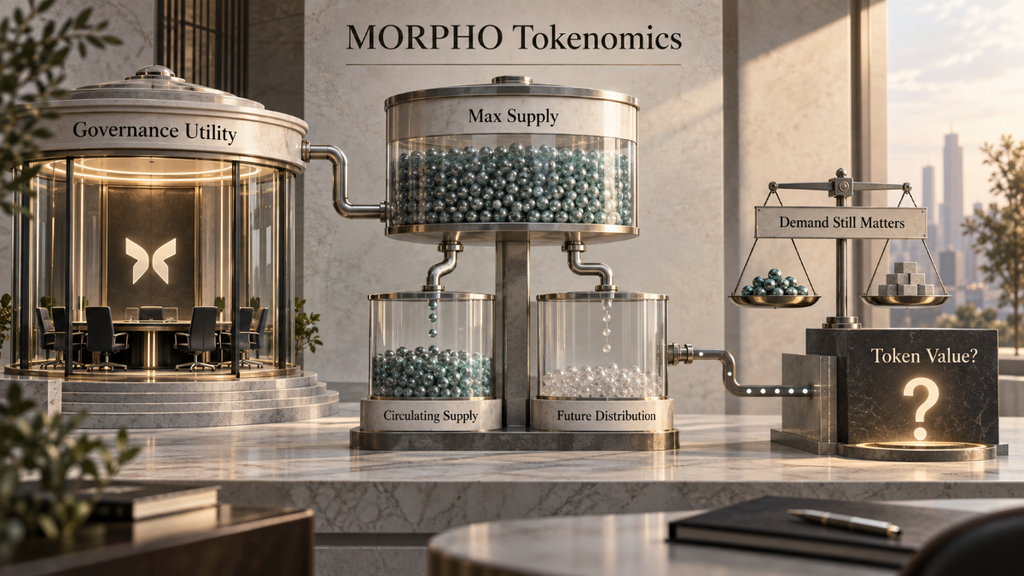
This is where token demand must be tested against future supply. MORPHO has a fixed maximum supply, but fixed supply alone does not prove that governance demand will match valuation.
MORPHO Tokenomics
| Tokenomics Item | Current Position | Why It Matters |
|---|---|---|
| Token name | MORPHO | Governance token for Morpho Protocol |
| Maximum supply | 1,000,000,000 MORPHO | Sets the fixed supply ceiling |
| Governance allocation | 35.4% | Controls the largest allocation bucket |
| Users and launch pools | 4.9% | Supports user distribution and incentives |
| Morpho Association | 6.3% | Funds ecosystem development |
| Contributor reserve | 5.8% | Supports future contributors |
| Strategic partners | 27.5% | Large partner allocation affects distribution |
| Founders | 15.2% | Major long-term insider allocation |
| Early contributors | 4.9% | Adds another contributor-linked pool |
| Circulating supply | Around 519M on CoinMarketCap at review time | Live supply needs source qualification |
| Main token risk | Governance value may not match market valuation | Protocol traction may not directly equal token demand |
Security Depends On More Than Audit Count
Morpho has a serious security culture compared with many smaller DeFi projects. Its documentation points to audits, formal verification, testing, peer review, security contests, and a large bug bounty program.
Those controls matter. DeFi lending handles collateral, liquidations, vault deposits, oracle inputs, and user funds. Strong review practices lower risk and show that the team treats security as a core product issue.
Still, audit count alone cannot prove safety. Morpho’s own risk documentation highlights smart contract risk, oracle risk, liquidation risk, counterparty risk, and vault role risk. A serious review should include those risks instead of hiding them behind the word audited.
Immutability Does Not Remove Every Dependency
Old claims that developers simply hold master keys over the full lending protocol need careful correction. Morpho Blue presents itself as a simple, immutable, governance-minimized base layer. That is different from a fully upgradeable protocol where one admin can freely change all lending rules.
Even so, immutability does not make every Morpho product trustless in the same way. Vaults, adapters, oracles, curators, risk caps, and governance-controlled registries can still shape user outcomes. A user who deposits through a vault depends on more than core lending code.
Oracle risk remains one of the largest issues. Every market needs price input. Bad pricing can trigger wrong liquidations, delayed liquidations, or bad debt. Isolated markets can contain damage, but they cannot make a bad oracle harmless.
Vault roles deserve equal attention. Curators and allocators decide how a vault uses markets and risk limits. A strong vault can make Morpho easier for users. A weak vault can hide complex exposure behind a clean interface.
The right conclusion sits between fear and hype. Morpho has strong technical foundations. Users still depend on market design, vault curation, collateral quality, oracle quality, liquidation behavior, and governance discipline.

The Real Value-Capture Question For MORPHO
Morpho’s product case looks stronger than its direct token-value proof. Coinbase distribution, institutional relationships, isolated-market architecture, vault infrastructure, and fixed-rate expansion all support the protocol case.
MORPHO holders still need a narrower answer. What exactly makes governance control economically valuable over time?
Governance can matter when a protocol controls important parameters, reserves, incentives, listings, registries, partner relationships, and long-term product direction. As Morpho grows, those decisions may become more important to lenders, borrowers, curators, integrators, and strategic partners.
Pricing governance value remains difficult. A token can control a useful network without receiving direct fees. Some holders may value influence, but influence does not always produce cash flow. Markets often price governance tokens on future expectations rather than present rights.
What Would Strengthen The Token Case
A stronger MORPHO case would show three things together. First, Morpho continues to grow real credit activity through consumer, DeFi, and institutional channels. Second, governance remains necessary to that growth. Third, token demand from users, partners, delegates, and strategic holders absorbs future distribution without relying only on market excitement.
Clearer public reporting would help. Readers need better visibility into protocol activity, vault growth, borrower demand, governance decisions, incentive spending, reserve use, and circulating-supply changes. That kind of reporting would make the token case easier to judge.
What Morpho Needs To Prove Next
Morpho’s first proof target is sustainable credit activity. Deposits and TVL can move quickly in DeFi. Stronger evidence would show recurring borrowing demand, healthy utilization, stable liquidation behavior, and market performance through stress periods.
Vault quality is the second test. Users need simple ways to understand who curates a vault, which markets it touches, which oracles it uses, what collateral risks exist, and what exposure caps apply. Modular lending becomes stronger when users can understand the modules.
Token relevance is the third test. MORPHO has governance utility, but the main token question remains open. Does governance power become valuable enough as Morpho grows, or does protocol usage mostly benefit borrowers, lenders, curators, and integrators?
Supply transparency is the fourth test. Market-data providers can show different live circulating-supply numbers. Official documentation also explains that governance decisions can affect future distribution. Cleaner communication would reduce confusion before users rely on one tracker.
Finally, Morpho needs to prove that institutional distribution does not create hidden concentration risk. Coinbase and Apollo are positives. They also increase the need for governance clarity, risk disclosure, and predictable token-supply reporting.
Morpho Review Verdict: Strong Design, Real Dependencies
Morpho is one of the more important DeFi lending projects because it changes how lending risk gets structured. Isolated markets, curator-managed vaults, and fixed-rate credit products give the protocol more flexibility than a single shared-pool design.
Product traction is real. Coinbase integrations, Apollo’s cooperation agreement, the $175 million funding round, and expansion toward fixed-rate credit all support the view that Morpho is becoming lending infrastructure rather than a small DeFi app.
The token case is more complicated. MORPHO has a fixed 1 billion maximum supply and meaningful governance utility. It also has large governance, partner, founder, and contributor allocations. Live circulating-supply numbers can differ across market trackers, and governance decisions can shape future distribution.
For readers, the clean conclusion is this. Morpho’s protocol design is credible, and its distribution is unusually strong for DeFi. MORPHO still needs a clearer value-capture story, cleaner supply interpretation, and continued risk discipline across vaults, oracles, and market settings.
This Morpho Review does not treat the project as a risk-free lending winner. It treats Morpho as a serious modular credit network whose technology looks stronger than the average DeFi lending token story, while the token still needs proof that governance value can keep pace with supply and valuation expectations.
Frequently Asked Questions
Morpho is a decentralized lending protocol for overcollateralized crypto lending and borrowing. It supports modular markets, vaults, variable-rate lending through Morpho Blue, and fixed-rate credit through Morpho Midnight.
MORPHO is the governance token of the Morpho Protocol. Holders can vote on governance decisions and influence the future direction of the protocol.
Morpho can reduce contagion by isolating risk into specific markets. It is not risk free. Users still face oracle risk, collateral risk, liquidation risk, vault risk, and smart contract risk.
Morpho was not the main source of the Kelp exploit. Galaxy Research reported that Morpho’s exposure was limited to roughly $1 million across two isolated markets, while other vaults remained unaffected. That supports the isolated-market argument, but it does not prove future immunity.
Yes. Coinbase uses Morpho-powered infrastructure for crypto-backed loans and USDC lending products. This gives Morpho important consumer distribution.
Official documentation lists a maximum supply of 1,000,000,000 MORPHO. Circulating-supply estimates can differ between market-data providers.
Morpho Association announced that Apollo or its affiliates may acquire up to 90 million MORPHO tokens over 48 months, subject to an ownership cap, transfer restrictions, and trading restrictions. This is a strategic agreement, not proof of immediate open-market buying.
Yes. Morpho has extensive security review coverage, formal verification, testing, and a large bug bounty program. Audits reduce risk, but they do not remove smart contract, oracle, vault, liquidation, or governance risks.

Founder & Managing Editor of CryptosMedia. Zahid Hussain leads evidence-based crypto research covering tokenomics, security, governance, adoption, and risk.
CryptosMedia separates verified facts from interpretation, avoids buy/sell recommendations, and updates reviews when major evidence changes.
1 thought on “Morpho Review: The Modular Reality of DeFi Lending”