
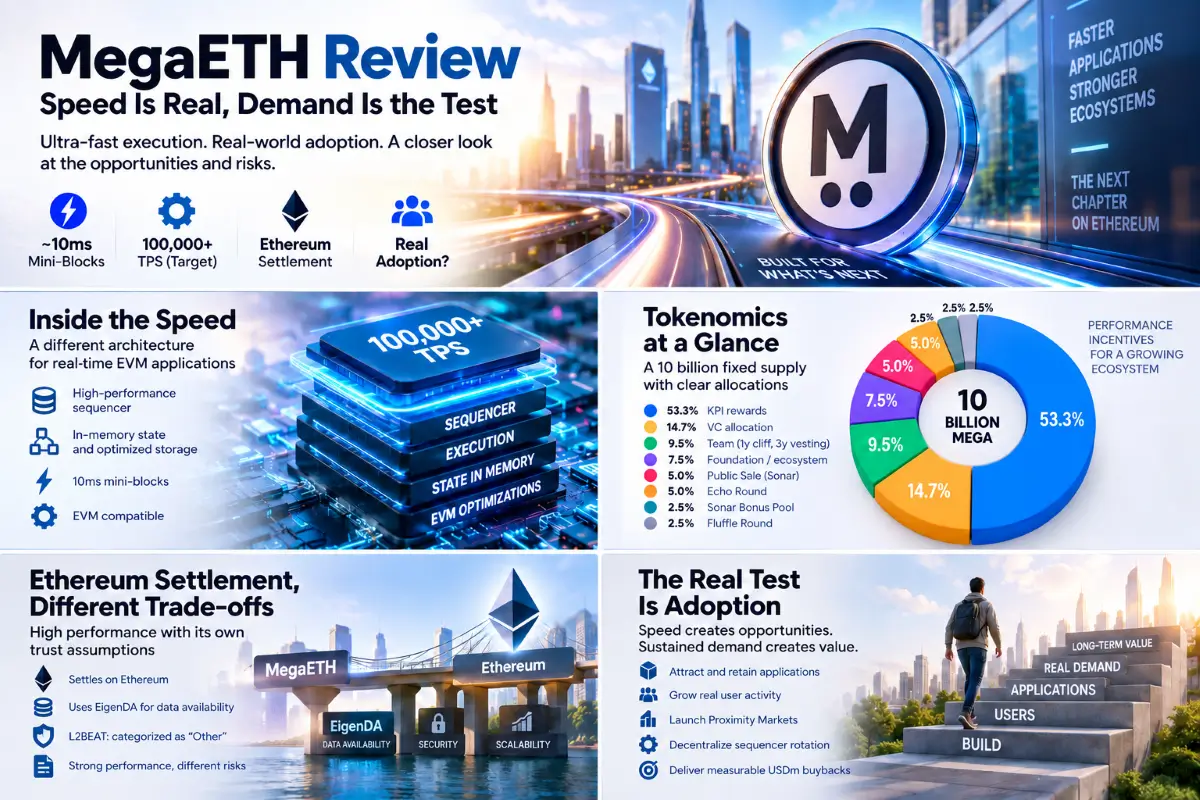
MegaETH is easy to judge by one number: 100,000 transactions per second. That number makes the network sound like a simple speed race against other Ethereum scaling systems. This MegaETH Review reaches a more useful conclusion. Fast execution is the strongest part of the project today, while sustained application demand, token value capture and decentralization remain less settled. Mainnet has been live since February 2026, while MEGA went live on April 30. The harder question is no longer whether MegaETH can process transactions quickly. It is whether that capacity can support an ecosystem that stays, grows and creates durable demand for the token.
That distinction changes the entire review. MegaETH has genuine technical work behind its low-latency design. It also has a token whose most important future utilities are not all operational, a large performance-linked reward pool, external data-availability dependencies and an ecosystem that has already learned how difficult application retention can be.
What MegaETH Actually Is
MegaETH is an Ethereum-based execution network that aims to make EVM applications respond much faster than they typically do on Ethereum mainnet. Chain ID 4326 is live, ETH is currently the native gas token, and the network produces MegaETH-specific mini-blocks roughly every 10 milliseconds alongside standard EVM-compatible blocks at about one-second intervals.
Calling it simply “a faster Ethereum” hides an important architectural distinction. MegaETH separates jobs that traditional blockchains often expect every node to perform. A high-performance sequencer handles ordering and execution, while other node roles receive state changes, maintain chain history or participate in proving.
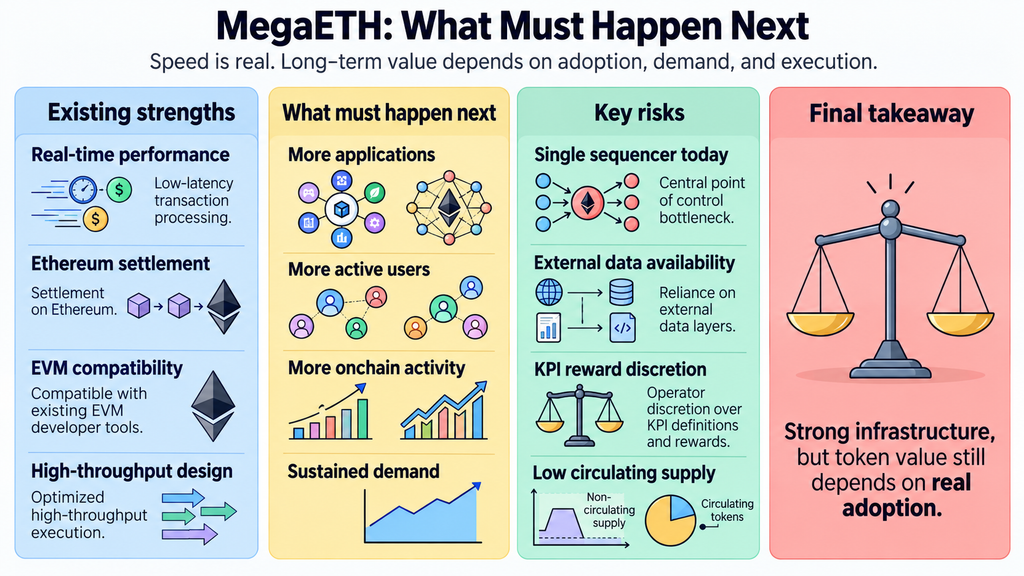
MegaETH still concentrates block production around a single high-performance sequencer, while multi-operator sequencer rotation remains a planned upgrade.
That specialization trades uniform hardware requirements for performance. It is one reason MegaETH belongs in the broader discussion about Ethereum Layer 2 trade-offs, but readers should not assume that its security model matches every conventional Ethereum rollup.
Ethereum remains the settlement layer. MegaETH relies on EigenDA for data availability rather than putting all transaction data directly into Ethereum blobs. L2BEAT currently categorizes MegaETH as “Other” rather than as a standard optimistic rollup, reflecting additional trust assumptions in the present design.
Separating performance claims from security claims makes that difference important.
Why It Is Fast Without Making Every Node a Supercomputer
A common explanation that MegaETH gets its speed simply by ‘storing everything in RAM’ is incomplete.
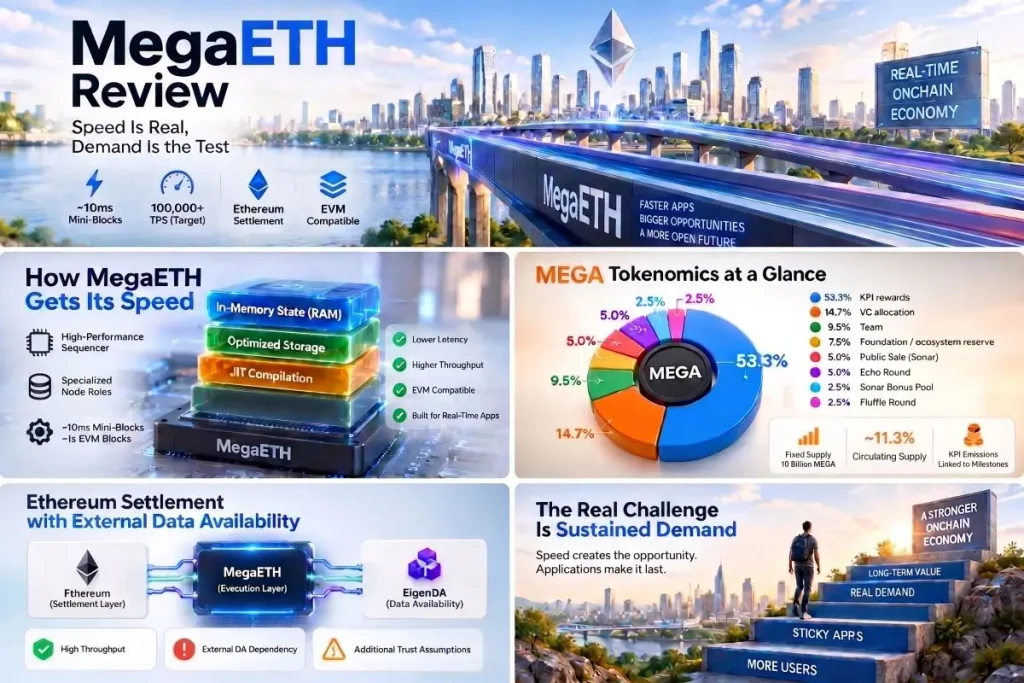
RAM is important, especially for the sequencer, but the architecture changes several bottlenecks at once. MegaETH has described sequencer hardware with roughly 100 CPU cores, 1-4 TB of memory and a 10 Gbps network connection. Keeping state in memory reduces expensive storage access during execution, while a redesigned state trie, a write-optimized storage backend and just-in-time compilation for EVM bytecode attack other bottlenecks.
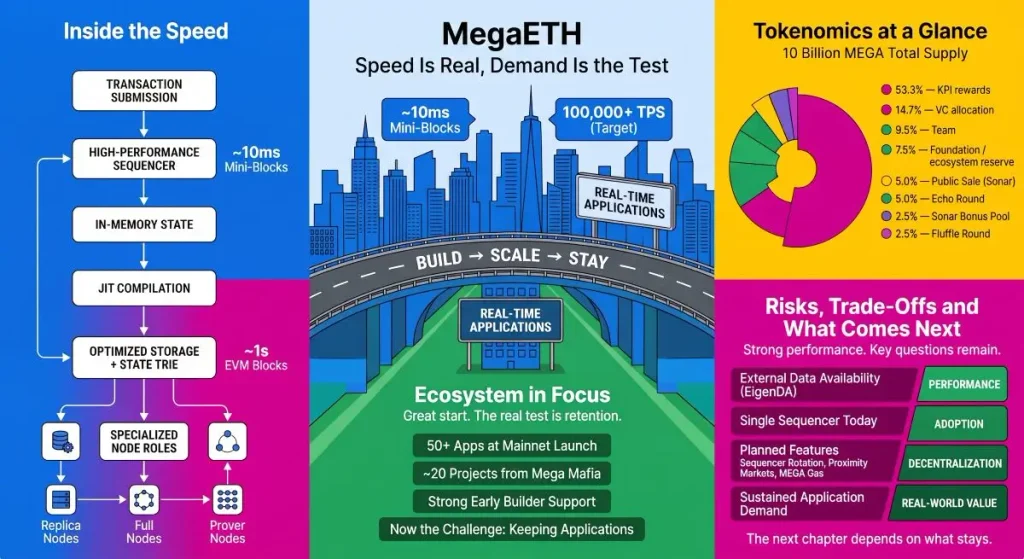
MegaETH divides work across specialized roles rather than requiring every participant to reproduce the sequencer’s hardware profile. After execution, the system sends different forms of state and block data to replica, full and prover nodes. That design is central to MegaETH’s performance thesis: concentrate the most demanding execution work instead of forcing every node to operate at the same level.
There is an interesting parallel with parallel EVM architecture, although the engineering choices are not identical. Both approaches challenge the assumption that EVM compatibility requires accepting today’s common execution limits.
Mini-blocks add another piece. They are lightweight MegaETH-specific blocks that provide rapid transaction inclusion, while one-second EVM blocks preserve compatibility with conventional wallets, explorers and developer tooling. Readers therefore should not interpret a “10ms block time” as 100 full traditional Ethereum-style blocks every second.
Speed here is a stack of engineering decisions, not a single hardware trick.
The 100,000 TPS Claim Needs Context
MegaETH currently presents 100,000-plus TPS as part of its performance target and real-time thesis. There is meaningful evidence behind the broader claim that the network can handle unusually heavy load, but headline capacity and everyday network demand are different measurements.
The project’s own production stress test processed 11 billion transactions over seven days. Spread evenly across that period, that works out to roughly 18,200 transactions per second. That is a substantial sustained workload, but it is also useful context: even the cited seven-day stress test did not average 100,000 TPS continuously.
Ordinary September activity is far lower.
At the September 5 check, DefiLlama showed about 2.17 million transactions over 24 hours, roughly 2,000 active addresses, $43.3 million in DeFi TVL and around $570,000 in daily decentralized-exchange volume. Two million daily transactions sound large in isolation, but 2.17 million over a full day averages only about 25 transactions per second.
That gap does not disprove MegaETH’s engineering. A network should build capacity before every application needs it.
It does change the question investors, developers and researchers should ask. A chain can have enormous execution headroom while current applications use only a small fraction of it. The next proof point is not another maximum-TPS headline. It is sustained demand for workloads that genuinely benefit from that capacity.
Low latency may be a competitive advantage. Low latency by itself is not adoption.
Ethereum Settlement Does Not Remove Every Trust Assumption
MegaETH settles commitments to Ethereum, but readers should not shorten “settled on Ethereum” into “has exactly Ethereum’s security model.”
Data availability is one reason.
MegaETH uses EigenDA so it can move substantially more data than the Ethereum blob capacity its designers considered practical for the performance target. That provides throughput, but it introduces an external data-availability layer into the system. MegaETH itself describes EigenDA as necessary for its high-throughput ambitions.
The current independent assessment is more cautious. L2BEAT’s MegaETH risk assessment says MegaETH posts transaction data to EigenDA and flags several maturity issues. Its current analysis says fewer than five external actors can submit challenges, independent challengers cannot access the relevant node source, only allowlisted proposers can publish state roots, and users have no exit window before instant contract upgrades. L2BEAT also says MegaETH does not yet satisfy all of its Stage 0 requirements.
That stage designation needs context. L2BEAT explicitly describes its framework as an opinionated measurement of rollup maturity and decentralization, not as a direct probability-of-hack score. Still, the underlying trust dependencies are material.
Contrast that with Arbitrum’s rollup model, which L2BEAT currently classifies as a Stage 1 optimistic rollup using Ethereum blobs for data availability. MegaETH makes a more aggressive performance trade-off by taking data availability outside Ethereum.
Audits add another layer of evidence. MegaETH’s MiCA whitepaper states that Spearbit and Sherlock audited protocol infrastructure, smart contracts and bridge mechanisms before mainnet beta, and that the teams remediated the identified critical and high-severity findings. Audits are valuable evidence of review, but they do not remove external-DA, upgrade, proposer or sequencer assumptions.
MegaETH Review: What the Token Actually Captures
Network performance and MEGA token economics are not the same thing. A fast network does not automatically create equivalent token demand.
Most importantly, MEGA is not currently the network’s gas asset. MegaETH’s live mainnet documentation lists ETH as the native and gas token. The MiCA whitepaper describes MEGA-denominated gas as a planned future function. It also presents staking, rotational sequencing and DAO governance as future or progressively introduced functions.
The current picture looks like this:
| Mechanism | Status | How MEGA is involved | Main dependency |
|---|---|---|---|
| USDm-linked buybacks | Live economic design | The Foundation uses USDm rewards to buy and accumulate MEGA | USDm adoption and rewards |
| KPI rewards | Live | Committed MEGA positions qualify for rewards when the program confirms milestones | KPI achievement and attestation |
| Proximity Markets | Planned | Low-latency access tiers would rely on auctions or MEGA locking | Product launch and trader demand |
| Sequencer rotation | Planned | Operators would stake MEGA and face slashing | Decentralized rotation going live |
| Network gas | Planned | Users may eventually pay gas in MEGA | Future implementation |
| DAO governance | Planned/progressive | Holders are expected to gain protocol voting functions | Governance deployment and reduced admin control |
MegaETH’s official MEGA token documentation is unusually clear about several of those distinctions. The documentation explicitly marks Proximity Markets and sequencer rotation as planned, while USDm-linked buybacks and the KPI commitment system already form part of the token model.
The MiCA document adds another useful constraint: MEGA does not represent equity, redemption rights or a contractual right to protocol revenue. Future utility may make the token economically important without converting it into a legal claim on MegaETH’s cash flows.
Treating every roadmap function as current token utility would therefore overstate the case.
53.3% of Supply Sits Behind KPI Rewards
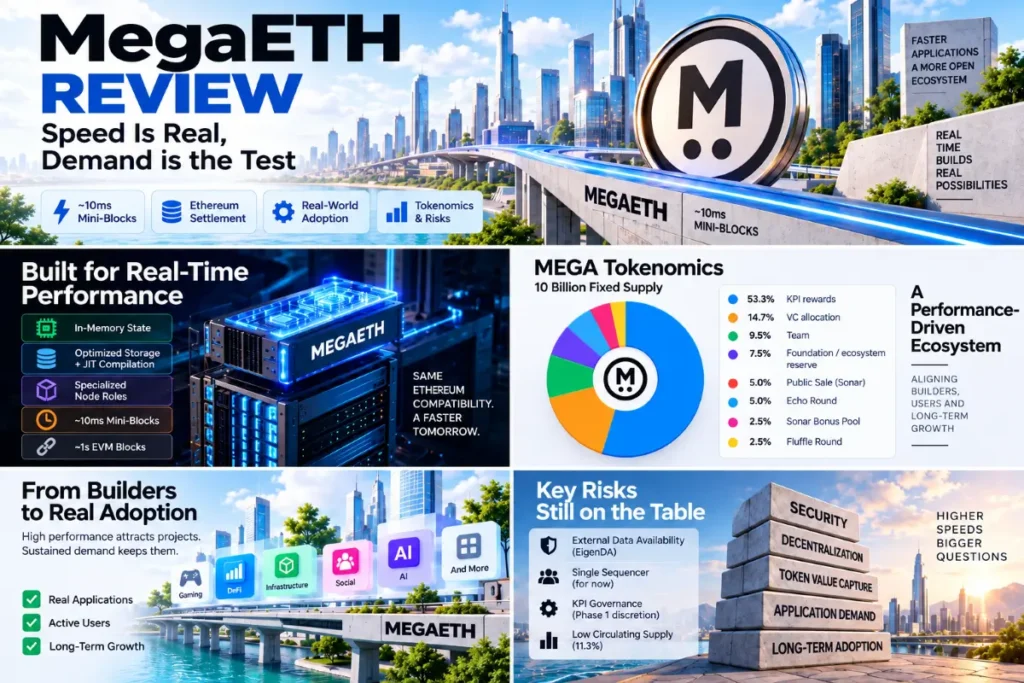
MEGA has a fixed initial supply of 10 billion tokens. Its detailed allocation is more nuanced than the claim that 53% is simply ‘locked staking supply’.
The MiCA allocation is:
| Allocation | Share | What it represents |
|---|---|---|
| KPI rewards | 53.3% | Performance-linked reward pool |
| VC allocation | 14.7% | Venture investor allocation |
| Team | 9.5% | Team allocation with a one-year cliff and three-year linear vesting |
| Foundation / ecosystem reserve | 7.5% | Ecosystem development and protocol reserve |
| Public Sale (Sonar) | 5.0% | Public token sale allocation |
| Echo Round | 5.0% | Prior investor round allocation |
| Sonar Bonus Pool | 2.5% | Bonus allocation associated with the Sonar sale |
| Fluffle Round | 2.5% | Prior investor round allocation |
The percentages sum to the full 10 billion supply.
The 53.3% pool is not a team or VC allocation, but its release is not mechanically independent of the project today. The pool supports KPI-linked rewards, while the current program gives the operator meaningful discretion over when and how to trigger and distribute them to eligible committed positions.
That does not make the design trustless today.
MegaETH ties KPI emissions to outcomes rather than fixed calendar dates. During the current Phase 1, however, the Foundation defines KPIs and performs the attestations that determine whether the network has achieved each milestone. Later phases aim to transfer KPI definition to token governance and eventually use oracle-based verification.
The current program terms make that discretion unusually important. The operator can establish, modify or discontinue KPIs and determine whether a milestone has been achieved, as well as the amount, timing and method of any reward distribution. That does not invalidate the KPI model, but a fully automatic emission schedule does not govern today’s 53.3% reward pool.
So the relevant concern is not “53% belongs to whales.” More than half of total supply sits inside a future emission mechanism whose early-stage milestone governance still involves Foundation judgment.
That is a much more precise risk than a simple whale narrative.
Low Float Matters, but Holder Counts Do Not Prove Whale Control
The September 5 market-data check reported around 1.13 billion MEGA in circulation, or 11.3% of the 10 billion total supply. CoinMarketCap placed market capitalization near $45 million while fully diluted valuation was close to $400 million. CoinGecko reported a $0.2177 all-time high on April 30, with the token trading roughly 82% below that level by early September.
That creates a legitimate low-float issue. The market is pricing a relatively small circulating portion of a much larger eventual supply. Future emissions, vesting and demand therefore matter significantly.
A holder-count argument does not survive verification.
Holder-count estimates vary across market-data providers, and raw address totals do not reveal beneficial ownership. Without tracing exchange wallets, custodial addresses, vesting contracts and linked wallets, a holder count cannot establish that a small group controls the market.
There is no need to exaggerate. An 11.3% circulating ratio already tells readers something important: dilution and emission mechanics deserve close attention.
USDm Is the Clearest Live Value-Capture Link
One of the more unusual parts of MegaETH’s economics is USDm.
USDm uses Ethena’s stablecoin stack. Rather than relying only on a conventional sequencer fee margin, MegaETH says the Foundation uses rewards from USDm to buy and accumulate MEGA. In theory, greater USDm adoption can therefore increase MEGA purchases without requiring normal users to pay unusually high gas fees.
USDm adoption is already measurable, although stablecoin supply should not serve as a shortcut for estimating the amount of MEGA actually purchased through buybacks. DefiLlama showed roughly $19.6 million of stablecoins on MegaETH on September 5, with USDm representing about 89% of that total.
Still, readers should not confuse a buyback mechanism with direct holder income.
The Foundation accumulates the purchased tokens. MEGA holders do not receive USDm revenue as a contractual cash distribution, and the MiCA whitepaper explicitly says the token does not grant revenue-distribution rights.
Future Proximity Markets could broaden value capture by monetizing privileged low-latency access to the sequencer. Sequencer rotation could create staking demand as well.
Both remain planned.
For current valuation logic, measurable USDm activity and actual buybacks deserve more weight than future revenue streams that have not yet matured.
The Harder Test Is Keeping Applications
MegaETH launched mainnet in February with more than 50 applications and a strong builder story. Its Mega Mafia accelerator helped roughly 20 projects that collectively raised substantial venture funding.
Then came a more revealing development.
In July, MegaETH ended the Mega Mafia accelerator. Co-founder Shuyao Kong said that “most” of its successful applications had stopped building on MegaETH. GTE moved toward its own chain, Noise chose Base, HelloTrade chose Monad, and Cap pursued a multichain strategy. MegaETH said its ecosystem strategy would shift toward applications whose design depends more specifically on MegaETH’s capabilities.
That is not proof that the ecosystem failed.
It is evidence that superior execution speed does not automatically produce developer retention.
A successful application can eventually decide that its own chain, another ecosystem, greater distribution, deeper liquidity or different infrastructure fits its business better. MegaETH’s challenge is therefore more specific than attracting teams: it needs applications for which 10ms execution provides enough unique value that leaving the network becomes unattractive.
Current usage reinforces why retention deserves attention. The network can handle far more activity than it presently receives. DeFi TVL, active addresses and DEX volume remain modest relative to large established Ethereum scaling ecosystems.
That gap between technical capacity and sticky demand is now more important than the original launch hype.
MegaETH, Arbitrum and Optimism Make Different Trade-Offs
A raw TPS table gives a distorted comparison because the networks measure performance differently and operate at very different levels of maturity.
A more useful comparison is architectural:
| Area | MegaETH | Arbitrum One | OP Mainnet |
|---|---|---|---|
| Ethereum settlement | Yes | Yes | Yes |
| Data availability | External EigenDA | Ethereum blobs | Ethereum blobs |
| Gas token | ETH | ETH | ETH |
| L2BEAT classification | Other | Optimistic Rollup | Optimistic Rollup |
| L2BEAT maturity | Does not yet meet all Stage 0 requirements | Stage 1 | Stage 1 |
| Latency approach | ~10ms mini-blocks, ~1s EVM blocks | Conventional rollup design | Conventional OP Stack rollup design |
| MEGA/ARB/OP token required for ordinary gas | No | No | No |
| Main differentiator | Extremely low execution latency | Established rollup scale and ecosystem | OP Stack and Superchain ecosystem |
L2BEAT currently places Arbitrum One and OP Mainnet at Stage 1, while MegaETH has more work to do under the same maturity framework.
The comparison also exposes an important misconception. Using OP Stack technology does not make MegaETH economically or architecturally identical to Optimism’s L2 architecture. MegaETH changes the execution environment and uses external data availability to pursue a much more aggressive latency target.
The benefit is performance headroom.
The cost is a different set of trust and infrastructure dependencies.
Readers should weigh both sides of that trade-off.
What Would Change the Assessment
Several measurable developments would make the next review more useful than watching price alone.
First, sustained application retention matters. A growing count of active users is useful, but applications that remain because they genuinely need real-time execution would provide stronger evidence of product-market fit.
Second, Proximity Markets need to move from a planned mechanism into observable usage. Researchers could then measure revenue, MEGA locking and demand for low-latency seats instead of modeling them.
Third, sequencer rotation would materially change the infrastructure story if independent operators begin rotating through the role while preserving low latency.
Fourth, KPI governance needs to move beyond Foundation-defined and Foundation-attested Phase 1 milestones. A successful transition toward holder governance and eventually objective verification would reduce discretion around a pool representing more than half the token supply.
Fifth, actual stablecoin growth and transparent buyback activity should drive the assessment of USDm economics. Transparent reporting would make the amounts flowing into MEGA accumulation easier to verify over time.
Finally, L2 maturity needs attention. Improvements in proposer access, challenge participation, upgrade controls and data-availability verification would matter more to the security assessment than another peak throughput benchmark.
These are all observable paths. None requires predicting the token’s future price.
My Verdict: Speed Is Proven More Than Demand
MegaETH no longer needs to prove that its execution architecture is technically interesting.
Ten-millisecond mini-blocks are live. A seven-day production stress test processed 11 billion transactions. The sequencer architecture, state-storage work and EVM optimizations attack real performance bottlenecks rather than merely changing marketing language.
The network case is now stronger than the token case.
The token story needs more restraint.
MEGA has a possible economic loop through USDm buybacks, performance-linked distributions, future proximity markets and planned sequencer staking. At the same time, ETH still pays network gas, several major MEGA functions remain future features, only about 11.3% of supply circulates today, and KPI-linked emissions account for 53.3% of supply while Phase 1 still depends on Foundation definition and attestation.
Infrastructure maturity also remains a meaningful concern. MegaETH’s external EigenDA model and current proposer, challenge and upgrade assumptions do not disappear because execution is fast.
The ecosystem adds one final caution. Some of the accelerator’s most successful projects chose other paths after benefiting from MegaETH’s early support. That makes application retention a live test rather than a theoretical concern.
My assessment therefore separates the network from the token: MegaETH has demonstrated a credible high-performance network, while MEGA remains a high-risk token whose strongest long-term utility mechanisms still need wider adoption or production deployment.
The old question was whether the speed was real.
Enough evidence now exists to move beyond that.
The next question is whether users, applications and economic activity will stay long enough to make that speed valuable.
Frequently Asked Questions
Yes. MegaETH launched its public mainnet on February 9, 2026. The network currently uses chain ID 4326 and ETH as its native gas token.
No. ETH is currently the native and gas token. The project’s MiCA documentation describes MEGA-denominated gas as a planned future function.
Initial total supply is 10 billion MEGA. The September 5, 2026 data check reported around 1.13 billion MEGA in circulation, or approximately 11.3% of total supply.
Not in the same sense as team or VC allocations. The 53.3% pool is reserved for KPI-linked rewards, but current program terms give the operator meaningful discretion over KPI definitions and reward distributions. Team allocation is about 9.5% and VC allocation about 14.7%.
It uses Ethereum for settlement, but the current system still has significant centralized or externally trusted components. MegaETH plans sequencer rotation, while L2BEAT currently flags proposer, challenge, upgrade and external data-availability assumptions and says the project does not yet satisfy all Stage 0 requirements under its maturity framework.

Founder & Managing Editor of CryptosMedia. Zahid Hussain leads evidence-based crypto research covering tokenomics, security, governance, adoption, and risk.
CryptosMedia separates verified facts from interpretation, avoids buy/sell recommendations, and updates reviews when major evidence changes.
1 thought on “MegaETH Review: Speed Is Real, Demand Is the Test”