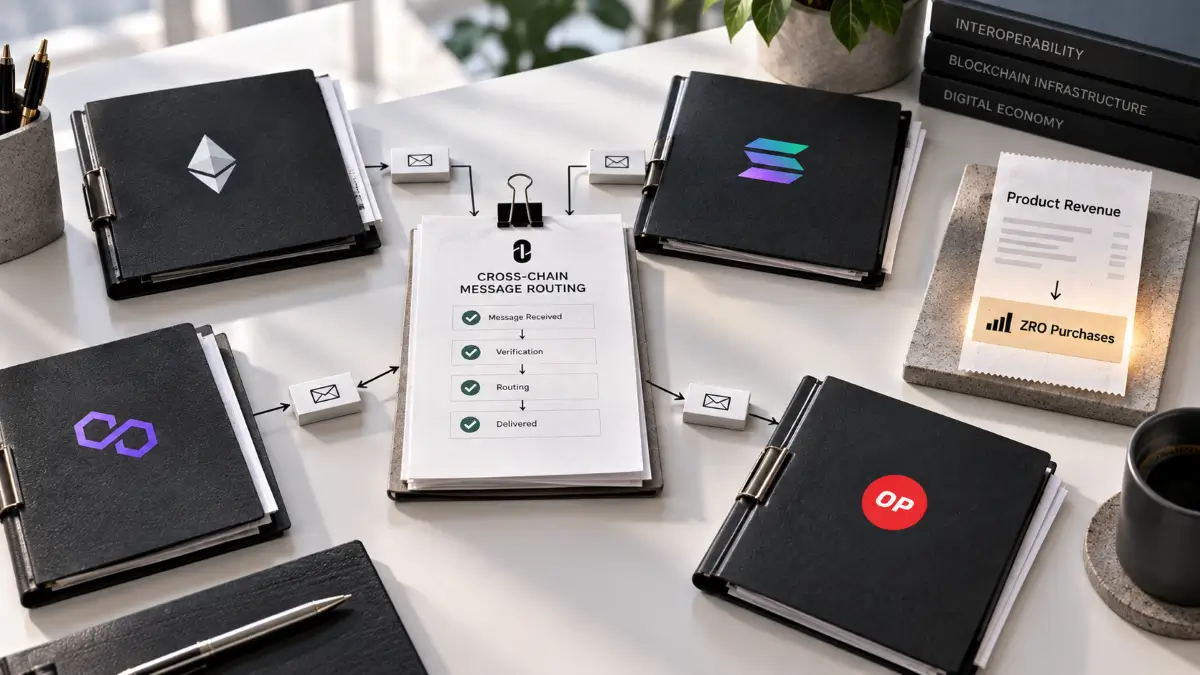
LayerZero has moved far beyond the story told at its 2024 token launch. The protocol now handles substantial cross-chain stablecoin and asset transfers, and Stargate directs revenue to open-market ZRO buybacks. That makes the main question for this LayerZero Review more useful than whether the technology is popular: does growing network activity create durable value for the token?
The answer is more complicated now. ZRO has live value-capture mechanisms, and its planned role goes beyond governance. But several pieces are still unfinished. The LayerZero protocol fee switch is separate from Stargate and LayerZero Labs revenue, Zero has not reached mainnet, and the $292 million KelpDAO exploit in April 2026 showed what can happen when a high-value pathway depends on one verifier.
The case for ZRO is stronger because the network is widely used and some product revenue now buys the token. The limits are just as important. Part of the future thesis still depends on products and fee mechanisms that are not fully live, while ongoing unlocks and application-level security choices remain material risks.
LayerZero Already Has Real Cross-Chain Usage
LayerZero is not a blockchain and it is not a conventional bridge. It is a messaging protocol that lets applications send instructions and assets across different networks. By mid-2026, LayerZero reported more than 160 million messages and over $260 billion in transferred value across roughly 165 networks, while its newer documentation describes support across more than 170 chains.
Those numbers matter because they show that the product is used. Stablecoins, tokenized assets, DeFi applications and omnichain tokens can all rely on the same messaging layer. The adoption case is much stronger than it was when ZRO launched in 2024.
Usage still needs to be separated from token demand. A message can move through LayerZero while most of the fee goes to the verifier and executor infrastructure that handled it. Network activity therefore shows real product use, but it does not prove that every additional message creates the same amount of ZRO buying.
| Evidence | What It Shows | What It Does Not Prove |
|---|---|---|
| 160M+ messages | LayerZero has meaningful protocol usage | Every message creates direct ZRO demand |
| $260B+ value moved | The network carries economically important transfers | LayerZero earns the transferred value as revenue |
| Stargate buybacks | A live product revenue stream buys ZRO | All LayerZero activity already flows to ZRO |
| Zero and ATLAS | The planned token role is expanding | Future mainnet economics are already proven |
How LayerZero V2 Actually Secures a Message
LayerZero V2 separates verification from execution. Decentralized Verifier Networks, or DVNs, confirm that a message observed on the source chain is valid. An Executor then delivers the verified message and supplies the gas needed on the destination chain.
The unusual part is that each application can choose its own security stack. An app can require several independent DVNs, set a threshold for optional verifiers, or use a much weaker configuration. This flexibility is useful because a low-value game and a billion-dollar asset bridge do not need the same cost and security profile.
It also means there is no single security level called ‘LayerZero security’. The actual trust assumptions depend on the DVNs, threshold, message library, executor and operational controls selected by the application. A similar trade-off appears in modular verification systems: giving builders more control also gives them more ways to configure security badly.
LayerZero’s documentation now recommends diversified production configurations and warns teams not to rely on defaults without checking the resolved setup. In 2026, LayerZero also moved active default pathways to a minimum 3-of-3 DVN configuration as part of its post-incident hardening.
The KelpDAO Exploit Turned Configuration Risk Into a Real Loss
The most important security event for a 2026 review is not the old WBTC custody debate. It is the April 18 KelpDAO rsETH bridge exploit.
The bridge lost 116,500 rsETH, worth about $292 million at the time. According to the LayerZero external incident report, attackers socially engineered a LayerZero Labs developer, compromised internal RPC infrastructure, poisoned the data seen by the LayerZero Labs DVN and used a denial-of-service attack against an external RPC provider. The affected KelpDAO pathway used a configuration in which one LayerZero Labs DVN signature was enough to verify a message.
That distinction matters. LayerZero’s report did not describe the incident as an exploit of the immutable LayerZero Endpoint contracts. But that does not make it somebody else’s problem. LayerZero Labs later acknowledged that allowing its own DVN to secure a high-value 1-of-1 pathway was a mistake.
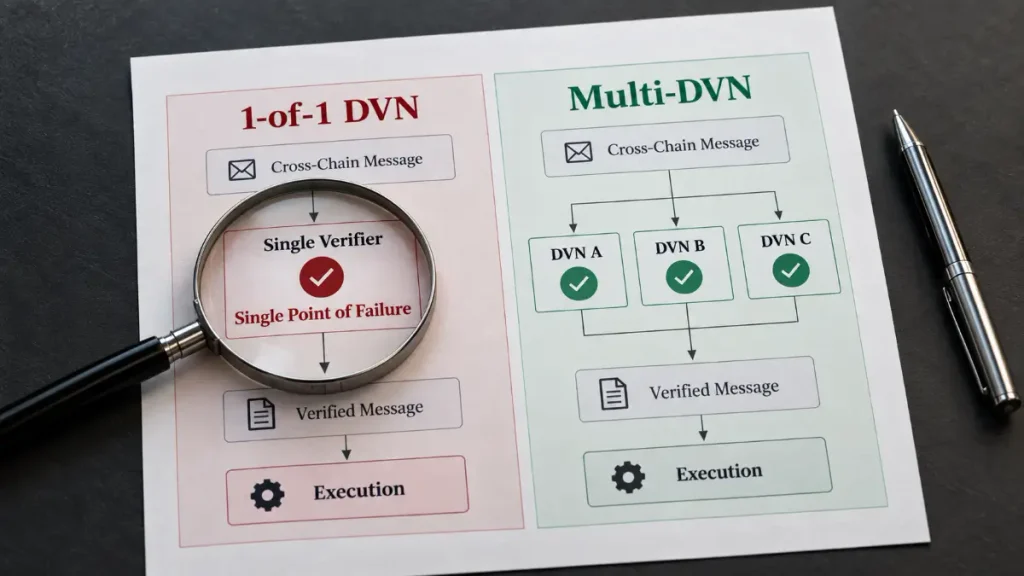
The lesson is stronger than ‘bridges are risky’. A modular security model works only when the application uses enough independent verification that one compromised provider cannot authorize a forged message. A similar lesson appears in post-exploit cross-chain security: the most useful evidence often comes from how a system changes after a real failure, not from an audit badge alone.
LayerZero responded by hardening defaults, updating message libraries and scheduling the LayerZero Labs V1 relayer for retirement. The protocol also maintains a bug bounty of up to $15 million and has undergone multiple security reviews, including Zellic assessments. Those measures add scrutiny, but they do not prove every application or pathway is safe. Each application’s actual verifier configuration still matters.
ZRO Value Capture Is Stronger Than It Was at Launch
The old ZRO thesis was easy to criticize. At launch, governance was the clearest native use, and paying messaging fees in ZRO was optional. That made it possible for LayerZero adoption to grow without creating equally strong token demand.
That changed materially after LayerZero acquired Stargate in 2025. LayerZero’s official ZRO economics disclosure says Stargate revenue now funds open-market ZRO purchases, with 100% of Stargate revenue going to ZRO buybacks since April 2026. The Foundation also says LayerZero entities deployed $112.7 million into ZRO buybacks from September 2025 through early June 2026, although that total includes a 50 million ZRO Foundation repurchase from strategic partners and a separate $10 million Labs purchase, not only recurring operating revenue.
This distinction is important. A Foundation transaction that removes investor supply is economically different from a recurring product fee that buys tokens every month. Both can reduce available sell pressure, but only recurring product economics demonstrate a repeatable connection between usage and token demand.
The same distinction matters in oracle infrastructure. A crypto network can be genuinely useful while the token remains a weaker claim on that usefulness. LayerZero has started closing that gap, but the source of each buyback still matters.
Stargate Buybacks Are Live, the LayerZero Fee Switch Is Not
There are several fee streams around LayerZero, and mixing them together makes the token look more mature than it is.
Every LayerZero message already pays the selected DVNs and Executor. Those are service-provider fees. Separately, LayerZero governance includes a protocol fee switch that can add a protocol-level fee and use the proceeds to buy and burn ZRO. Three referendums have shown more than 96% support among participating votes, but turnout has been low and the fee switch remains subject to governance rather than functioning as a universal live tax on every LayerZero message.
LayerZero Labs also raised some commercial pricing on September 1, 2026. Stargate OFT transfers through the Stargate app can now include a product fee of up to two basis points, capped at $250, while the minimum LayerZero Labs Executor fee increased to $0.25 per transaction. LayerZero explicitly states that these are product and infrastructure fees. They do not activate or replace the protocol fee switch.
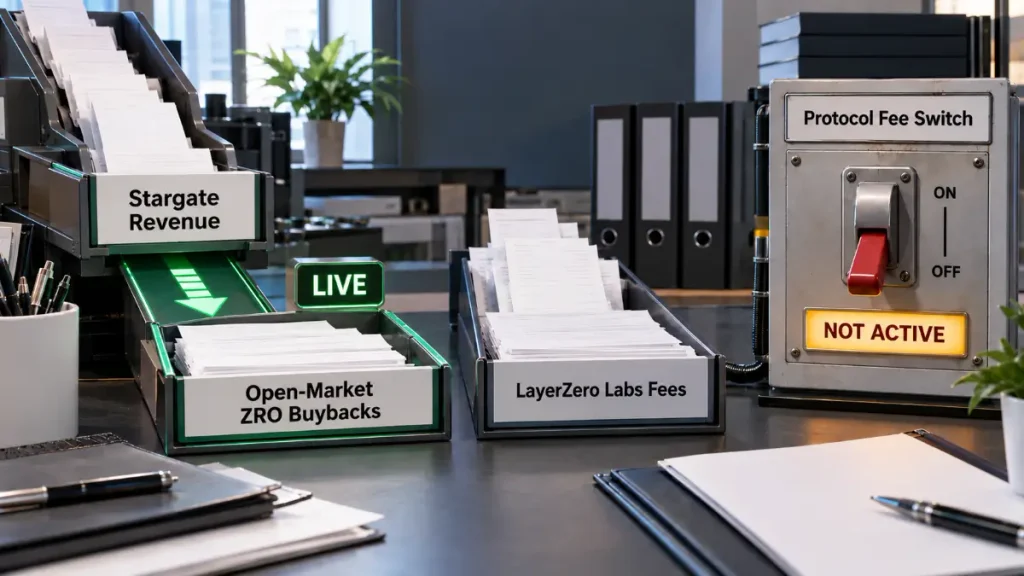
So the current value-capture picture has three layers: live Stargate buybacks, discretionary or strategic purchases by LayerZero entities, and a protocol fee switch that still depends on governance. Treating all three as the same recurring cash flow would overstate what ZRO captures today.
Zero and ATLAS Could Change ZRO’s Role, but They Are Not Live Yet
LayerZero is also building Zero, a separate Layer 1 blockchain aimed at institutional markets and high-throughput financial applications. As of September 11, 2026, LayerZero still describes Zero as a future launch, while ATLAS remains marked as coming later this year. Zero’s economics therefore belong in the thesis as a future dependency rather than current revenue.
The planned role for ZRO is much broader on Zero. LayerZero plans to use ZRO for delegated proof-of-stake security, gas fees and governance. ATLAS plans to route, after the trading-venue rebate, 25% of remaining fees to the market creator and 75% to ZRO buybacks and burns. Trading venues can also stake ZRO to qualify for higher fee rebates.
If Zero launches successfully and attracts meaningful trading, payments or settlement activity, ZRO would have a much clearer economic role than it had at the 2024 TGE. But testnet targets, institutional partnerships and announced fee splits are not the same thing as production demand. Until mainnet activity exists, those economics remain conditional.
This is also where LayerZero differs from a project whose token already secures the base network. The same test applies to infrastructure tokens: service demand needs a clear route into token economics. Zero is LayerZero’s attempt to make that route much more explicit for ZRO.
ZRO Tokenomics: 1B Supply, Ongoing Unlocks and a Data Problem
ZRO has a fixed stated supply of 1 billion tokens. The original allocation gave 38.3% to the community and Foundation, 32.2% to strategic partners, 25.5% to core contributors and 4% to tokens repurchased and pledged to the community. Later legal settlements, Foundation repurchases and re-locking changed token ownership, so today’s wallet balances no longer match the original allocation exactly.
| Tokenomics Item | Published Figure | Why It Matters |
|---|---|---|
| Maximum supply | 1,000,000,000 ZRO | Fixed headline supply |
| Community & Foundation | 38.3% original allocation | Includes ecosystem and Foundation-controlled supply |
| Strategic partners | 32.2% original allocation | Monthly unlocks create potential supply pressure |
| Core contributors | 25.5% original allocation | Contributor vesting remains part of dilution risk |
| Repurchased tokens | 4.0% original allocation | Later legal and buyback transactions changed this picture |
| Unlocked supply | 514M as reported by LayerZero on June 3, 2026 | Unlocked does not mean circulating or sold |
The market-data layer adds another complication. On September 11, 2026, CoinMarketCap reported roughly 373.99 million ZRO circulating, while CoinGecko reported about 353.31 million. LayerZero’s own June disclosure said 514 million tokens were unlocked. These figures can all coexist because ‘unlocked’, ‘circulating’ and ‘held in an unlocked wallet’ are not the same category.
For readers, the useful conclusion is not to force one number into every context. Use market-data circulating supply for market-cap calculations, use the vesting schedule to understand future releases, and use wallet or Foundation disclosures when asking whether unlocked investors are actually selling.
Unlocks Create Supply Risk, but Unlocks Are Not the Same as Selling
The old version of the ZRO story treated every unlock as if it would immediately hit the market. That is too aggressive. Strategic partners and contributors do receive newly unlocked supply, but holders can keep those tokens, transfer them privately or sell them.
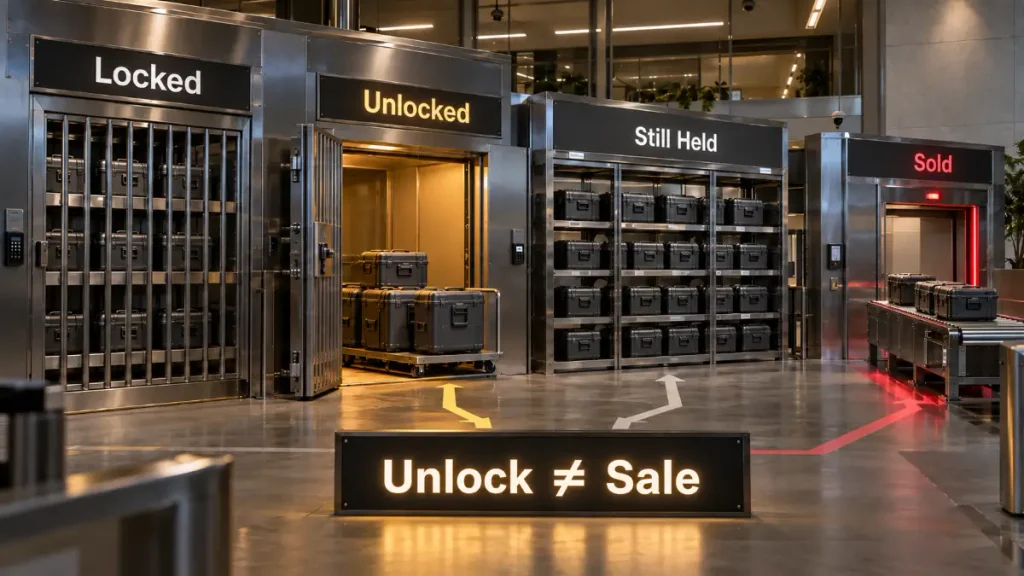
LayerZero’s June 2026 disclosure said 134.7 million ZRO had unlocked to investors since TGE and that 85.9 million, or 63.8%, was still held as of May 31. It estimated public-market investor sales at an average of 4.9 million ZRO per month. Those figures come from LayerZero itself, so they should be treated as issuer-reported analysis rather than independent proof, but they are still more informative than assuming that gross unlock equals sell pressure.
The dilution risk remains real because large partner and contributor allocations continue to vest. The better question is whether recurring buybacks and new demand can absorb the portion that actually reaches the market. That is measurable over time and does not require pretending every unlock is either harmless or catastrophic.
The 2024 Airdrop Controversy Is No Longer the Main ZRO Question
LayerZero’s June 2024 ‘Proof of Donation’ launch required claimants to contribute $0.10 per ZRO to Protocol Guild. The mechanism was controversial because the payment was mandatory for claiming, despite being described as a donation.
That history is worth remembering, but it should not dominate a 2026 assessment. The more important questions now are whether live products generate recurring buybacks, whether Zero turns planned staking and gas utility into real demand, how much unlocked supply reaches exchanges, and whether the post-Kelp security changes reduce single-provider failure risk.
What Would Prove the ZRO Thesis Is Working?
LayerZero already has adoption. The remaining test is whether that adoption produces repeatable token economics without taking unacceptable security shortcuts.
- Stargate buybacks that grow with recurring fee revenue rather than one-off treasury transactions.
- Clear reporting that separates LayerZero protocol fees, LayerZero Labs commercial fees and Stargate product revenue.
- Zero mainnet launching with real staking, gas use and independent validators rather than only announced partners.
- ATLAS generating production trading fees that actually buy and burn ZRO.
- Investor and contributor sales staying manageable as monthly vesting continues.
- High-value applications using diversified DVN configurations instead of relying on a single verifier.
- No repeat of the operational failure pattern exposed by the KelpDAO incident.
Verdict: Real Network, Improving Token Capture, Unfinished Proof
LayerZero is no longer easy to dismiss as a strong protocol with a weak token. The network has substantial cross-chain usage, Stargate creates a live path from product revenue to open-market ZRO purchases, and the planned Zero and ATLAS economics would give ZRO staking, gas and buy-and-burn roles that are much stronger than its launch-era utility.
But the token thesis is not fully proven. The protocol-wide fee switch is still a governance-dependent mechanism, Zero is not yet on mainnet, market-data providers disagree on circulating supply, and partner and contributor vesting continues. Most importantly, the KelpDAO exploit showed that LayerZero’s flexible security design can become dangerously weak when an application relies on one verifier and that verifier’s operational infrastructure is compromised.
The fairest conclusion is therefore conditional. LayerZero has already proved that developers and issuers want cross-chain infrastructure. ZRO has started to capture some of that activity. The next stage is proving that recurring fees, buybacks and future Zero usage can grow faster than supply reaching the market, while stronger verifier configurations prevent another high-value single-point failure.
Frequently Asked Questions
LayerZero is an interoperability protocol that lets applications send messages and assets across different blockchains. It is not itself a blockchain, although LayerZero Labs is separately developing the Zero Layer 1 network.
ZRO currently supports governance, while Stargate revenue funds ZRO buybacks. On the planned Zero network, ZRO is intended to be used for staking, gas and governance. ATLAS is also designed to use part of its post-rebate trading fees to buy and burn ZRO.
No. DVNs and Executors receive service fees for messages, so network usage does not flow one-for-one into ZRO. Stargate buybacks create a live value-capture route, while the protocol fee switch and future Zero economics are separate mechanisms.
Market-data providers currently disagree. On September 11, 2026, CoinMarketCap reported about 373.99 million ZRO circulating while CoinGecko reported about 353.31 million. LayerZero separately reported 514 million tokens unlocked in June, which is not the same as circulating supply.
In April 2026, the KelpDAO rsETH bridge lost about $292 million after attackers compromised infrastructure used by the LayerZero Labs DVN. The affected pathway used a 1-of-1 verifier configuration, so one compromised DVN attestation was sufficient to approve a forged message.
Not yet. As of September 11, 2026, LayerZero still describes Zero as launching later in 2026. Its planned ZRO staking, gas and fee economics should therefore be treated as future rather than current demand.
The main risks are ongoing token unlocks, future value-capture mechanisms failing to attract enough real usage, and application-level security configurations that can create single points of failure. The KelpDAO incident showed that the last risk is practical, not theoretical.

Founder & Managing Editor of CryptosMedia. Zahid Hussain leads evidence-based crypto research covering tokenomics, security, governance, adoption, and risk.
CryptosMedia separates verified facts from interpretation, avoids buy/sell recommendations, and updates reviews when major evidence changes.
8 thoughts on “LayerZero Review: Can ZRO Capture Cross-Chain Growth?”