

This Akash Network Review starts with something many crypto-AI projects still struggle to prove: customers already pay for its compute. Network usage crossed $5 million in cumulative compute spend during Q1 2026, while AkashML reported 1.7 billion tokens processed per day through OpenRouter. Real demand makes Akash easier to judge than a token built mainly around future AI promises.
This Akash Network Review asks a harder question. Does growing compute demand create lasting value for AKT? Burn-Mint Equilibrium now connects compute payments to AKT more directly, but the full ACT-to-AKT conversion cycle can create net burns or net mints depending on price movement. Provider trust and a planned move toward shared security add two more layers that matter beyond headline usage.
Akash Is a Cloud Marketplace Before It Is an AI Story
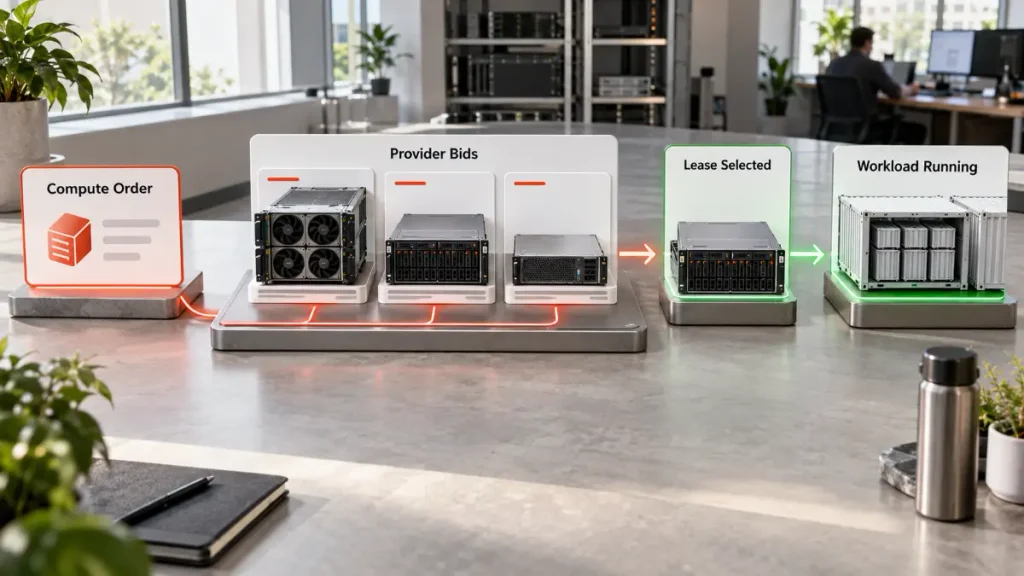
Akash connects tenants that need computing resources with independent providers that supply CPUs, GPUs, memory and storage. Tenants describe required hardware and pricing limits, providers bid for deployments, and selected workloads run on provider infrastructure. Akash uses blockchain to coordinate orders, bids, leases and settlement, AI training or inference itself does not run inside blockchain consensus.
This distinction keeps the product understandable. Akash is not a decentralized intelligence market like the system discussed in our Bittensor review. It is closer to an open cloud market where developers rent machines, then run normal containers, AI models, databases or applications on those machines.
Reverse-auction design is central to pricing. Providers compete for eligible orders instead of one company setting every hardware rate. Kubernetes handles workload orchestration on provider clusters, while marketplace state remains coordinated through Akash.
Paid Compute Is Real, but Usage Metrics Need Context
Akash crossed $5 million in all-time compute spend during Q1 2026. That does not mean the network generated $5 million during those three months. It means cumulative spend since launch passed that level during the quarter. Akash also reported AkashML processing 1.7 billion tokens per day through OpenRouter.
Those numbers matter because they show people are using and paying for services. They still do not prove profit, enterprise-grade reliability or equivalent AKT demand. Akash’s Q1 2026 report is useful evidence, but each metric should be read for what it actually measures.
Current evidence can be summarized without turning usage into a stronger claim than data supports:
| Evidence | What It Shows | What It Does Not Prove |
|---|---|---|
| $5M+ cumulative compute spend | Paying demand exists | $5M of Q1 revenue or profit |
| 1.7B AkashML tokens/day | Managed AI inference has measurable activity | Equivalent long-term AKT demand |
| Reverse-auction leases | Providers compete for real deployments | Uniform hardware quality or uptime |
| BME settlement | Compute payments now touch AKT economics | Every workload permanently burns AKT |
BME Reconnects Compute Spending With AKT
Akash previously supported stablecoin settlement because cloud users need predictable dollar costs. That improved usability but weakened AKT’s role: tenants could consume compute without creating the same direct demand for native token.
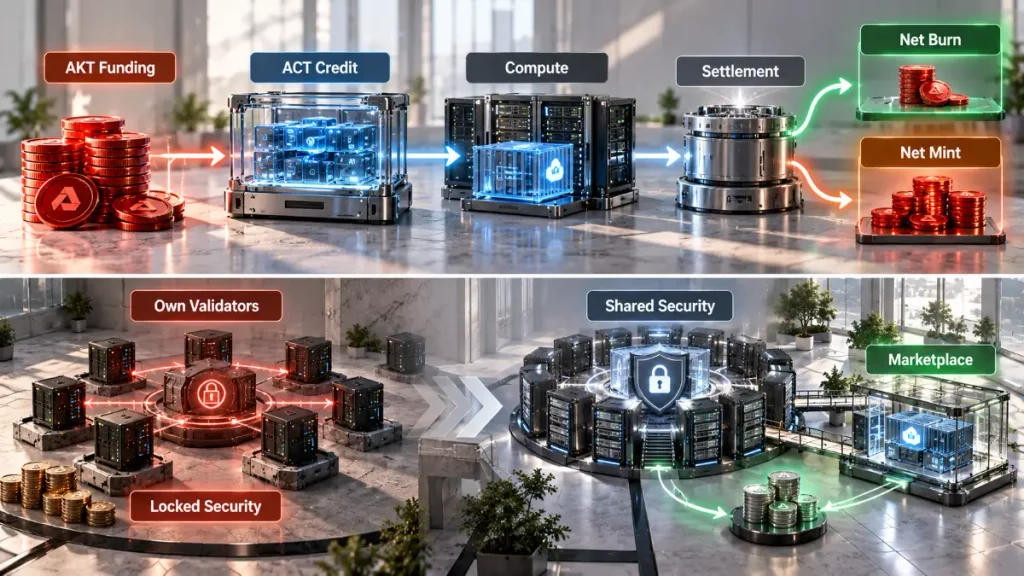
Burn-Mint Equilibrium changed that relationship on March 23, 2026. Tenants use ACT, a non-transferable compute credit designed around a one-dollar value. Funding ACT requires AKT. Card payments also trigger an AKT market purchase before credits are created. Providers are paid in ACT through lease settlement and can later burn ACT to mint or remint AKT through BME.
The economic route is therefore more direct: compute funding creates AKT demand, AKT moves out of circulation while ACT remains outstanding, and providers receive ACT as work is settled. They can later convert that ACT back into AKT through BME. Stable pricing survives without letting marketplace activity bypass AKT as easily as it could under direct stablecoin settlement.
BME Can Burn or Mint AKT
BME is not a simple permanent-burn mechanism. AKT used to create ACT is removed from liquid circulation at the funding price. When ACT is later burned back to AKT, the BME module calculates how much AKT is returned at the current oracle price.
If AKT rises while credits remain outstanding, fewer AKT are needed when ACT is converted back to AKT than entered the BME vault earlier. The difference becomes a net burn. If AKT falls enough, that conversion can require more AKT than the vault can reissue from earlier funding, creating a net mint for the shortfall. Akash’s BME design explicitly supports both outcomes.
This makes net supply change more useful than gross burn figures. Outstanding ACT, vault AKT, collateral ratio and net burn over time show whether compute activity is reducing supply after settlement rather than only during top-up.
Price feeds also become part of token economics. BME uses AKT/USD oracle data to value funding and settlement, so bad pricing can affect conversion amounts. That dependency is easier to understand alongside our Pyth Network review, because Akash’s 2026 roadmap includes Pyth integration as one source for BME pricing.
Akash Tokenomics: Hard Cap Meets Elastic Settlement
AKT has maximum supply of 388,539,008 tokens. Current market data shows about 297.67 million AKT circulating, roughly 76.6% of maximum supply. High circulating percentage narrows distance to stated cap, but it does not prove balanced ownership or low selling risk.
AKT currently combines staking, governance and marketplace settlement roles. BME makes compute demand more relevant to token than direct stablecoin settlement did, while provider payouts can return AKT to circulation. Supply therefore has a hard ceiling but an elastic path inside that ceiling.
Most useful tokenomics question is not whether AKT burns. It is whether paid compute creates enough continuing buy pressure and net supply reduction after provider settlement, while staking and other issuance continue to operate within network rules.
| Tokenomics Area | Current Position | Why It Matters |
|---|---|---|
| Maximum supply | 388.54M AKT | Sets lifetime issuance ceiling |
| Circulating supply | About 297.67M AKT | Roughly 76.6% of maximum supply is circulating |
| Core roles | Staking, governance, settlement | AKT has network-security and marketplace functions |
| Compute credit | ACT, non-transferable and USD-oriented | Gives tenants stable pricing while preserving AKT settlement |
| Funding flow | AKT → ACT | Compute funding creates AKT demand and removes AKT from liquid float |
| ACT conversion / refund | ACT → AKT through BME | Part of earlier supply removal can return when ACT is converted back to AKT |
| Net BME effect | Burn or mint | Price movement between funding and settlement changes final supply effect |
| Oracle dependency | AKT/USD price feeds | Conversion and collateral health depend on reliable pricing |
| Main tokenomics test | Paid compute vs net AKT issuance | Usage matters most when demand remains after full settlement cycle |
Cheap Compute Does Not Automatically Mean Cloud Parity
Akash can offer competitive hardware prices because independent providers compete for workloads. That gives developers another route to scarce or expensive GPU capacity, especially when a workload does not need every managed service bundled by a hyperscaler.
Price comparisons still need discipline. AWS, Azure and Google Cloud sell more than raw GPU hours. Enterprise support, private networking, compliance tooling, managed databases, service guarantees and deep software integrations can matter as much as hardware rate.
Crypto compute projects also differ beneath similar GPU marketing. Our io.net review examines another distributed compute marketplace, while our Render Network review covers job-based GPU demand with different settlement economics. Hardware supply can overlap without making token models interchangeable.
Provider Trust Remains a Real Security Boundary
Blockchain can prove lease and payment state without proving that every physical machine is equally reliable. Provider hardware, network connectivity, configuration and operator behavior still sit outside consensus. A deployment can be valid on-chain and still face operational problems at hardware level.
Akash added confidential compute in July 2026 to reduce one of these trust assumptions. Compatible providers can run selected workloads inside hardware-backed trusted execution environments using AMD SEV-SNP or Intel TDX, with supported NVIDIA GPU configurations. Current documentation still labels this feature experimental, so it should not be treated as universal protection across the network.
Mainnet 14 also moved Akash from Cosmos SDK v0.45 to v0.53 in October 2025, replacing years of older chain infrastructure. That modernization matters for maintainability, but upgrade history is not an audit. CertiK currently lists Akash as not audited by CertiK and shows no third-party audit in its audit-history field.
Shared Security Could Change AKT’s Old Staking Role
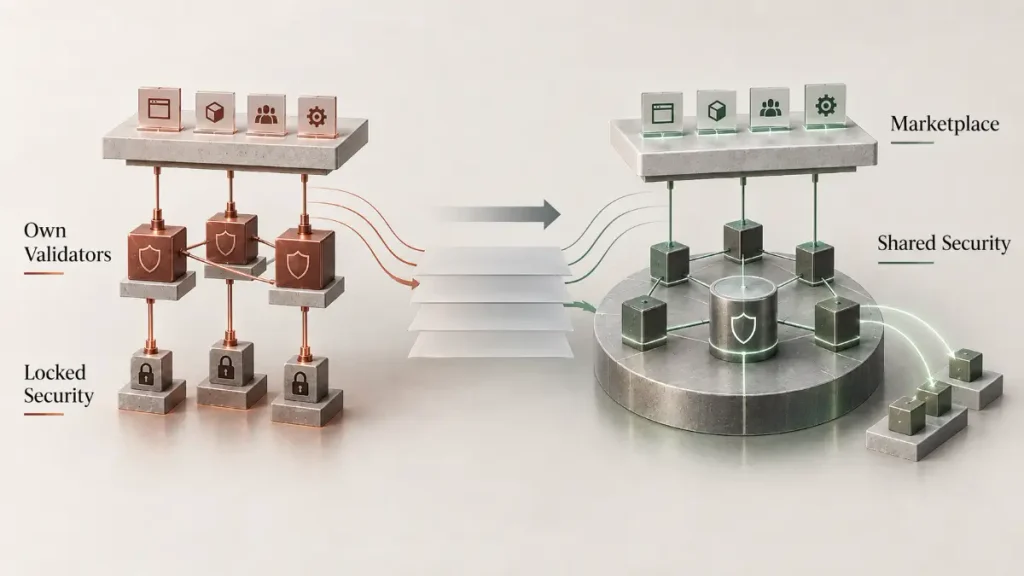
Akash is preparing a larger architectural change through its shared-security migration program. Current network uses its own Cosmos SDK proof-of-stake validator set. Proposed model would outsource blockchain security to an established Layer 1 while keeping Akash marketplace logic focused on compute.
Reason is capital efficiency. A sovereign chain requires substantial AKT to remain staked and requires continuous engineering around consensus, validators and upgrades. Shared security is intended to reduce both burdens. Akash’s roadmap currently targets late 2026 for this work, while migration documentation continues to define implementation details.
This creates a token trade-off. Freeing AKT from sovereign security can improve liquidity and reduce infrastructure overhead, but it can also reduce one reason tokens stay locked. BME then becomes more important because marketplace activity must carry more of AKT’s economic case.
Akash Still Needs Better Proof at Provider Level
Akash has stronger product evidence than it had a year ago, but decentralized cloud quality cannot be judged from deployment count alone. Provider utilization, uptime, hardware verification and repeat tenant spend matter more as network targets serious AI workloads.
Homenode expands potential GPU supply beyond data centers, while confidential compute improves isolation on compatible hardware. Both widen opportunity and also make verification more important. Large provider count means little if useful hardware stays idle or tenants cannot predict service quality.
What Would Strengthen the Akash Case?
Future assessment should rely on measurable operating data rather than AKT price moves. Useful evidence includes:
- continued growth in paid compute spend after BME.
- repeat usage instead of one-off deployment activity.
- net AKT burn or mint after complete BME settlement cycles.
- outstanding ACT and BME collateral health.
- provider uptime and GPU utilization.
- broader hardware verification and confidential-compute availability.
- clearer independent security review for core BME and marketplace components.
- final shared-security design and its effect on AKT staking.
These metrics connect product demand with token economics. They are more useful than asking whether decentralized AI remains a popular market narrative.
Verdict: Real Compute Makes BME Worth Watching
Akash has real infrastructure behind its AI positioning. Paying compute demand exists, managed inference is active, GPU capacity is available through an open marketplace, and BME fixes a genuine weakness in older stablecoin settlement by reconnecting network spending with AKT.
Token case is still conditional. BME does not guarantee permanent deflation, provider quality remains partly outside blockchain security, and shared-security migration could reduce AKT’s legacy staking role even if it improves capital efficiency.
Central test for this Akash Network Review is therefore simple: can growing paid compute create durable AKT demand after provider settlement, while network reduces dependence on sovereign staking? Akash now has mechanisms that make this question measurable. Net BME supply data, repeat compute spend and migration design should provide the answer.
Frequently Asked Questions
Akash is an open cloud-compute marketplace where independent providers offer CPU, GPU, memory and storage resources to tenants.
No. Blockchain coordinates marketplace state and settlement. AI inference, training and other workloads run on provider hardware.
Burn-Mint Equilibrium links compute settlement to AKT. AKT funds non-transferable ACT compute credits, while providers receive ACT and can later burn it to mint or remint AKT through BME.
No. Rising AKT price between funding and settlement can create net burn. Falling price can require additional AKT minting for provider payout.
AKT has stated maximum supply of 388,539,008 tokens. About 297.67 million were circulating in September 2026.
CertiK currently lists Akash as not audited by CertiK and shows no third-party audit in its audit-history field. Monitoring should not be treated as completed independent audit evidence.
Akash is working toward shared security rather than continuing indefinitely with only its own sovereign validator set. Final implementation should be judged from migration documentation rather than assuming a specific destination chain.

Founder & Managing Editor of CryptosMedia. Zahid Hussain leads evidence-based crypto research covering tokenomics, security, governance, adoption, and risk.
CryptosMedia separates verified facts from interpretation, avoids buy/sell recommendations, and updates reviews when major evidence changes.
5 thoughts on “Akash Network Review: The Truth About Decentralized AI”